
India Fashion: Why Growth Is Concentrating at the Bottom of the ASP Curve
 Nikhil Dalal
At a headline level, India’s online fashion market appears to be in good health. Across categories and business models, most platforms continue to report positive GMV and revenue growth. From the outside, this creates the impression of broad-based momentum of a market rising evenly across segments and price points.
But a closer look tells a more uneven story.
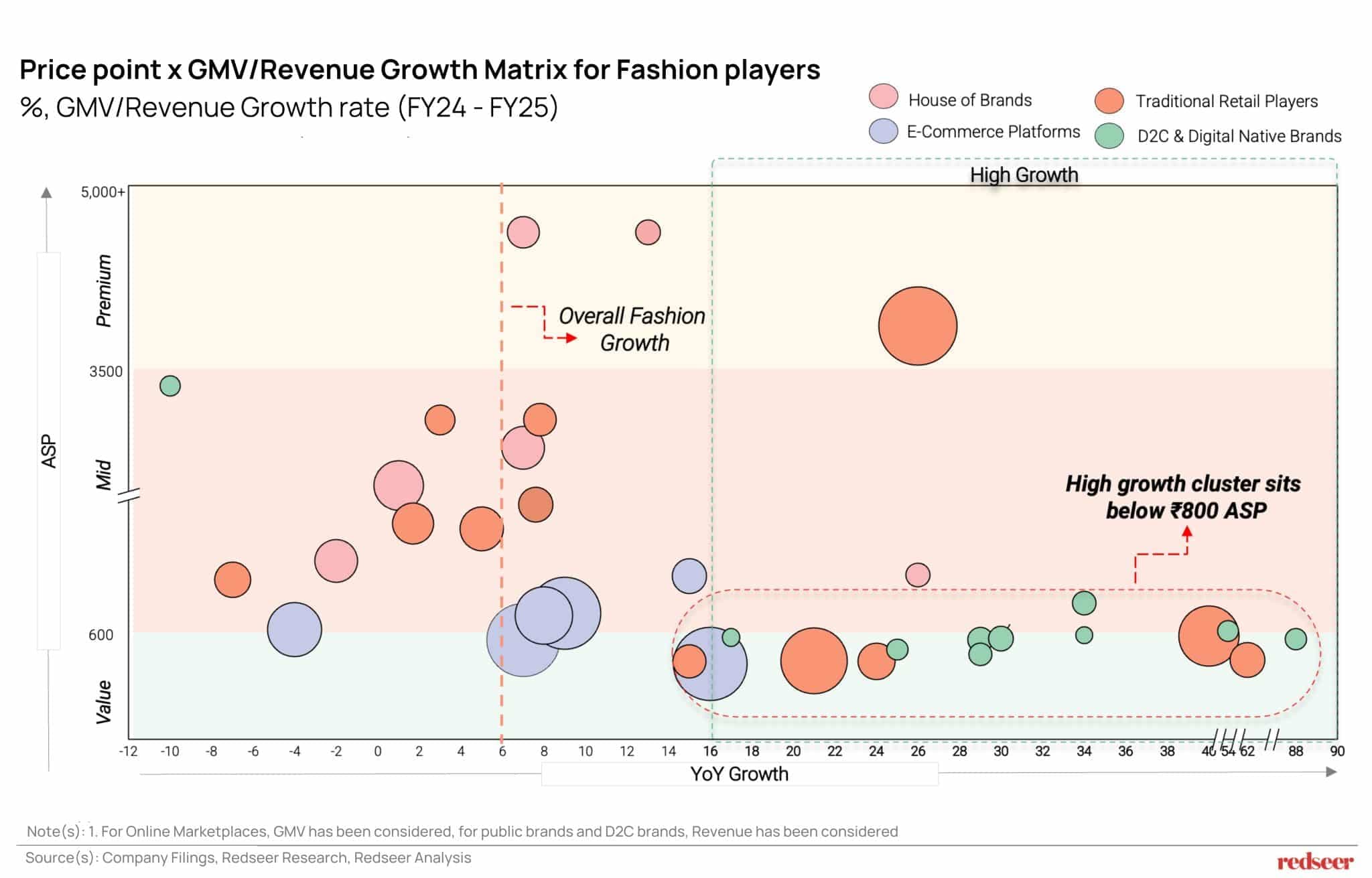
When fashion growth is analysed through the lens of average selling prices (ASPs), a clear pattern emerges. The fastest-growing cluster in online fashion today sits firmly below the ₹800 ASP mark, concentrated within value fashion. This is not the outcome of a single breakout player skewing the numbers, but a dense cohort of brands and platforms growing well ahead of overall market rates.
As ASPs rise, growth begins to fragment. Mid-priced and premium players increasingly track closer to category-level growth, with outcomes varying widely by brand, execution, and category depth. Evidence of sustained growth acceleration at higher price points remains limited.
A Value-Led Phase of Growth
This distribution suggests that India’s current phase of online fashion growth is fundamentally value-led. Price accessibility, aggressive online execution, and breadth of assortment are doing most of the heavy lifting. While premium fashion continues to grow, it has not yet reached a point where it can structurally outpace the broader market.
As online penetration deepens, this concentration at the bottom of the ASP curve matters. Growth anchored within a narrow price band intensifies competition, compresses differentiation, and makes sustaining elevated growth rates increasingly difficult without moving up the value curve.
In other words, scale is still being built at the entry end of the market—but durable growth will require brands to prove that they can climb beyond it.
What This Means for the Market
For brands and platforms, the challenge ahead is not capturing value-led demand—that opportunity is already crowded—but demonstrating the ability to expand ASPs without losing momentum. This requires sharper brand positioning, tighter category focus, and a clear proposition that goes beyond price.
For investors, the key question is not whether value fashion will continue to grow—it likely will—but how long this band can absorb incremental players before growth becomes increasingly zero-sum.

What Investors Should Monitor
- Headroom in the ₹600–₹800 ASP band
Is this segment still expanding meaningfully, or are players increasingly competing for the same customer pool?
- Ability to move up the value curve
Are brands showing sustained ASP expansion, or is growth still anchored in discount-led volume?
- Signals of premium inflection
Is there consistent evidence of demand acceleration beyond the value band, or does growth flatten as prices rise?
The Bottom Line
India’s online fashion market is growing—but not evenly. Today’s growth is being built at the bottom of the ASP curve, where accessibility drives scale but also heightens competitive pressure. The next phase will belong to players who can translate value-led traction into price-led expansion—without breaking demand.
Because in a market where growth clusters at the bottom, the real test is not how fast you scale, but how convincingly you trade up.
The insights have been derived from Redseer ‘Benchmarks’, the most trusted insights platform on the Indian internet landscape. Its proprietary consumer internet data allows us to make granular and long-term comparisons that reveal underlying trends and shifts in consumer behaviour.
Benchmarks track city-level utilisation, expansion mix, and maturity trends across major quick commerce and consumer internet companies, offering its investors, brands, and platforms a clearer lens on how reported growth aligns with underlying economics.

Written by
Nikhil Dalal
Associate Partner
Nikhil has experience working with Cognizant in business development and strategy roles for the US healthcare sector. He appreciates analysing issues, solving complex problems, and case studies.
Talk to me