India’s Most Reliable Financial Cohort Is Also Its Most Underserved
 Jasbir S Juneja
India’s FinTech boom has been one of the defining economic stories of the past decade. The RBI Financial Inclusion Index climbed from 46 to 67 between March 2018 and March 2025. UPI transaction volumes grew at an 81% CAGR between March 2020 and March 2024, reaching 13.5 billion monthly transactions. Mutual fund AUM nearly tripled to $790 billion. By nearly every headline metric, India’s financial ecosystem is deeper, faster, and more accessible than it has ever been.
Yet one segment has been systematically left behind, despite being among the most attractive cohorts in the entire market by the numbers. Indian women hold just 17% of active personal loans, 13% of credit card outstanding, and 23% of mutual fund AUM. In a country where women now constitute nearly half of all internet users, up from 20% in 2014, the gap between digital access and financial product adoption is not closing at the pace the headline numbers suggest.
This is not a market waiting to be created. It already exists, in scale, quality, and growth velocity. The question for BFSI players is why existing models fail to capture it.
Lower Risk. Faster Growth. Smaller Slice.
The data on women as a financial cohort should be uncomfortable for anyone not targeting them aggressively.
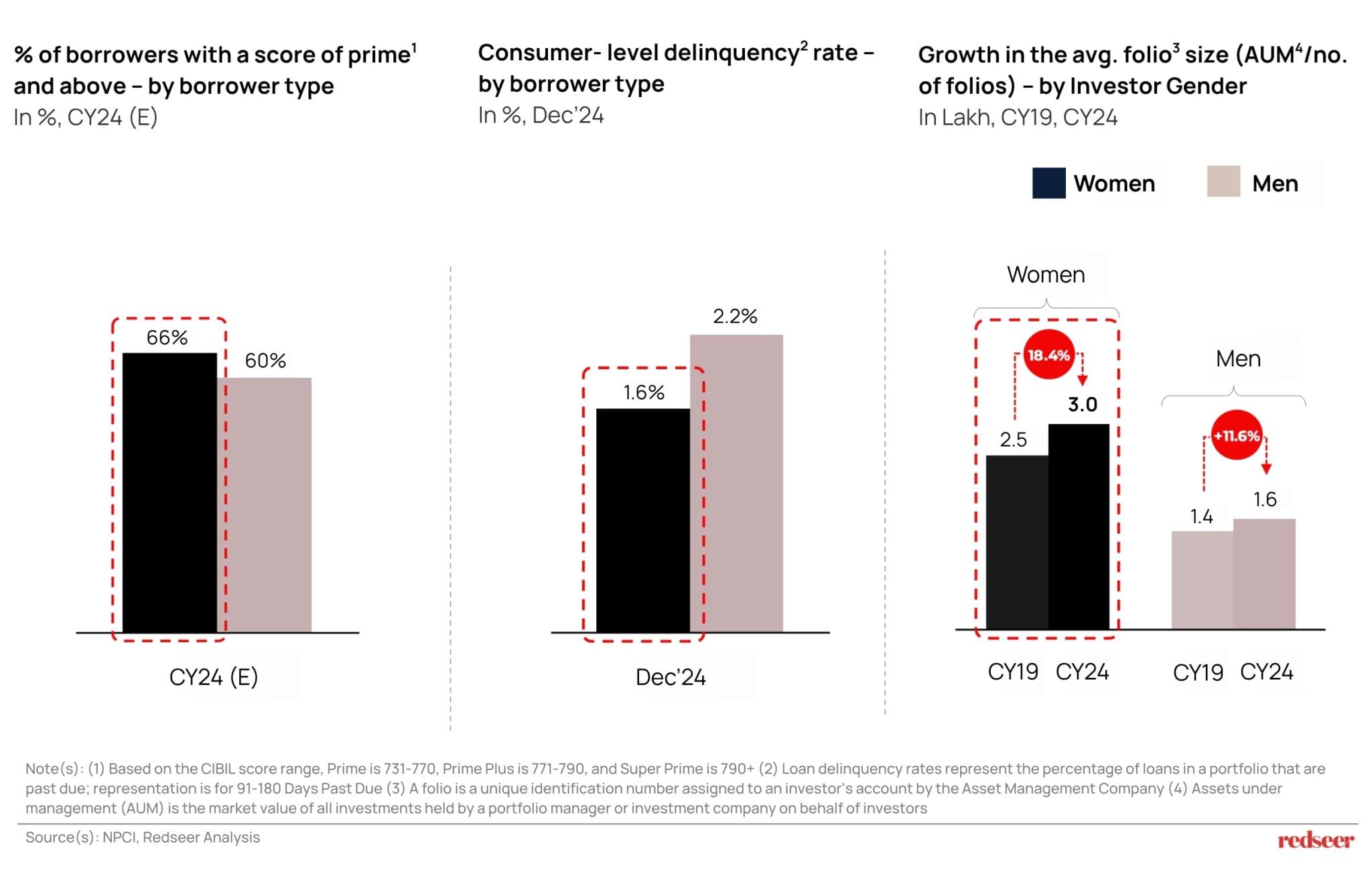
Women borrowers outperform men on every risk metric that lenders care about. As of CY24, 66% of women borrowers hold a prime or above CIBIL score, against 60% for men. Their delinquency rate stands at 1.6%, compared to 2.2% for men.
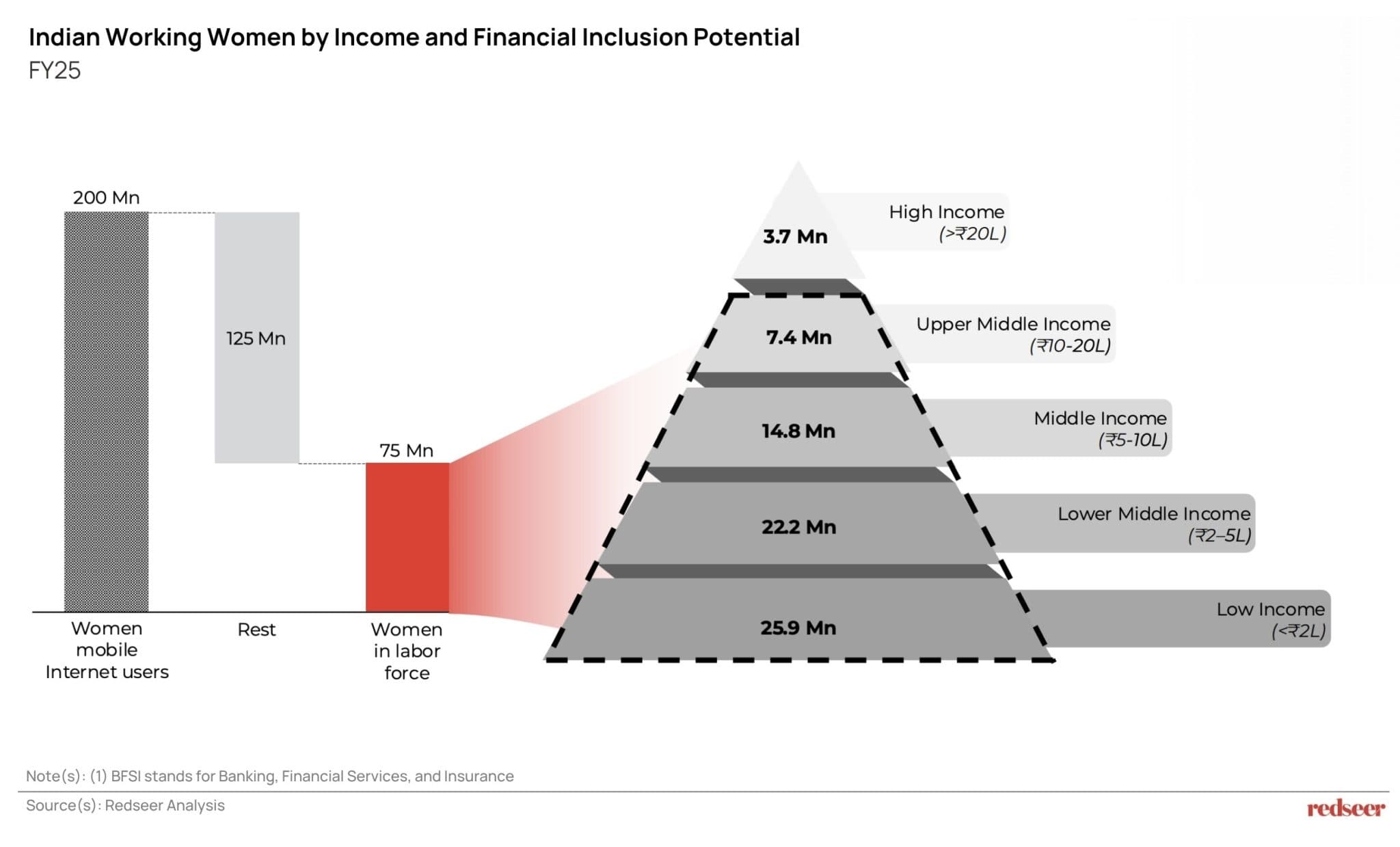
Translated into market size, these numbers are hard to ignore – an untapped AUM pool of approximately INR 2,00,000 billion, an insurance pool of INR 17,000 billion, and a lending base of INR 67,000 billion, all among women who are either underserved or not served at all. The immediate target is approximately 75 million working women with mobile internet access, spread across income brackets from below INR 2 lakh to above INR 20 lakh annually.
Access Arrived, But Adoption Didn’t.
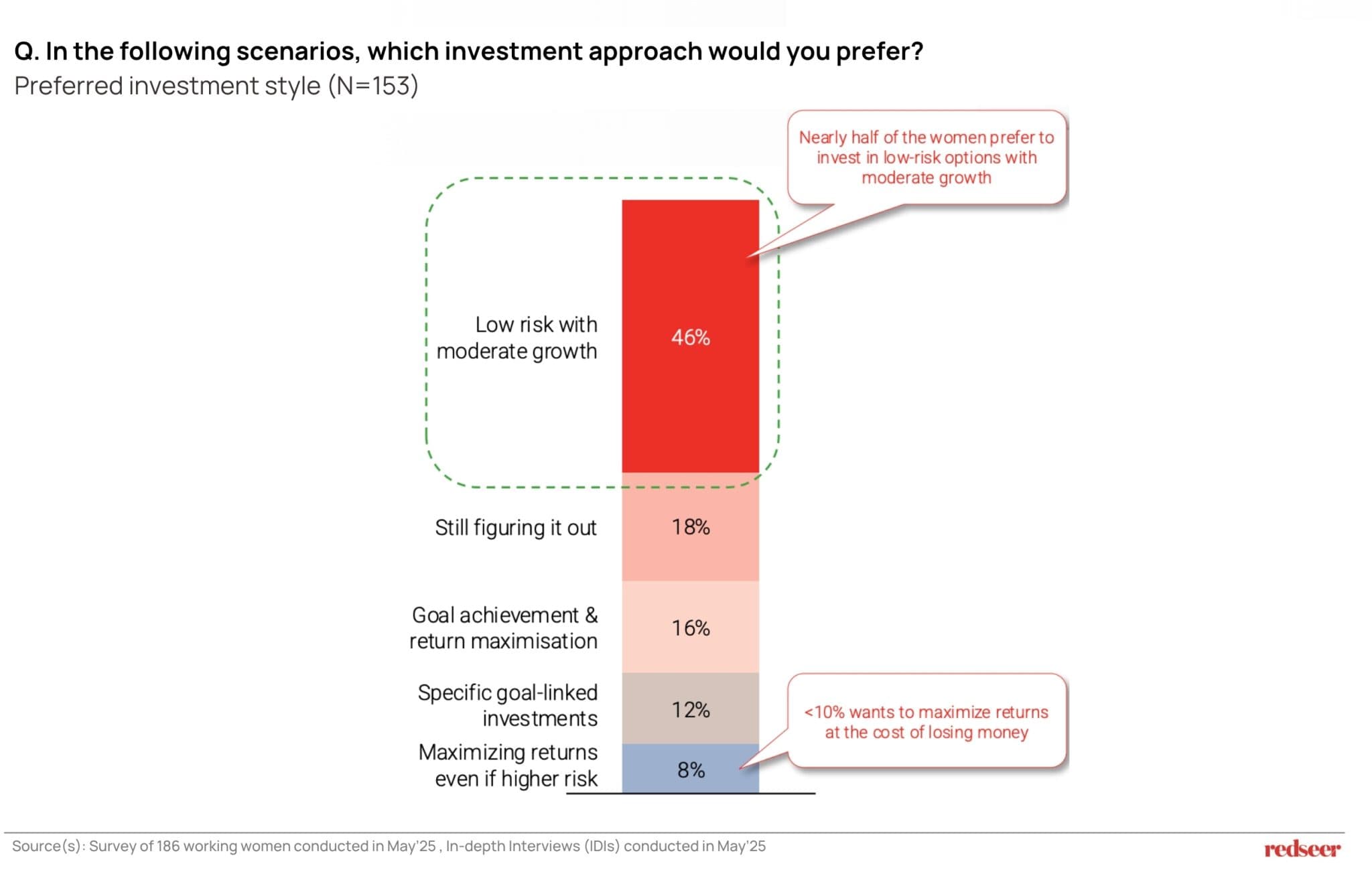
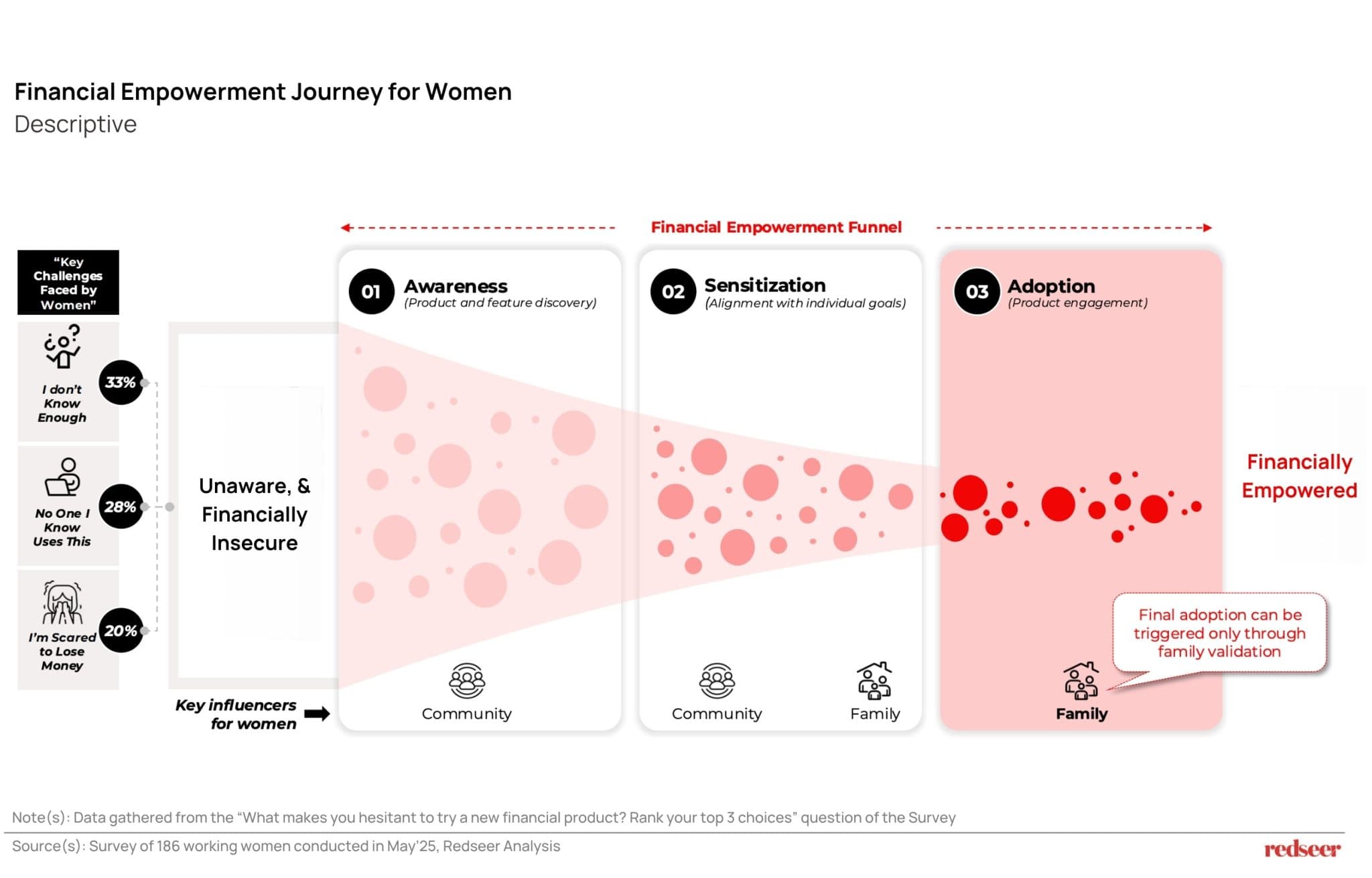
The easy assumption that women are less financially engaged or inherently more risk-averse does not hold up. In a survey of 186 working women conducted in May 2025, 97% cited lack of information as their primary reason for hesitating to try new financial products.
When asked about their preferred investment style, only 8% wanted to maximise returns at higher risk. 46% preferred low-risk options with moderate growth. 16% wanted goal-linked investments that also delivered reasonable returns. And 18% said they were still figuring it out. Taken together, the picture is one of women who want clarity, safety, and relevance, none of which the current product architecture reliably provides.
The intent is there. What is missing is the bridge between intent and action. This is not a problem unique to India. Cross-country analysis shows that in developing nations, women’s financial decisions are strongly shaped by community and family, while goal-based planning remains at a nascent stage with weak formal linkage. In developed markets, individual decision-making dominates, and goal-based planning is deeply embedded in platforms. India sits firmly in the first camp, which means the solutions that work in Western markets cannot simply be imported.
That bridge is blocked in three specific ways.
The first is representation. Around 80% of testimonials on major FinTech platforms feature male voices. Fourteen of the top fifteen finance YouTubers in India are male. Insurance agent networks remain 71% male as of FY24, having shifted by only three percentage points over four years.
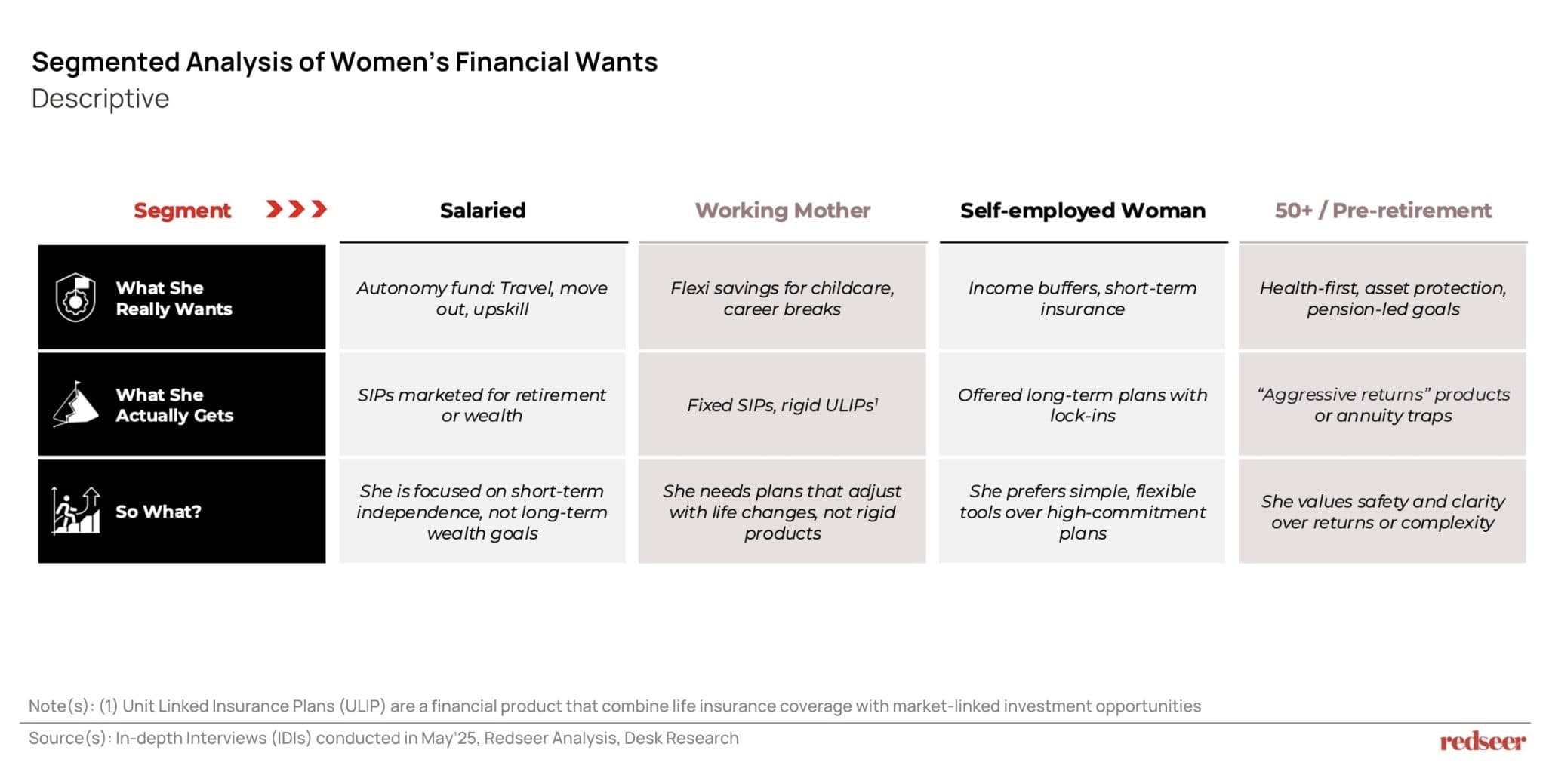
The second is product misalignment. A salaried woman in her late twenties is largely looking for an autonomy fund, money she can use for travel, upskilling, or independence. What she typically gets is a SIP pitched around retirement. A working mother needs savings that flex around career breaks. She gets fixed SIPs and rigid ULIPs. A self-employed woman wants short-term income buffers and simple insurance. She is offered long-term plans with lock-ins. Across every life stage, what women want and what they are sold are remarkably different.
The third, and most important, is that financial adoption for women in India is rarely an individual decision. In the survey, 70% of women ranked family advice as their top source of financial guidance, rising to 84% when second and third preferences are included. Only 26% said they were the sole financial decision-maker in their household. The influence of family is strongest among younger women, and those in lower-income households.
Community features like gamification, peer forums, and group challenges have found limited traction on FinTech platforms not because they are poorly designed, but because they address credibility, without solving for the assurance and validation that only family trust can provide.
The Lever Is Reframing, Not Rebuilding
The report’s findings point to changes that do not require service providers to build entirely new products. They require rethinking how existing ones are packaged, distributed, and explained.
The most actionable lever is reframing products around goals, rather than product categories. Women’s savings behaviour is predominantly goal-driven. 56% associate their financial decisions with aspirational life goals such as a child’s education, retirement comfort, or personal independence. A PPF and a term insurance plan presented as components of a “Child’s Future” bundle have a different appeal compared to the same products sitting side by side in a standard catalogue.
The second lever is designed for the household rather than the individual. Shared decision dashboards, family goal integration, and easy-to-understand monthly summaries that women can choose to share with family members directly address the trust gap that stalls adoption at the final stage.
The third lever is representation in distribution. Platforms that invest in certifying female financial advisers, and in commissioning financial content that features women as active decision-makers beyond token occasions like Women’s Day, build something more durable than brand equity. They close the first-mile gap that keeps women from seeing themselves in the product at all.
The Gap Is Commercial, Not Cultural
Indian women are already saving. They are already online. They are better borrowers than men and their investment portfolios are growing faster. The opportunity is not on the horizon. It is sitting right here, largely untouched.
The industry has spent years building products for men and hoping women would follow. Some have, most have not. The fix is not a new product range or a women’s day campaign. It is asking a simpler question: does this product speak to how she actually makes decisions, with her family, around her real goals, in language that does not make her feel like an afterthought?
The players who answer that question first will not just win a new customer segment. They will have acquired the most reliable one in the market.

Written by
Jasbir S Juneja
Partner
Jasbir is a Chemical Engineer with a bachelor's in technology from the Indian Institute of Technology. Jasbir has worked with numerous high-profile clients in every industry to develop result-delivering strategies at Redseer Strategy Consultants.
Talk to me

Trolley’s IPO on Boursa Kuwait: Building the Market Case for Gulf Convenience Retail

Kuwait’s Convenience Retail Moment: What Trolley’s IPO Says About Where Gulf Retail Is Heading

Beauty Blitz 2030: Mapping India’s Ascent to a $40 Billion Powerhouse

SEA’s USD 123 Bn Remittance Market: Fragmented Landscape, Focused Winners


