
Quick Commerce Finds Its New Normal with Scale, Mix, and Momentum
 Nikhil Dalal
The start of a new year is usually when demand cools, excess capacity shows up, and reality sets in. January 2026, however, is telling a different story for Quick Commerce.
Rather than resetting to pre-festive levels, the category has held on to OND-scale demand more strongly than in previous years, signalling that what looked seasonal is increasingly structural.
It’s Not Just a Festive Hangover – Scale Is Holding!
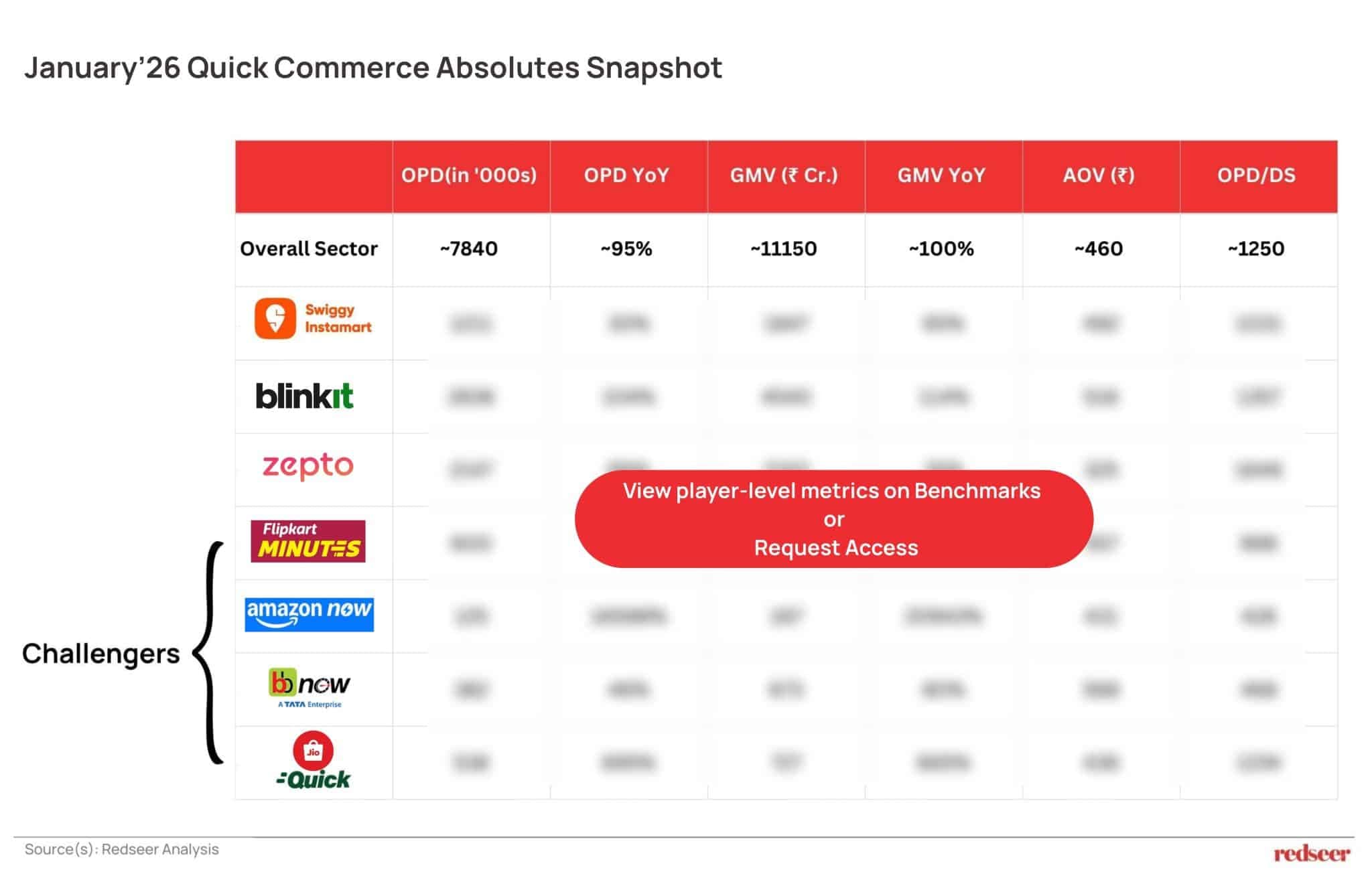
In January, Quick Commerce GMV reached ~₹11K crore, growing ~100% YoY, while order volumes climbed ~95% YoY to ~7.8 million OPD. Sequentially, volumes were still up ~7% MoM, and the Republic Day week marked the month’s peak, with OPD touching ~8.3 million.
What’s notable here is not just growth, but continuity. Demand didn’t fall off a cliff post-festive; it stayed elevated.
AOV (post MRP discounts and excluding delivery fees) remained flat MoM, but still grew ~5% YoY to ~₹460, holding up despite expansion into smaller cities where baskets are typically lighter. Meanwhile, Monthly Transacting Users expanded ~95% YoY to ~5.2 crore, reinforcing that growth is being driven by more users and more missions, not just higher spend from the same cohort.
Supply Is Expanding and Getting More Productive
January also saw continued supply-side expansion. Dark store count increased from ~5,990 in Dec’25 to ~6,280 in Jan’26, pushing the serviceable footprint deeper into new catchments.
Crucially, this expansion hasn’t diluted productivity. PAN-India OPD per dark store improved to ~1,255, up ~15% YoY. In other words, scale is being absorbed more efficiently than before—a key marker of category maturity.
Growth Is No Longer Just About Grocery
The clearest shift in January shows up in the category mix. Non-grocery grew ~1.6x faster than grocery, reinforcing that Quick Commerce growth is now being driven by use-case expansion, not incremental grocery frequency alone.
Within non-grocery:
- Fashion (+340%) and Mobiles (+245%) are scaling rapidly from a low base
- BPC (+140%), BGM (+200%), and Baby Care (+160%) are adding meaningful depth
- Home & Furniture (+90%) and ePharma (+115%) are growing steadily
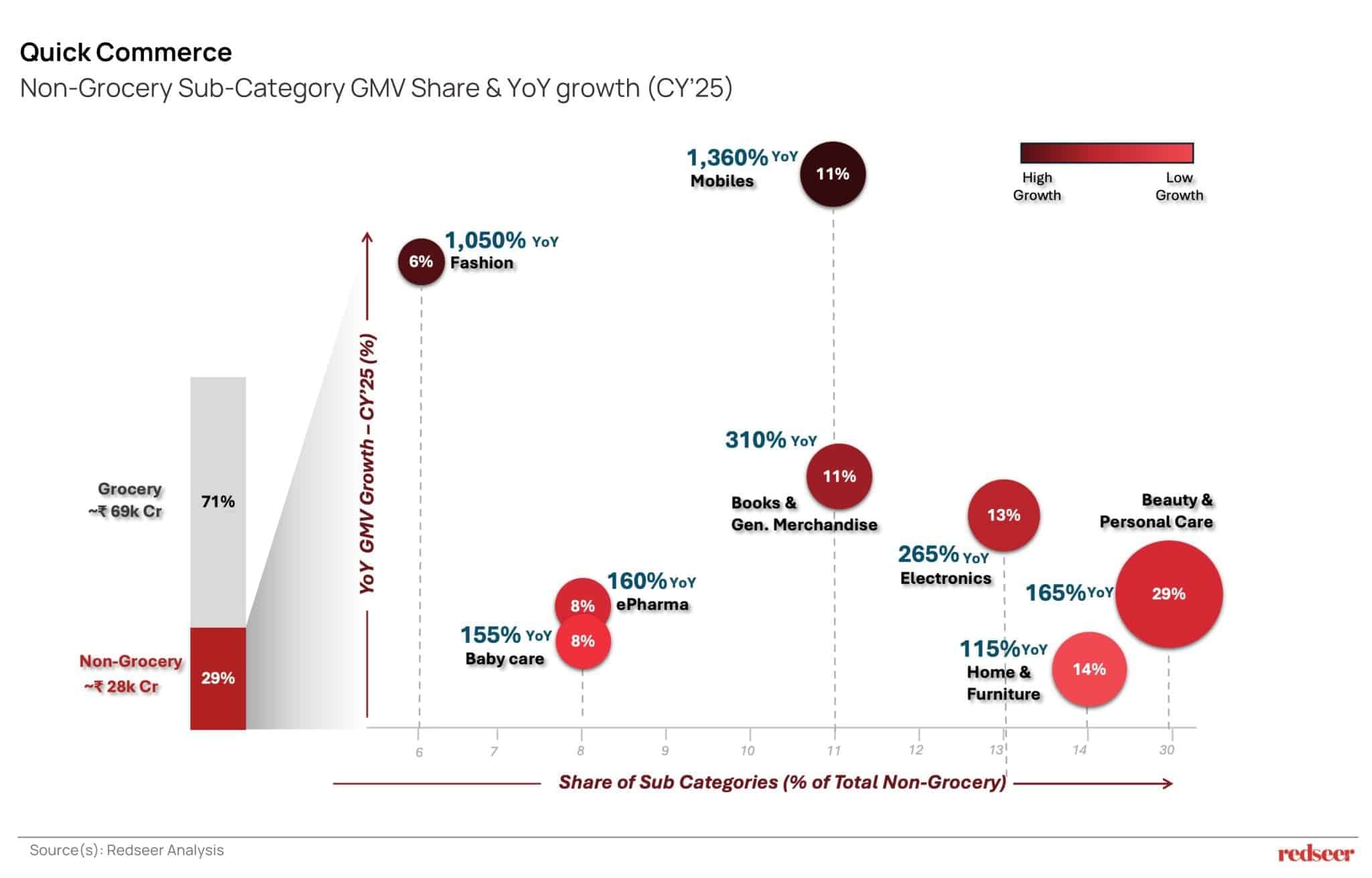
As non-grocery expands, demand is also shifting toward larger basket sizes. Higher AOV buckets are scaling faster, reflecting a gradual but important change in how consumers are using Quick Commerce.
Efficiency Is Where the Real Gap Is Opening
At a platform level, January reveals growing divergence.
Leading platforms have improved OPD per dark store by ~13% YoY to ~1,350, even as they expand into smaller cities where baseline efficiency is lower. Strong growth in the top-8 cities has more than offset this dilution.
Challenger platforms, meanwhile, are operating at roughly half the efficiency of the top three, though some micro-markets are already hitting 1,000+ OPD per dark store. Most of their growth is coming from existing users, with efficiency expected to improve as recall and density build.
This divergence matters. As CY26 progresses, city-level maturity and execution discipline will increasingly determine profitability at the dark store level. We may also begin to see regional leaders emerge outside the top-8 cities, where high efficiency could meaningfully shift economics.
Competition Is Stirring, but Leadership Holds
January also points to early signs of competitive disruption. While the top three platforms continue to scale at roughly ~75% YoY GMV growth, challenger platforms are growing ~4x faster, leading to visible share movement at the margin.
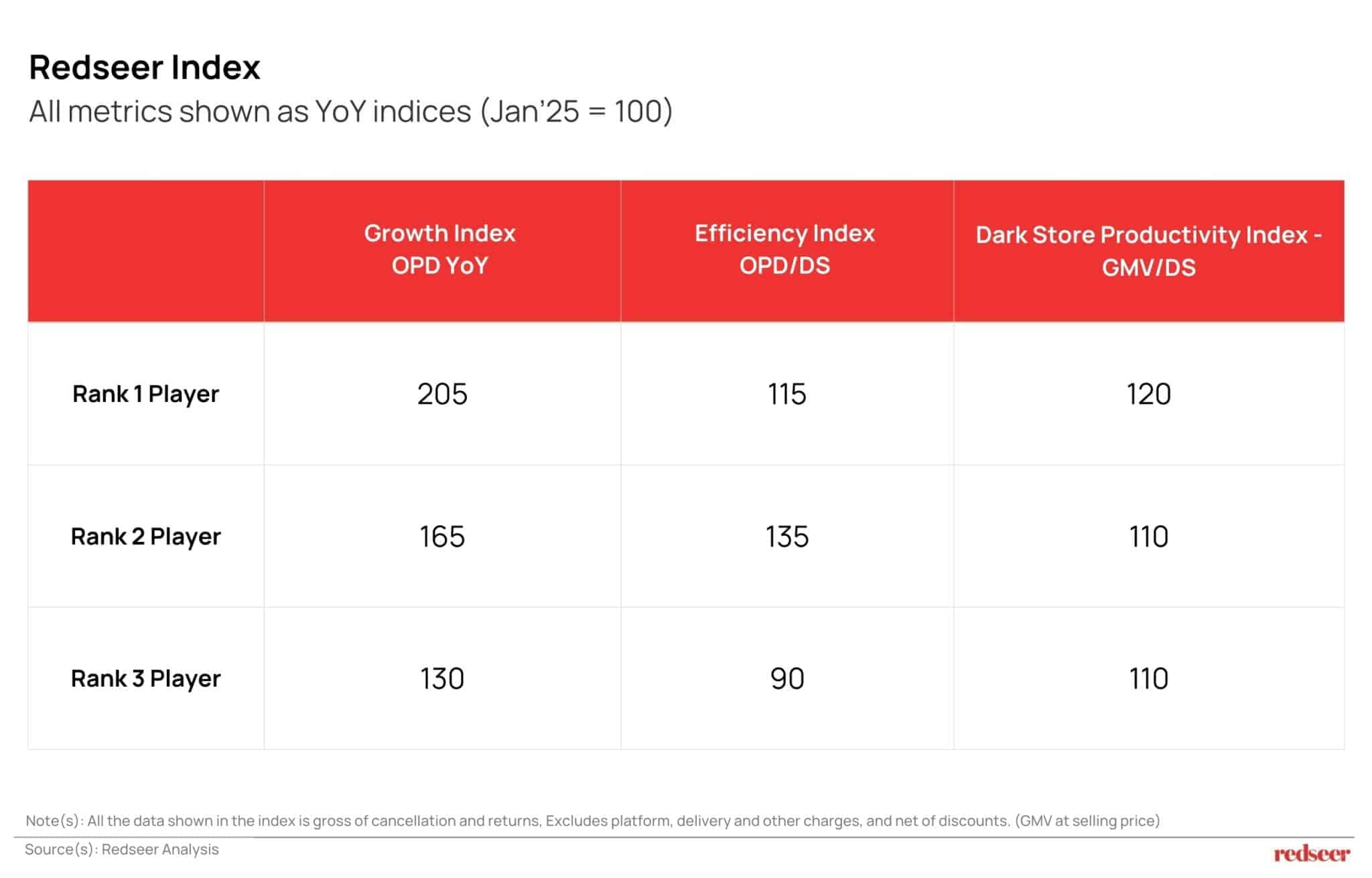
Leadership remains intact for now, but the market is no longer static. Execution gaps are widening, with leaders converting scale into productivity more consistently than the rest.
The January Signals
Three signals stand out as Quick Commerce moves deeper into CY26:
- Scale expansion from CY25 is now being absorbed more efficiently, though unevenly across platforms and cities.
- Growth quality is improving, driven by non-grocery categories and mid-to-higher AOV baskets rather than pure frequency.
- While incumbents remain firmly ahead, competitive pressure is building, with at least one challenger delivering outsized growth.

The key question for CY26 is no longer whether demand exists—it clearly does. The real test will be how efficiently platforms convert that demand into sustainable economics, balancing city maturity, supply discipline, and the ability to defend AOV while continuing to scale.
Quick Commerce is moving from a phase of expansion to one of execution. January suggests that the winners of this phase will be decided less by who grows fastest, and more by who grows sustainably faster.
The insights have been derived from Redseer ‘Benchmarks’, the most trusted insights platform on the Indian internet landscape. Its proprietary consumer internet data allows us to make granular and long-term comparisons that reveal underlying trends and shifts in consumer behaviour.
Benchmarks track city-level utilisation, expansion mix, and maturity trends across major quick commerce and consumer internet companies, offering its investors, brands, and platforms a clearer lens on how reported growth aligns with underlying economics.

Written by
Nikhil Dalal
Associate Partner
Nikhil has experience working with Cognizant in business development and strategy roles for the US healthcare sector. He appreciates analysing issues, solving complex problems, and case studies.
Talk to me