
Saudi Q-com Regulations: Ending the Subsidy Era?
 Sandeep Ganediwalla
Over the past few weeks, we have spoken with several regional and global investors, and one question consistently comes up: How will the new regulatory environment reshape the Q-commerce market in the GCC?
Saudi Arabia and the UAE released platform guidelines last year. Qatar has already implemented price-control measures. Kuwait recently introduced regulations targeting irregular practices and SME protection.
To understand what this means in practice, in this article, we focus on Saudi Arabia, the largest Q-com market in the region, and assess how regulatory developments could reshape the market.
KSA experienced subsidy-led demand acceleration, but at the cost of distorted economics
Saudi Arabia’s food delivery sector has exceeded expectations in 2025, outperforming our H2’25 volume estimates by 6%. Adoption and ordering frequency have scaled faster than anticipated. However, much of this scale has been built on heavy subsidies – free delivery, deep discounting, and cashbacks, which shifted value toward consumers while compressing margins for platforms and restaurants.
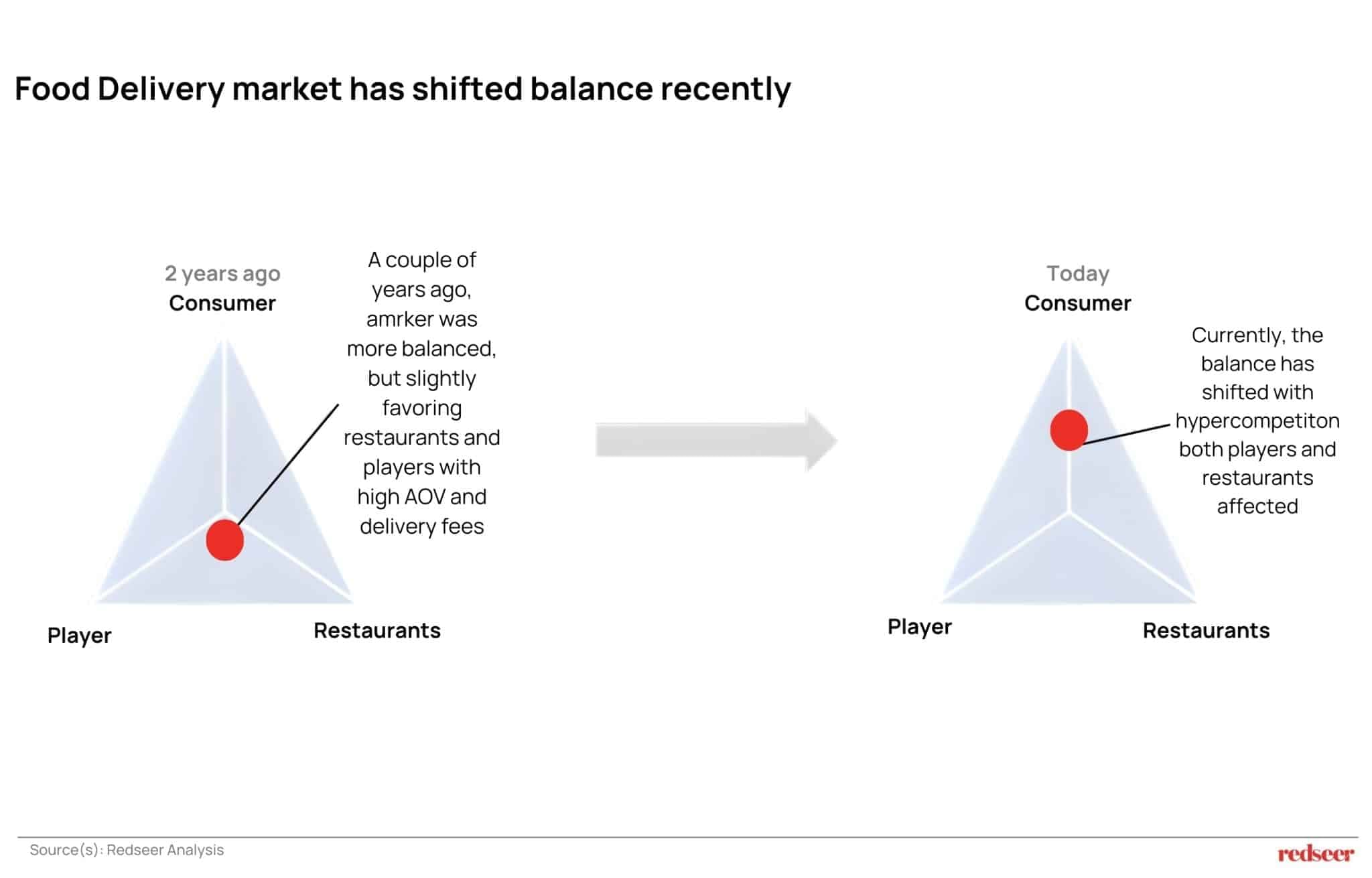
The growth was therefore characterised by scale, not sustainability.
The regulator has already sent strong signals to address the structural imbalances
Recognising these distortions, the General Authority for Competition (GAC) released draft guidelines to enhance competition in the food delivery platform sector. The guidelines explicitly target:
- Predatory pricing/selling below cost
- Discrimination between restaurants or sellers
- Exclusive contracts between platforms and restaurants
- Self-preferencing practices that exclude competitors
In effect, the regulator is drawing boundaries around how platforms compete, without limiting their ability to innovate. Which brings us to the two questions investors are asking.
Question One: Will regulation accelerate or decelerate growth?
We believe demand fundamentals will remain intact. Online food ordering in KSA has not grown purely at the expense of offline channels. Instead, it reflects structural demand drivers:
- Lifestyle changes (10% of users increasingly ordering at the workplace)
- Variety-driven demand (20% ordering more frequently due to expanded restaurant choice)
- Convenience and impulse-driven purchases
Importantly, Saudi consumers are not inherently hyper price sensitive (Our earlier consumer surveys indicate that experience ranked above pricing as a key decision driver). Pricing became disproportionately important because subsidy intensity made it so.
As aggressive discounting moderates, we expect customer experience to become the primary differentiator, retention to take precedence over acquisition, and organic demand to support sustainable GMV growth.
Overall, growth may normalise from peak subsidy-led levels, but we do not expect a structural slowdown in demand.
Question two: Will regulation change the competition structure?
Saudi’s top three players, Keeta, Jahez, and HungerStation, collectively hold more than 90% market share. This concentration mirrors mature global markets, where scale advantages are significant. Hence, we do not expect a major structural shift in market composition.
However, we do expect meaningful changes in how competition plays out: reduced predatory pricing cycles, less aggressive commission restructuring, greater transparency around fees, and lower reliance on exclusivity
Instead of competing primarily on subsidies, platforms will likely focus on discovery optimisation, faster delivery, improved customer support, and multi-vertical integration/product differentiation
Overall, the regulations are likely to keep players in check, reduce extreme competitive volatility, and encourage sustainable operating models.
Conclusion
In summary, Regulation should not be interpreted as a disruptive lever, but as a clear signal of market maturation. We believe the regulatory framework will support long-term sector health, improve value sharing across stakeholders, and preserve growth while reducing distortion.
Saudi Q-commerce is moving from subsidy-driven acceleration to structurally sustainable growth. Innovation will remain strong, but capital will be deployed with greater discipline, supporting long-term value rather than short-term benefits.
This perspective is part of our Middle East Q-commerce benchmark offering, available via subscription.
If you would like to explore implications across other GCC markets or discuss Saudi Arabia in more detail, we will be happy to chat

Written by
Sandeep Ganediwalla
Partner
Sandeep is the Partner with 20+ years of experience in consulting and technology. He has expertise in multiple sectors including ecommerce, technology, telecom and private equity.
Talk to me

India’s Most Reliable Financial Cohort Is Also Its Most Underserved

Trolley’s IPO on Boursa Kuwait: Building the Market Case for Gulf Convenience Retail

Kuwait’s Convenience Retail Moment: What Trolley’s IPO Says About Where Gulf Retail Is Heading

Beauty Blitz 2030: Mapping India’s Ascent to a $40 Billion Powerhouse


