
The Dark Store Blind Spot: The part of quick commerce growth that the topline doesn’t show
 Nikhil Dalal
The quick commerce story is familiar - rapid growth, widening reach, and expanding footprints. The headlines hold: India’s next wave is increasingly driven beyond the largest metros. What’s less visible is how unevenly that growth is translating into operating maturity.
We solve the strategy behind scale!
Non-metro markets have become the new engine, clocking a 328% YoY jump in daily orders. Dark store footprints are following suit, expanding faster outside city limits than within them.
It’s the kind of growth curve that lends itself to compelling narratives, the promise of ‘new demand, new India’ neatly packaged.
But here’s the twist most miss: the growth story isn’t the same as the efficiency story.
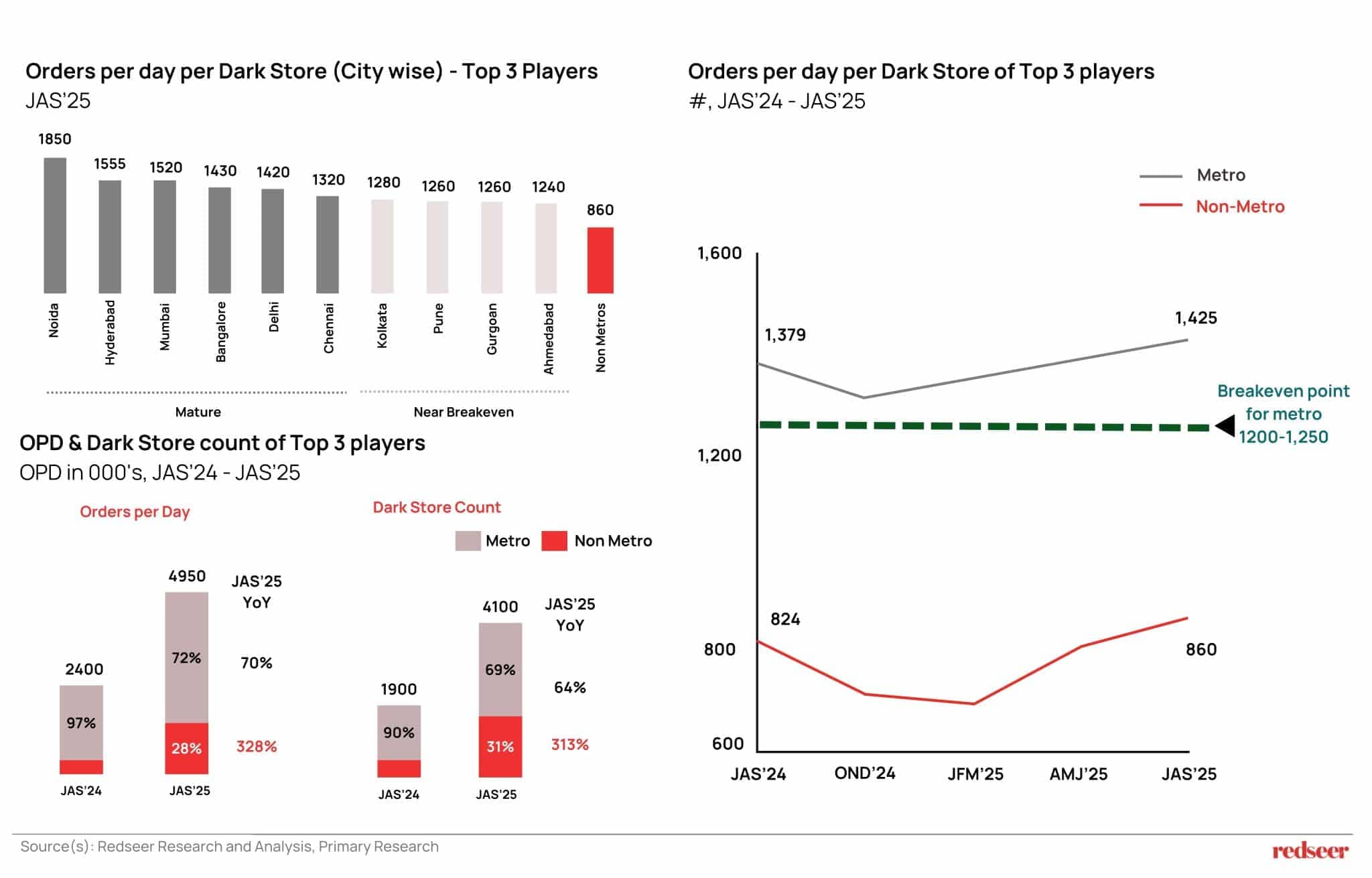
Beneath that surge lies a widening gap between scale and sustainability.
Dark Store Expansion Shows Only a Partial View of Growth
City-wise OPD/DS data reveals that only a handful of mature metros consistently operate at or above the 1,200–1,250 breakeven range, with utilisation outcomes varying sharply by city cohort and vintage. Non-metro dark stores still hover around ~850 orders per day per dark store.
This is where the economics begin to diverge. Quick commerce isn’t just scaling demand; it’s scaling cost faster than utilisation can catch up. Each new store below breakeven spreads fixed costs thinner, deepens burn, and drags margins lower.
The topline continues to reflect expansion. The underlying economics, however, are increasingly shaped by where maturity is concentrated and where it is not. As growth broadens across cities at different stages of utilisation, headline averages lose explanatory power.
At this stage of the cycle, this loss of signal is most visible in city-level ramp curves, cohort maturity, and utilisation distributions.

What Investors and Platforms Should Monitor Closely
- Store-level breakeven timelines over aggregate GMV growth, as industry averages increasingly mask widening dispersion in OPD relative to breakeven.
- Time-to-maturity for new non-metro dark stores, as early ramp trajectories increasingly diverge from mature metro cohorts.
- Expansion velocity: Changes in the pace and mix of store additions increasingly matter more than absolute growth, especially when viewed alongside city-level utilisation outcomes.
The insights have been derived from ‘Benchmarks’ by Redseer, the most trusted insights platform on the Indian internet landscape. Its proprietary consumer internet data allows us to make granular and long-term comparisons that reveal underlying trends and shifts in consumer behaviour.
Benchmarks track city-level utilisation, expansion mix, and maturity trends across major quick commerce and consumer internet companies, offering its investors, brands, and platforms a clearer lens on how reported growth aligns with underlying economics.

Written by
Nikhil Dalal
Associate Partner
Nikhil has experience working with Cognizant in business development and strategy roles for the US healthcare sector. He appreciates analysing issues, solving complex problems, and case studies.
Talk to me