
Value Retail: The Quiet Force Reshaping MENA’s Consumer Economy
 Akshay Jayaprakasan
Value retail has re-emerged as a central driver for MENA retail consumption. After a period where convenience, variety, and speed dominated purchasing choices, affordability has returned to the top of the hierarchy, reinforcing a structural shift in how demand is evolving across categories.
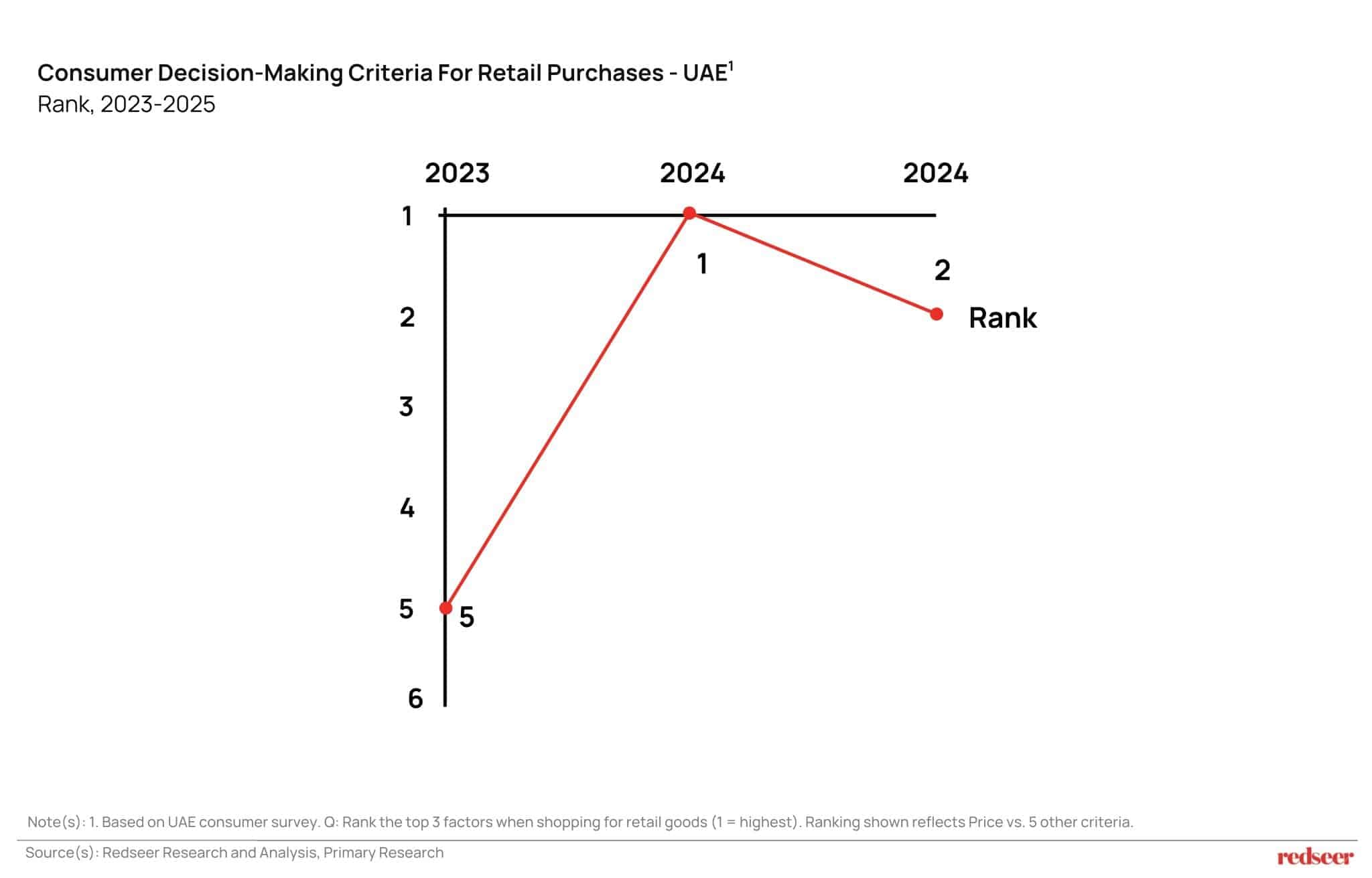
Value has re-emerged as a leading decision driver for MENA consumers
Have a question?
Our experts are just a click away.
Our UAE consumer surveys, used as a representative view for wider MENA shopping behaviour, show a clear reprioritisation of what matters to shoppers when selecting a retailer. Respondents ranked six key criteria: Trust, Variety, Pricing, Speed of Fulfilment, Customer Service, Loyalty Program, and Rewards. Among these, Pricing moved from being the second least important factor in 2023 to the top decision driver in 2024, before settling again as the second-most important factor in 2025.
This progression highlights how affordability has strengthened its role in consumer decision-making. While Trust, Customer Service, and Speed of Fulfilment continue to matter, consumers across segments are placing greater emphasis on the price–value equation and are more willing to switch retailers when pricing sharpens. This suggests that value is not a short-term reaction, but a durable preference reshaping retail choices across the region
Supply is scaling rapidly to meet the region’s value demand
Across the GCC and wider MENA region, value-focused supply has expanded faster in the past three years than in the decade prior. Established chains have been strengthening their footprint, deepening assortment, and improving availability. Viva has grown from a niche discounter into a mainstream neighbourhood destination, with 100+ stores across the UAE; Daiso, Day-to-Day, SAVA, Home Box, Primark, and Brands For Less have been consistently adding stores across key catchments; and category-led value players in home, beauty, and lifestyle continue to broaden reach. The strategic intent is clear: value is no longer a secondary proposition but a core growth engine.
In parallel, digital entrants are reshaping expectations. Temu, Shein, and Amazon Bazaar are introducing global value supply chains into the region, widening both price ranges and assortment depth. Their presence has pushed the market toward sharper pricing, higher SKU variety, and more frequent refresh cycles.
These shifts create a more competitive mix of offline and online formats. For the first time, the region has a valuable ecosystem with meaningful scale across channels.

A global benchmark: Meesho illustrates how value models scale and expand the market
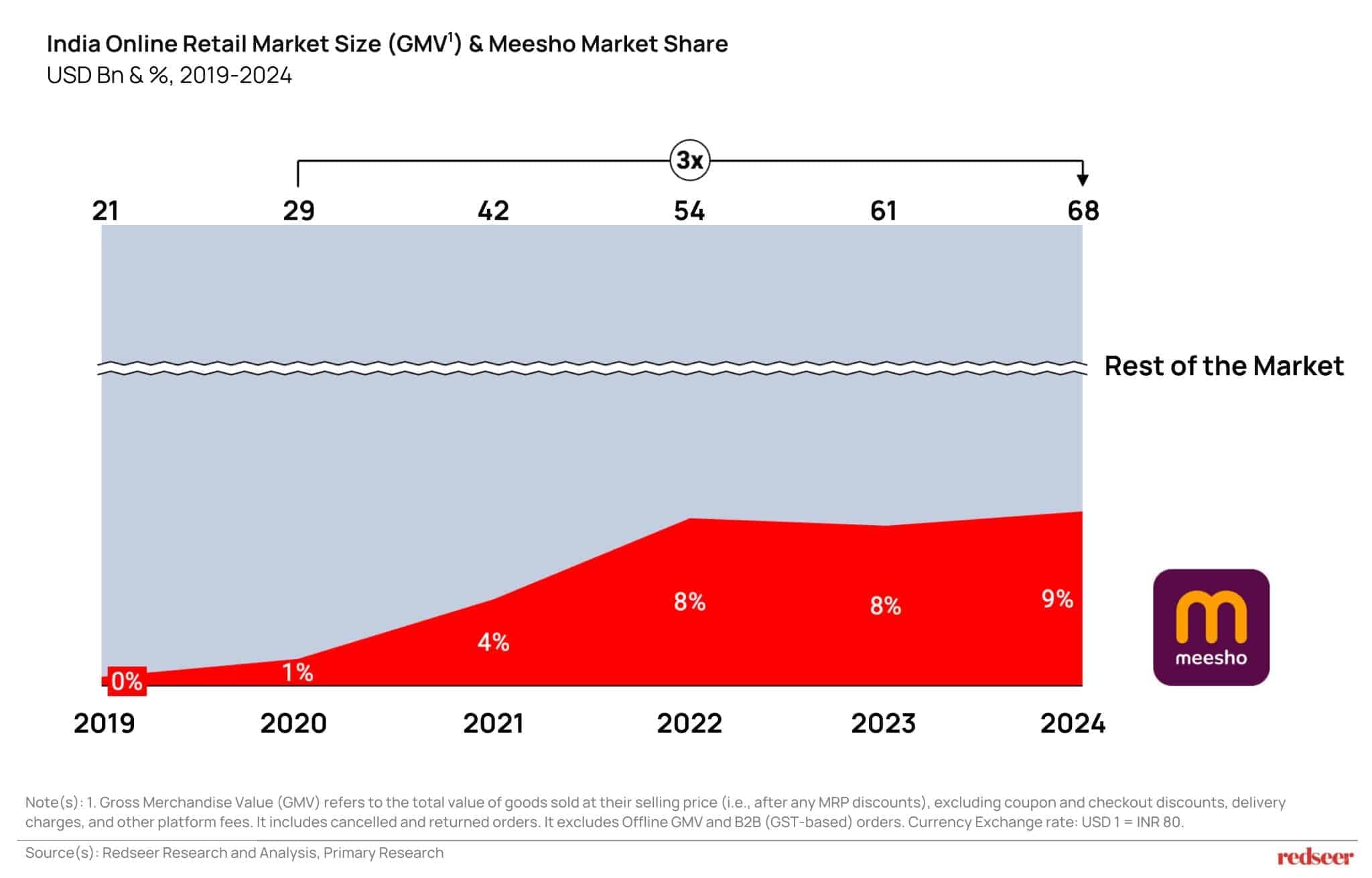
Meesho’s trajectory offers one of the clearest demonstrations of how a value-first platform can build meaningful scale in a competitive e-commerce landscape. Meesho expanded its share of India’s online retail market from 0% in 2019 to 9% by 2024, even as the overall market GMV grew from USD 21 billion to USD 68 billion over the same period. This level of share gain, achieved in a market long dominated by two incumbents, underscores the strength of Meesho’s structural value proposition.
The model is built around affordability, long-tail supply, and SME participation. By enabling millions of small sellers and micro-entrepreneurs, Meesho created a cost-efficient supply stack that consistently meets value demand without relying on aggressive discounting. This supply depth allowed the platform to serve large cohorts of consumers — especially in tier-2 and tier-3 cities — who were historically underserved by mainstream marketplaces.
These dynamics were a central theme in Meesho’s recent IPO, where Redseer partnered with the company as the market consultant, shaping the industry narrative underpinning the offering. The industry insights, highlighted in Meesho’s IPO documentation, point to three drivers behind this growth: a structurally low-cost, SME-led supply base; strong penetration beyond top metros; and deep engagement in value-centric categories such as fashion, home, and lifestyle. These dynamics are not India-specific. They closely resemble the conditions emerging across MENA today.
MENA has the right conditions for value-led models to scale
MENA’s retail structure closely mirrors the conditions that enabled Meesho’s growth. A large share of retail activity is driven by SMEs, yet much of this supply remains offline or under-digitised. This creates an opportunity for value-led platforms and retailers to organise long-tail supply while maintaining low-cost structures.
As highlighted in our report on Unlocking the next wave of MENA e-commerce growth, SMEs will be critical in driving the next leg of online retail growth, and value retail is a segment that can meaningfully enable this shift.
On the demand side, online retail penetration is concentrated in Tier 1 markets, while a significant share of consumption continues to sit outside these hubs. This creates room for value propositions to unlock incremental demand beyond major cities, particularly in categories where affordability is a primary consideration.
Together, a fragmented SME base and underserved non-Tier 1 markets create a strong foundation for value-first models to scale across MENA.

Value retail is re-emerging as a core driver of MENA’s retail evolution. Consumer preferences have shifted decisively toward affordability, supply is expanding rapidly across channels, and global precedents show how value-led models can grow by expanding the market rather than redistributing share.
With a large SME-driven retail base and significant headroom beyond Tier 1 markets, MENA is well-positioned for the next phase of value-led growth. Players that combine affordability with depth, relevance, and operational discipline will be best placed to lead this shift.

Written by
Akshay Jayaprakasan
Associate Partner
Akshay brings over a decade of experience across consulting and technology, with deep exposure to India, Southeast Asia and the Middle East. He has delivered multiple keynotes, served on industry panels, and is frequently quoted by leading Middle East media on the digital economy.
Talk to me

Click-Book-Track: The Rise of New-Age Intracity Logistics Platforms in India

Indonesia’s USD 500 Bn Banking Gap: Can Digital Banks Win before Incumbents Digitize?

India’s Most Reliable Financial Cohort Is Also Its Most Underserved

Trolley’s IPO on Boursa Kuwait: Building the Market Case for Gulf Convenience Retail


