
What Does the Current Geopolitical Situation Mean for the UAE Consumer Economy?
 Sandeep Ganediwalla
The UAE has seen external shocks before, but they do not all play out in the same way. Some hit confidence first, some hit spending power, and some change how people move and shop almost overnight. The right way to read the current moment is not to assume one broad outcome for the whole economy. It is to understand what kind of shock this is, where the UAE is more exposed, and which signals will tell us whether this remains a short disruption or turns into a longer reset.
Not all conflicts impact consumer economies in the same way
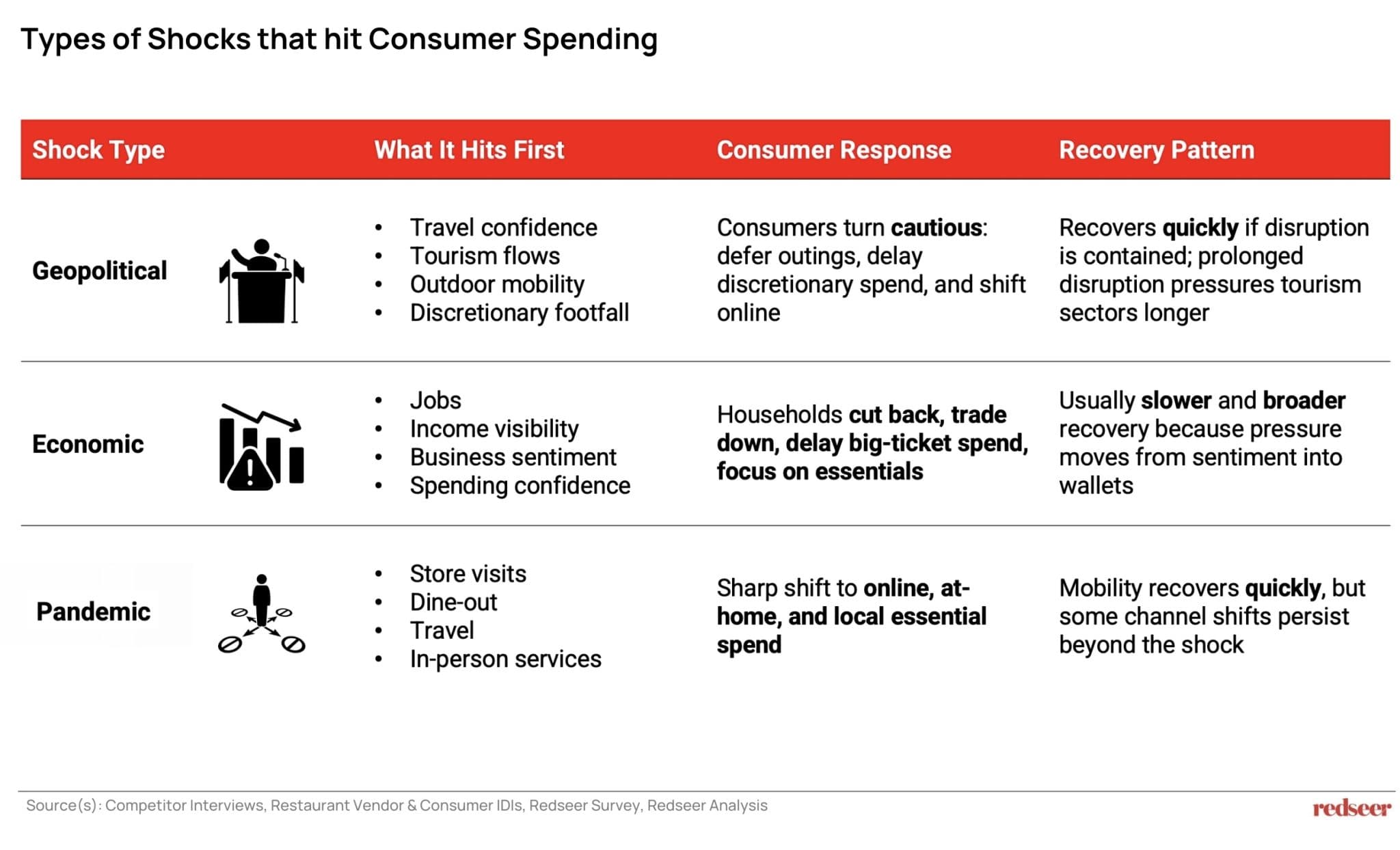
There are three broad kinds of shocks that impact consumer spending-
- Political and geopolitical shocks hit sentiment, mobility, travel, and discretionary demand first.
- Economic shocks are broader, showing up through jobs, income visibility, and consumer confidence.
- Pandemic-style shocks change daily behaviour and channel mix fastest, pushing demand from physical to digital and from out-of-home to at-home.
Each shock has varying impacts on consumption. However, one key lesson we have learnt is that duration matters as much as severity. A short disruption usually creates caution, postponement, and some temporary channel shift. A longer disruption starts affecting tourism, big-ticket spending, investment decisions, and the pace of recovery more meaningfully. That is why the same event can look very different after one week versus after one quarter.
The impact will split across demand pools, sectors, and channels
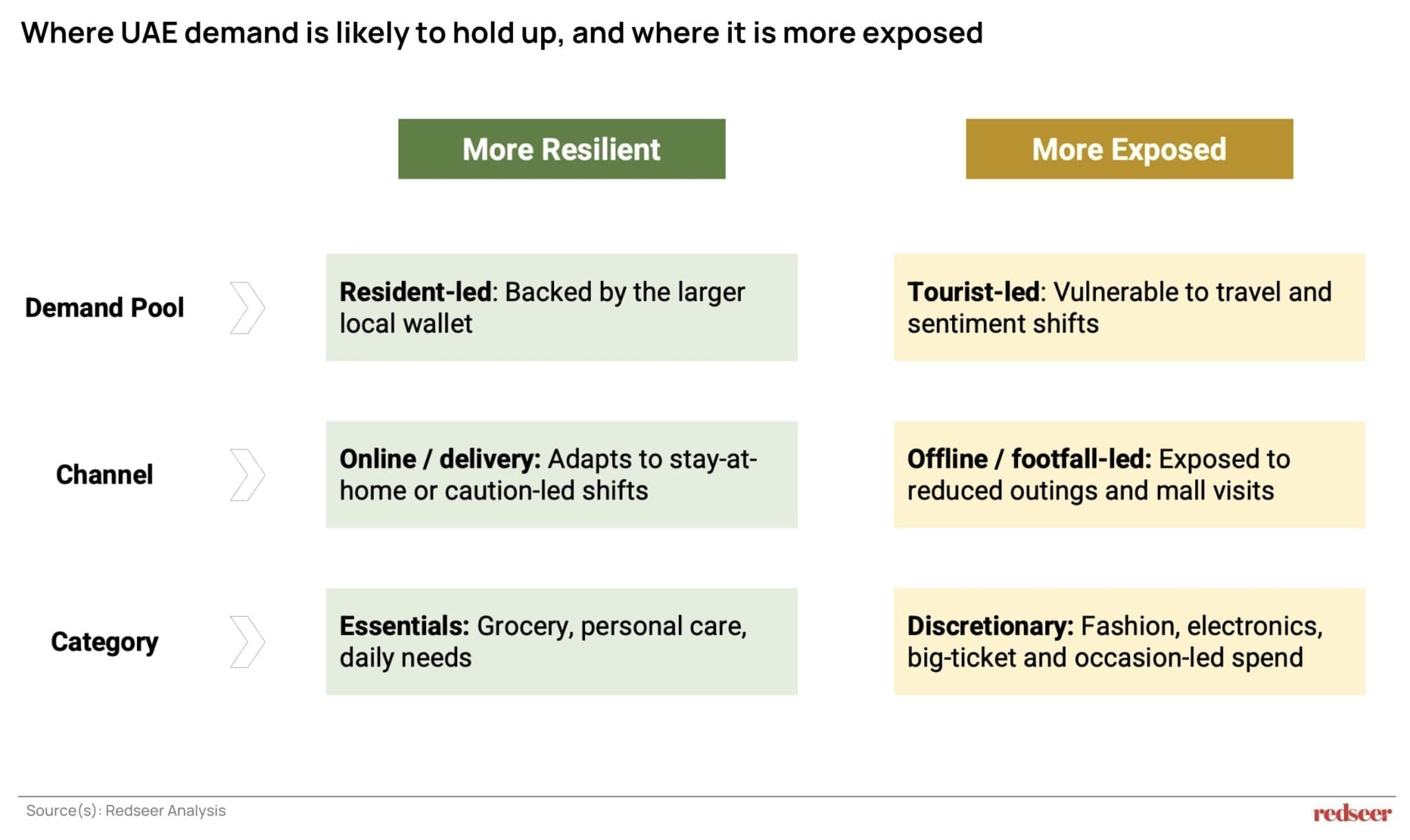
The UAE consumer economy is large and diversified, which is why the impact here will be uneven rather than uniform. The first-order effect is unlikely to be a collapse in overall demand. It is more likely to be a split between resident-led and tourist-led demand pools. That split will also show up by channel and category. Tourist-linked sectors such as hotels, travel, and mall-led discretionary retail are more exposed. Resident-led essentials will be more resilient. Online channels should hold up better than offline if consumers temporarily reduce outings. This is especially relevant in a market where online retail penetration has already reached the mid-teens and quick commerce is now meaningful infrastructure, not a niche convenience layer. Hence, another way to look at this is as a reallocation story first and only later a destruction story if the disruption persists.
The real question now, is what decides whether this is a short wobble or a longer reset
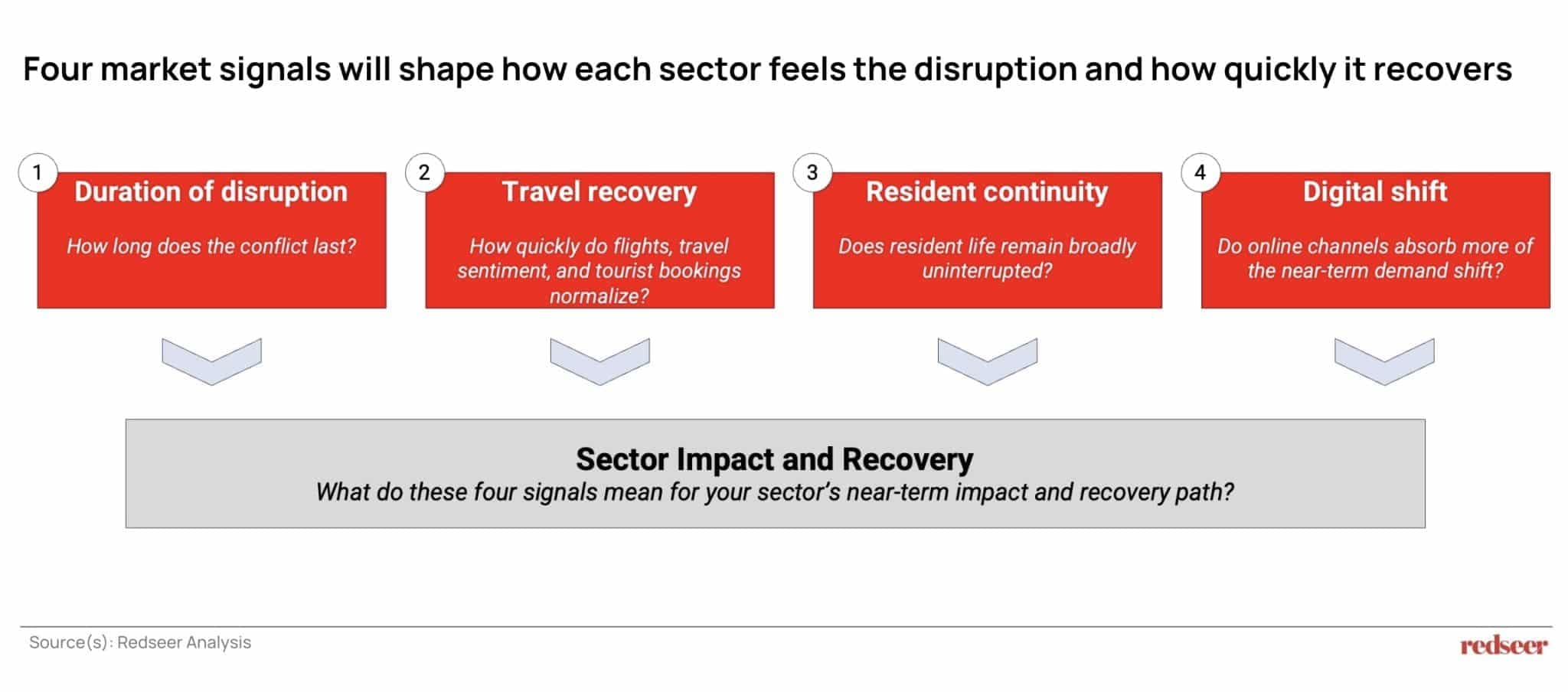
In this backdrop, a few questions need to be answered before we outline the expected impact. First, how long does the disruption last? Second, how quickly do flights, travel sentiment, and tourist bookings normalize? Third, does resident life remain broadly uninterrupted, since that protects the larger share of the UAE consumer wallet? Fourth, do digital channels absorb more of the near-term demand shift? And finally, what do these four signals mean for your sector’s outlook and recovery path?
Objectively answering these questions will help take an informed view on the impact on each sector. The reason to stay constructive is that the country still has strong recovery fundamentals: a large non-oil economy, a sizeable resident consumption base, and digital infrastructure that can absorb some of the demand shift. So the medium-term story is not broken. But the pace of recovery will depend on how these watchpoints evolve over the next few weeks and months.
The key takeaway is simple. First, understand what kind of shock this is. Second, identify where the UAE is exposed and where it is buffered. Third, watch the few signals that decide recovery. The UAE has the scale and fundamentals to recover strongly, but the path will depend on whether this remains a short disruption or becomes something more prolonged.
We will continue tracking the data and come back with a deeper read as the picture becomes clearer.

Written by
Sandeep Ganediwalla
Partner
Sandeep is the Partner with 20+ years of experience in consulting and technology. He has expertise in multiple sectors including ecommerce, technology, telecom and private equity.
Talk to me

How Devaluation Forced Egypt’s Online Fashion Market to Go Local. And Win.

Click-Book-Track: The Rise of New-Age Intracity Logistics Platforms in India

Indonesia’s USD 500 Bn Banking Gap: Can Digital Banks Win before Incumbents Digitize?

India’s Most Reliable Financial Cohort Is Also Its Most Underserved


