
Beauty & Personal Care in Quick Commerce: From Convenience to Everyday Relevance
 Nikhil Dalal
India’s overall online BPC market has scaled 2.4x in three years from ~₹21K Cr in CY22 to ~₹52K Cr in CY25. Within this broader surge, quick commerce has emerged as the fastest scaling channel, not merely riding category growth but reshaping how BPC is consumed.
Beauty in Quick Commerce: Scaling Faster Than the Category
The GMV of Beauty & Personal Care within quick commerce has expanded ~22.5x between CY22 and CY25, marking one of the fastest scale-ups within the ecosystem.
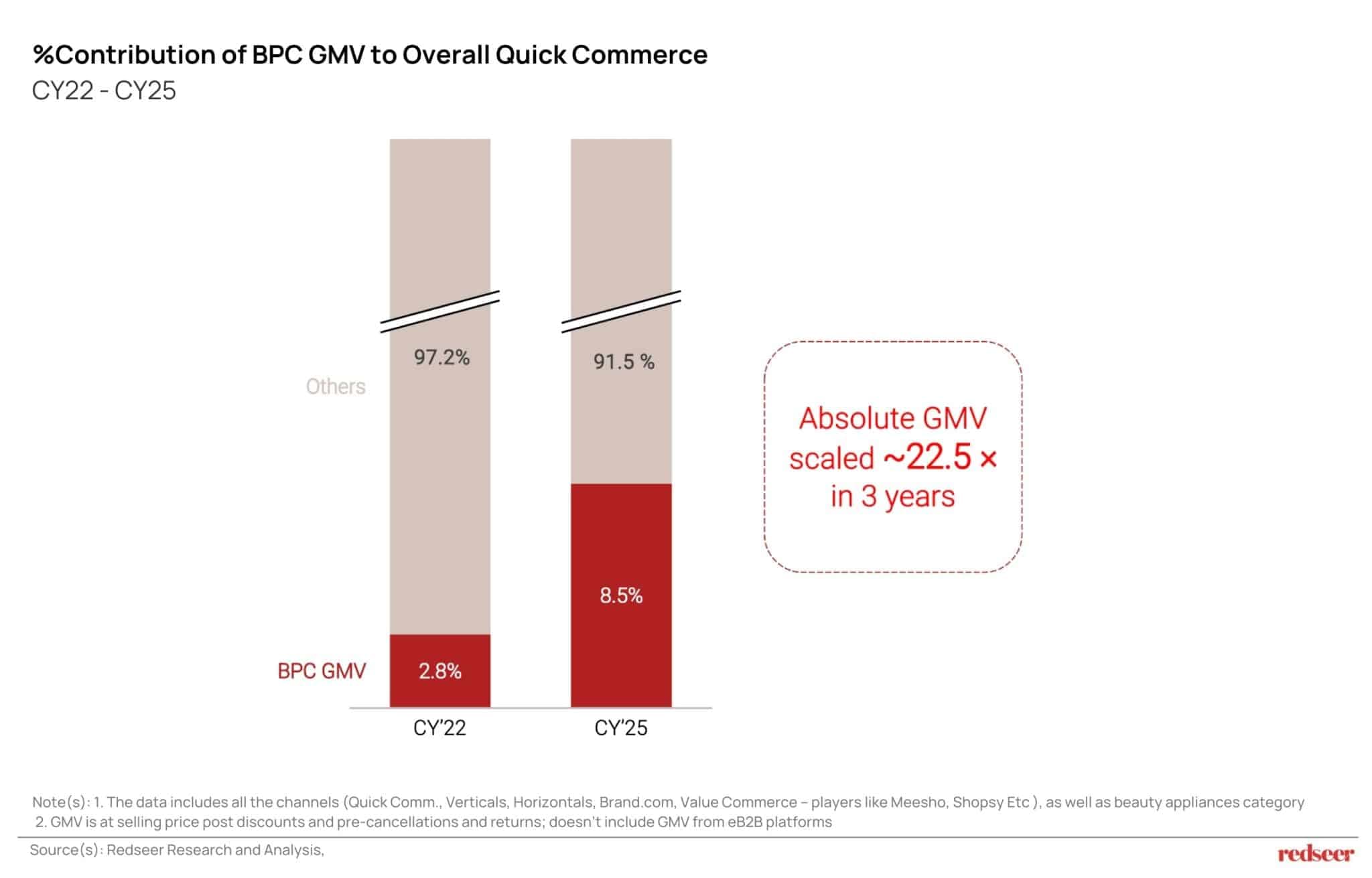
This expansion signals that Beauty is no longer a peripheral add-on within quick commerce. It is now the second-largest category after grocery, positioning BPC as a structural growth driver within the ecosystem.
Channel Shift: Where BPC Growth Is Concentrating
While overall online BPC has grown 2.4x from CY22 to CY25, growth across channels has not been uniform. Quick commerce has expanded its share of online BPC from ~2% in CY22 to ~16% in CY25 — an ~8x increase in channel contribution over three years.
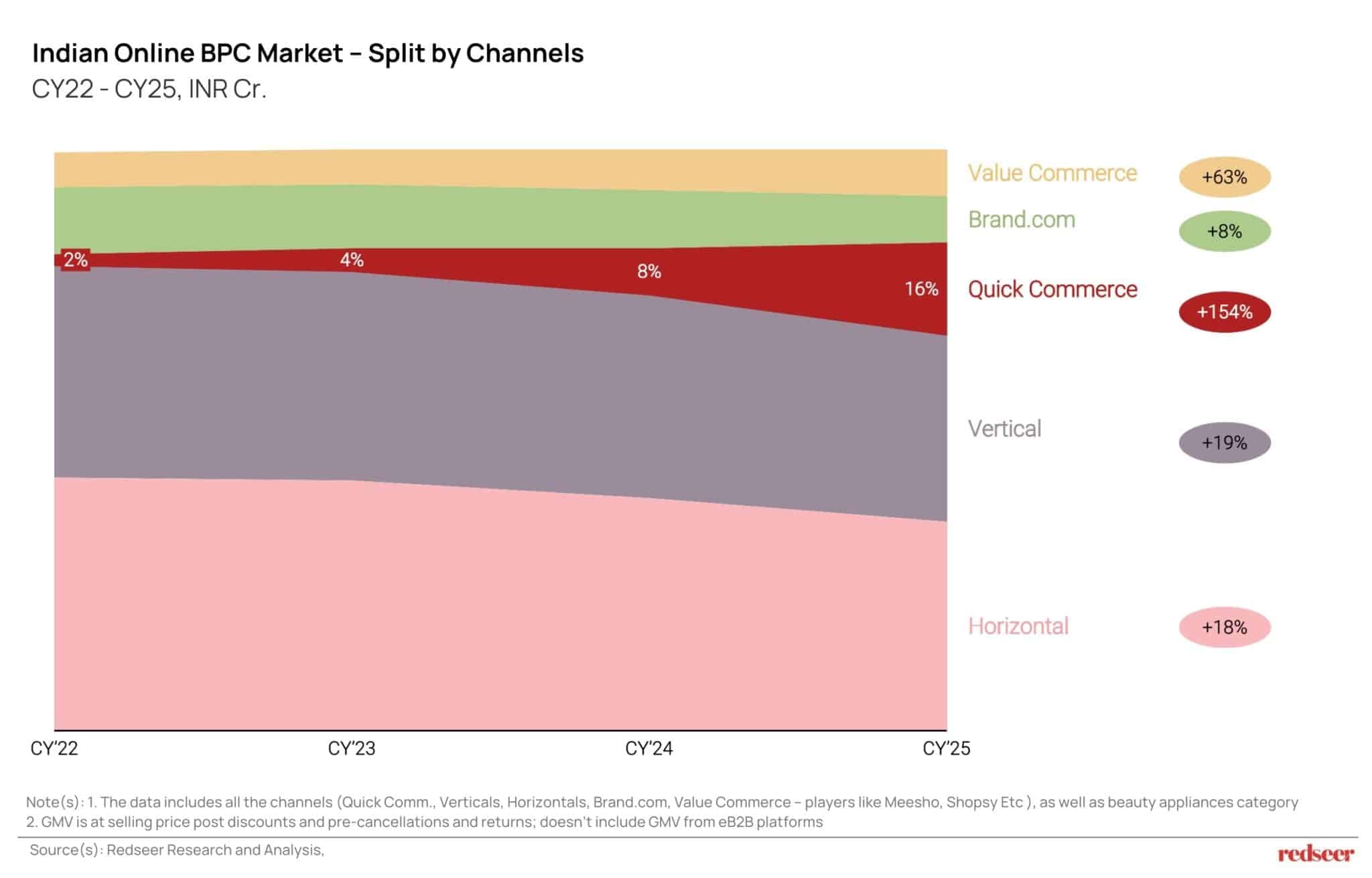
Importantly, quick commerce and horizontal platforms now show increasingly similar category compositions, particularly across replenishment-heavy segments such as skin care, hair care, and bath & body.
The share gain by quick commerce appears to be coming primarily from horizontal platforms, driven by immediacy-led purchases of repeat essentials, rather than discovery-driven buying.
To understand this shift better, we look at how BPC spends across channels in CY25.

Channel Composition: What Consumers Buy Where
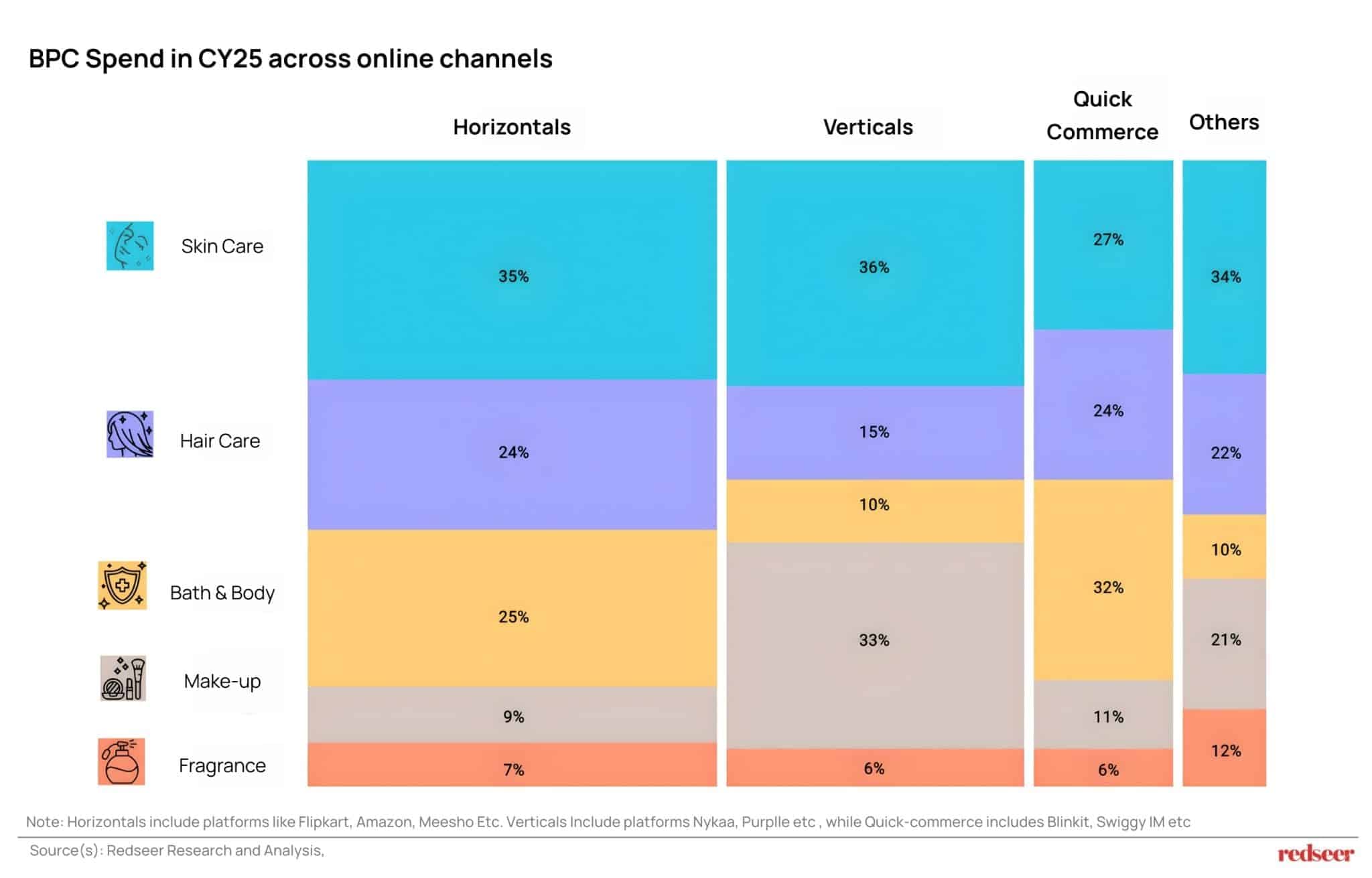
The composition reveals that quick commerce is not competing head-on with vertical beauty platforms on discovery-heavy segments like makeup. Instead, it mirrors horizontal platforms in core care categories, suggesting that it is capturing daily essentials demand rather than displacing discovery-led channels.
What’s Driving Growth? Emerging Trends in Quick Commerce
- Quick commerce as default for essentials: BPC’s 8% share within QC is driven by impulse buying, daily replenishment, and one-cart convenience. Broader assortments are making quick commerce the default channel for everyday BPC.
- Experience-led engagement:
Platforms are increasingly leaning into visual-first interfaces, recommendation algorithms, and seasonal offerings that convert browsing into buying. Personalisation, sample kits, and limited-edition launches are crucial in nudging users towards frequent purchases.
- Differentiation through content and bundling:
Early adopters are integrating influencer-led content, user reviews, and bundled offers—like curated skincare kits for gifting—to expand basket sizes and repeat engagement.
- Platform strategies and assortment expansion:
Some platforms are aggressively expanding their lifestyle SKU mix, while others are prioritising onboarding niche beauty and essentials brands.
The Road Ahead: From Convenience to Everyday Utility
Quick commerce is transitioning from emergency fulfilment to an everyday utility embedded in lifestyle routines. BPC will grow vertically—with deeper subcategories, more specialised options— in comparison to fashion, which expands horizontally with broader product variety.
The winners will be platforms and brands that master convenience-led consumption: building depth in beauty, breadth in fashion, and operationally scalable models that balance speed, assortment, and profitability. Channel strategy is no longer about presence—it’s about relevance, frequency, and long-term resilience.
The insights have been derived from Redseer’s ‘Benchmarks’, the most trusted insights platform on the Indian internet landscape. Its proprietary consumer internet data allows us to make granular and long-term comparisons that reveal underlying trends and shifts in consumer behaviour.
Benchmarks track city-level utilisation, expansion mix, and maturity trends across major quick commerce and consumer internet companies, offering its investors, brands, and platforms a clearer lens on how reported growth aligns with underlying economics.

Written by
Nikhil Dalal
Associate Partner
Nikhil has experience working with Cognizant in business development and strategy roles for the US healthcare sector. He appreciates analysing issues, solving complex problems, and case studies.
Talk to me