
India’s Defence DeepTech Flywheel: The $6Bn Market Nobody’s Watching
 Mrigank Gutgutia
The global tech ecosystem is grappling with risky and uncertain investments. Meanwhile, in India, a sector with built-in customers, policy-mandated demand, and export upside is flying under the radar.
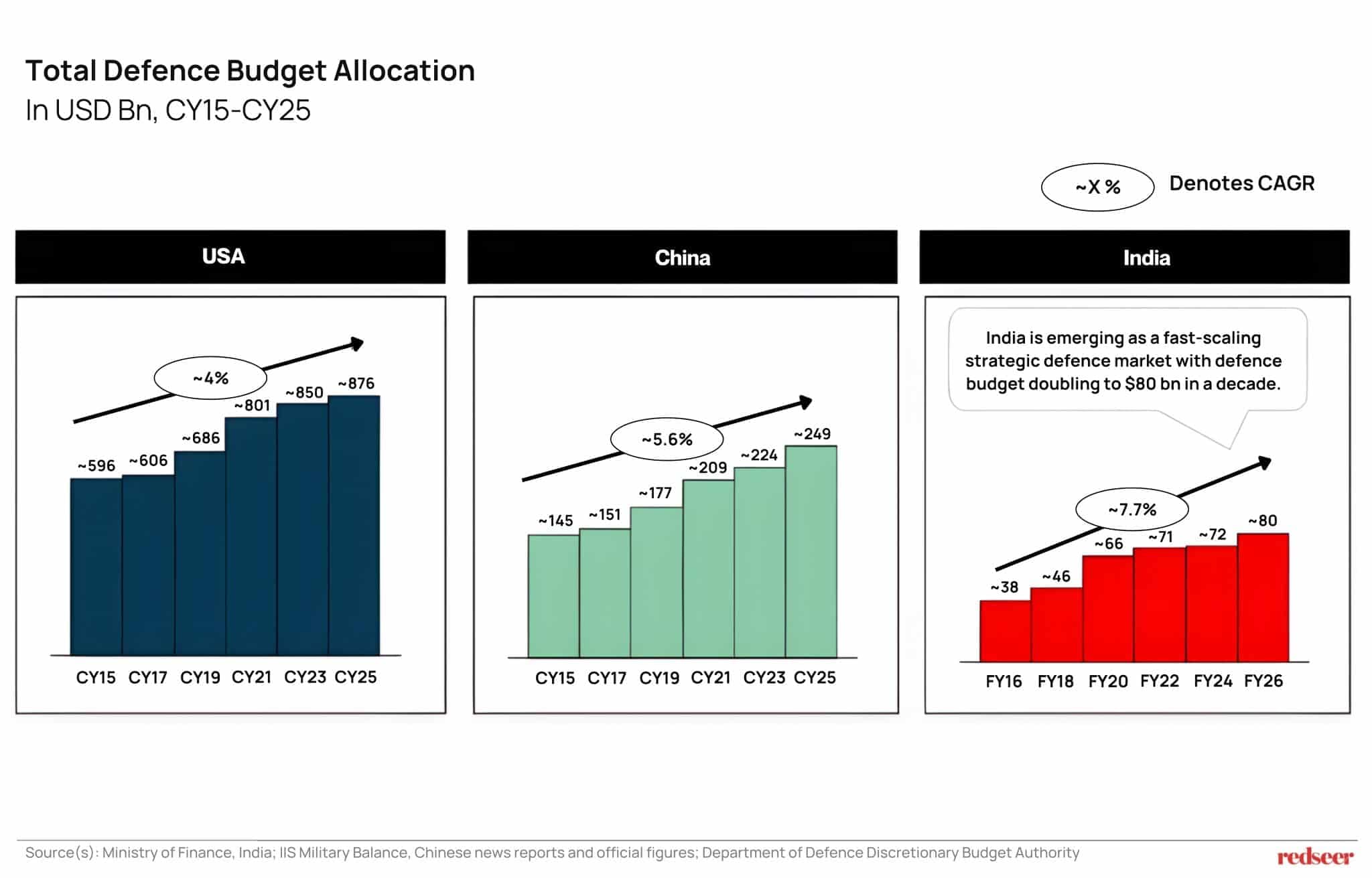
India’s defence budget is set to hit $80 billion in FY25-26, doubling in the past decade at a 7.7% CAGR that outpaces both the United States (4%) and China (5.6%).
Want to evaluate new investment and M&A opportunities?
This marks a notable shift in India’s position from an import-dependent state to a defence behemoth.
India’s defence spending has historically gone primarily to imports and operational expenses. The shift results from an evolving enforcement mechanism. Beyond missile systems like Akash, Agni and Prithvi, the Indian government seeks to indigenise the manufacturing of various facets of defence technology, including surveillance systems, radar and sensors under the Defence Acquisition Procedure (DAP) 2020. Specific programmes illustrate this, such as
- The INR 20,000 crore ($2.4 billion) 87 MALE drone project has been fast-tracked for the defence forces.
- investments in indigenous radar and sensor systems, and
- the push for next-generation batteries and battlefield microgrids.
This policy shift, combined with a $20 billion-plus procurement backlog, is channelling capital into defence DeepTech. The result is a $6 billion market (CY2025) projected to reach $10-12 billion by 2030, embedded within India’s broader DeepTech surge from $9-12 billion currently to $27-33 billion by decade’s end.
Where does the opportunity lie?
Within the $6-6.5 billion market, opportunities are distributed unevenly. The high-opportunity zones combine low entry barriers with high growth: unmanned systems, AI-enabled training and protection systems, and energy and propulsion technologies.
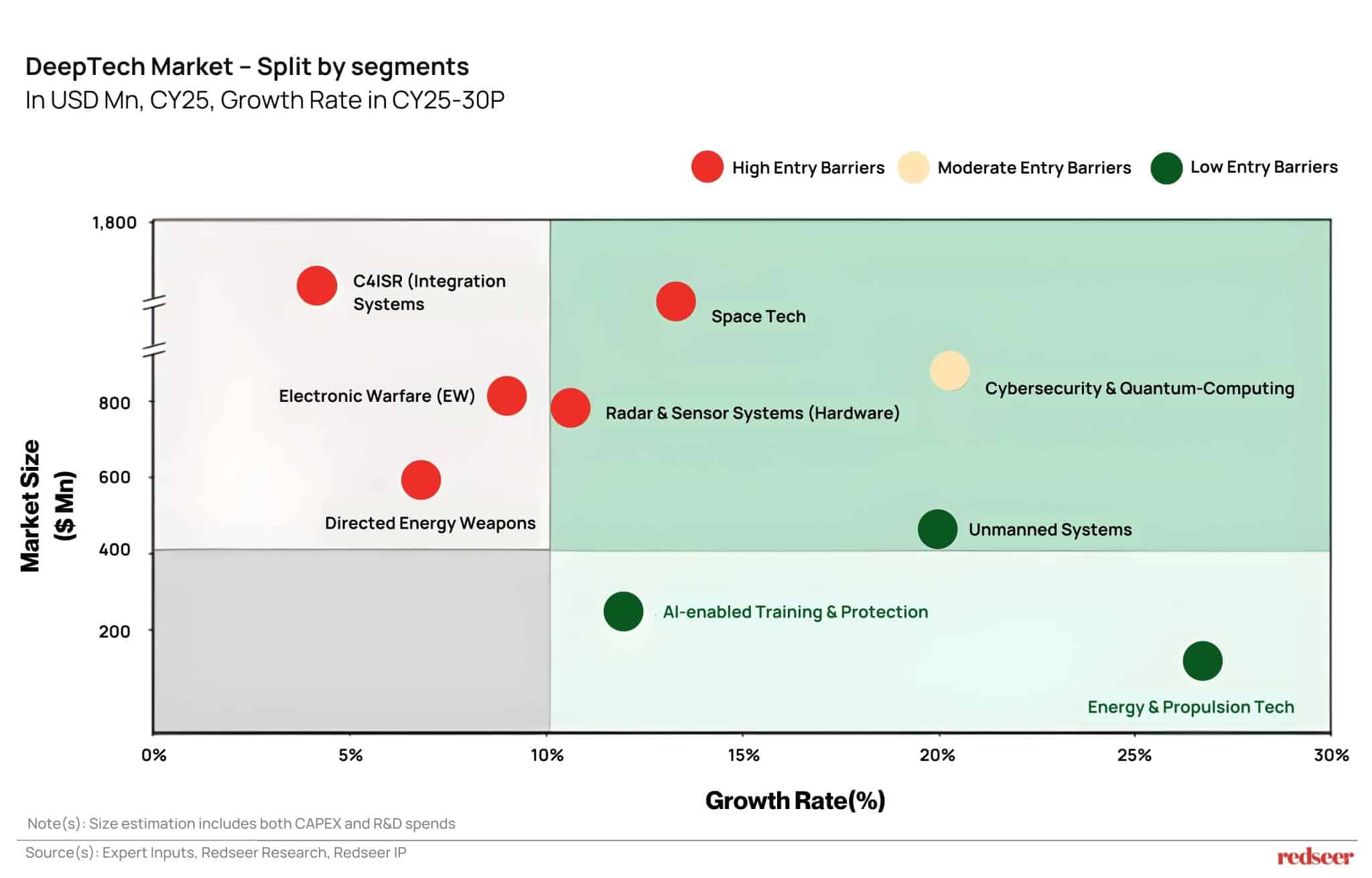
Medium-opportunity segments include cybersecurity and quantum computing, radar and sensor systems, and electronic warfare. Segments like directed energy weapons, space tech, and C4ISR integration are tougher to crack, requiring heftier investments and longer timelines. Enabling technologies – spanning sensing, instrumentation, AI layers and propulsion tech – thus emerge as the most immediately investable opportunities.
The soaring drone market
Within the space of unmanned systems, the drone sector is expanding rapidly. From $200-250 million in 2025 (projected), India’s military drone market is expected to reach $650-700 million by 2030 – a 3x growth in five years. Presently, ISR (Intelligence, Surveillance, Reconnaissance) drones dominate at 80%, attack drones account for 15%, and logistics drones make up 5%.
But the growth is being constrained by supply chain gaps. A recent FPV drone tender was scrapped because 20-30 applicants lacked indigenous component capability. Most Indian drone OEMs still rely on imports for batteries, motors, sensors, and flight controllers, underscoring the need for end-to-end domestic manufacturing capabilities. This opens the field for capital to be infused in several areas:
- Intelligent and resilient drones: AI-enabled systems with GPS-independent navigation, jammer-proof resilience, and stealth designs with a focus on multi-sensor data fusion (EO/IR, LiDAR, acoustic) and swarming autonomy.
- ISR drones: A gradually emerging cohort of players could develop devices for short patrol and long-haul endurance missions.
- Attack drones: Civilian/agricultural drones could be converted into armed drones for tactical operations.
- Component supply chain: Manufacturers of critical drone components like motors, flight controllers, EO/IR payloads, and advanced batteries can meet a growing market with export potential. Thus, India’s drone ecosystem is expected to mimic the automotive space: OEMs supported by a massive component supplier base by 2030.
The geopolitical and technological thrust
While internal policy lays the foundation for India’s defence DeepTech renaissance, geopolitical tailwinds are propelling it further. Countries are actively seeking alternatives to Chinese manufacturing for sensitive technologies. Manufacturing hubs in the US and Europe do not offer the cost advantage that India does, placing India at a lucrative juncture.
Technology has matured to compound this advantage. AI enables autonomous systems at scale. Battery technology (4680 cells, solid-state, sodium-ion) can power extended missions. Sensor costs have dropped 60-70% over five years.
Defence has pre-committed buyers with multi-year procurement cycles. Payment terms are patient (18-24 month cycles are common), but buyers are guaranteed within a highly organised and regulated market.
The Flywheel is Turning
India’s defence DeepTech offers something increasingly rare: predictable demand curves backed by policy mandates and budget commitments.
Right now, a $6 billion market is heading towards $10-12 billion by 2030, drones will grow 4-7x in five years, a component ecosystem is emerging, and export momentum is building. The segments with clearest near-term opportunities – unmanned systems, AI-enabled training, energy and propulsion tech – combine low entry barriers with 15-30% annual growth.
The question isn’t whether India’s defence DeepTech will scale; the procurement backlog and policy commitments guarantee that. The question is: who positions themselves in the enabling stack before the ecosystem matures?
Download our report on India’s DeepTech Renaissance, and book a 1:1 with Redseer experts, to establish your right to win.

Written by
Mrigank Gutgutia
Partner
Mrigank leads business research and strategy engagements for leading internet sector corporates at Redseer Strategy Consultants. He has developed multiple thought papers and is regularly quoted in media and industry circles.
Talk to me

India’s Most Reliable Financial Cohort Is Also Its Most Underserved

Trolley’s IPO on Boursa Kuwait: Building the Market Case for Gulf Convenience Retail

Kuwait’s Convenience Retail Moment: What Trolley’s IPO Says About Where Gulf Retail Is Heading

Beauty Blitz 2030: Mapping India’s Ascent to a $40 Billion Powerhouse


