
Indonesia’s USD 500 Bn Banking Gap: Can Digital Banks Win before Incumbents Digitize?

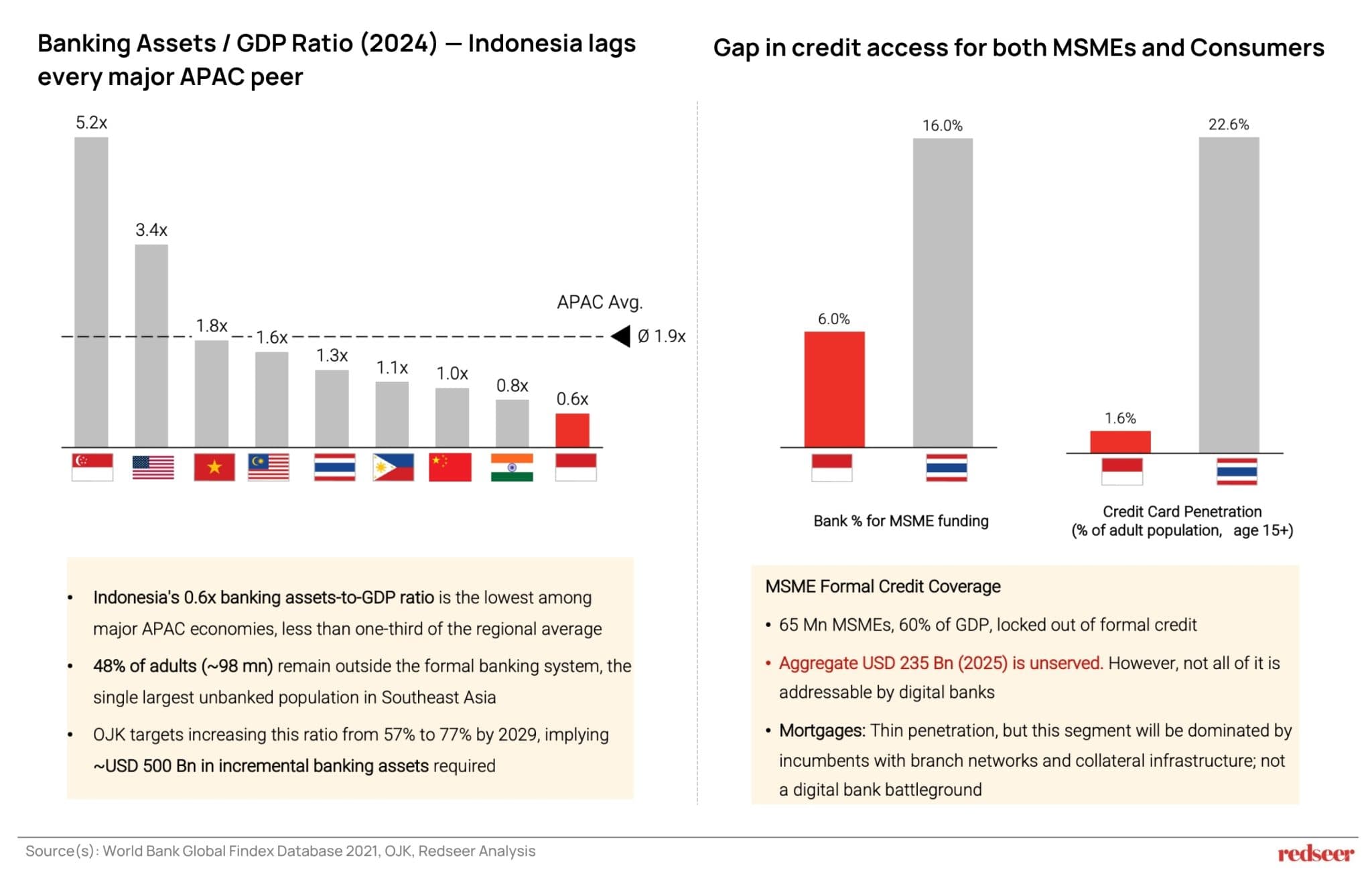
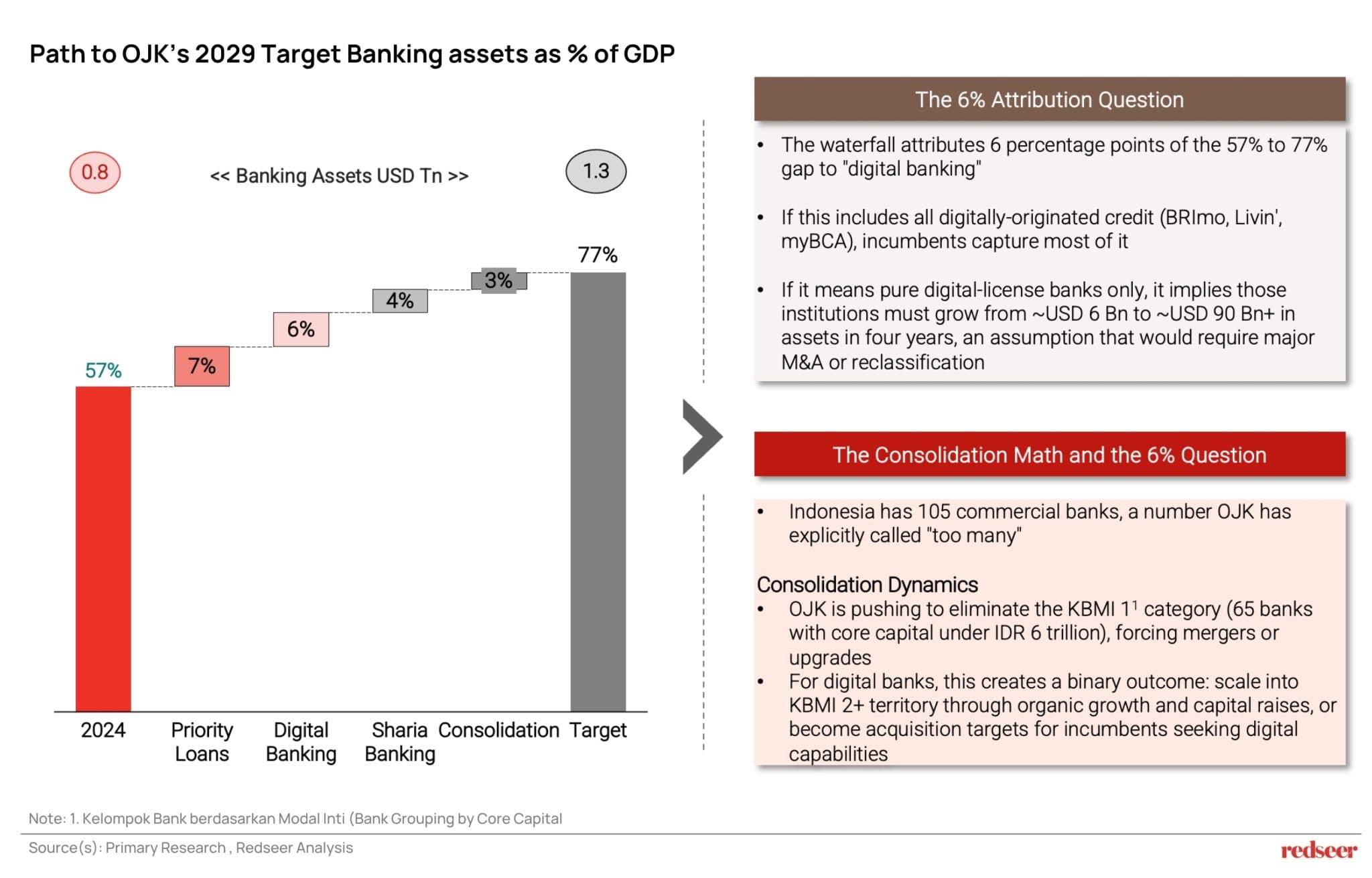
Indonesia’s OJK1 aims to raise Banking Assets to GDP to 77% by 2029, up from 57% in 2024. This means adding around USD 500 Bn in banking assets. Both digital and traditional banks are growing quickly to capture this opportunity.
However, digital distribution alone may not be enough. The winners will need a clear cost advantage and stronger credit underwriting. Otherwise, most growth will remain with traditional banks, even for digitally sourced loans.
Time is also critical. OJK is encouraging KBMI-1 banks (core capital below IDR 6 trillion or ~USD 350 million) to increase their capital. As a result, digital banks must either grow and raise capital quickly or become acquisition targets.
Note: OJK (Otoritas Jasa Keuangan), the Financial Services Authority, is an independent Indonesian government agency responsible for regulating and supervising the country’s entire financial services sector
As Indonesia raises its Banking Assets-to-GDP ratio, unsecured consumer lending and MSME credit present opportunities for digital banks
At ~57% GDP, Indonesia’s banking assets are less than one-third of the APAC average. The OJK aims to raise this to 77% by 2029, implying about USD 500 billion in more assets. However, a sizable portion of this growth is not accessible to digital banks. Mortgages and large corporate lending will remain with traditional, branch-based banks.
The main opportunity for digital banks lies in unsecured consumer lending and micro-SME credit, segments with meaningful market size and weaker coverage by traditional banks.
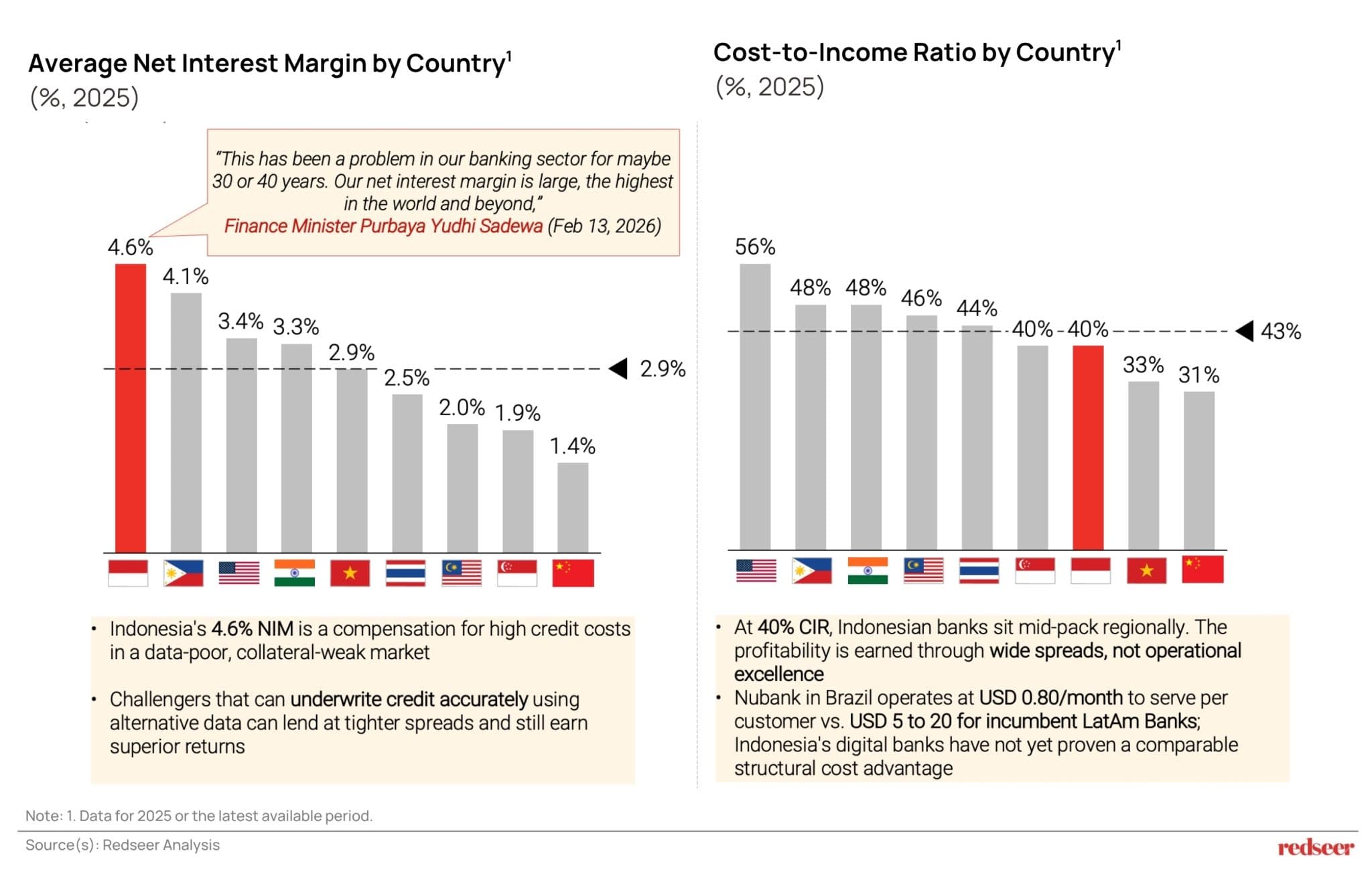
Fat margins mask thin efficiency: the cost structure digital challengers must break
Indonesian banks earn NIMs of 4.6%, 2x the APAC average. However, their cost-to-income ratios sit mid-pack regionally at 40%. This underscores that the high margins compensate for large credit losses in a data-poor, collateral-light market. It is not a sign of banks’ efficiency.
This market structure presents an opportunity for digital banks. Those who lend at tighter spreads using better data, can still earn returns that exceed the incumbents’ because the starting NIM is wide.
For context, Nubank in Brazil operates at ~USD 0.80/month cost-to-serve per active customer, ~ 85% below incumbent LatAm banks (estimated at USD 5 to 20+/month depending on institution and methodology). Indonesia’s digital banks have yet to show comparable structural unit economics, with most still in early-stage profitability.
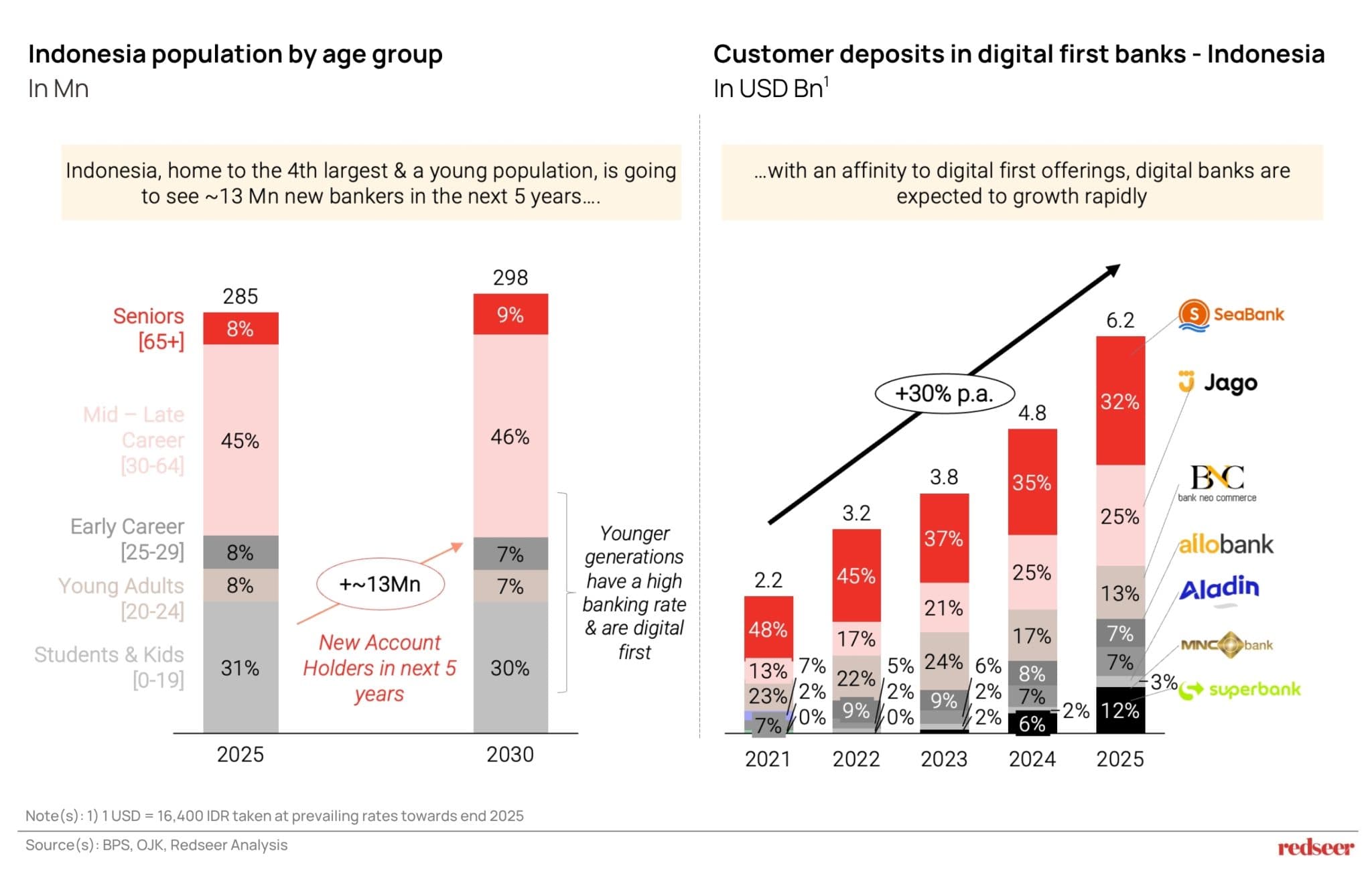
13 million digital-first account holders in five years will power the demand wave for banking services
Want to get strategic guidance?
Indonesia’s 285 million population is skewed towards the young i.e., ~40% is under 25. This demographic profile points to a substantial incoming cohort of first-time banking customers: an estimated 13 million new account holders over the next five years, the majority of whom will gravitate to mobile-first banking by default rather than by deliberate choice.
This shift is already visible in deposit flows. Across seven digital banks, customer deposits grew from USD 2.2 Bn in 2021 to USD 6.2 Bn in 2025, compounding at 30% per year. SeaBank and Bank Jago account for the largest shares. However, this acquisition window has a limited shelf life.
Incumbents such as BRI and Mandiri are investing significantly in their own digital channels. Once user experience and deposit rates converge across platforms, the first-mover advantage in capturing deposits will erode quickly.
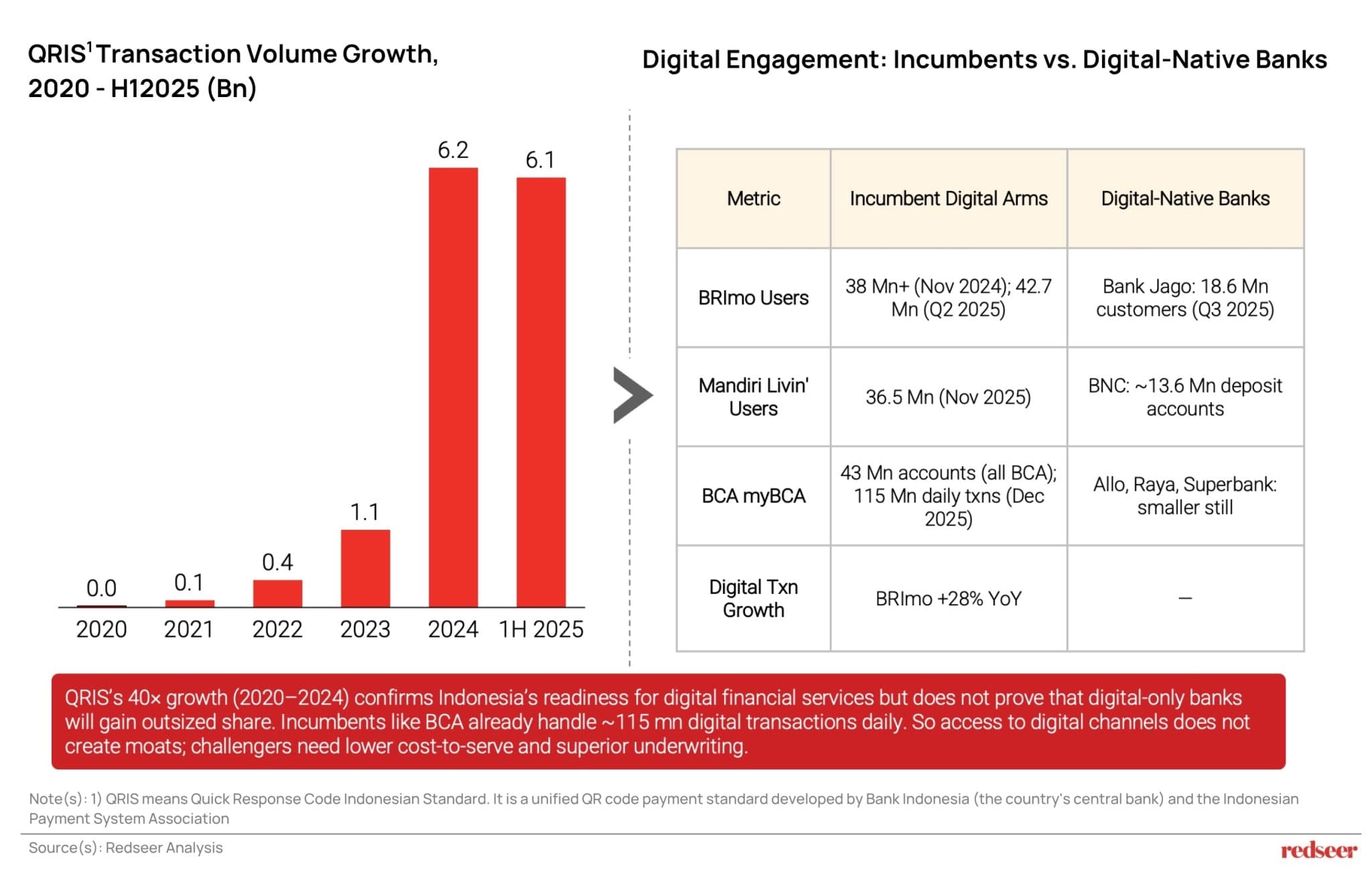
Digital rails are not a moat for digital-first banks; incumbents already run on them
Indonesia’s QRIS grew from almost zero to 6.2 Bn transactions between 2020 and 2024, a 40x jump that shows Indonesia is ready for digital financial services.
For now, traditional banks are capturing most of this growth. BRImo has 42.7 Mn users and is growing transactions by 28% year-on-year. Mandiri Livin’ has 36.5 Mn users, while Bank Central Asia (BCA) processes 115 Mn digital transactions daily.
Having a digital channel is now just the baseline. For new challengers to win, they need two things: a cost structure that traditional banks cannot match, and better credit decision-making.
Three models, one question: which digital bank economics survive a tough credit cycle?
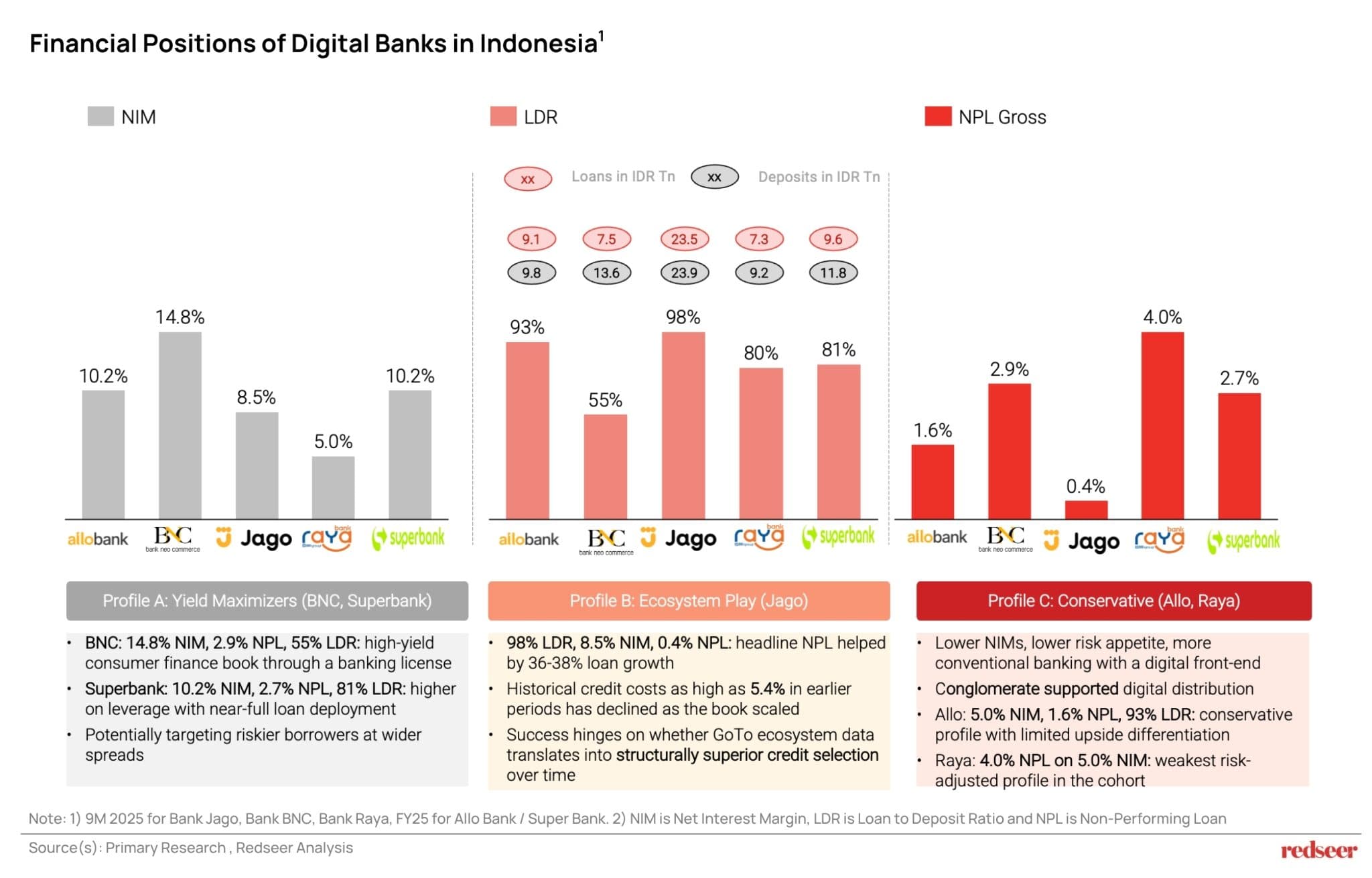
Indonesia’s five main digital banks are pursuing distinct strategies, and their financial profiles reflect these differences clearly.
BNC and Superbank both run with high lending margins (above 10% NIM) but carry elevated levels of NPLs (non-performing loans). In substance, they function more like consumer finance companies operating under banking licenses.
Bank Jago is the most compelling case. It deploys nearly all its deposits into loans (98% LDR), yet maintains a notably low bad loan ratio (0.4% NPL). Its core thesis is that data from the GoTo ecosystem enables superior credit choice compared to traditional banks.
Allo and Raya adopt more conservative approaches, relying on the distribution networks and backing of their parent conglomerates.
The most consequential question facing the sector is still whether these models can prove resilient across a full credit cycle, when loan portfolios face a genuine stress test.
OJK’s 77% target means scale or sell. The clock is ticking
OJK’s 6% target for digital banking assets can be interpreted in two ways: it could refer to loans originated through digital channels, or to assets held by fully licensed digital banks. If it is the former, traditional banks are already ahead, as they have scaled digital lending quickly. If it is the latter, digital-only banks will need to grow their assets much faster, requiring acquisitions or partnerships to accelerate scale.
Meanwhile, digital challengers are operating under constraints they cannot control. Incumbent banks are rapidly improving their own digital capabilities, while regulators are encouraging industry consolidation. To compete meaningfully, digital banks will need to excel at credit underwriting and deliver services at a lower cost than traditional players.

Written by
Roshan Behera
Partner
Roshan is a Partner based in Singapore and focuses on Southeast Asia. His sector coverage includes e-commerce, logistics, fintech, eB2B, on-demand services, and other emerging sectors.


Viet-Nomics: Southeast Asias Rising Economic Star

USD 30 Bn Market in Motion: New Revenue Models Shaping Mobility & Delivery in SEA

Building Durable Younger-Customer Economics in BFSI Market

The $6 Tn Question: Who Wins SEA’s Digital Payment War?

Indonesia BNPL Market: Growth Meets Credit Discipline

Indonesia’s Digital Banks Are Coming of Age:Can Incumbents Fight Back?

SEA’s USD 123 Bn Remittance Market: Fragmented Landscape, Focused Winners

Southeast Asia’s Next Unicorn Factory: The $480B MSME Lending Market

SEA BNPL: Superior Unit Economics Powering Sustainable Growth

WealthTech: Riding SEA’s $70B Digital Gold Rush

SEA POS: Monetizing beyond the USD 680 Bn opportunity at checkout

2025: The Mean Matters
Viet-Nomics: Southeast Asias Rising Economic Star
USD 30 Bn Market in Motion: New Revenue Models Shaping Mobility & Delivery in SEA
Building Durable Younger-Customer Economics in BFSI Market
The $6 Tn Question: Who Wins SEA’s Digital Payment War?
Indonesia BNPL Market: Growth Meets Credit Discipline
Indonesia’s Digital Banks Are Coming of Age:Can Incumbents Fight Back?