
Meeting India’s Protein Goals: Lessons from the Branded Egg Market
 Mrigank Gutgutia
The average Indian meal has been notoriously calorie-dense but protein-deficient. In 2025 however, protein had its moment in the sun, with steadily rising Google searches and online purchases of everything from whey protein to high-protein ice cream. As the Indian meal evolves to include more protein, staples such as eggs, pulses and dairy are also undergoing a brand makeover.
Egg consumption in India has grown consistently at 6-7% annually, reaching approximately 5,000 tonnes in 2024 with a market value of $8-9 billion.
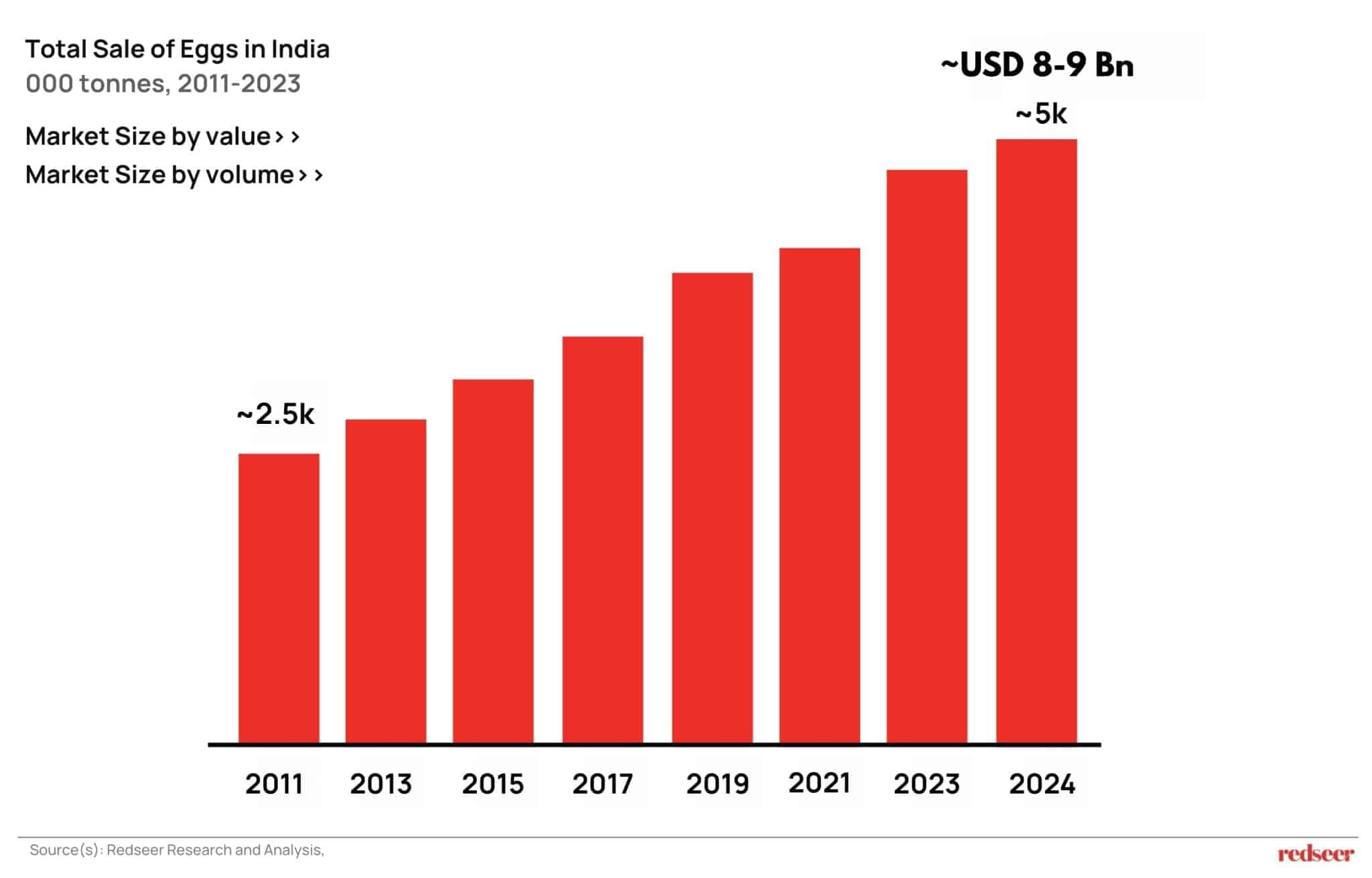
The category is experiencing simultaneous disruption across four dimensions.
- Evolving consumer preferences towards premiumisation and health-first use cases, with growing willingness to pay for organic, free-range, and nutritionally enhanced options.
- Product advancement through IoT-enabled farming and advanced feed technologies that maintain consistent quality, resolving the trust deficit that plagues manufactured RTE products.
- New channel mix emergence, particularly through quick commerce platforms that enable convenience in purchasing fresh protein without the preparation barriers of raw ingredients, or the health concerns of processed alternatives.
- New-age brand development that treats eggs as a branded category rather than a commodity, demonstrating that even staple proteins can command premiums through quality differentiation and distribution innovation.
This transformation is reshaping the entire value chain. Traditional egg distribution relied on minimal branding with local/regional reach, entirely player-owned supply chains, and physical retail outlets positioning eggs as basic and affordable. The emergence of “next-day morning” platforms over the past decade, such as Country Delight and FreshToHome introduced initial brandification, emphasising freshness through online delivery.
The turning point arrived in the last five years with new-age brands achieving over 50% of sales through quick commerce, offering 10-minute delivery of premium options. Recent data from major platforms shows leading egg brands generating monthly GMV of ₹35-75 million on Blinkit, with similar performance on Zepto.
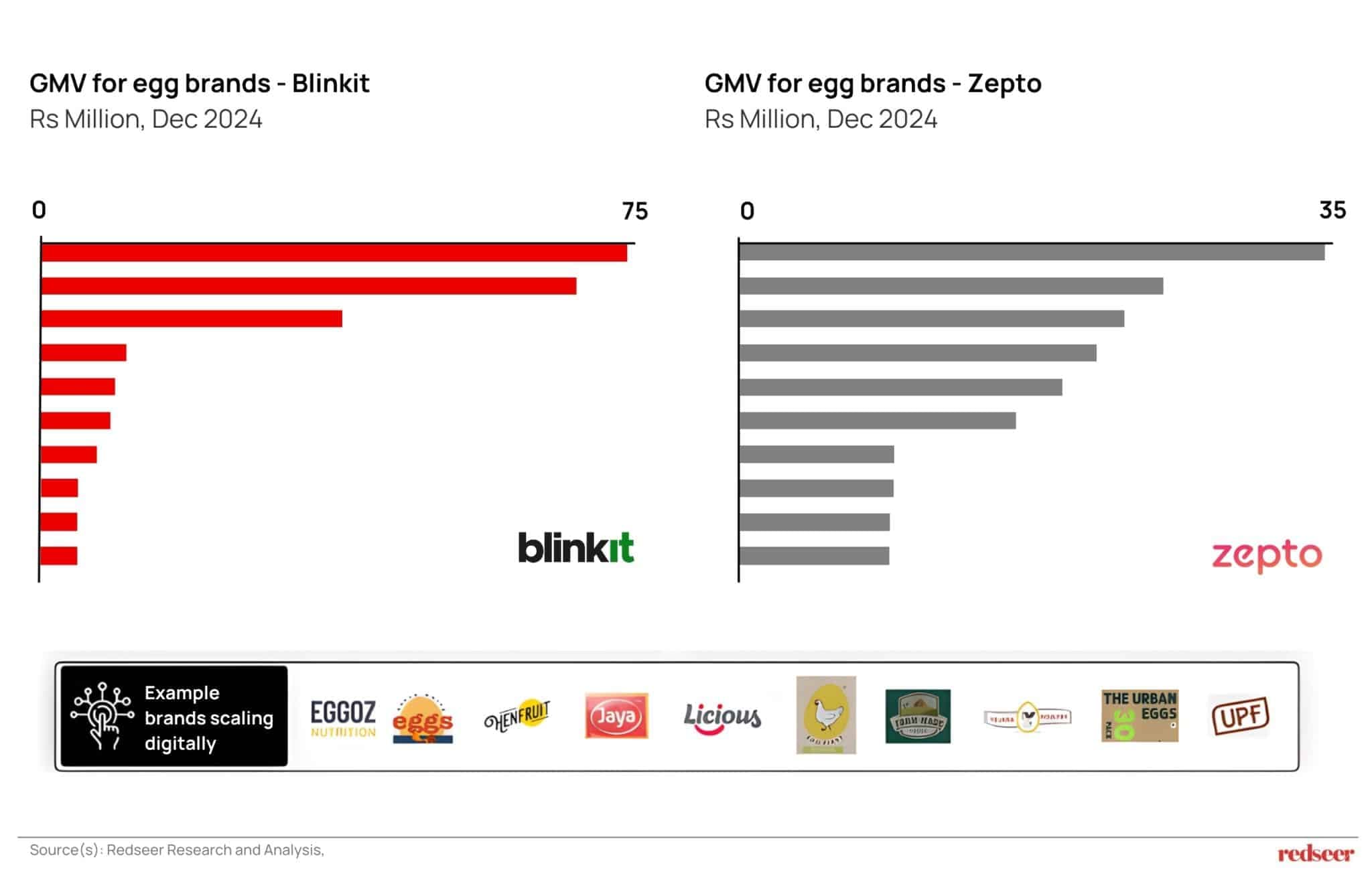
This represents extraordinary velocity for what was, until recently, a commodity category.
The International Precedent: Profitability at Scale
The question for investors and operators evaluating protein opportunities is whether branded plays can achieve not just growth, but profitable scale. The US-based Cal-Maine Foods provides compelling evidence of the value players can unlock through integration.
Cal-Maine manages approximately 16% of the US layer hen flock, marketing around 1.15 billion dozen eggs annually with eggs representing 100% of revenue. Their integrated model spans feed mills, farming, and processing, with a balanced portfolio of conventional and specialty eggs. Their distribution focuses on B2B partnerships, with 49% of revenue from top retail partners including Walmart, Sam’s Club, and Publix.
This approach delivered revenue growth from $1.4 billion in 2020 to $2.3 billion in 2024 (15% CAGR), while EBITDA margins expanded from 6% to 19%. These economics, achieved in a single protein category, validate several principles transferrable to the Indian context:
- Vertical integration enables quality risk management, while improving unit economics
- Specialty/premium positioning commands meaningful price realisation beyond the commodity baseline
- B2B distribution partnerships provide volume and predictability
The Indian context differs in scale, fragmentation, and infrastructure maturity, but the fundamental lesson holds. Protein categories can support scaled, highly profitable branded businesses when execution combines supply chain control, channel strategy, and premium positioning.
Strategic Framework: Building Beyond the Egg Analogy
For decision-makers evaluating opportunities across protein-rich convenient foods, the egg category’s trajectory offers four strategic principles:
1. Leverage quick commerce as brand-building infrastructure, not just distribution. The 20% quick commerce penetration for batters versus sub-2% for typical grocery demonstrates how categories aligned with platform economics can scale rapidly. Protein products with short shelf life, frequent purchase occasions, and quality sensitivity fit this model, as quick commerce solves cold chain and freshness challenges while building premium brand positioning.
2. Design for B2B scale while building consumer brand equity. Cal-Maine’s 49% concentration with the region’s top three retailers shows that profitability flows from distribution partnerships. Indian brands should use quick commerce for rapid consumer validation and premium positioning, then leverage that equity for offline retail partnerships that deliver volume economics.
3. Integrate selectively around quality control points, not comprehensively. Full vertical integration may not be viable initially, but controlling critical touchpoints like feed quality, cold chain and processing standards creates defensible moats. This applies to any protein category where consistent quality determines brand trust.
4. Resist premature category expansion. Cal-Maine’s success with 100% egg revenue demonstrates that category depth creates more value than breadth in protein spaces. Master supply chain, distribution, and branding in one protein segment before pursuing adjacencies.
The Bottom Line
The egg category’s transformation demonstrates that protein categories can support rapid brand-building and profitable scaling.
For investors and operators, the opportunity lies in building the next generation of convenient foods around inherently healthy, protein-rich categories where convenience enhances, rather than compromises nutritional value.
Quick commerce platforms have solved the distribution and cold chain challenges that historically stalled the growth of fresh protein categories. Consumers are willing to pay a premium for quality and health. International precedents demonstrate profitability at scale. The market is ripe for capture by players who can execute the strategy the fastest, within this blink-and-miss window of opportunity.

Written by
Mrigank Gutgutia
Partner
Mrigank leads business research and strategy engagements for leading internet sector corporates at Redseer Strategy Consultants. He has developed multiple thought papers and is regularly quoted in media and industry circles.
Talk to me

Gen Z: Defining Trends, Influencing Spends

Dark Stores Can Be Profitable. GCC Is Where It Happens First.

India’s Gated Communities: Gateway to $900 Bn Consumption Unlock

Beauty & Personal Care in Quick Commerce: From Convenience to Everyday Relevance


