
SEA Eyewear: Clear Vision For A ~USD 11 Bn Market
 Roshan Behera
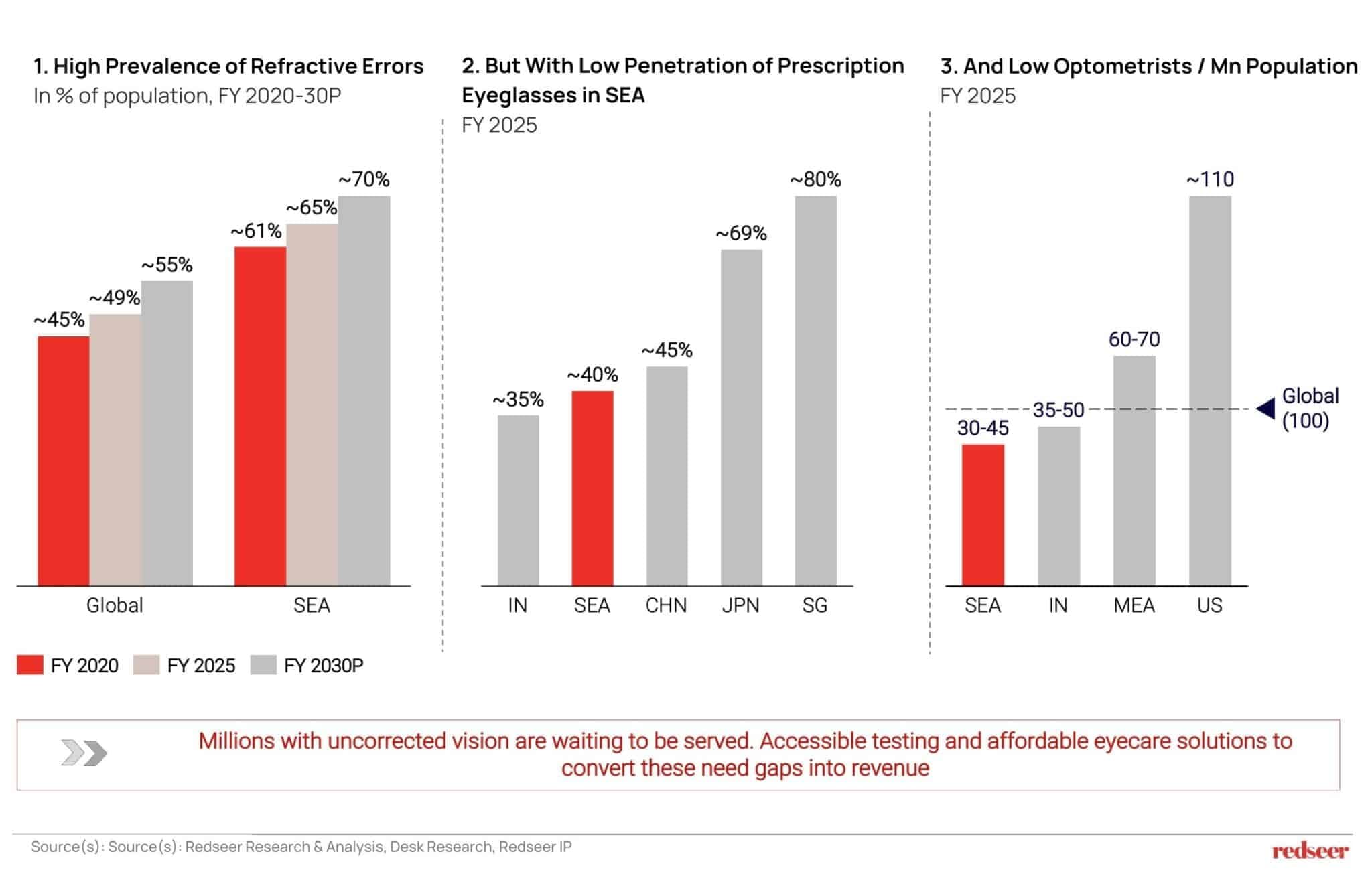
Southeast Asia’s eyewear market is a large, fast-growing, and structurally underserved opportunity. ~65% of the population requires vision correction, yet only ~40% wear prescription eyeglasses today, leaving a significant unmet need.
Want to evaluate new investment and M&A opportunities?
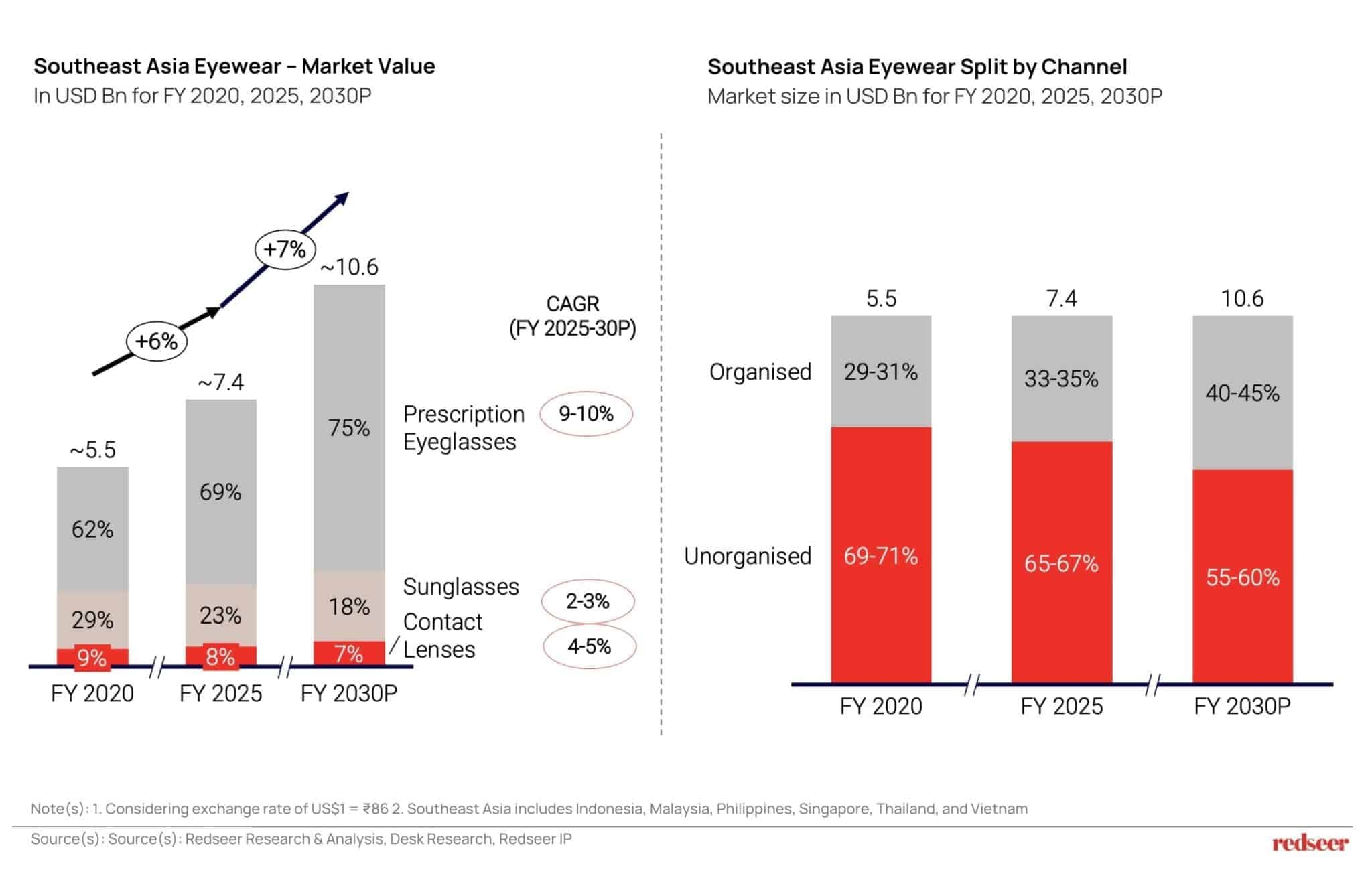
This gap, combined with strong GDP growth, rising discretionary spend, and rapid digital adoption, is expected to expand the eyewear market from ~USD 7.4 billion in 2025 to ~USD 10.6 billion by 2030.
Organized, tech-enabled players are best positioned to capture this shift as the market formalizes and trades up.
Globally, vertically integrated models have demonstrated powerful advantages in cost, speed, and product tailoring, but full-stack integration requires substantial capital and capabilities.
For most Southeast Asian players, a more pragmatic path is selective verticalization, i.e., using technology, partnerships, and targeted integration points to unlock value without overextending capital.
Southeast Asia’s eyewear market remains untapped, constrained by low consumer awareness and significant supply-side gaps
Southeast Asia faces an acute vision correction gap, with 65% of the region affected by refractive errors, creating a vast but critically underserved market.
Rising digital penetration is transforming consumer behavior, driving product discovery, shaping brand preferences, and accelerating purchase frequency, particularly in lifestyle eyewear categories. Yet most consumers maintain a reactive mindset, seeking vision care only when eyesight deteriorates significantly.
Limited retail infrastructure compounds the challenge: Southeast Asia lacks sufficient optical stores and qualified optometrists to meet demand.
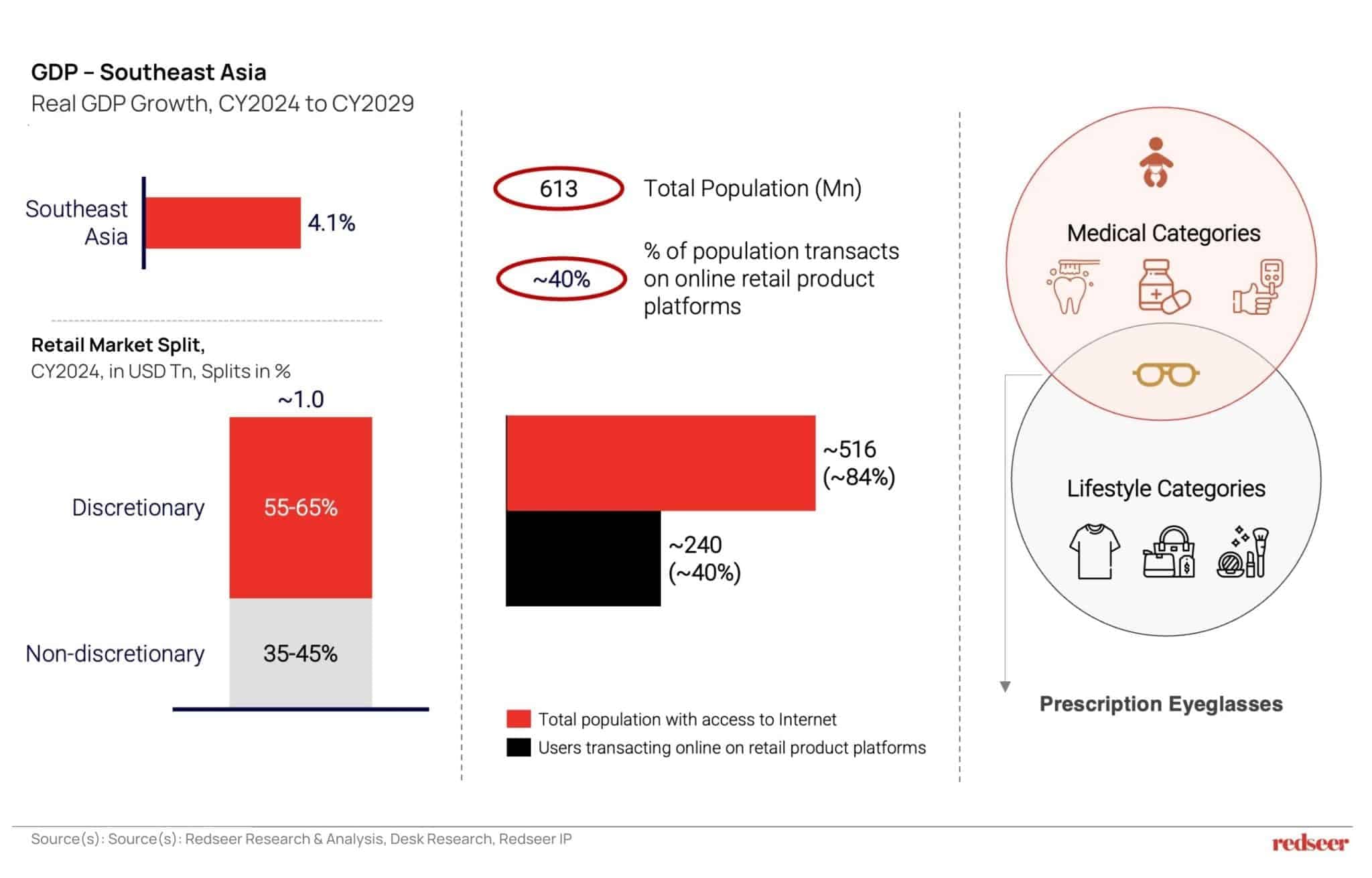
Rising disposable income and digitalization are transforming prescription eyewear from a medical necessity into a high-growth lifestyle category
Southeast Asia enjoys a comfortable 4%+ GDP growth with 600M+ population and high discretionary spend.
Digital penetration is massive:
- Nearly everyone is online, and about half already shop retail digitally.
- Rising affordability and awareness create strong demand for accessible, stylish product options.
- This shifts prescription glasses from the pure medical to lifestyle category, blending healthcare and fashion.
Net: the category is set to formalize and trade up fast.
Market tailwinds will drive a USD 10.6B opportunity by 2030, with organized retail growing 2-3x faster than unorganized channels
Driven by penetration-led expansion across Indonesia, Vietnam, Malaysia, the Philippines, and Thailand, alongside Singapore’s growing organized retail sector, the SEA eyewear market is expected to be worth USD 10.6 Bn by 2030. This growth stems from the rising prevalence of refractive errors, with myopia being the most common.
Increased adoption and usage frequency are driving steady volume growth in both sunglasses and contact lenses. Organized retail is gaining rapid traction, with its market share projected to grow 2-3x faster than unorganized channels during this period.
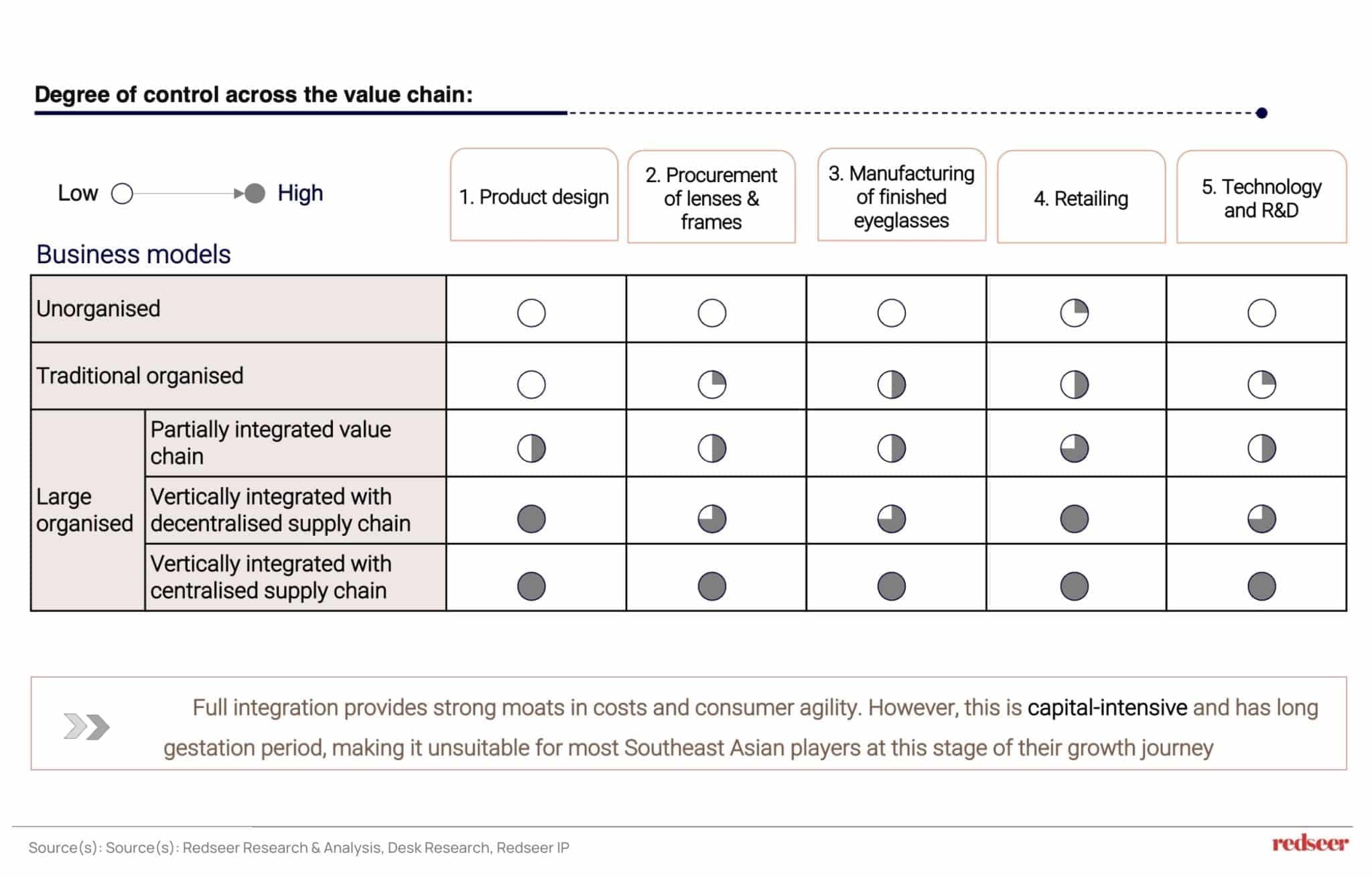
While full-stack vertically-integrated business models offer strategic moats, it is difficult to replicate for sub-scale Southeast Asian peers…
Vertical integration is the “gold standard” business model for eyewear today. The payoff is a significant cost advantage over traditional retailers. Integration helps to control the design, the quality, and the delivery timeline.
However, it requires upfront investments in manufacturing plants, lens production tech, and strategic acquisitions to control the supply chain and in-house R&D. The relatively smaller-sized Southeast Asian players cannot reap the benefits of scale economies at this stage of growth.
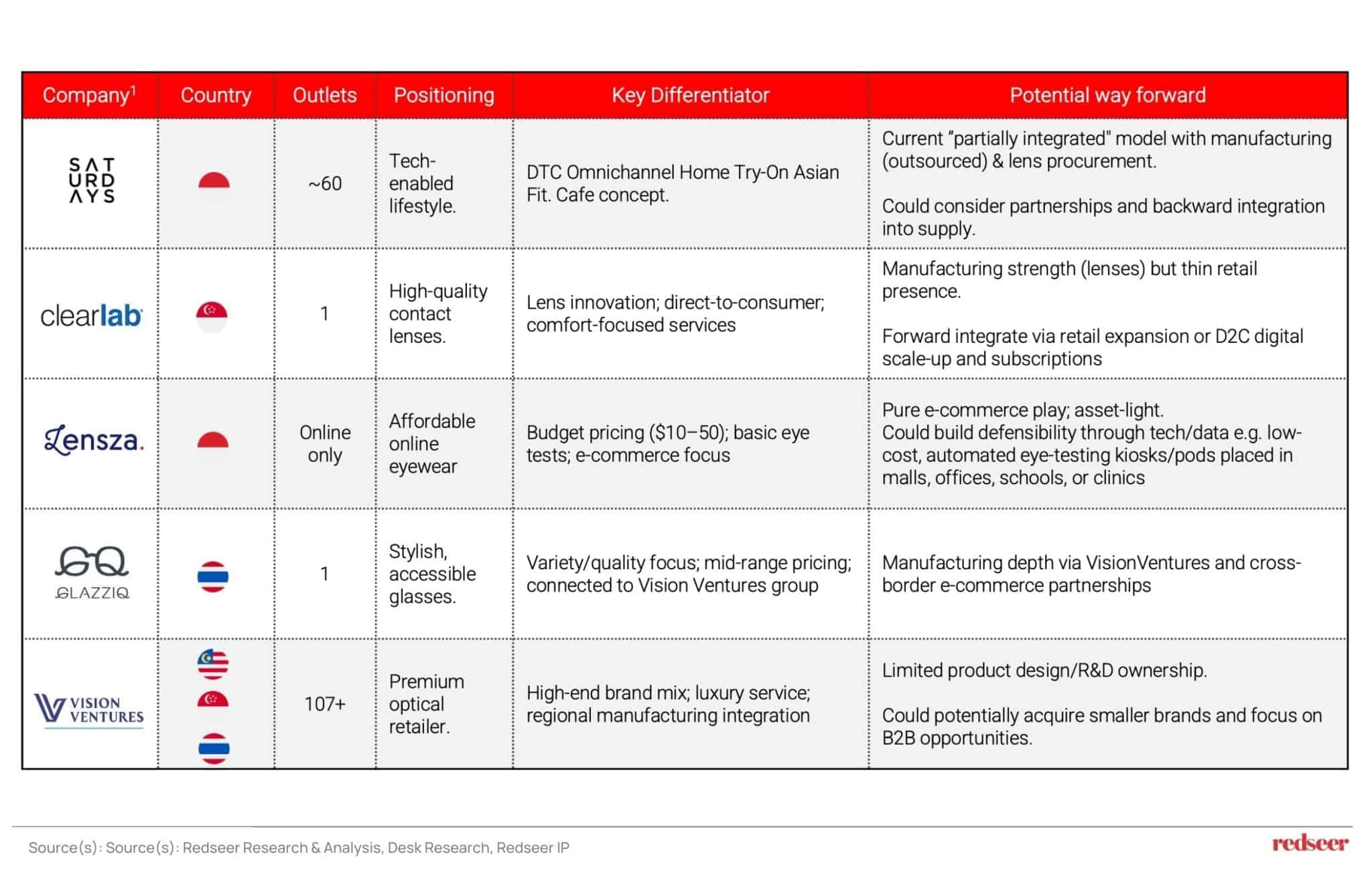
…winning in the region requires a hybrid model: select verticalization along with strategic partnerships and tech-enabled distribution
Select verticalization can drive differentiation in areas such as eye-testing protocols, vision data capture, and prescription accuracy.
As diagnostic data compounds, it improves retention, reduces remakes and returns, and supports subscription models such as children’s myopia monitoring and corporate eye-care programs.
Partial backward integration into specialized lens production, like comfort-focused contact lenses, advanced materials, or custom lenses, can unlock higher-margin, recurring revenue without full-scale manufacturing ownership.
The optimal path varies by player: asset-light players should build technology moats and partnerships; manufacturing-led players can expand forward into retail and services; large incumbents should invest in design, data, and acquisitions to counter disruptors.

Written by
Roshan Behera
Partner
Roshan is a Partner based in Singapore and focuses on Southeast Asia. His sector coverage includes e-commerce, logistics, fintech, eB2B, on-demand services, and other emerging sectors.
Talk to me