
SEA’s USD 123 Bn Remittance Market: Fragmented Landscape, Focused Winners
 Roshan Behera
Southeast Asia’s USD 123 Bn remittance market is undergoing rapid change. Digital players are growing faster than the overall market, driving down fees and shifting competition toward superior user experience, i.e., intuitive apps, transparent pricing, stronger fraud protection, and broader payout options.
At the same time, profit pools are moving beyond person-to-person (P2P) transfers. Growth is increasingly concentrated in small-business payments, and financial “plumbing” such as API1s and payment infrastructure that other companies can build on.
To win in Southeast Asia, companies need a corridor-led strategy, tailored to specific country pairs such as between Singapore and the Philippines. Continued success requires expanding beyond remittances into FX2, and business transaction systems, as is being demonstrated by some of the leading players in the region.
Note(s): 1) API means Application Programming Interface, 2) FX means Foreign Exchange.
Southeast Asia’s USD 123 Bn remittance market is digitizing fast
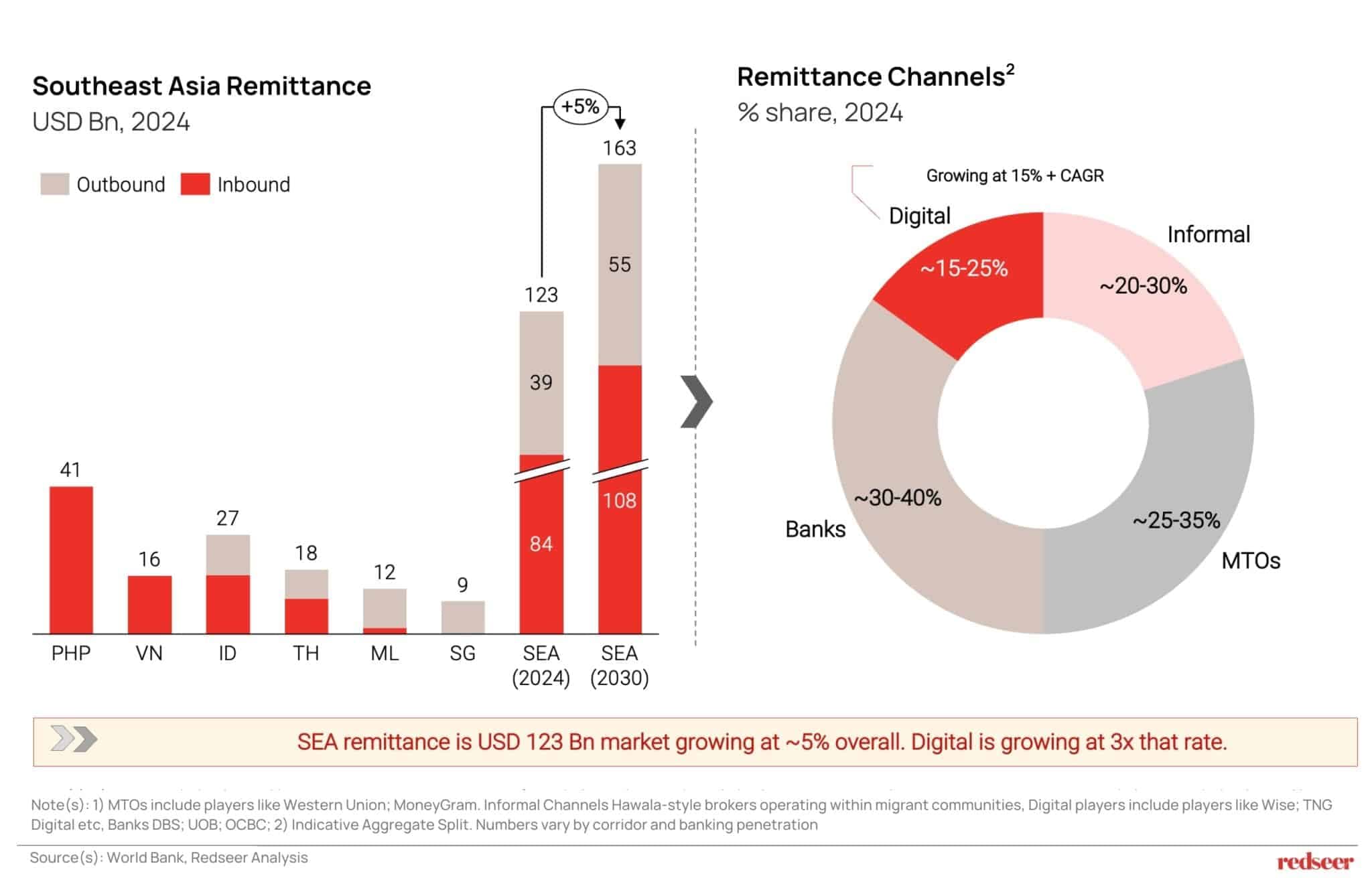
The USD 123 Bn remittance market is dominated by inbound remittances (68% of total), and is led by the Philippines, 33% of total. Banks and Money Transfer Operators (MTOs) dominate the scene with 55-75% of the market.
A sizable chunk, ~20-30%, gets routed via “informal1” channels due to gaps in the onboarding process, elements of trust, and last-mile coverage.
Digital remittance, ~15-25% of the total, is the fastest-growing channel.
Three market types need three different playbooks
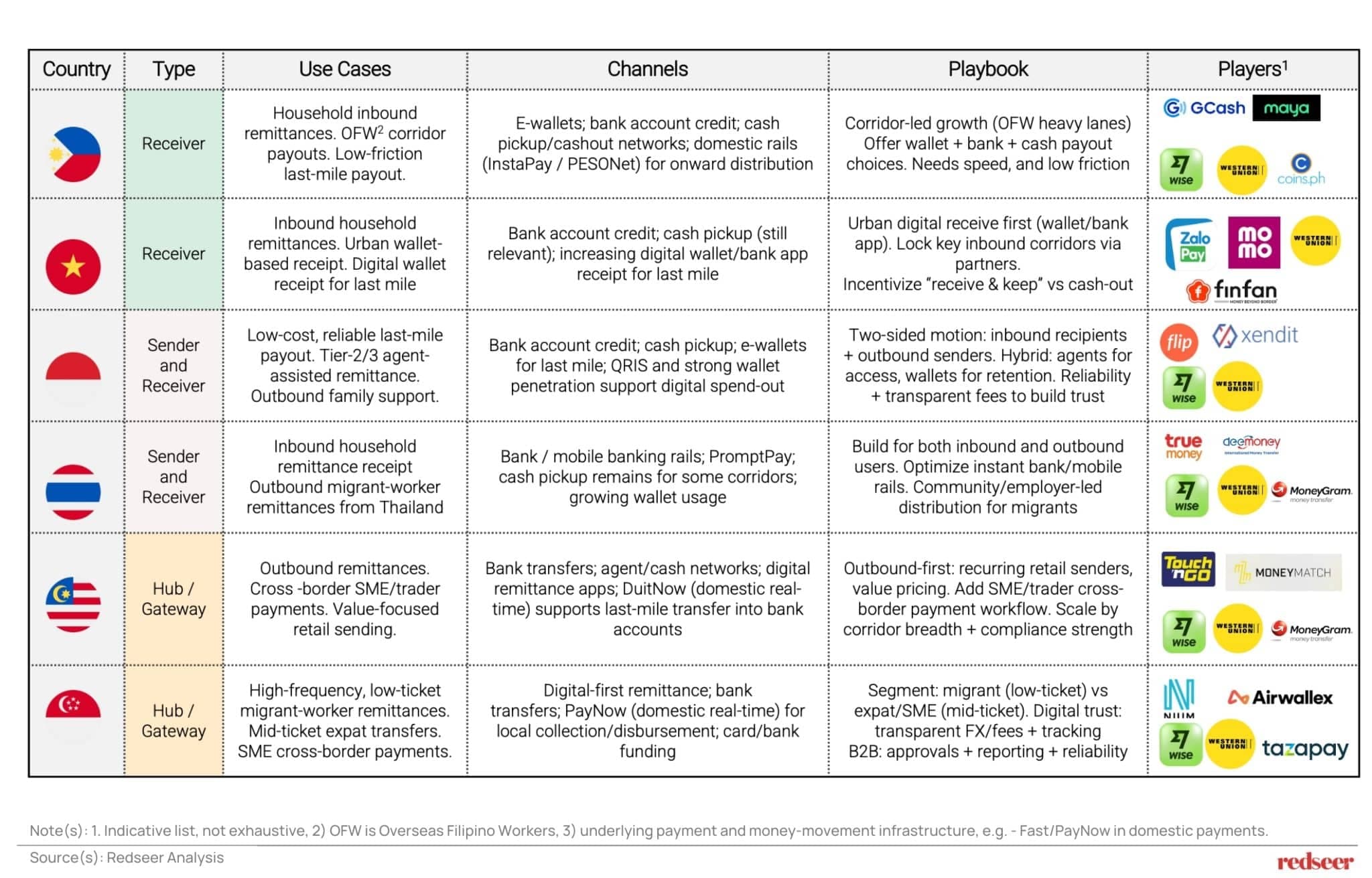
Southeast Asia can be grouped into three remittance market archetypes, each requiring a distinct strategy to win.
Receiver markets such as the Philippines and Vietnam are primarily inbound-led. Success depends on building deep payout density, offering flexible cash-out and wallet options, and driving recipient engagement through adjacent services like bill payments, savings, and lending.
Two-way markets such as Indonesia and Thailand combine meaningful inbound and outbound flows. Winning players focus on compliance-led customer acquisition, partnerships with employers and distribution channels, and a strong value proposition on price, speed, and FX transparency.
Regional hubs such as Malaysia and Singapore play a different role. Here, competitive advantage is built on infrastructure, i.e., robust licensing, treasury and liquidity management, scalable rails3, and partnerships that enable regional expansion.
Profit pools are migrating from crowded Consumer P2P to higher-margin cross-border plays
Want to get strategic guidance?
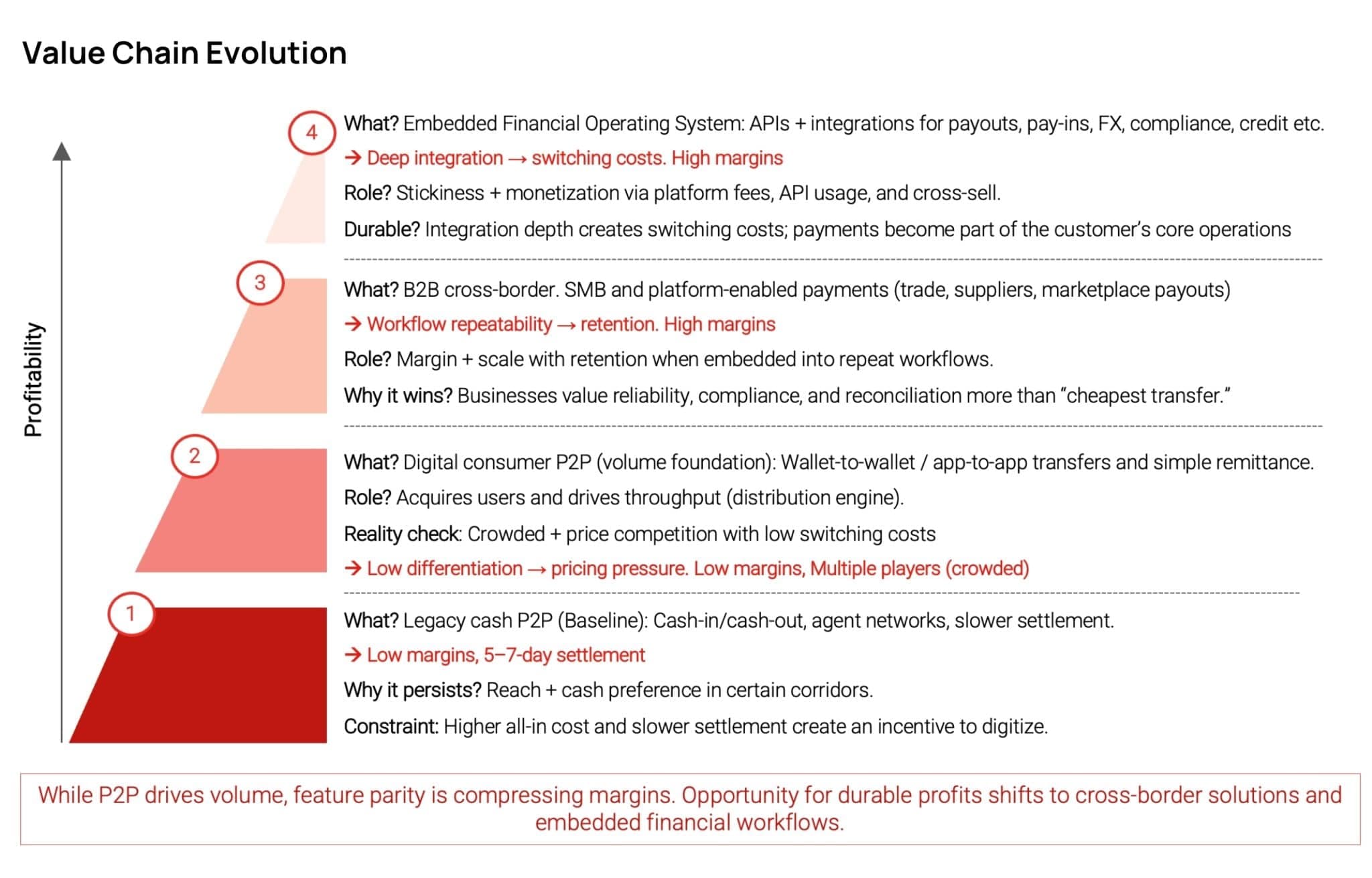
Profit is shifting from P2P payments to small-business payments, where trust, reliable cash-out, and strength in key routes matter.
Companies are now making more profits from tools that other businesses can use (like payment processing, currency exchange, digital wallets, and compliance checks), as well as from business credit card programs that attract new customers.
Global winners show the pattern: win a bottleneck, then compound
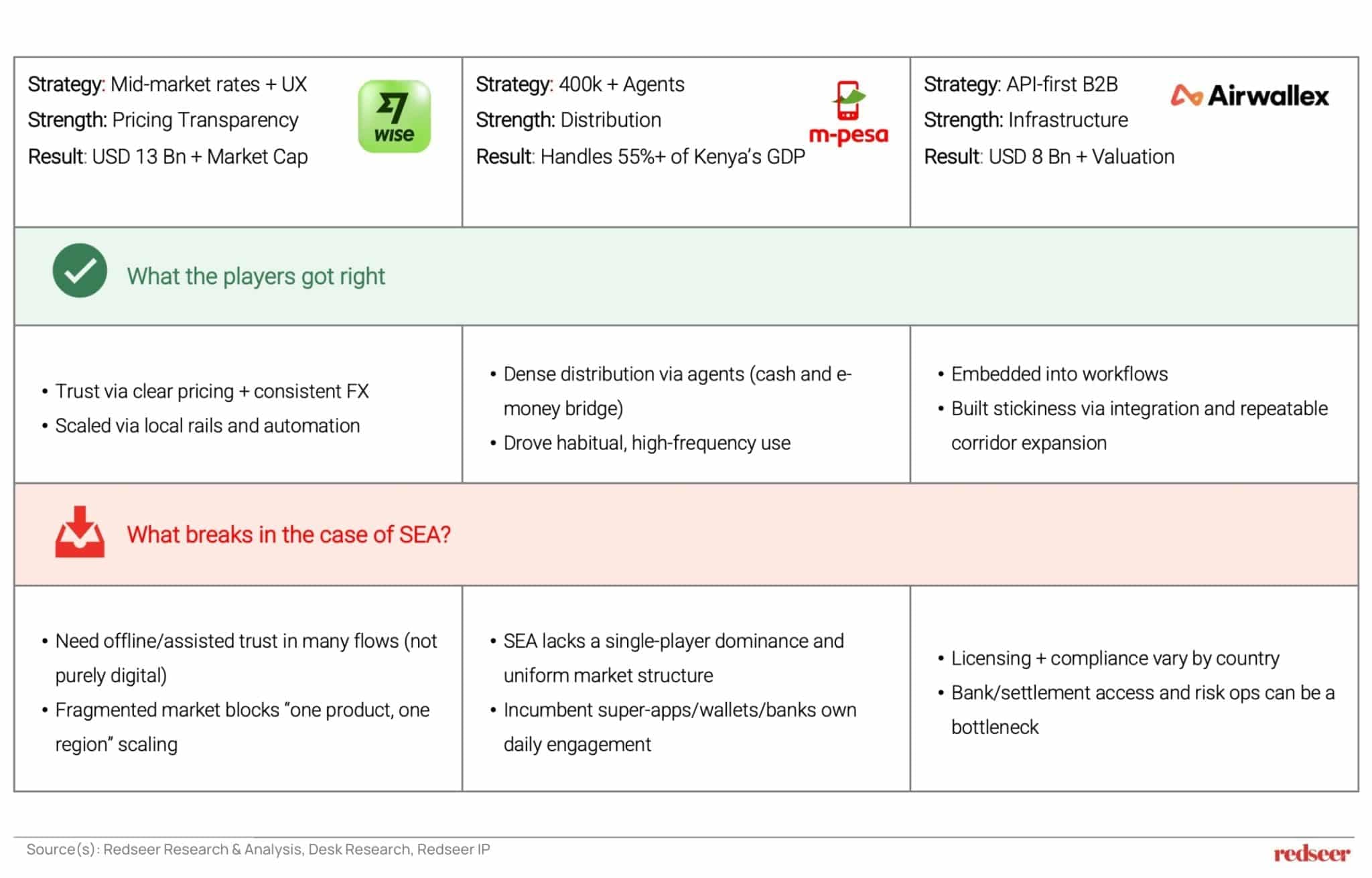
Global fintech winners scaled by solving structural bottlenecks before scaling up.
Wise grew cross-border payments via fee transparency and direct rails, lowering effective fee margin with high volumes, while reinvesting profits to support growth.
M‑Pesa won by making distribution of the product, i.e., dense agent networks that drove mass adoption.
Airwallex built an advantage through global financial infrastructure (licenses, multi-currency accounts, APIs), supporting premium valuations but depending on regulatory harmonization.
In Southeast Asia, these models must be tweaked due to fragmented licensing, cash preference, KYC complexity, data-localization rules, and informal trust networks that make distribution and compliance as critical as pricing or tech.
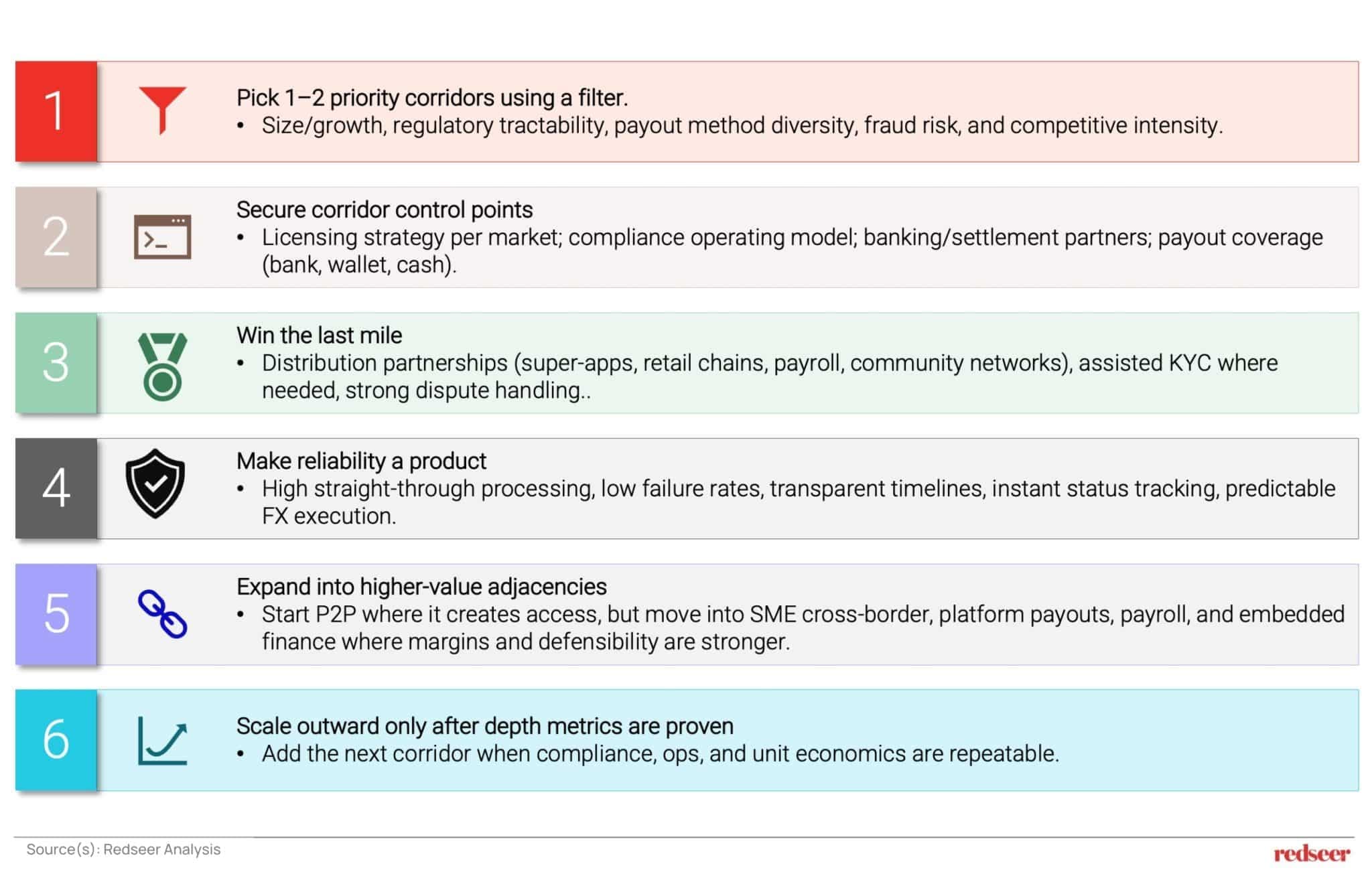
How to win in SEA? corridor-first execution, not regional expansion
In Southeast Asia, the strongest remittance businesses often start by focusing on a few high-traffic country pairs. They win by combining easy ways for customers to send money with dependable ways for recipients to get paid, i.e., through bank accounts, wallets, or cash pickup, and by managing cash and currency well enough to offer consistent, transparent prices.
They usually begin with one clear entry point, such as a single distribution partner, one payout network, or a business payouts/disbursements product, and then expand from there.
Several Southeast Asia–origin companies, like Nium, Thunes, 2C2P, Xendit, and Tazapay, are building different parts of the cross-border payments ecosystem. Their business models are likely to be closely watched as they scale up profitably.

Written by
Roshan Behera
Partner
Roshan is a Partner based in Singapore and focuses on Southeast Asia. His sector coverage includes e-commerce, logistics, fintech, eB2B, on-demand services, and other emerging sectors.
Talk to me

Viet-Nomics: Southeast Asias Rising Economic Star

USD 30 Bn Market in Motion: New Revenue Models Shaping Mobility & Delivery in SEA

SEA POS: Monetizing beyond the USD 680 Bn opportunity at checkout

Enabling Pine Labs’ high-impact growth decisions