UAE property market is entering a pause, not a panic
 Sandeep Ganediwalla
The UAE consumer has navigated uncertainty before. But not all shocks land the same way.
Most external disruptions hit one part of the economy first. The 2008 financial crisis moved through jobs and credit. A pandemic reshapes mobility and channel behaviour. The Iran conflict is doing something more simultaneously: it is affecting sentiment, household finances and forward-looking decisions at the same time.
Property is where this is showing up most clearly.
A home purchase in the UAE is not just a financial decision. For many residents, especially expats, it is also a sign of confidence in staying, investing and planning for the future. That is why the early signal from the market is important.
Sentiment has shifted; commitment to the UAE is holding
Residents are concerned. Nearly five in ten UAE residents rate mentioned they are highly concerned about the war’s impact on daily life. Eid was an early sign of this pressure, with 50% of residents saying they spent less than last year due to the conflict.
The top concern is not geopolitics or military escalation; it is food price inflation, cited by 51% of residents. Job loss risk follows at 46%, and personal and family safety at 39%. This is now a cost-of-living story as much as it is a security story.
At the same time, most residents still seem to view this as a short disruption rather than a long reset. 54% expect the situation to be resolved within 4 weeks to 2 months, and nearly 80% say they intend to stay in the UAE or haven’t taken any decision yet.
Trust in UAE institutions is also holding up well. 67% of residents say their trust in the UAE government has increased since the war began. This indicates that sentiment has been impacted, but without leading to a broader loss of confidence in the country itself.
The intent to stay is firm, but the ability to absorb rising costs is under pressure
Consumer finances are under real and perceived pressure. Food and grocery bills have risen for nearly 8 in 10 residents in the past three to four weeks. Fuel costs have moved similarly, with 67% reporting an increase. These are not only macro abstractions playing out but can be felt at the checkout counter and the petrol station, every day.
The spending response has been swift and decisive. 65% of households have shifted into defensive spend mode, either concentrating spending on essentials only or actively stockpiling.
What makes this more than a short-term squeeze is the fragility sitting underneath it. More than half of UAE residents couldn’t sustain their current lifestyle for more than six months if they lost their primary income today. The financial cushion, for most households, is thinner than it looks.
Residents are aware of this and are acting on it. 45% have increased their emergency savings since the war began. 37% have reduced credit card spending. 33% have withdrawn cash from banks. 30% have deferred large purchase decisions.
That is a meaningful constraint on big-ticket, long-horizon decisions. This is the bigger issue for property.
That financial caution is now showing up in the property market too
Real estate is uniquely war-sensitive in the UAE, because for most expats a property decision is also a commitment to the country itself.
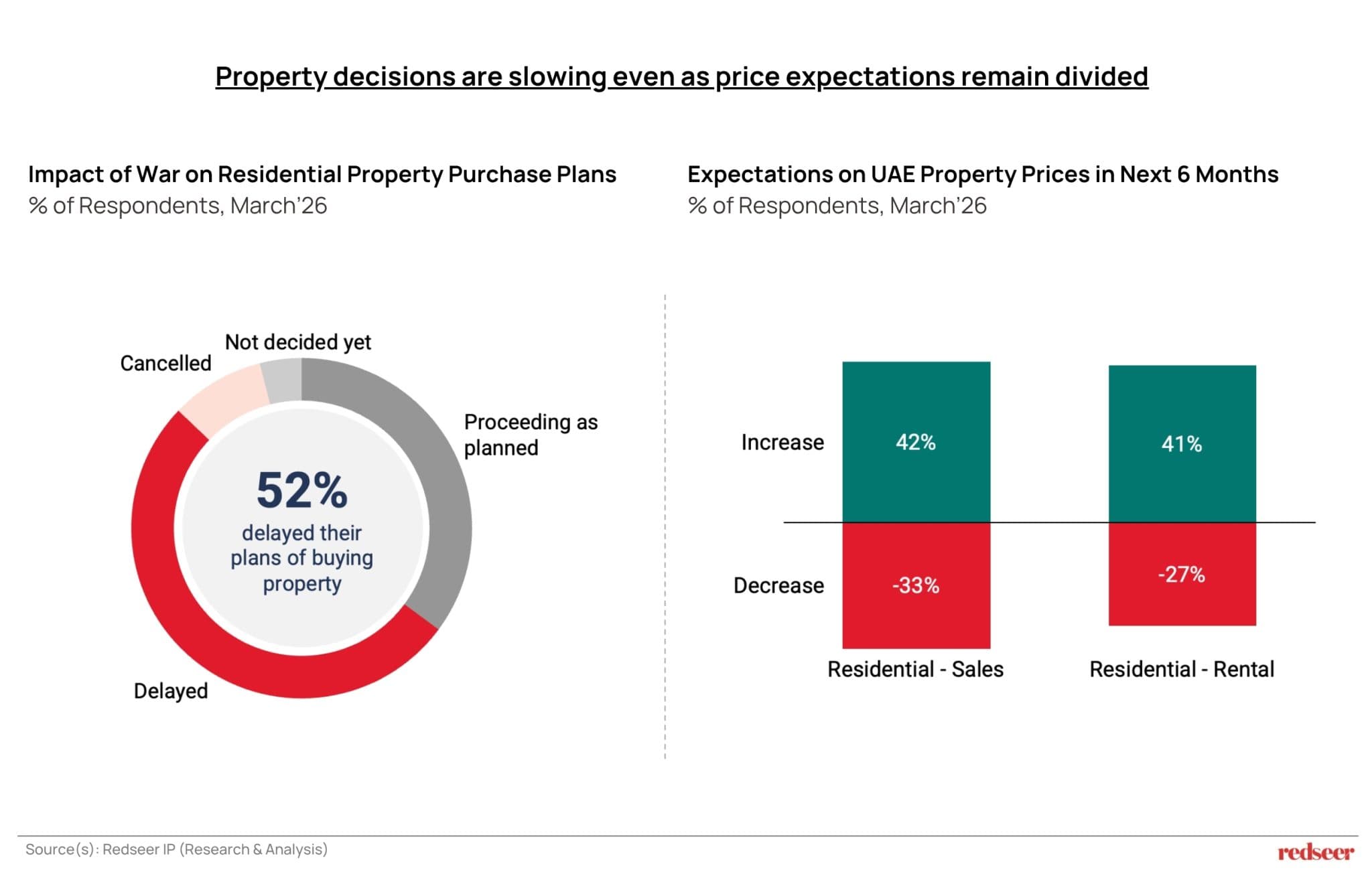
Before the war, 39% of respondents had active property buying plans in the UAE. The war has reshuffled those intentions dramatically. Of those with plans, 52% have now delayed until the situation stabilises, and 9% have cancelled outright.
Importantly, this is still not a clean price-correction story. Expectations remain split. On residential sales prices, 42% expect an increase, versus 33% who expect a decrease. On rentals, 41% expect an increase versus 27% who expect a decrease. In other words, buyers are hesitating before prices are clearly repriced.
Looking beyond the immediate crisis, for property developers and agents, the recovery may not be uniform: the ‘wait and see’ majority will likely return within 3–6 months of stabilisation.
Overall
The current situation has affected sentiment, household finances and property decisions at the same time. But the picture is still more balanced than bearish.
Residents are concerned, and buyers are clearly more cautious. But trust in the UAE system remains strong, many expect the disruption to be short-lived, and price expectations are still divided rather than decisively negative. That suggests the first impact on property is likely to be slower decision-making and weaker transaction momentum, not necessarily a sharp repricing.
For now, the UAE property market looks like it is pausing, not turning. If the disruption remains short, a meaningful part of this delayed demand can still return once confidence stabilises.

Written by
Sandeep Ganediwalla
Partner
Sandeep is the Partner with 20+ years of experience in consulting and technology. He has expertise in multiple sectors including ecommerce, technology, telecom and private equity.
Talk to me