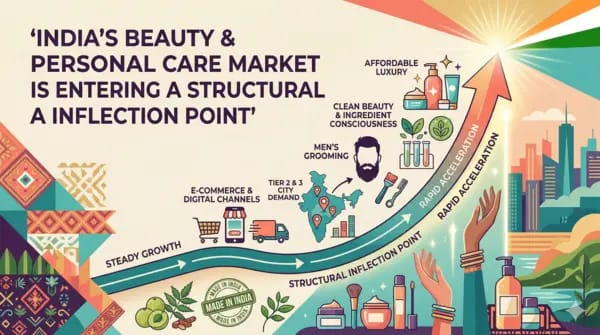
India’s Beauty & Personal Care Market Is Entering a Structural Inflection Point
India’s beauty & personal care market in India is projected to reach $40 billion by 2030, making it the fourth-largest BPC market globally.
But scale alone isn’t the story. What makes this phase different is how growth is redistributing across:
- Digital channels
- Masstige positioning
- Ingredient-led formats
- Younger consumer cohorts
For brands, platforms, and investors, this is no longer a demand expansion story. It is a profit pool reallocation story.
And this is where strategy consulting firms in India increasingly focus, identifying where growth will compound, not just where it is visible.
From FMCG-Led to Portfolio-Fragmented Growth
Historically, India’s BPC market was dominated by large FMCG conglomerates. Even today, only around 20 brands exceed ₹1,500 crore in revenue.
But that structure is shifting.
Digital marketplaces and quick commerce have reduced geographic constraints. Influencer ecosystems have normalised routine-based consumption. Ingredient transparency and dermatologist-backed positioning are increasingly influencing purchase decisions across the BPC category.
As highlighted in Redseer’s report on India’s $40Bn Beauty & Personal Care Market, the next wave of scale will not come from blanket expansion. It will come from category-level precision.
For investors and FMCG & BPC brands, this creates a new mandate: Which sub-categories deserve disproportionate capital?
The Masstige Pivot: Where Margins Expand
One of the clearest structural shifts in BPC is the rise of masstige, products priced between mass and premium, typically in the INR 1.5-6/ml range.
In categories like body lotion, masstige brands are projected to drive over 30% of the online opportunity by 2030.
This shift reflects three reinforcing forces:
- Consumers seeking dermatologist-backed formulations
- Movement toward functional, ingredient-centric products
- Ethical positioning (vegan, paraben-free, cruelty-free) entering mainstream preference
As detailed in Redseer’s analysis of The Body Lotion Opportunity in Indian E-Commerce, online channels are expected to command over half of total body lotion purchases by 2030.
For investors and FMCG & BPC brands, the implication is clear: growth concentration is expected where digital discovery intersects with differentiated positioning.
Digital Is Not Just a Channel, It Is a Profit Architecture
India’s BPC growth is increasingly digital-first. Online marketplaces and quick commerce have:
- Lowered entry barriers for new brands
- Enabled targeted SKU experimentation
- Accelerated routine education via content
- Compressed time-to-scale
But digital growth is uneven. Categories that require education, ingredient trust, and routine formation tend to scale faster online. Body lotions, serums, and dermatologist-backed formats fit this profile.
This reinforces a structural insight: Digital commerce is reshaping discovery and scaling patterns in select categories.
For business strategy consulting firms in India advising investors in the space, capital allocation decisions must follow category behaviour, not channel hype.
Gen Z and Alpha: The Demand Multiplier
India’s demographic dividend is reshaping BPC demand. Gen Z and Alpha consumers are emerging as the largest beauty spend cohort. Their expectations differ:
- Routine-based buying over impulse
- Ingredient literacy
- Brand authenticity
- Influencer validation
- Ethical transparency
This cohort is digitally native and digitally influenced.
Redseer’s broader BPC research suggests that brands unable to align assortment, communication, and pricing with these expectations risk stagnation, even if topline market growth remains strong.
For investors and FMCG & BPC brands, this changes portfolio design: Winning brands are not expanding SKU count. They are refining proposition clarity.
Strategic Implications for Brands and Investors
The beauty & personal care market in India is expanding toward $40Bn. But the structural questions are more nuanced:
- Where are sustainable margin pools forming?
- Which sub-categories justify disproportionate focus?
- How should digital and offline investments be sequenced?
- How does masstige positioning balance scale with profitability?
Redseer’s research across both the macro BPC market and sub-category analyses such as body lotion indicates that the future will favour:
- Digitally enabled discovery
- Ingredient-led differentiation
- Structured SKU architecture
- Platform-native growth models
This is where strategy consulting firms in India create tangible impact, by translating category shifts into executable corporate strategy.
The Structural Takeaway
As India’s BPC market grows, value creation is increasingly concentrated in specific categories, price tiers, and distribution channels. Macro growth toward $40Bn is visible. Digital channel acceleration is measurable. Masstige expansion is identifiable. But sustainable advantage will depend on:
- Category-level prioritisation
- Channel-profit alignment
- Cohort-specific positioning
- Capital discipline
For brands navigating this transition, partnering with experienced strategy consulting firms in India ensures growth decisions are rooted in structural clarity rather than momentum narratives.
Because in India’s beauty market, the scale will expand broadly. But profit pools will concentrate selectively.