KSA Food Delivery: What Comes Next After the Subsidy War


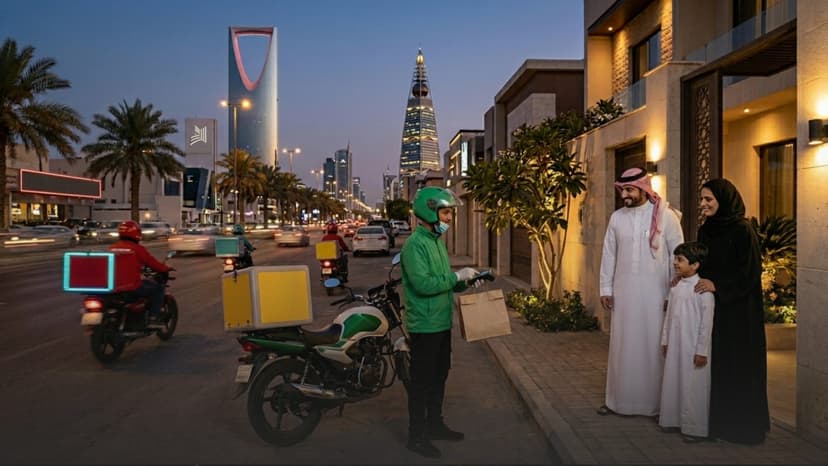
Saudi Arabia’s food delivery market has grown into a genuine digital infrastructure. With SAR 24 Bn in GBV in 2025, over 13 million yearly active users, and more than 100,000 active riders, it now accounts for nearly 20% of total foodservice spend and is growing at roughly three times the rate of non-oil GDP.
But the path here was not linear. The market has moved through three distinct phases, each with its own winners and its own costs. Understanding where it has been is the clearest way to understand where it is going.
1. Phase 1 (2022-24): A four-way win
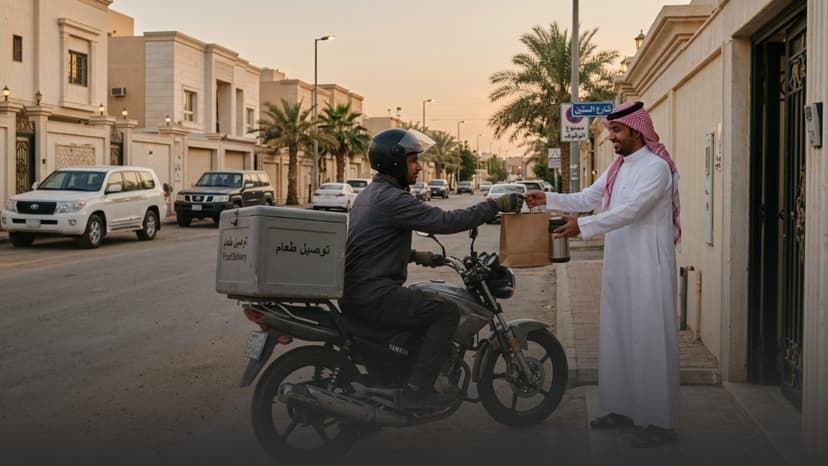
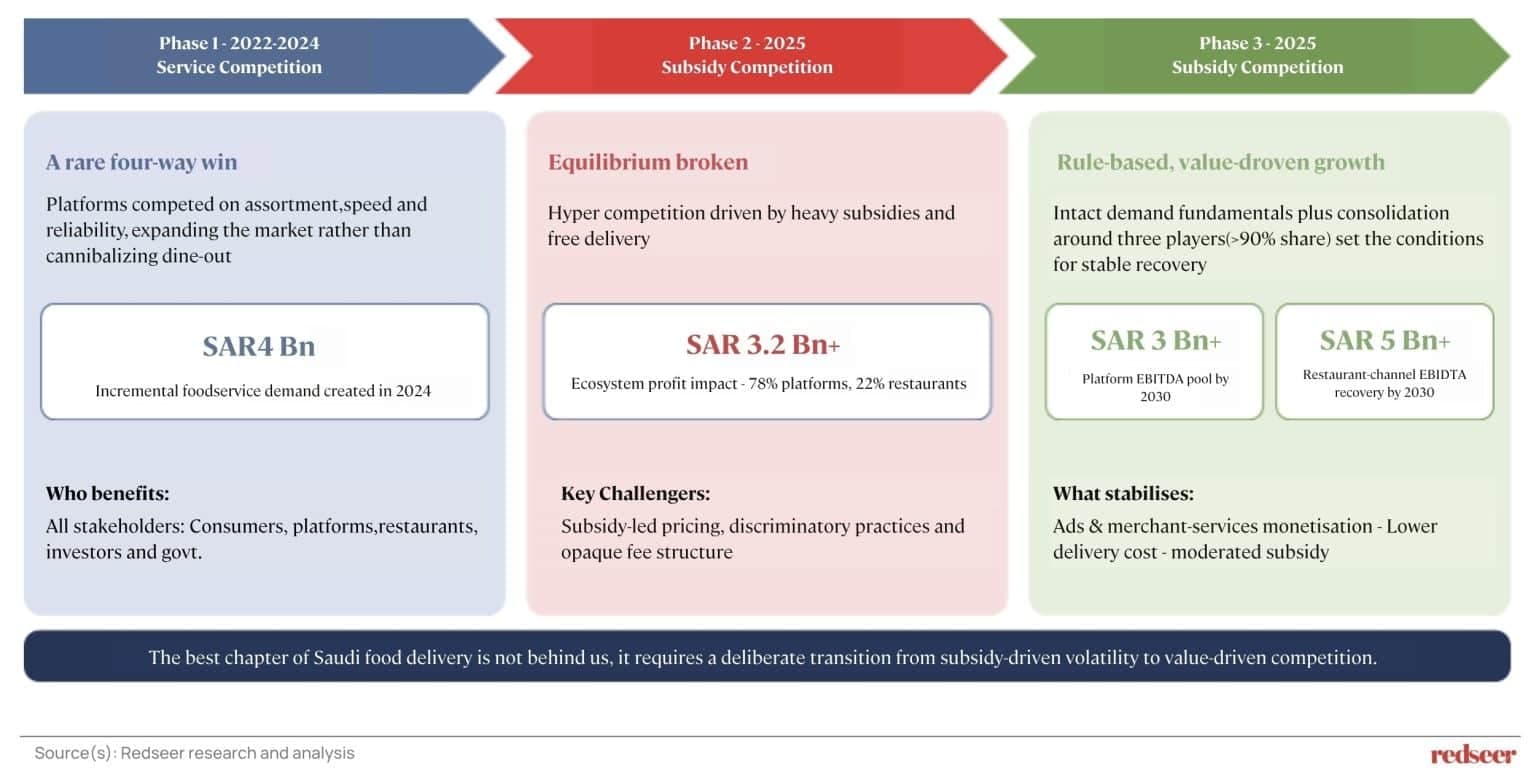
Between 2022 and 2024, food delivery in KSA worked for almost everyone. Consumers gained access to a wider range of restaurants and new ordering occasions. Restaurants, including thousands of independent operators, reached customers far beyond their physical locations. Riders gained one of the largest private-sector employment channels in the Kingdom. The government saw a fast-growing, taxable, digitally native sector aligned with Vision 2030.
We estimate that aggregators created SAR 4 Bn in incremental foodservice demand in 2024 alone, expanding the overall market rather than simply pulling spend away from dine-out. This was not a zero-sum story. It was a functioning ecosystem where each stakeholder had a reason to be in it.
2. Phase 2 (2025): When competition shifted from service to subsidies
2025 marked a clear inflection. The entry of a well-funded new competitor reset the basis of competition from service quality to promotional intensity. Discount intensity surged from 20% to 36% of GBV. Free delivery became the default. Consumers benefited in the short term, with effective order values falling and order frequency rising.
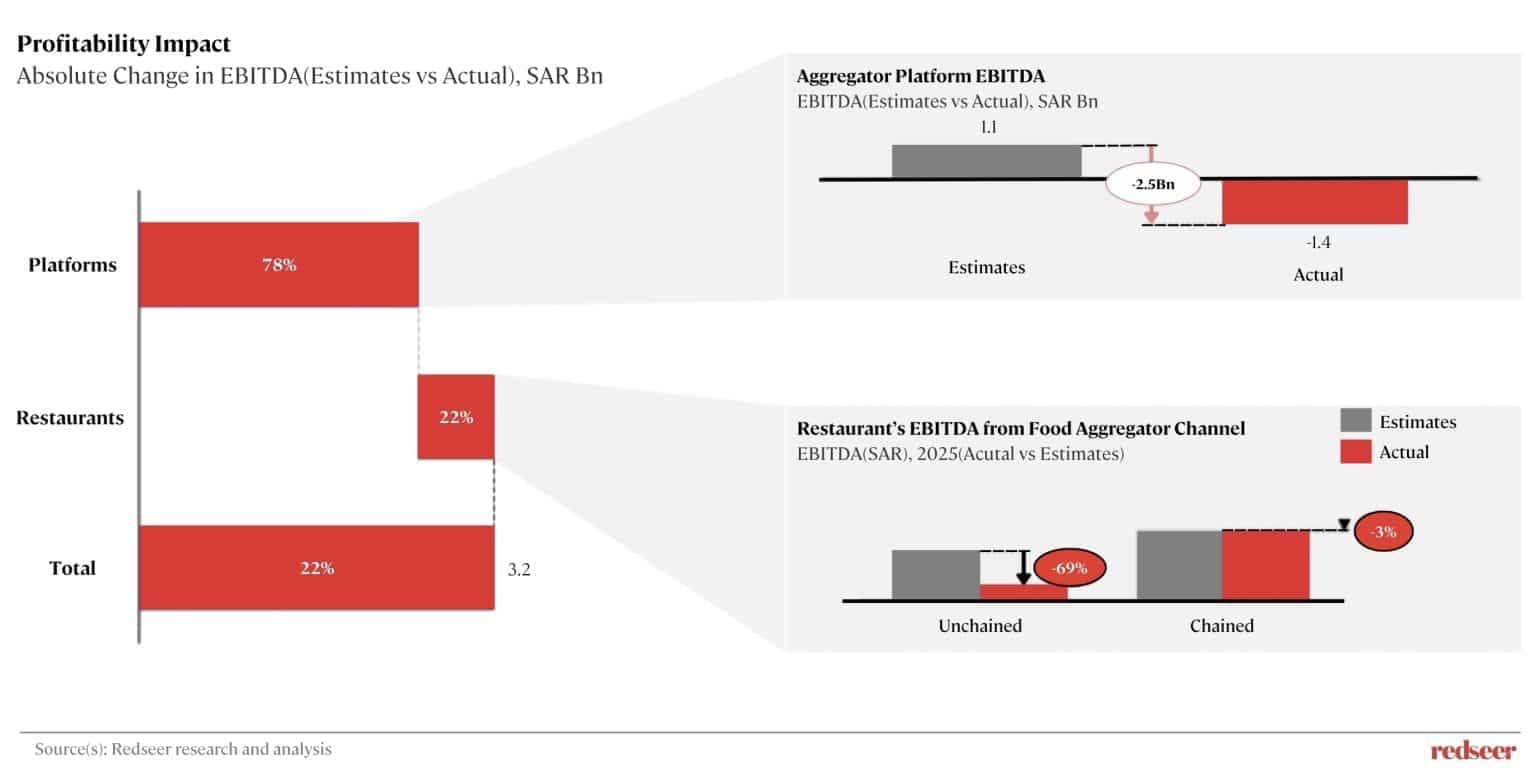
But the gains for consumers came at a cost distributed across the rest of the ecosystem. The industry EBITDA pool contracted by SAR 3.2 Bn of which roughly three-quarters was borne by aggregator platforms and the remainder by restaurants. SME restaurants, with limited negotiating power and high platform dependence, absorbed a disproportionate share of the pressure. One notable platform exited the market entirely. And investor sentiment weakened, with estimated market capitalisation erosion of SAR 8 Bn across listed and private players.
The value did not disappear. It redistributed, largely toward consumers and away from the platforms, restaurants, and investors that had built the ecosystem. That redistribution raised a straightforward question: how long could it hold?
3. Phase 3 (2026 onwards): Recharting the path
The conditions for recovery are already forming. The market has consolidated to three players holding over 90% share, consistent with how mature delivery markets look globally. The General Authority for Competition issued guidelines in March 2025 addressing subsidy-led pricing and exclusionary practices, a signal of market maturation rather than restriction. And structural demand drivers, lifestyle shifts, convenience expectations, digital adoption, remain intact independent of promotional intensity.
Our projections point to a platform EBITDA pool of SAR 3 Bn by 2030, with restaurant-channel EBITDA recovering by SAR 5 Bn over the same period, as commission economics rebalance and subsidy intensity moderates.
The best chapter of KSA food delivery is not behind it. But getting there requires the market to compete on value creation rather than subsidy depth. Phase 3 is that transition.
Written by



KSA Food Delivery: Free Delivery Isn’t Free

Brands Beyond the Shelf: MENA Consumer Brands’ New Growth Playbook
The Online Grocery Report 2026: The Five-Way Win and What Comes Next

Unlocking the Next Wave of MENA E-commerce Growth

KSA-Hyperlocals: Moving Towards Multi-Verticality

KSA food aggregators to deliver a million smiles

GCC Q-commerce: Expansion & Consolidation

36% Growth. Falling Profits. Compressed Valuations. What Changed in KSA Food Delivery in 2025?

Saudi Q-com Regulations: Ending the Subsidy Era?

KSA Food Aggregators Leap Ahead in Growth Journey

Keeta has gained ~10% market share in KSA— what’s next?

Omnichannel Owns a Big Slice of Online Retail in KSA
KSA Food Delivery: Free Delivery Isn’t Free
Brands Beyond the Shelf: MENA Consumer Brands’ New Growth Playbook
The Online Grocery Report 2026: The Five-Way Win and What Comes Next
Unlocking the Next Wave of MENA E-commerce Growth
KSA-Hyperlocals: Moving Towards Multi-Verticality
KSA food aggregators to deliver a million smiles