Habit or Desire – What’s driving India’s Beauty & Personal Care Market?


“Grooming is scaling through routine-led replenishment, while Makeup and Fragrance are finding growth through premiumisation, identity, and creator-led discovery.”
In India, the growth of beauty and personal care is being shaped by habit and self-expression.
The growth mix is changing
India’s online beauty and personal care market reached ₹56k Cr, growing at about 35% YoY.
The topline is strong. What is more telling is the story underneath it.
The market is now being shaped by two parallel engines.
- In Grooming, growth is coming from categories becoming part of daily or frequent routines.
- In Makeup and Fragrance, growth is being driven by premiumisation, self-expression, occasions, and creator-led experimentation.
Quick Commerce is making the routine-led shift more visible. Its share of overall online BPC increased from about 9% in FY25 to ~18% in FY26, while growing at over 120% FY26 YoY. Within Grooming specifically, quick commerce’s share grew from ~10% in FY25 to ~16% in FY26 – a shift that is most visible in routine-led categories like Body Care, Body Wash, and Sun Care, where repeat purchase behaviour is now being formed on quick commerce platforms.
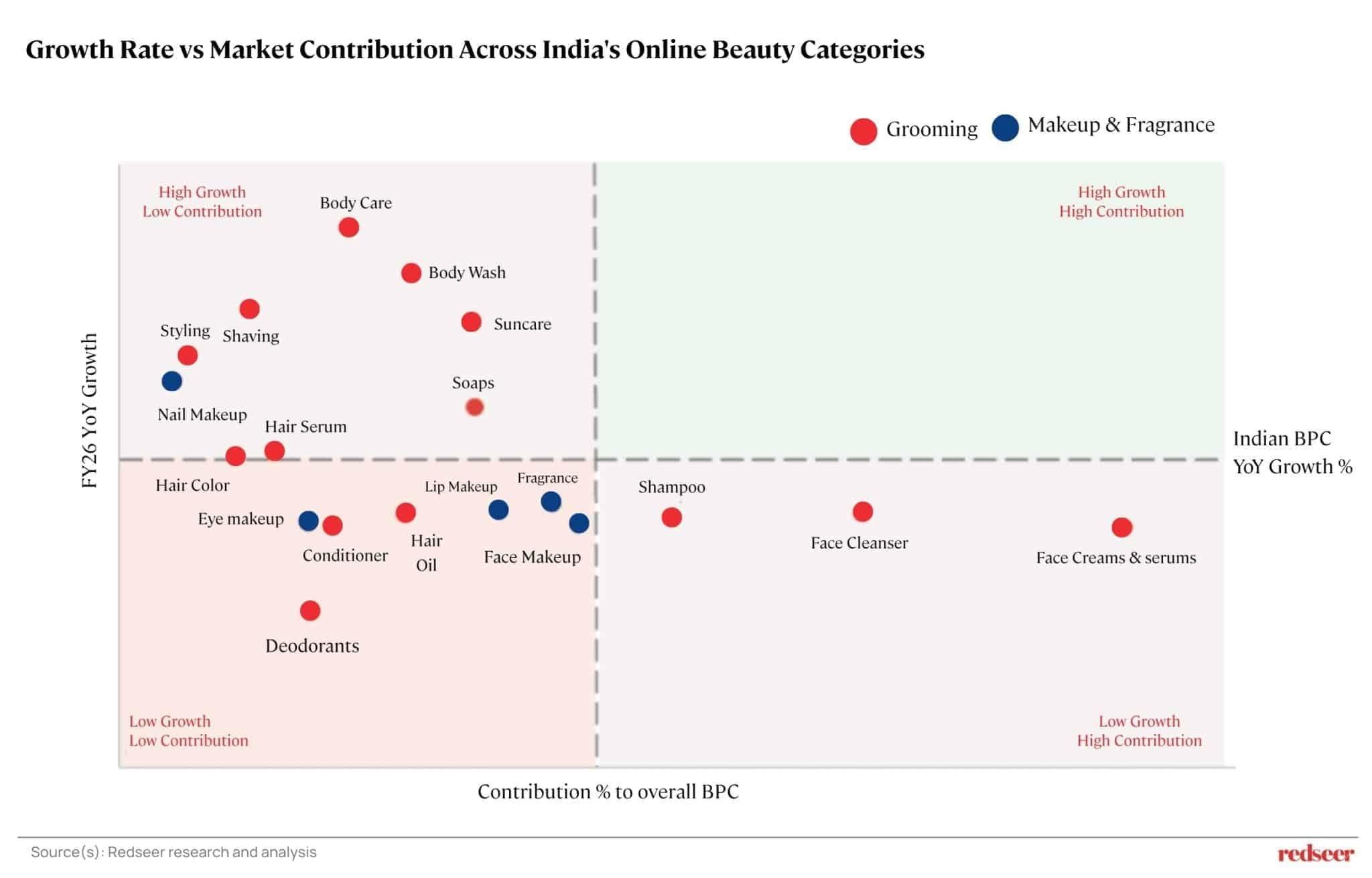
Large categories such as Face creams & serums and Face cleansers continue to anchor the market, contributing roughly 10% - 15% each as share in overall online BPC, but their growth is closer to the 30% – 35% FY26 YoY range. Faster momentum is coming from categories where behaviour is changing, either because they are becoming routine-led or stronger tools of identity and express.
Grooming is being led by routine expansion
Grooming tells a volume and velocity story. At 37%, it grows above the market average. Not because of elevated awareness or outsized content investment, but because certain categories have quietly become non-negotiable in the daily routine. Consumers are using them more often, running out faster, and reordering without deliberation.
“Grooming is growing at 37% – way above the market average.”

Body Care, the clearest illustration of this dynamic.
Growing at 65 to 70% YoY, its share of overall online BPC increased from roughly 2.5% to 3%+ in a single year. The driver is a meaningful expansion in how Indian consumers think about skincare, from face-focused routines to full-body concerns, including pigmentation, dryness, body acne, and uneven texture. Dermatologists and creators have reinforced this through content anchored around active ingredients and full-body skincare rituals.
Quick Commerce now contributes roughly 20 to 25% of Body Care sales, up from the mid-teens, a clear signal that repeat purchase cycles are forming on the channel.
“Quick Commerce now contributes roughly 20 to 25% of Body Care sales”
Body Wash tells a parallel story, but with a format shift at its core.
Growing at 60 to 65% YoY and outpacing Soaps at 40 to 45% YoY, it now contributes roughly 4% of overall online BPC, up from the mid-3% range. Consumers are moving away from functional cleansing toward fragrance-led, sensorial, and self-care-oriented routines. Influencer content around shower rituals, fragrance layering, and exfoliation has made Body Wash a daily staple rather than an occasional upgrade. Quick Commerce contributes roughly 20 to 25% of Body Wash, consistent with its growing role in high-frequency replenishment.
Sun Care category moved from seasonal usage to a daily skincare essential
This shift is showing up in the numbers. Growing at 55 to 60% YoY, its share moved from roughly 4% to 5%+. Sustained dermatologist-led content has repositioned SPF as foundational for pigmentation prevention, acne mark protection, and anti-ageing, not just sun protection. Improved formulations suited to Indian weather and skin tones have removed the practical barriers to daily use. Quick Commerce contributes roughly 10 to 15% of Sun Care, up from high single digits, as daily usage converts into predictable replenishment behaviour.
Makeup and Fragrance are being reshaped by premiumisation and self-expression
Where Grooming is a replenishment story, Makeup and Fragrance are a desire story. At roughly 30%, the segment grows below the market average. But the nature of that growth is distinct. Consumers here are not reordering on autopilot. They are trading up, discovering through content, and using beauty as a vehicle for identity and occasion-led expression.
“Grooming is a replenishment story, Makeup and Fragrance are a desire story”
The most structurally significant shift is in Fragrance. Having overtaken Deodorants in online BPC, Fragrance now contributes roughly 6% of overall online BPC and grew at 30 to 35% YoY, while Deodorants sit below 3% share and grew closer to 20% YoY. This marks a consumer transition from functional freshness to personal expression, where scent has become a signal of identity, mood, and social presence. Creator content around signature scents, occasion-specific fragrances, and affordable luxury dupes has been the primary growth catalyst.
“Quick Commerce now contributes roughly 15 to 20% of Perfume sales, up sharply from high single digits.”
Within Makeup, the real momentum is concentrated in specific pockets. Face Makeup, Lip Makeup, and Eye Makeup remain meaningful, growing at 30 to 35% YoY. The faster-moving category is Nail Makeup, growing close to 50% YoY, well above the segment average, though it remains below 1% of overall online BPC. Affordable experimentation, a strong DIY beauty culture, and creator-led nail art content have made nail care a frequent and accessible form of self-expression.
What this means for brands and platforms
The data points to two structurally different opportunities, and they require structurally different responses.
In Grooming, the opportunity is the repeat purchase. Body Care, Body Wash, and Sun Care are growing at 55 to 70% because they have become daily habits, reordered on quick commerce without much deliberation. Quick commerce share in these three categories rose between 6 and 11 percentage points in a single year. For brands, the priority is securing that replenishment slot before a competitor does. For platforms, protecting the tenth order matters more than winning the first.
In Makeup and Fragrance, the opportunity is premiumisation and identity. Fragrance has overtaken Deodorants and is growing faster. Nail Makeup is growing at nearly double the market average. These are considered choices driven by creator content, occasions, and the desire to express something. Winning here requires curation and storytelling, not just replenishment mechanics.
The brands and platforms that will capture disproportionate share are those that have correctly identified which engine they are competing in and built their channel strategy, content investment, and retention mechanics accordingly.
The question for every brand and platform is not which category is growing. It is this: are you building for habit or for desire?
The insights have been derived from Redseer’s Benchmarks, the most trusted insights platform on the Indian internet landscape. Its proprietary consumer internet data allows us to make granular and long-term comparisons that reveal underlying trends and shifts in consumer behaviour.
Benchmarks track city-level utilisation, expansion mix, and maturity trends across major quick commerce and consumer internet companies, offering its investors, brands, and platforms a clearer lens on how reported growth aligns with underlying economics.
Written by

Director


Digital Disruption in Home Category: Whitespace to Market Leadership

India Online Retail 2026: The Fastest Year in Five, and the New Engines Behind It

India’s Internet Economy: Built for Scale, Ready for Capital

India’s $40Bn Beauty & Personal Care Market: Growth, Shifts and Opportunities for 2030

The Redseer Brand Index

India Hair Growth Market Report 2026

The Body Lotion Opportunity in Indian E-Commerce

Value Grocery Commerce: The Bharat Unlock

Reinventing Packaged F&B with Quick Commerce
India’s Beauty Industry : Transforming boundaries across Audiences and Categories

Beauty Unveiled: Decoding the Success of Pure-Play Beauty Companies

Redseer advised a global beauty company on its acquisition of a multi-brand D2C Platform
Digital Disruption in Home Category: Whitespace to Market Leadership
India Online Retail 2026: The Fastest Year in Five, and the New Engines Behind It
India’s Internet Economy: Built for Scale, Ready for Capital
India’s $40Bn Beauty & Personal Care Market: Growth, Shifts and Opportunities for 2030
The Redseer Brand Index
India Hair Growth Market Report 2026