
Why AI Is Accelerating the Flex Workplace Era


For the past two years, the corporate world has operated on a tidy assumption: AI will hollow out the knowledge economy, shrink corporate teams, and reduce the demand for office space. Redseer’s survey of 272 enterprises and 50+ leadership interviews across sectors tells a different story.
“AI, GCCs and senior-weighted organisations are reshaping the future of work and workplace strategy “
In CY2025, India’s AI-specific workforce crossed 700,000 professionals, up 6x since 2019. While 95% of enterprises expect AI adoption to accelerate over the next 18-24 months, hiring trends already point in that direction: no surveyed organisation reported a decline in AI/ML headcount, and 85% reported an increase. India’s knowledge-economy office stock, meanwhile, steadily scaled to approximately 915 Mn sq ft. AI is not shrinking office demand. It is changing the nature of that demand.
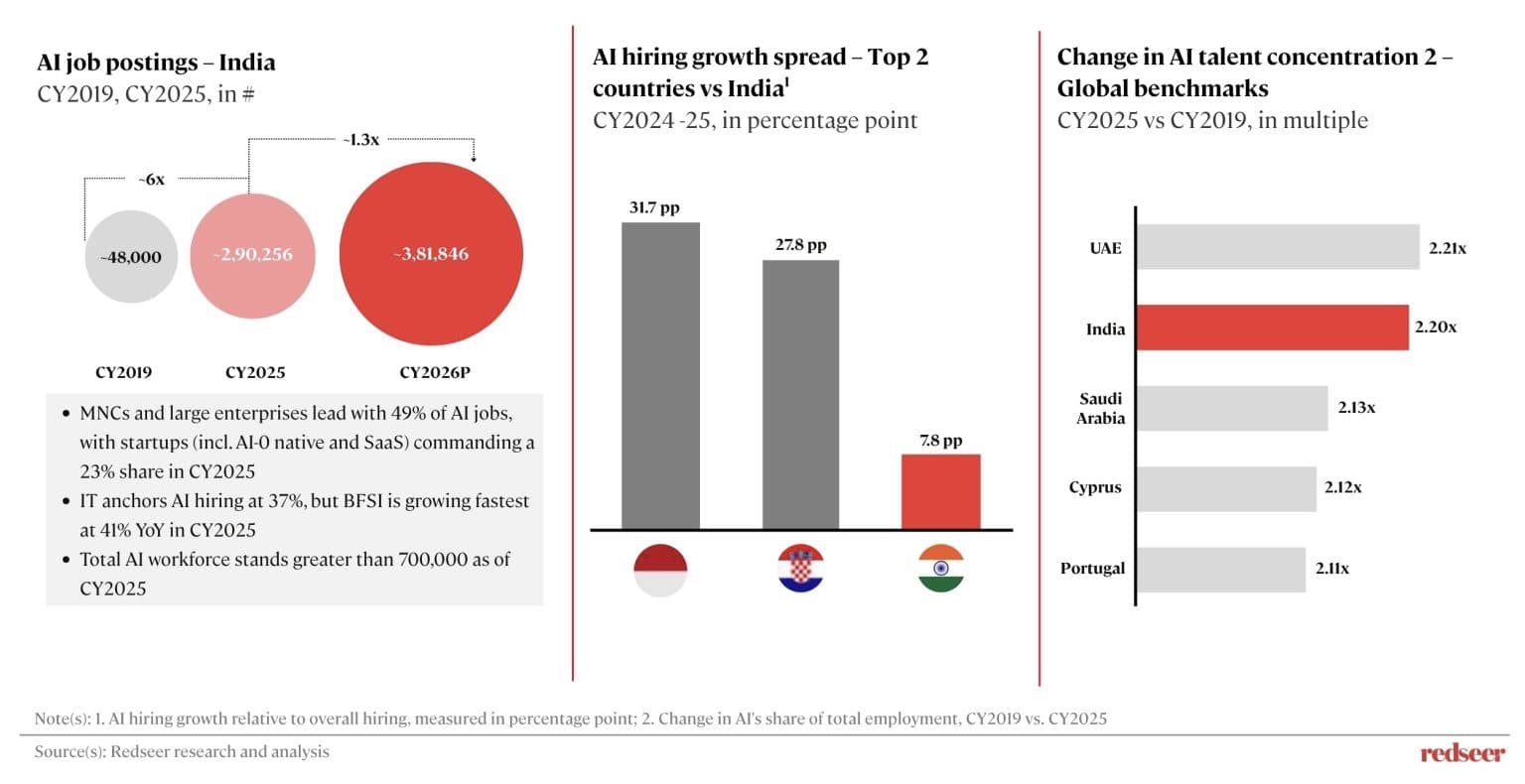
Every tech wave predicted job loss. History disagrees
Every technology cycle arrives wrapped in predictions of mass job destruction. Yet across successive technology waves, India’s employment base expanded from roughly 180-190 Mn workers during the automation era to nearly 330 Mn today. AI appears to be following the same pattern. Less than 5% of jobs are fully automatable, while roughly 60% are expected to be reshaped instead of eliminated. AI absorbs routine execution work while increasing demand for judgment, coordination, supervision, and domain expertise.
AI is rebuilding the corporate hierarchy

The most visible structural shift is in workforce composition. The traditional office floor – once a dense layer of entry-level workers – is being cleared by automated workflows. In its place emerges a leaner, highly specialised brain trust. Expectations of a more senior-weighted workforce over the next 3-5 years cut across every vertical, led by AI-native startups (96%), GCCs (75%), BFSI firms (70%) and SaaS companies (67%).
This senior-weighted shift has a direct spatial consequence. As teams become leaner and more specialised, companies spend more per seat. Average space allocation per employee is expected to expand from 80-90 sq ft today to 95-100 sq ft by 2028, reflecting the growing premium on collaboration zones, meeting spaces, and technology-rich environments. Senior employees also expect a different quality of workplace. 89% of enterprises say workspace quality matters more than it did 2 years ago, and 82% cite it as a meaningful factor in their AI talent hiring pitch. The office is no longer just infrastructure. It is now part of the offer.
93% of the firms are now more collaborative. Their offices have to follow suit

Counterintuitively, AI is also making teams work together more, not less. 93% of enterprises report higher collaboration intensity than a year ago as AI-led workflows require continuous human validation, alignment, and exception handling. Meeting-room demand is projected to increase by 30–50%. The office, in this model, is no longer a place for individual execution, rather a hub for coordination.
That shift is visible in what firms now demand from their buildings. 78% of the surveyed enterprises now prioritise high-speed and redundant connectivity, 62% prioritise video-conferencing capabilities, and 49% identify larger collaboration spaces as critical. Each of these is a structural specification, not a preference, and together they describe a fundamentally different building from the commodity cubicle model they are replacing.
India is becoming the world’s second HQ

“83% of GCCs are investing in GenAI and 58% already deploying Agentic AI in production”
This reconfiguration pressure is most visible in the segment driving the largest share of new office demand – the GCC ecosystem. Around 80-120 new GCCs are expected to enter India annually, with GCC employment projected to reach 3.7 Mn professionals by CY2030 and their share of India’s office leasing growing from 38% today to 48% by 2030, accounting for nearly 55 Mn sq ft of annual leasing.
GCCs are also increasingly driving AI deployment, product development, and global innovation mandates, effectively operating as second headquarters. The shift is already visible in investment priorities, with 83% of GCCs investing in GenAI and 58% already deploying Agentic AI in production. R&D roles within GCCs are projected to rise from 15% in 2015 to 35% by 2030, and global leadership positions based out of India are expected to grow from 6,500 to over 30,000 in the same period. India is no longer a delivery outpost. It is increasingly becoming the strategic engine.
Yet the very forces driving GCC expansion are also making workforce planning less predictable. While 86% of GCCs report a planned net increase in India headcount over the next two years, the shape of that headcount is becoming harder to predict. Real-estate strategies built around long-term certainty are increasingly struggling to keep pace.
“86% of GCCs report a planned net increase in India headcount over the next two years”
Why flex wins in an AI economy

AI is making headcount planning significantly less predictable across the board. 45% of enterprises report that AI has already made headcount harder to predict, with roles, skill requirements and hiring priorities increasingly shifting. A workforce model that changes this quickly cannot comfortably sit inside real-estate commitments designed around decade-long certainty. The consequence is already visible: 75% of the surveyed enterprises have compressed their planning horizons to 3 years or less, compared to a pre-2020 environment dominated by 5-10 year leases.
This is precisely where flex becomes not just convenient but structurally necessary. With unpredictable headcount making long-term lease lock-ins difficult to align with business needs, 82% of the surveyed enterprises plan to increase their flex allocation over the next two years, with 69% citing speed-to-market and 67% citing flexibility as primary drivers.
Workplace expectations are rising too, with senior AI talent placing a greater premium on quality environments and built-in infrastructure. India’s flex stock has expanded from 33 Mn sq ft in 2020 to 103 Mn sq ft in 2025, making it the world’s most mature flex market with roughly 11% penetration, ahead of the US and most developed markets. The incoming GCCs are increasingly adopting flexible formats, with GCC flex leasing growing 1.7x faster than other segments and AI-led hiring expected to account for nearly 31% of all flex seat leasing by CY2030.
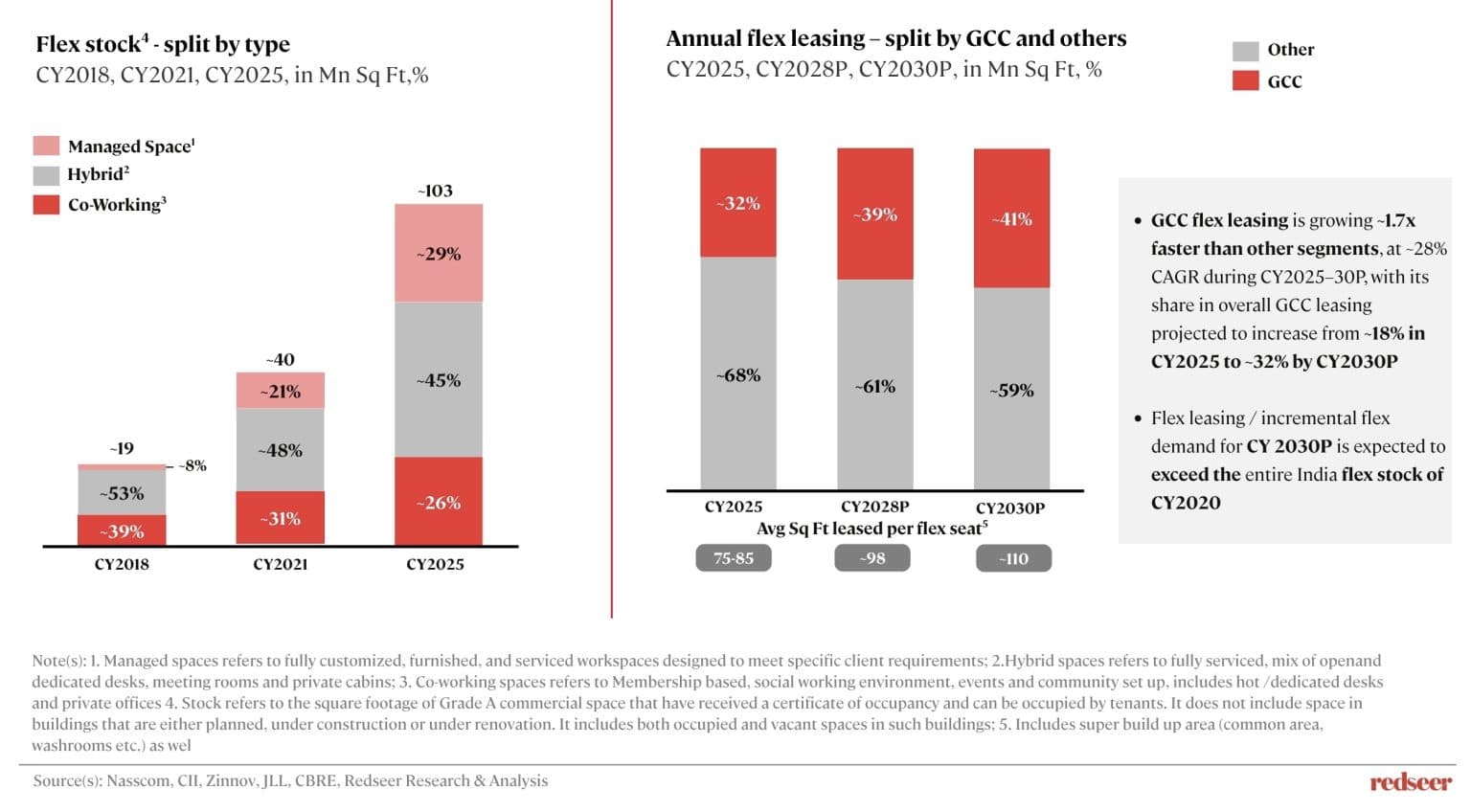
“Global leadership positions based out of India are expected to grow from 6,500 to over 30,000 by 2030”
By CY2030, India’s knowledge economy is expected to generate roughly 79 Mn sqft of incremental office demand and nearly 716,000 additional knowledge-economy jobs over the pre-AI baseline. Far from shrinking the workplace, AI is accelerating a shift toward more specialised talent, more collaborative work, and more dynamic real-estate strategies.
AI was supposed to be the office market’s disruption. It is turning out to be its upgrade.
Want to explore the complete findings? Download the full report for deeper insights and detailed analysis.
Written by


Engagement Manager

AI and The Future of Workspaces in India

India Data Centres 2.0

Redseer Gig Internet Workforce Report: 2026

India’s Internet Economy: Built for Scale, Ready for Capital

Advertising Unlocks Scale for the Next Generation of Consumer Platforms

Artificial Intelligence: The Next Growth Catalyst in Advertising

India’s DeepTech Renaissance: The Convergence of Defence, Robotics & Innovation Opening New Opportunities

How AI-led Hiring Is Reshaping India’s Office Market

The Gaming and Interactive Media Opportunity in India

Why Global Apparel Players Are Betting Big on India!

Skilling and Employability Solutions for the Next Half Billion

Impact of GCC’s and AI on India’s Job Market and Office Infrastructure Planning
AI and The Future of Workspaces in India
India Data Centres 2.0
Redseer Gig Internet Workforce Report: 2026
India’s Internet Economy: Built for Scale, Ready for Capital
Advertising Unlocks Scale for the Next Generation of Consumer Platforms
Artificial Intelligence: The Next Growth Catalyst in Advertising