Redseer Gig Internet Workforce Report: 2026


Executive Summary:
India’s consumer internet economy has transformed how hundreds of millions buy, travel, and access services – and behind it sits a workforce built on a different premise than a traditional job. India’s Gig Internet Workforce has grown to over 6 million monthly active workers and is on track to nearly triple to ~17-21 Mn by the end of the decade.
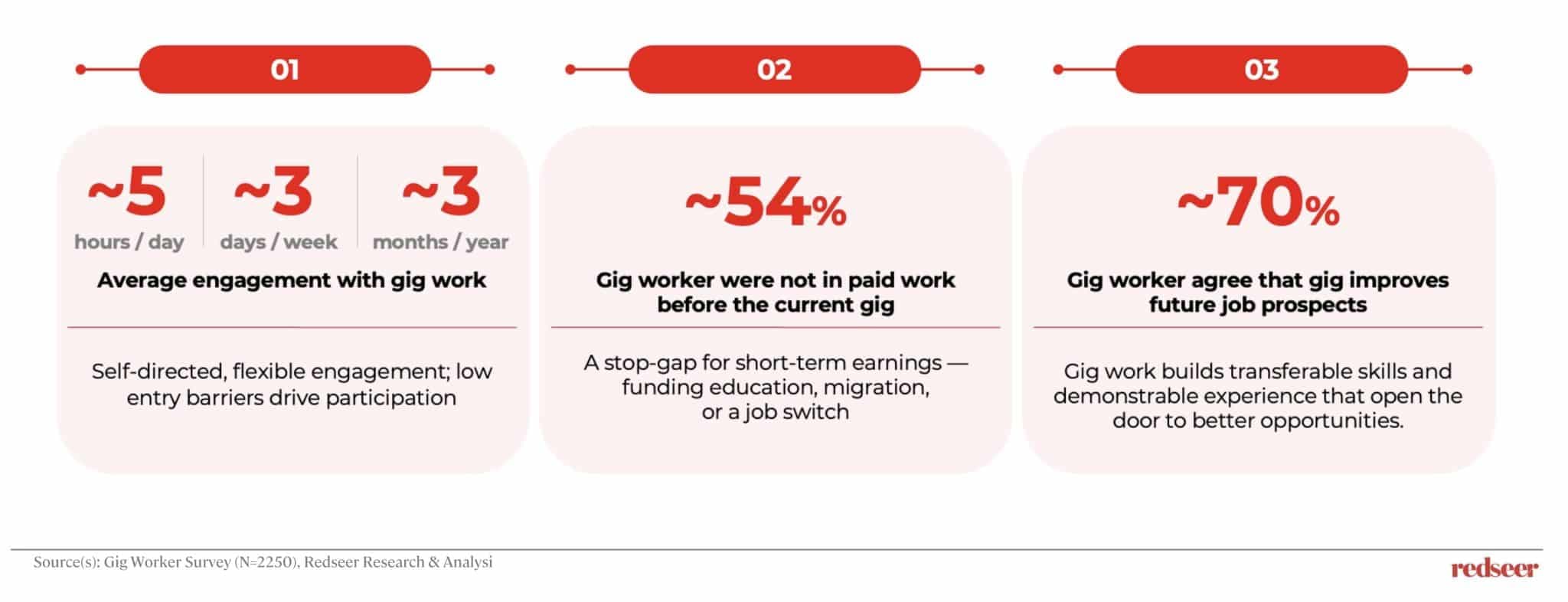
But scale isn’t the most important thing about it: 90%+ of workers choose part-time engagement, and the average worker is active on a platform for only ~3 months a year. Gig internet is, by design, India’s best stop-gap – a flexible, transient, supplemental earning opportunity.
That design is precisely what makes it effective as a livelihood engine. ~54% of gig workers had no paid work of any kind before joining – making gig internet a genuine entry point into the workforce across the country’s underserved cohorts. And once in, the earnings hold up: full-time gig workers earn up to ~2.5X of the people in comparable informal and formal roles.
As gig work becomes a bigger part of how India earns, welfare and policy are catching up – but the report’s central argument is that benefit design has to be built around the part-time, transient nature of the role, not retrofitted from full-time employment models.
Table of Contents:
- Executive Summary
- Gig Internet is a critical pillar of India’s workforce
- Gig work is flexible by design, easy to enter, and valued by workers
- Gig is India’s best stop-gap, transient, and supplemental earning opportunity
- Welfare, regulation, and the future of workforce participation
- Strategic recommendations for platforms and policymakers
Key Highlights
- 17–21 Mn monthly active gig workers by 2030
- ~70% of India’s annual non-farm job gap could be addressed through gig internet
- 54% had no paid work of any kind before joining gig platforms
- Up to 2.5X higher earnings than comparable occupations
- 90%+ engage in part-time capacity (<40 hrs/week)
- 90%+ choose gig work for flexibility
- Welfare coverage is increasingly comparable with formal employment
- Women remain significantly underrepresented, creating the next major inclusion opportunity
Why This Report Matters
India’s Gig Internet Workforce is approaching a point where industry leaders are facing multiple strategic questions:
- What separates workers who use Gig work as a launchpad from those who rely on gig work as a primary source of income?
- How do gig earnings and their welfare coverage compare to formal roles?
- Why are platforms and policymakers converging on welfare now, and what does the new Code on Social Security change?
- Where does the next wave of gig internet growth come from, and which sectors and worker segments lead to that build by CY30?
- Women are ~1% of India’s gig workforce despite strong participation in home services. What would it take to replicate that success across other sectors?
This report provides a worker and policymaker lens into these questions, offering a framework to understand the future of livelihood creation in India’s gig economy.
Download the Redseer Gig Internet Workforce Report 2026 to uncover the data, frameworks and strategies shaping the future of India’s gig workforce, and what platforms, policymakers, and investors need to know to support its next phase of growth.
Written by


Engagement Manager