India’s Internet Economy: Built for Scale, Ready for Capital


EXECUTIVE SUMMARY
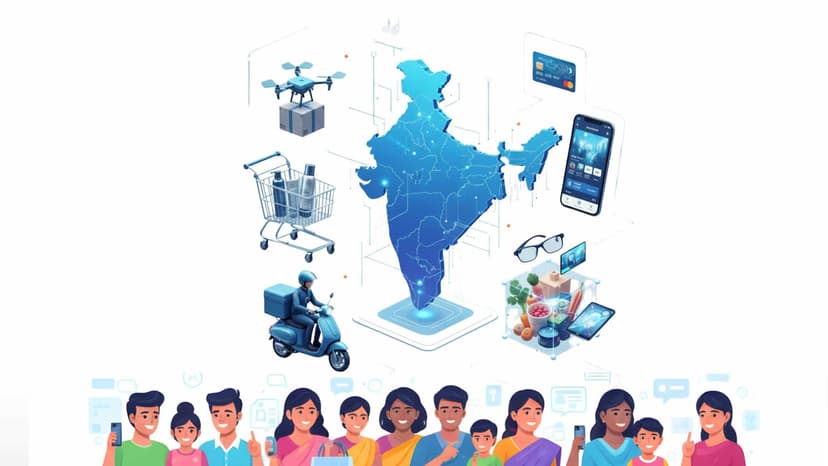
India’s new-age economy is on track to triple to ~$300 Bn in revenue by FY31, approaching the scale of India’s technology industry today. Combined EBITDA swung by ~$6 Bn between FY23 and FY25 to turn positive at $1.4 Bn, and ~$300 Bn of FY31 revenue implies $5-10 Bn of profit.
Underneath the aggregate, a proven core has formed. Around 70 unlisted new-age companies above ₹500 Cr in revenue are already scaled, growing and profitable, spread across all six sectors. In consumer goods, a further ~50 new-age brands between ₹100-500 Cr are growing and profitable today, which puts a visible cohort behind the leaders for the first time.
Redseer Strategy Consultants believes India’s new-age economy has moved from promise to proof, and that the asset base is now deep enough to meet the capital coming toward it. With ~70 new-age companies already scaled above ₹500 Cr and ~50 new-age consumer brands growing profitably behind them, public and private funding reaching ~$50 Bn by CY30 has somewhere credible to go. Value will realise through four routes in parallel, and M&A becomes an increasingly important one as the M&A-ready pool grows past 300 companies by FY31.
In consumer goods, where the deepest pool of new-age companies sits, the ₹100 Cr+ brand base is set to grow from ~90 in FY22 to ~500 by FY31. Of ~110 brands founded since 2016 that have crossed ₹100 Cr in select categories, ~26 have cleared ₹500 Cr and ~8 have crossed ₹800 Cr. Quick commerce and D2C have nearly halved the time it takes to reach both marks, while the transition beyond ₹500 Cr continues to depend on offline retail, distribution and working capital.
Private market funding is growing ~25% year on year, and public and private funding together could reach ~$50 Bn by CY30 as new-age companies move from ~25% to ~40% of India’s IPO proceeds. Investors remain cautious on three questions: proof of scale economics, AI’s measurable impact on the P&L, and the durability of moats.
REPORT CONTENT
01. India’s new-age economy triples to ~$300 Bn revenue by FY31, with a growing pool of profitable and investable companies
- Where the growth sits across consumption-led sectors and emerging tech
- How the profit pool turned positive, and what still concentrates it
- The 70 unlisted companies already scaled, growing and profitable
02. India reliably builds ₹100-500 Cr consumer brands, and a growing set is now graduating beyond ₹500 Cr
- How the ₹100 Cr+ brand base grows from ~90 to ~500 by FY31
- Why quick commerce and D2C have halved the time to scale
- What separates the ~26 brands that have cleared ₹500 Cr
- What investors should underwrite over the next 24 months
03. Capital is available, and investors remain cautious on valuation, AI impact and the durability of moats
- Where private capital is concentrating, and why a few large rounds carry the year
- What 40 growth and late-stage investors say a company must prove
- How multiples vary from 3.4x to 11.5x across sectors
- The four routes through which value will be realised
04. As the pool of scaled companies deepens, M&A becomes an increasingly important route to value
- Why M&A could reach ~$10 Bn a year by CY30
- The three conditions unlocking it
- Which buyers are converging on which targets
FOR DECISION MAKERS
Profit is beginning to follow revenue.
Combined EBITDA turned positive in FY25 after a ~$6 Bn swing. ~$300 Bn of FY31 revenue implies $5-10 Bn of profit, a 2-3% margin against 12-18% for listed FMCG.
Capital is growing faster than the pool it can back.
Private funding is up ~25% year on year and total funding could reach ~$50 Bn by CY30, with new-age companies moving from ~25% to ~40% of India’s IPO proceeds.
₹500 Cr is the test that matters for a consumer brand.
Reaching ₹100 Cr has become faster and cheaper. Of ~110 brands founded since 2016 above ₹100 Cr, ~26 have cleared ₹500 Cr, which points to a distribution barrier that brand strength alone does not solve.
Four exit routes will absorb the pipeline.
Private capital takes ~50% of 200+ brands, the IPO track ~20%, strategic M&A ~15% and steady compounding ~15%. Private capital carries the largest share, and the remaining half spreads across three routes, so the pipeline does not depend on any single one staying open.
REDSEER PERSPECTIVE AND STRATEGIC TAKEAWAYS
For consumer brands, the constraint beyond ₹500 Cr is structural. The same quick-commerce and D2C infrastructure that carries a brand to ₹100 Cr does not carry it past ₹500 Cr, and the transition depends on offline retail, distribution and working-capital capability that most founders are still building.
That changes what scarcity means. As the ₹100 Cr+ pool deepens, having scale stops being the differentiator and having a credible path beyond ₹500 Cr becomes it.
Four implications for deploying capital into Indian consumer goods over the next 24 months:
- Beyond ₹500 Cr, distribution depth, GT/MT readiness and working-capital capability become increasingly important alongside brand strength and consumer metrics.
- The ₹300-500 Cr pool deepens materially by FY31, which reduces today’s scarcity and favours brands that build scaling capability early.
- As scaled-brand supply grows faster than exit routes, assets with several credible paths to value should command a premium.
- Categories graduate at different rates, so category dynamics should shape both scale and exit expectations.
WHO SHOULD READ THIS
Private equity and growth investors: which exit routes different companies are headed toward, and what a company needs to prove before it is investable.
Strategic buyers and corporate development teams: where traditional and new-age buyers are converging on the same targets, and what separates deals that integrate well.
Founders and operators of scaling consumer brands: what typically stalls growth beyond ₹500 Cr, and which capabilities matter most in that transition.
Investment bankers and M&A advisors: how the opportunity evolves from opportunistic tuck-ins toward structural, at-scale deals through CY30.
Download the Report
Understand where India’s new-age capital is concentrating, what separates the brands that clear ₹500 Cr, and how M&A becomes a structural route to value through CY30.
Written by