From Staffing the Stack to Owning It: India’s Calculated AdTech Move.


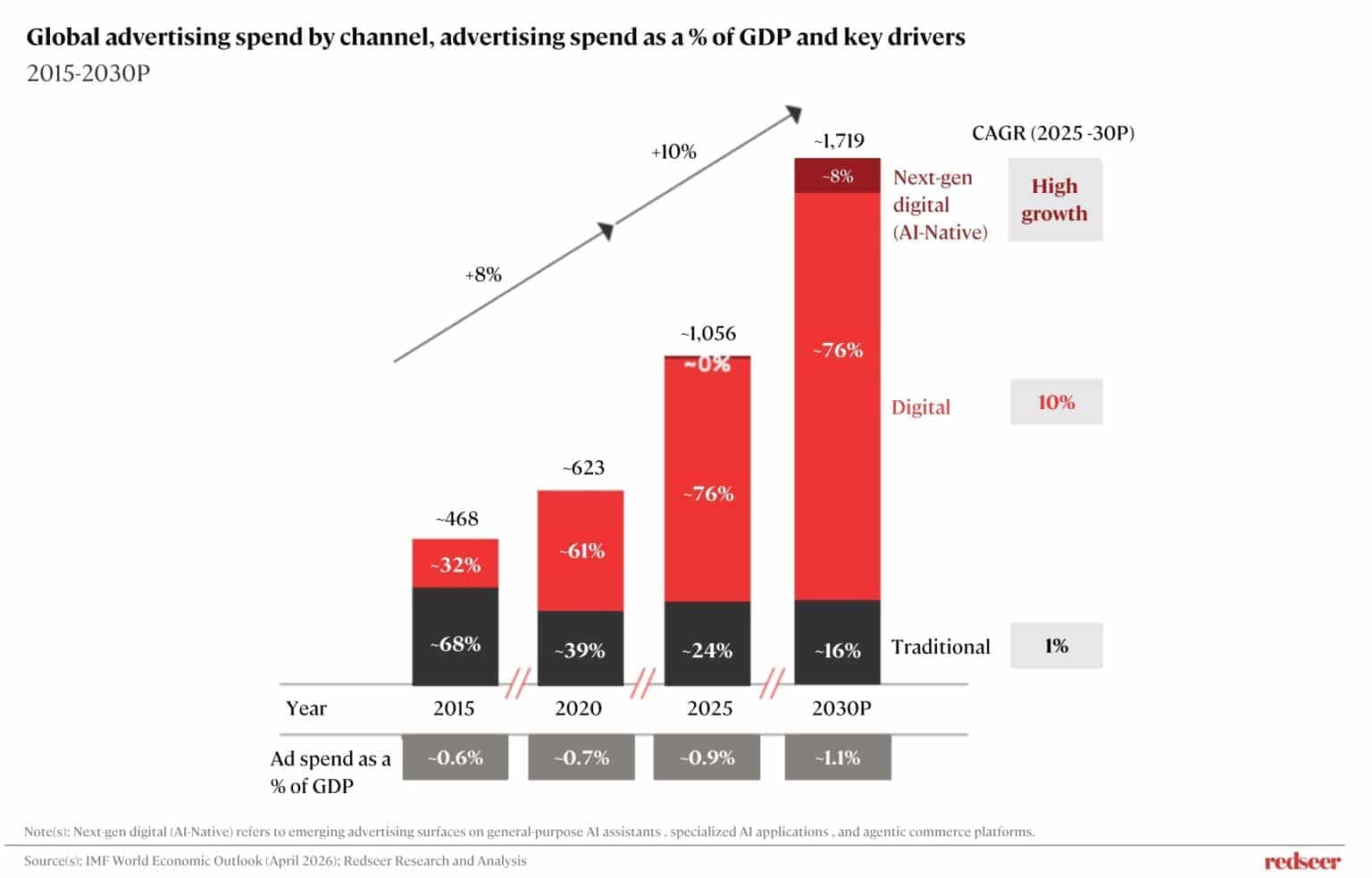
The global advertising spend has crossed $1 trillion in 2025. The technology behind that spend is now being rebuilt from scratch. The rebuild has an address, and it is in India.
Over 76% of the global advertising spend is digital, and 80-85% of that digital spend transacts into programmatic spend – meaning advertising is bought and sold automatically by technology systems in real time.
AI is now rebuilding those systems from the ground up. The rebuild requires Infrastructure Specialists, Systems Engineers and ML Practitioners at scale. With ~2.7 Mn engineering enrolments a year, 1,800 to 2,000 GCCs generating $65 to 75 billion in exports, and AdTech roles paying 2x to 4x times the IT services baseline – Indian firms are not just staffing for transition but to build and own the product entirely.
To know why this moment is important, let us dive deeper into what AI is doing to the AdTech stack.
The stack is being rebuilt, not patched
With the evolution of advertising media, each shift has added a new layer over the existing one. Display over print, mobile over display, and programmatic over mobile. The older layers are sitting dormant, and AI is reaching those layers as well and rewriting how it works.
From bidding and targeting to creative production and fraud detection – each function is being rewritten around generative models, agentic systems and machine learning.
By 2030, as agents become ubiquitous, the Agent-driven Commerce or Agentic Commerce is expected to intermediate 10-25% of the United States e-commerce sales.
This results in a reorganisation of engineering inside every AdTech company. Agentic systems and GenAI ops, which barely existed three years ago, have now occupied half the engineering organisation in AdTech companies. Manual operations are losing ground quickly. Replacing the AdTech stack needs the depth of talent that India has been building for three decades.
India already has the stack
The new AdTech stack requires engineers who can build systems to make a million decisions per second, finalising which ad to display, to which user, what the price is, and within a fixed duration. India is producing Specialised Engineers who can build systems that can learn from billions of data and get sharper over time.
A growing share of the workforce is no longer back-office support. It is product-grade AI development. And the numbers imply the same. In FY25, India had enrolled ~2.7 Mn engineering and technology students. The developer community is growing at ~20-22% a year – on track to be the largest in the world by CY30.
MarTech and AdTech roles in India pay 2x to 4x times the average IT service salary. Their work is harder, and the talent for that work is scarcer. India is not competing on just the price point; India is competing on capability also, and the pay confirms the demand.
It is worth noting that the structure of market advertising is important for India specifically. There are two players in the market:
- Closed ecosystems are platforms such as Google, Meta, and Amazon (audience, technology, and ad inventory all owned within one system)
- Open ecosystems such as OpenX, theTradeDesk, and unityADS (Ad space across thousands of independent websites and apps, bought and sold through shared technology)
India’s AdTech firms operate in open ecosystems.
“Indian advertising market is expected to grow at a strong 10-15% CAGR over 2025-2030P, driven by expanding consumer classes and accelerating digital infrastructure.”
From building for others to owning the product
While talent in India is at scale, who holds the revenue and bears the cost of running it has changed.
Leading Indian AdTech players are operating across 50+ countries, with over 80% of their workforce in India, running the full business from Bengaluru. Not support hubs, not delivery centres, but ownership of the product and the economics it generates.
It is important to note the difference between closed and open ecosystems here. Closed ecosystems’ margins are internal. Open ecosystems need to earn their margins by connecting advertisers with audiences across the internet. The advantage compounds when AI is doing the connecting, every advertiser, impression and additional publisher.
You earn a margin when you build a product for someone else. But when you own the product, you capture revenue, costs, and the compounding data advantages, which get stronger with every impression. India’s AdTech firms are not only building the stack but owning it as well.
Where value lands in the AI era
Owning a product matters, especially when you are in the right position. There are four archetypes in the programmatic advertising landscape, where each type is differentiated by its data depth, distribution reach, and AI flywheel maturity.
- Closed Ecosystems
- Open Ecosystems
- Sub-scale Open Ecosystem Players
- New-age AI Intermediaries
The ones best positioned to capture AI’s benefits are the scaled open ecosystems. With more data, better models will be developed, which results in more advertisers and publishers.
Sub-scale open ecosystems and New Age AI Intermediaries have the right intent and ideas but have not scaled enough to run the cycle effectively. They must go in with a scaled partner or position their products for acquisition.
Indian scaled open ecosystem players are already running the playbook that wins, moving toward owning both sides of the programmatic value chain.
The gap between each archetype is model investment, scale, and data.
Before AI, a well-funded challenger could close the quality gap within a couple of years. But now that time has shortened drastically. With different platforms training their models and collecting large amounts of data, the ability to close that gap is only widening.
Better data sets mean better trained models, which leads to more actionable wins, attracting more publishers and advertisers. This, in turn, generates more data with the cycle running itself. AdTech firms that experiment with AI running production first will compound the cycle advantage. Firms that wait will fall behind because the cycle will not pause.
A $1 trillion market is being rewired – this rewiring demands exactly what India has spent thirty years building. The talent, the GCC infrastructure, and the product-owning firms – all are here. The question is, which Indian firms will move fast enough to own the largest share of what comes next?
Written by


Senior Consultant

Artificial Intelligence: The Next Growth Catalyst in Advertising

Advertising Unlocks Scale for the Next Generation of Consumer Platforms

India’s Internet Economy: Built for Scale, Ready for Capital

Advertising Is the Oil Powering The Digital Economy

AI and The Future of Workspaces in India

India Data Centres 2.0

Micro-Drama’s J-Curve Moment: What Marketers, Platforms, and Investors Need to Know

The Gaming and Interactive Media Opportunity in India

Why Global Apparel Players Are Betting Big on India!

Digital Advertising in India and disruptive trends

AI is the Next Growth Catalyst in Advertising

How AI-led Hiring Is Reshaping India’s Office Market
Artificial Intelligence: The Next Growth Catalyst in Advertising
Advertising Unlocks Scale for the Next Generation of Consumer Platforms
India’s Internet Economy: Built for Scale, Ready for Capital
Advertising Is the Oil Powering The Digital Economy
AI and The Future of Workspaces in India
India Data Centres 2.0