Southeast Asia Beverage’s Selective- Spending Moment

Southeast Asia’s beverage market is entering a phase where people are spending more carefully. Consumers are becoming pickier and thinking harder about what gives them good value. They compare prices, pack sizes, promotions, loyalty rewards, brands, and where they buy products.
Because of this, raising prices across the board can be risky. It may help profits for a short time, but it can also make people buy less often, spend less overall, or lose trust in a brand.
A better approach is to offer stronger and clearer value. Leading companies are trying different strategies such as offering products at different price points, adjusting pricing by sales channel, giving clearer loyalty rewards, and pricing products for different occasions.
In this piece, we look at what consumers across Southeast Asia want, with local, on-the-ground perspectives to support smarter pricing and value decisions.
Feel free to contact us if you would like to discuss the findings in more detail.
Consumers are spending more carefully; pricing power now depends on where they cannot easily trade away
Beverage consumers are becoming more selective about where they still see value. That means broad price increases are becoming riskier. Companies can still raise prices in strong occasions or premium formats, but pushing price everywhere can reduce purchase frequency and weaken brand trust. The smarter approach is more targeted pricing. Some occasions support bundles and premiumization, while others require stable entry pricing or even value redesign before further increases.
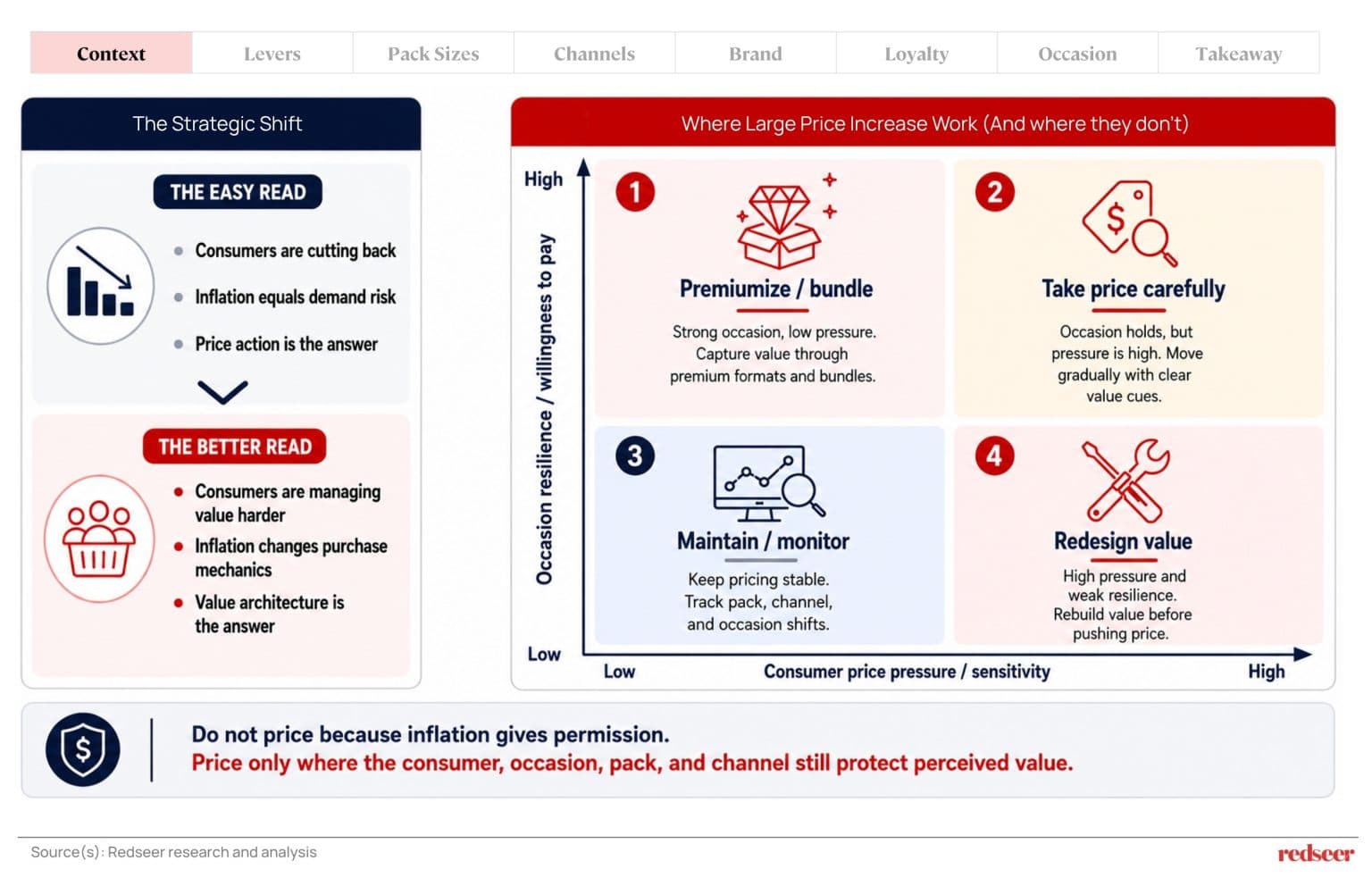
Consumers are now actively managing value across four levers: Pack Sizes, Shopping Channel, Promo/Loyalty, and Product Brand
Want to get strategic guidance?
Consumers are adjusting how they shop to protect value. Some are moving to smaller packs to lower spending at one time, while others are comparing channels to find better deals or convenience.
Promotions and loyalty programs are becoming more important, especially when savings are easy to see. Brand trust also matters more, with many consumers shifting toward brands that feel reliable and worth the price.
The key takeaway is that pricing alone is not enough. Companies need to manage the full value system across packs, channels, promotions, loyalty programs, and brand positioning.
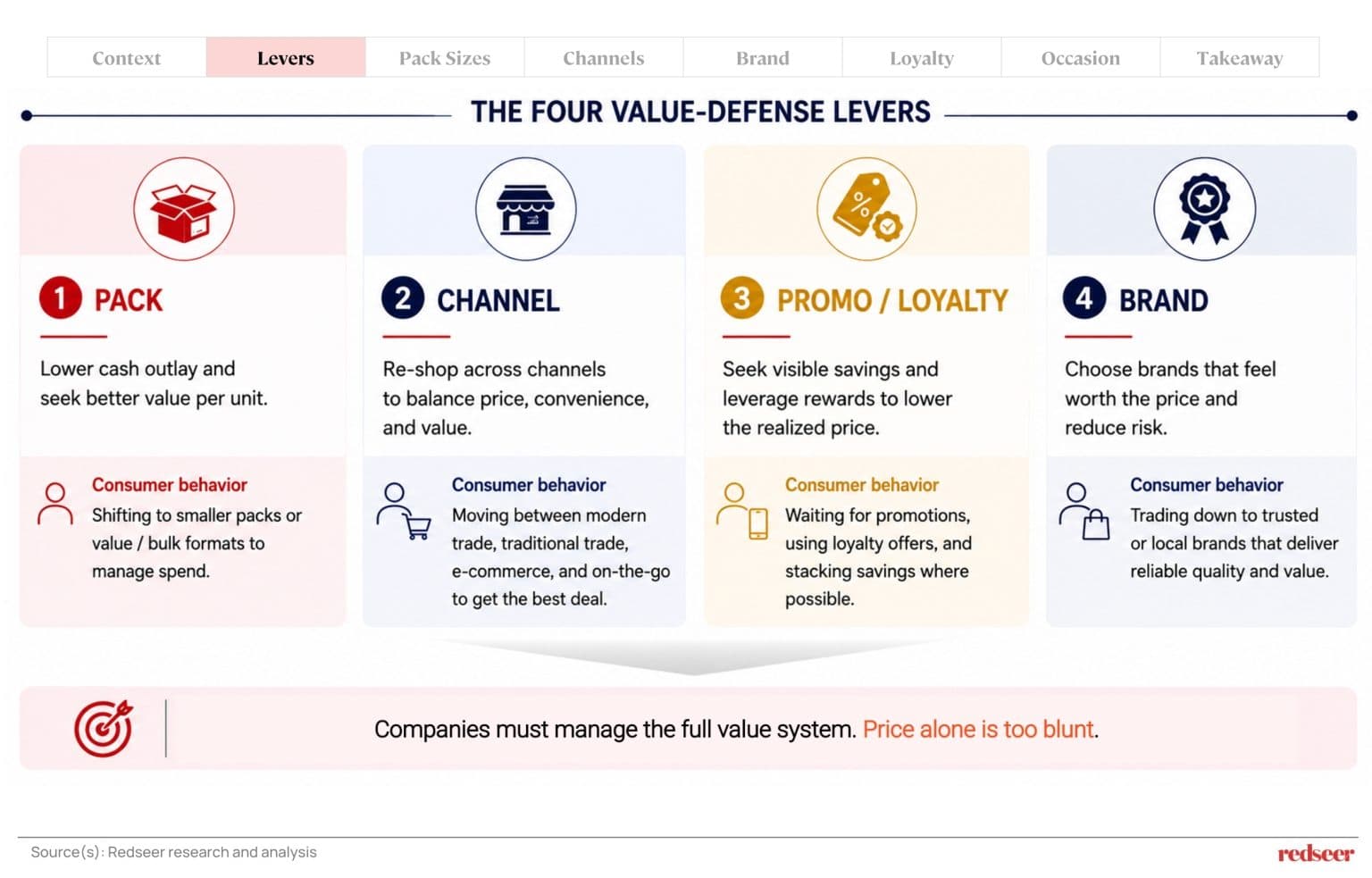
Consumers are shifting toward either smaller entry packs or larger value packs. Companies need to manage both ends of the pack-price ladder effectively.
Smaller packs remain the dominant response in markets such as Indonesia, Malaysia, and the Philippines, where over half of consumers say they are shifting toward smaller formats. These packs help consumers manage cash spending while staying in the category. But the picture is different in Thailand and Vietnam, where 33% and 39% of consumers, respectively, are moving toward bulk or value packs. This suggests some consumers are focusing on improving value per unit instead of simply reducing spending per trip.
So the right approach is a market-specific pack ladder that protects affordability in some markets while testing value and bulk formats in others.
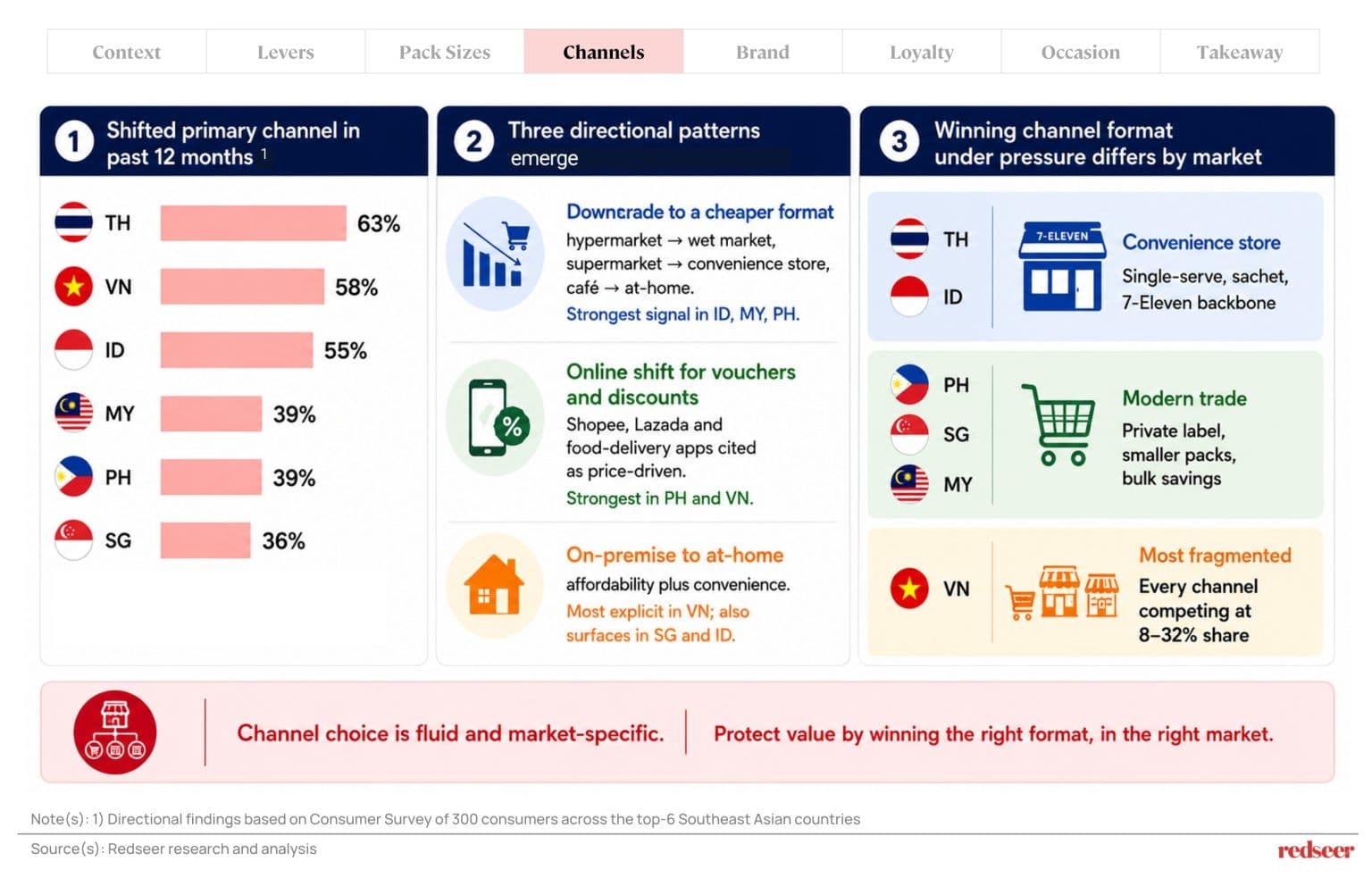
Consumers are re-shopping the channel before they switch the brand; defending the right format is the first line of value defense
Consumers are not only changing what they buy; they are changing where they buy. Channel switching is highest in Thailand, Vietnam, and Indonesia, where more than half of consumers shifted their primary channel in the past 12 months. This suggests consumers are first seeking better value through format, convenience, and access before fully switching brands.
The pattern differs by market. Indonesia, Malaysia, and the Philippines show a stronger move toward cheaper formats. The Philippines and Vietnam show higher relevance of online vouchers and discounts, while Vietnam remains highly fragmented across channels.
So the response cannot be one-size-fits-all. Operators need to defend the channel format that matters most in each market, whether convenience stores, modern trade, online discount channels, or multi-channel execution.
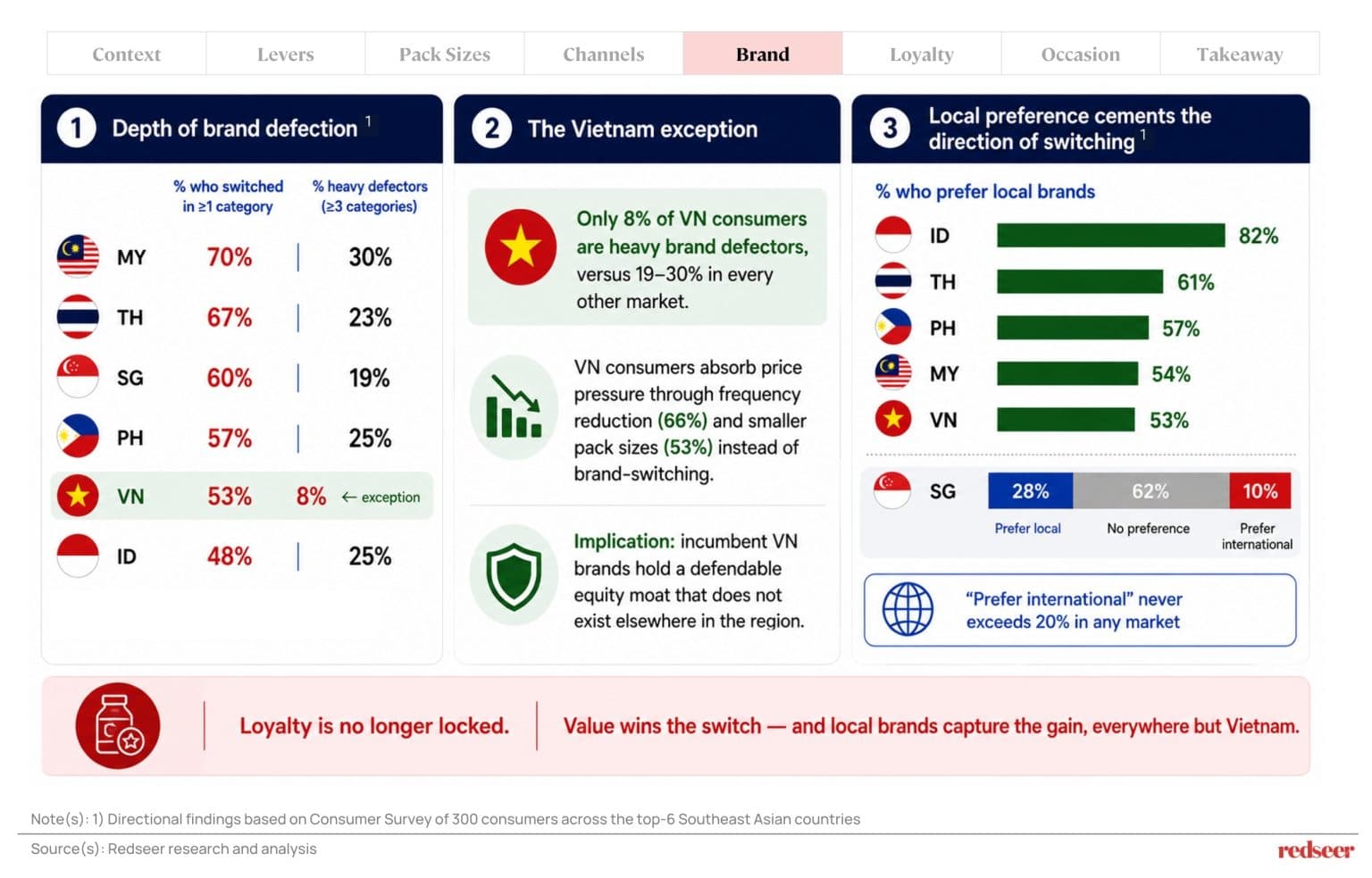
Brand strength has stopped buying pricing power everywhere, but Vietnam, and local players are capturing the trade-down
Brand loyalty is weakening as consumers search harder for value. In Malaysia, Thailand, Singapore, and the Philippines, more than half of consumers have switched brands in at least one category, showing that brand strength alone no longer protects pricing power.
Vietnam is the exception. Only 8% of Vietnamese consumers are heavy brand defectors, versus 19–30% in every other market. Consumers there appear more likely to reduce frequency or shift pack sizes than switch brands, giving incumbents a stronger equity buffer.
Local-brand preference is also strong in most markets, especially Indonesia, Thailand, and the Philippines. When consumers trade down, local players are often well placed to capture the switch.
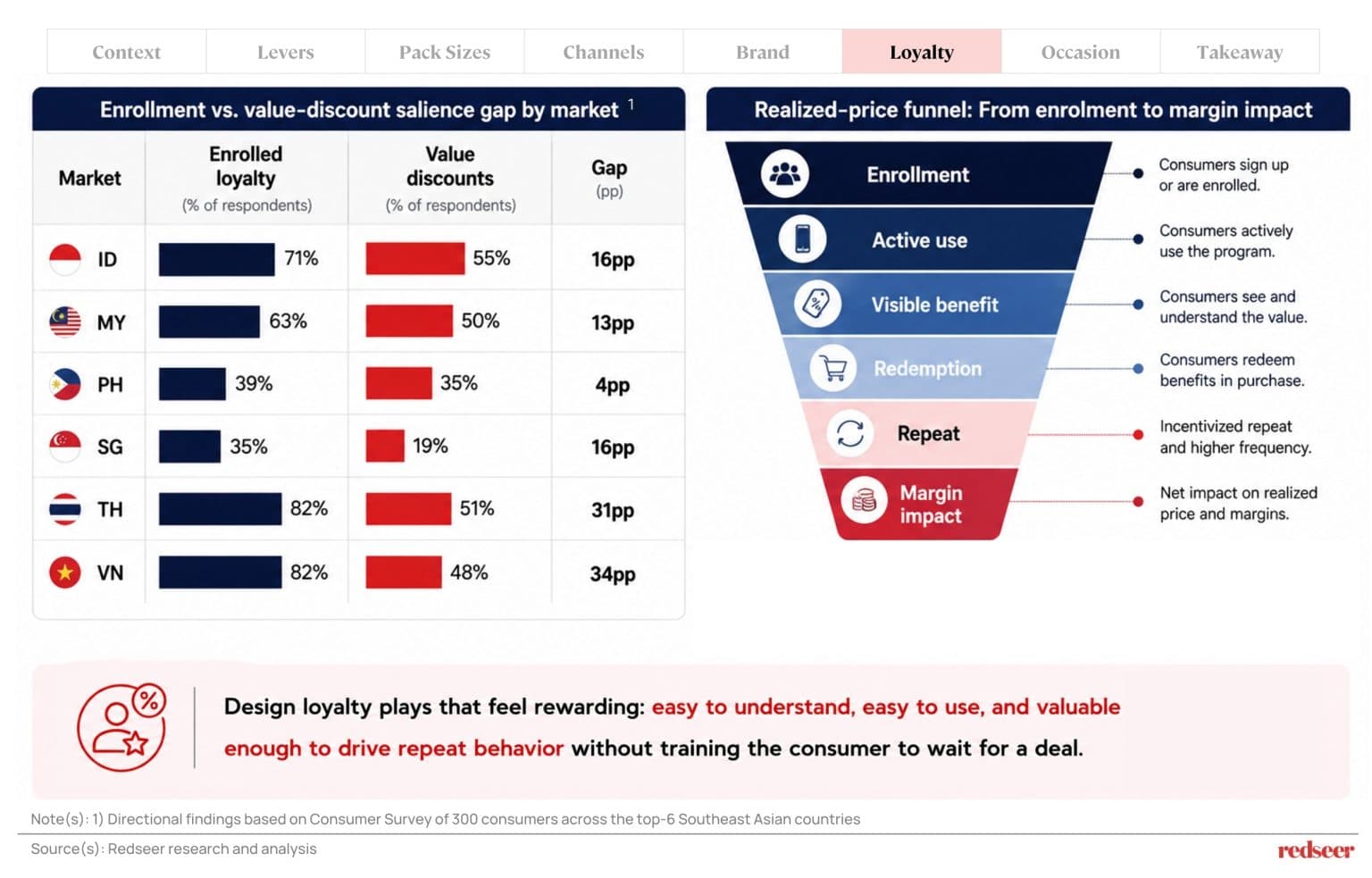
Loyalty programs work only when customers can clearly see the savings
High loyalty-program enrollment does not automatically mean consumers see real value. The gap is especially large in Thailand and Vietnam, where more than 80% of consumers are enrolled but only around half of respondents strongly associate the programs with meaningful savings. Even Singapore shows a 16-point gap between enrollment and discount relevance.
From a company’s point of view, the priority should be to make savings visible, avoid excessive discounting, and measure whether rewards are driving repeat purchases and better pricing outcomes. This metric matters because loyalty only works when consumers actively use the program, understand the benefit, redeem rewards, and return more often.
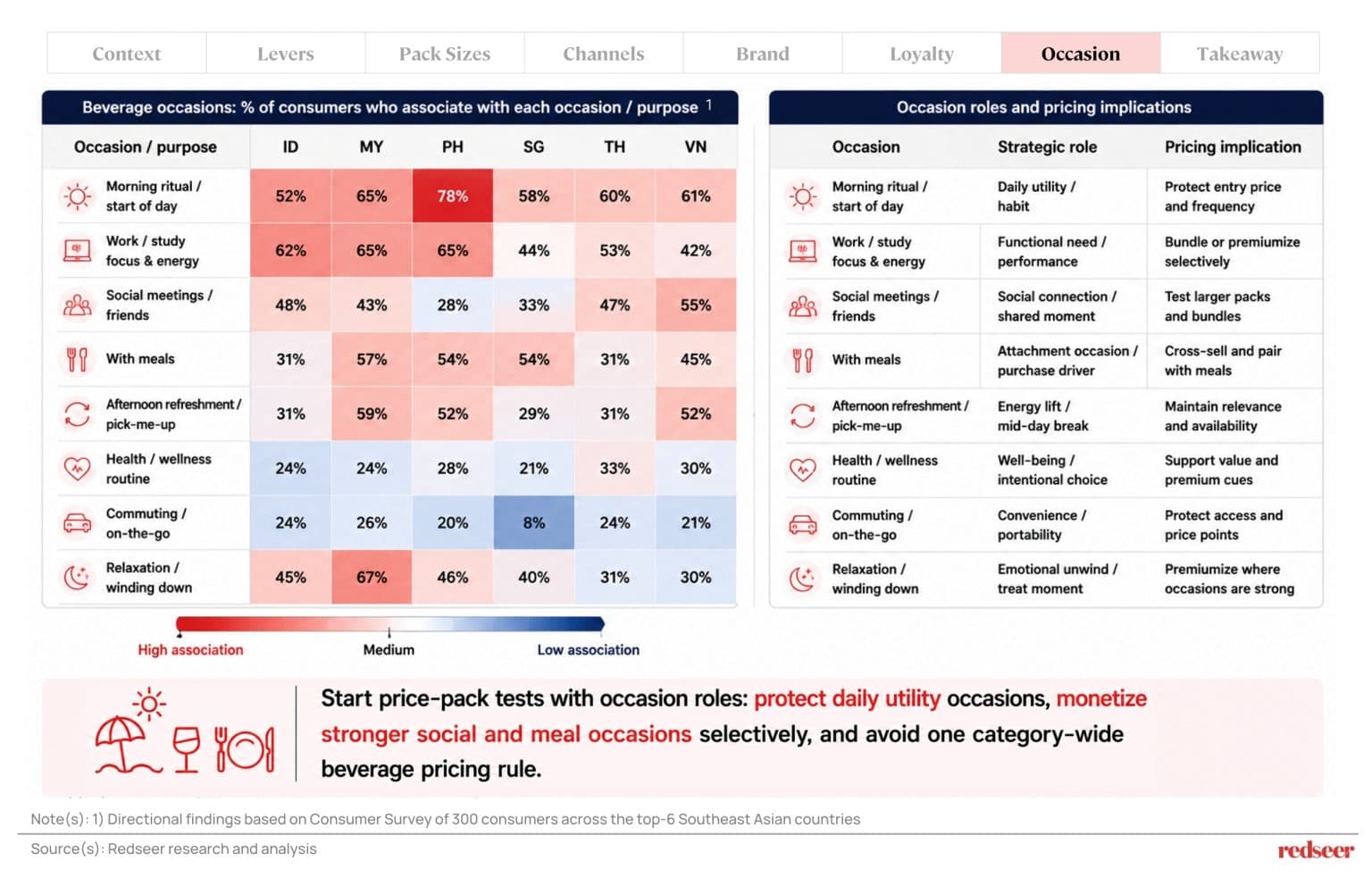
Pricing must shift from SKU to occasion logic: one category price leaves strong moments under-monetized while making fragile daily routines too expensive
Different beverage occasions carry different pricing power, and companies should price accordingly.
Morning routines are especially strong in the Philippines, where 78% of consumers associate beverages with the start of the day, while relaxation moments are strongest in Malaysia at 67%.
These differences matter because not every occasion should be priced the same way. Daily utility occasions may require affordable entry pricing to protect frequency, while stronger social or meal occasions can support bundles, larger packs, or selective premiumization. Beverage pricing should follow consumer behavior by occasion, not broad category averages.
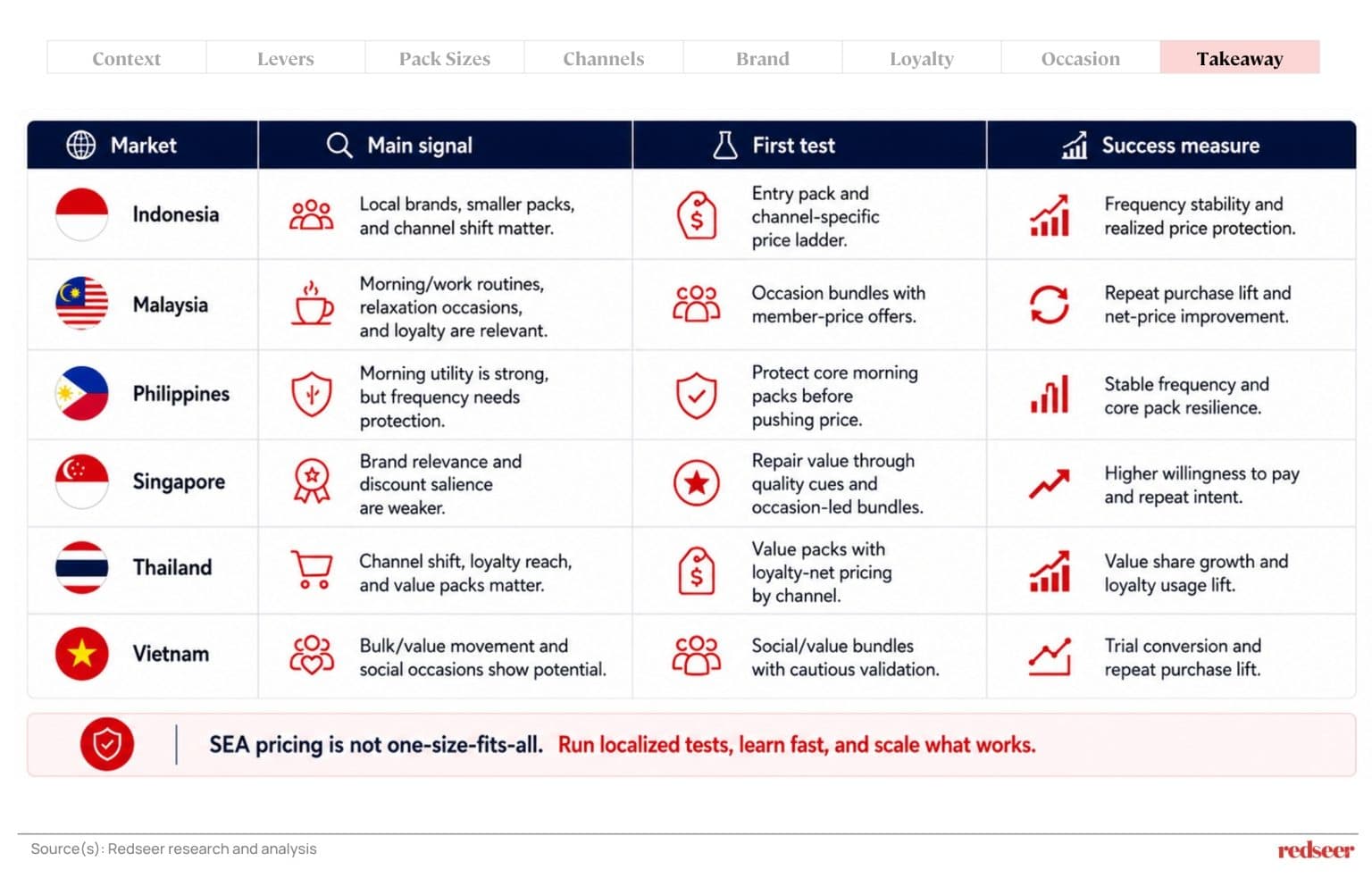
Consumer pressure is reshaping Southeast Asia, and winning responses must reflect how each market behaves
We notice that Indonesia is seeing stronger focus on smaller packs, local brands, and channel shifts, while Malaysia shows greater relevance for loyalty programs and occasion-based pricing. In the Philippines, protecting core morning routines matters most before pushing further price increases. Thailand highlights the importance of coordinating channels, loyalty, and value packs, while Vietnam shows growing interest in social occasions and bulk-value formats. Singapore stands out for weaker discount relevance and lower willingness to pay.
So F&B companies should run localized tests, learn quickly, and scale what works market by market.

Written by
Roshan Behera
Partner
Roshan is a Partner based in Singapore and focuses on Southeast Asia. His sector coverage includes e-commerce, logistics, fintech, eB2B, on-demand services, and other emerging sectors.


Viet-Nomics: Southeast Asias Rising Economic Star

USD 30 Bn Market in Motion: New Revenue Models Shaping Mobility & Delivery in SEA

Capability Is the New Brand: How Beauty’s Moat Moved Down the Value Chain

Cracking the Code on Indonesia’s Fitness Trend

Rebuilding the Restaurant P&L: Reimagining Southeast Asian F&B

SEA Food Consumption: Where the Meal Earns the Bill

Quick Commerce: Winning SEA through Categories, Channels and Occasions

Inside discount retail: Winning on thin margins

The Singapore Launchpad: When local proof is enough to build an overseas consumer brand

From Local Fashion Brands to Regional Consumer Leaders

Dancing with Dragons: Southeast Asia’s Guide to Competing and Collaborating with Chinese Giants

Rewriting the Recipe: Why Healthier Snacks Are Gaining Ground in Indonesia
Viet-Nomics: Southeast Asias Rising Economic Star
USD 30 Bn Market in Motion: New Revenue Models Shaping Mobility & Delivery in SEA
Capability Is the New Brand: How Beauty’s Moat Moved Down the Value Chain
Cracking the Code on Indonesia’s Fitness Trend
Rebuilding the Restaurant P&L: Reimagining Southeast Asian F&B
SEA Food Consumption: Where the Meal Earns the Bill