The Singapore Launchpad: When local proof is enough to build an overseas consumer brand

Singapore is a strong consumer market, so local success deserves more credit than it often gets. The country gives brands access to affluent consumers, dense retail infrastructure, reliable logistics, and high service expectations. A brand that wins in Singapore has usually passed a demanding first test.
The challenge starts when the brand has proven demand at home but needs a larger customer base to keep growing. At that point, overseas expansion becomes less about ambition and more about evidence: customer pull, price fit, channel control, operating discipline, and capital timing.
This report looks at how Singapore consumer brands have built overseas scale, which expansion routes are available, and what founders and investors should test before backing the next market.
Singapore proves brand quality, while the larger growth runway often opens overseas
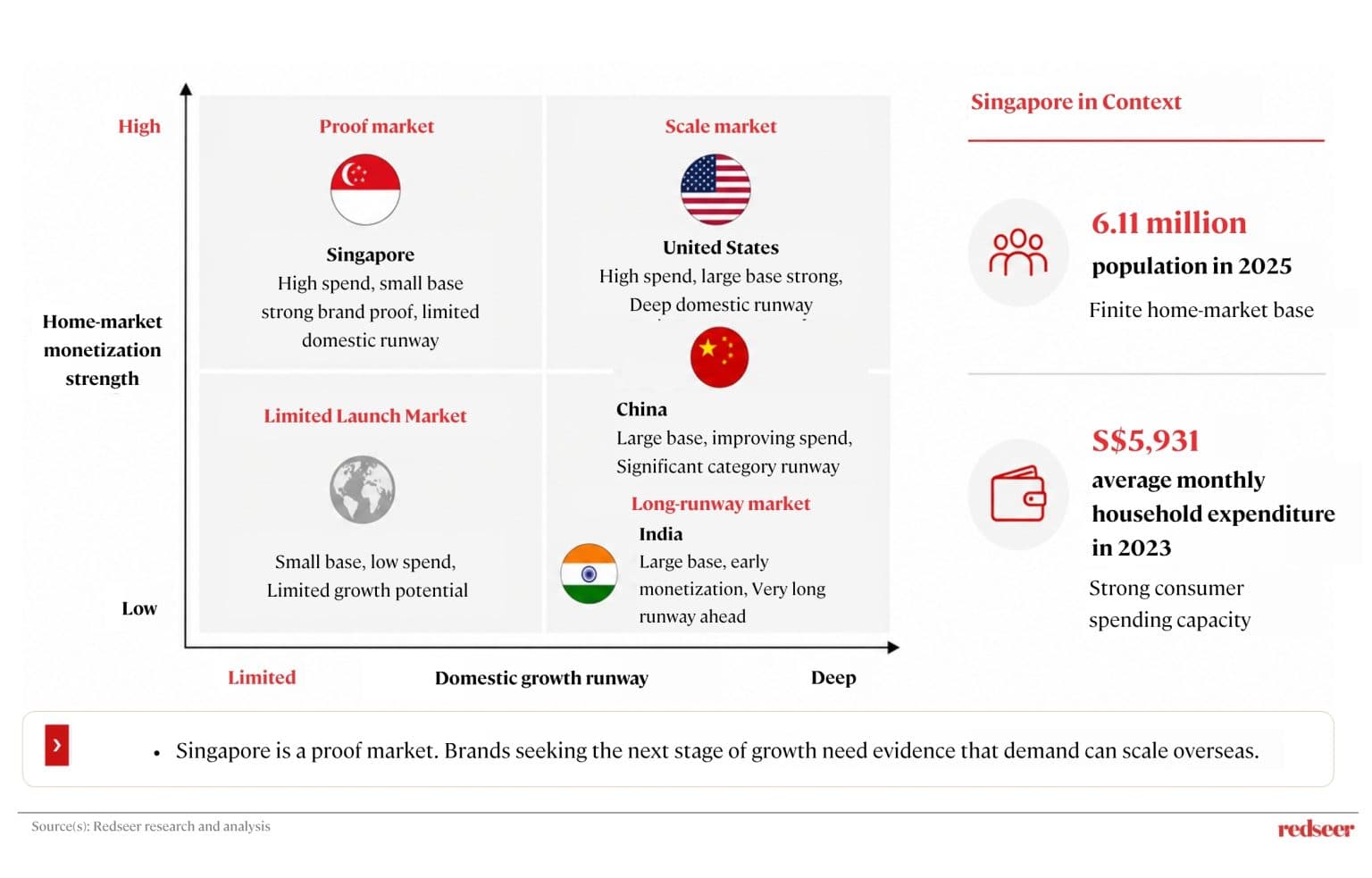
Singapore provides a quality test market. It has a compact base of high-spending consumers, strong retail infrastructure, and demanding service standards. These conditions help brands test product quality, pricing power, customer experience, and brand trust.
The constraint is category depth. A city market can support strong brands, but many categories eventually run into limited household count, store runway, or local customer base. The strongest founder question is therefore specific: has Singapore validated the brand, and is there enough domestic headroom for the next growth stage?
The breakout brands show proof through overseas revenue, stores, and channel depth
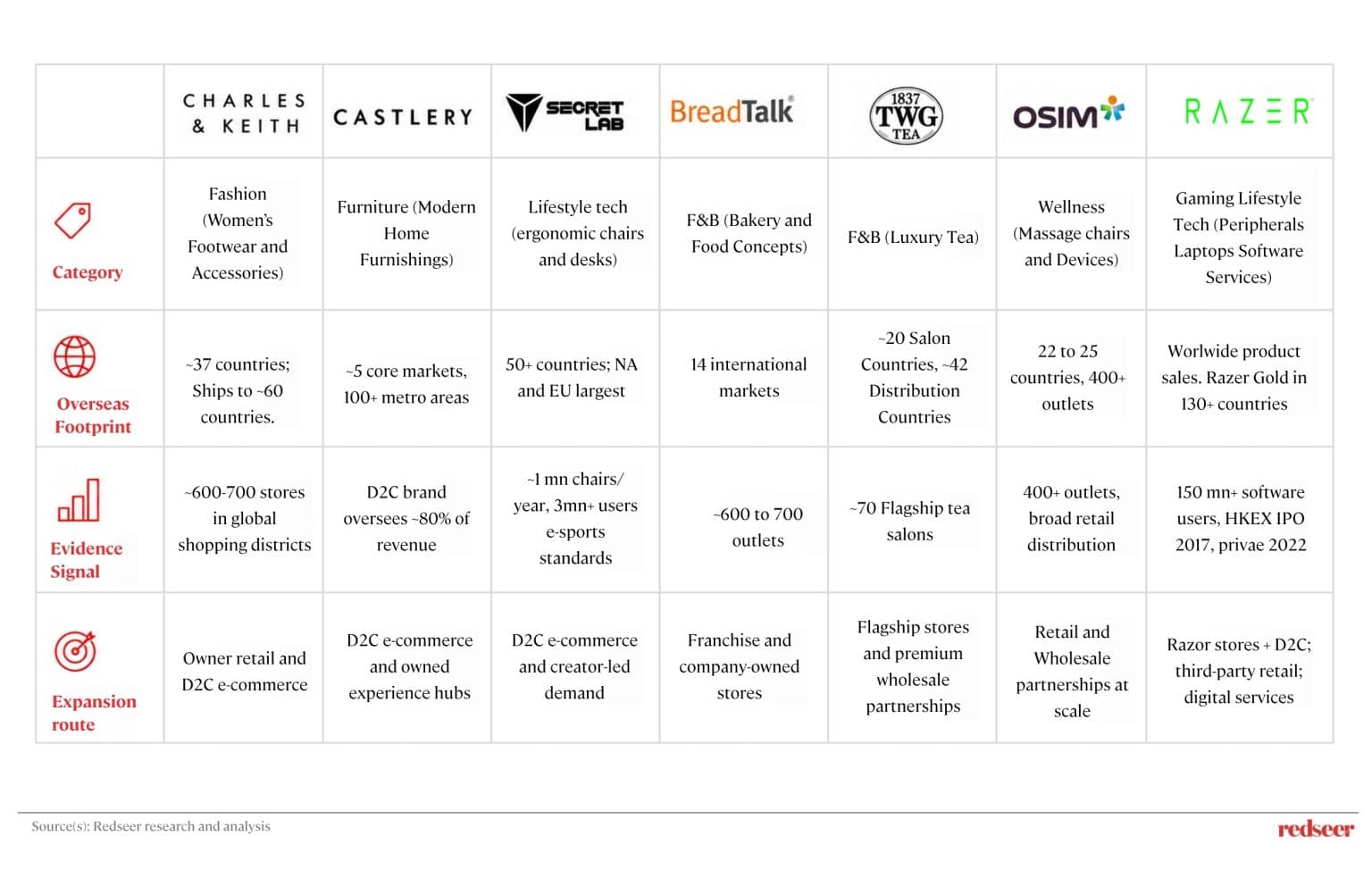
Singapore has already produced consumer brands with measurable overseas presence across fashion, furniture, gaming hardware, F&B, premium tea, and wellness. The evidence shows up in different forms: store networks, overseas revenue mix, international customer base, market footprint, and distribution reach.
The examples offer a wide set of options for Singapore founders. Charles & Keith, Castlery, Secretlab, BreadTalk, TWG Tea, OSIM, and Razer did not all scale through the same route.
Their paths show that Singapore brands can expand through retail, D2C, F&B platforms, premium positioning, and multi-market operations…
Singapore Brands scale through four routes: SEA Depth, Global Premium, D2C-led Growth and Retail Partners
Want to get strategic guidance?
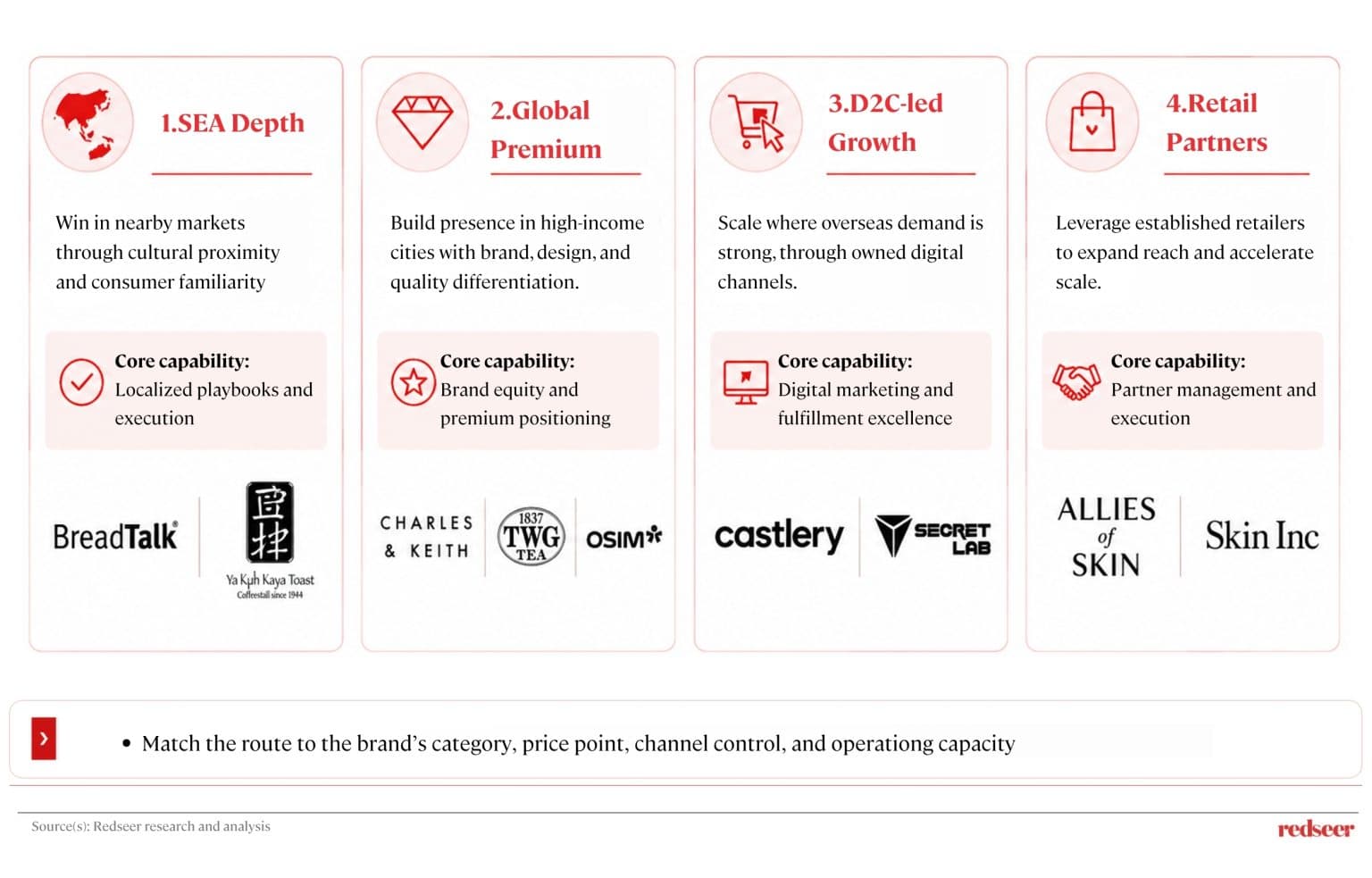
Singapore brands have expanded abroad across four broad routes. Some build SEA depth through stores, country teams, franchisees, or partners. Some use premium positioning to enter global cities. Some build overseas demand through D2C channels before adding physical presence. Others scale through established retail partners.
The route matters because each path requires different capabilities. SEA depth needs local adaptation and partner control. Global premium needs brand strength and service standards. D2C-led growth needs fulfilment, customer acquisition, and service. Retail partners need channel negotiation and merchandising discipline.
Expansion gains traction when demand, pricing, channels, operations, and capital line up
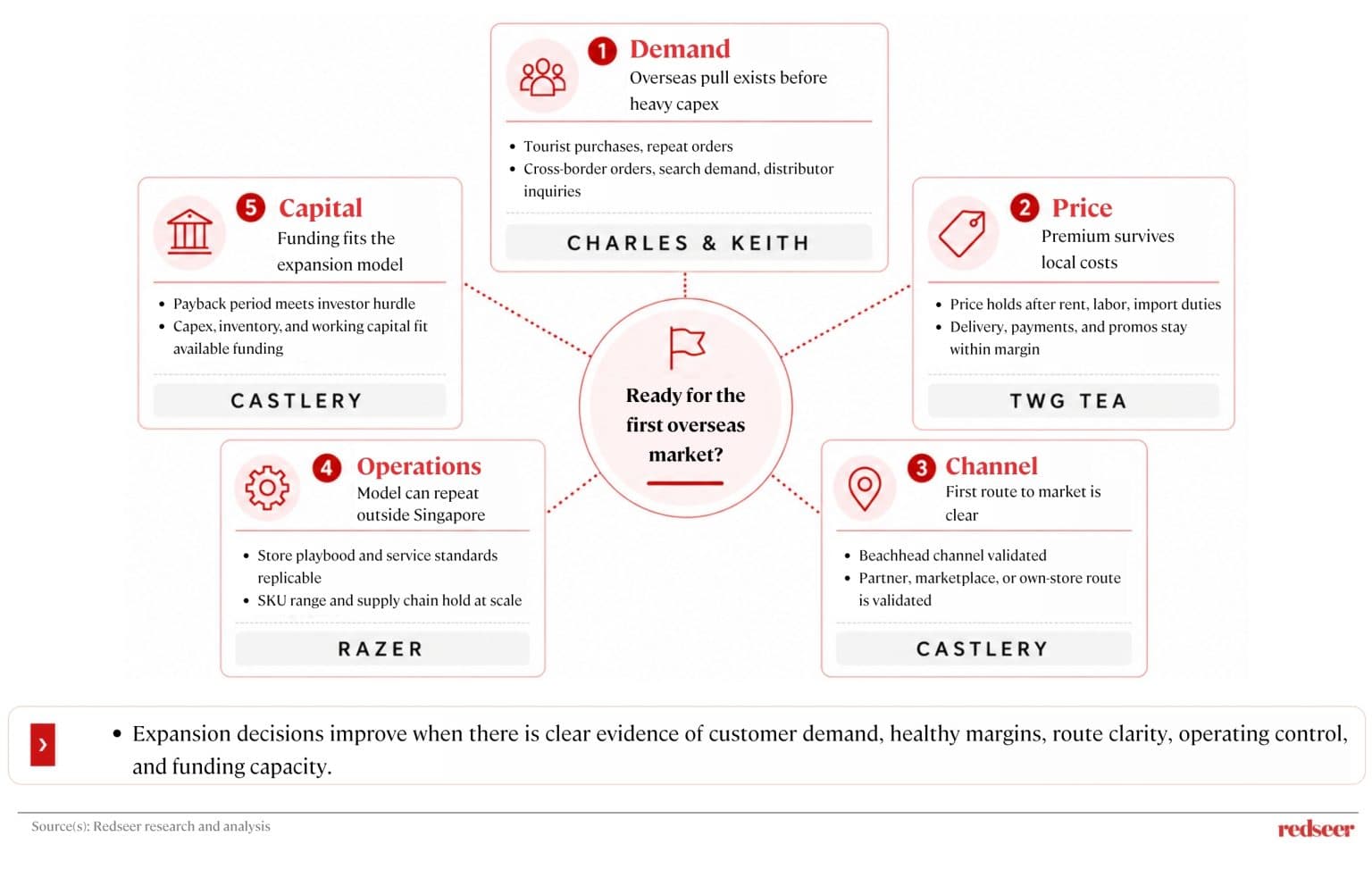
Overseas expansion starts with five tests. The first is demand: customers outside Singapore must show clear interest or early purchase behavior. The second is price: the product must work after local costs, duties, rent, partner terms, or delivery costs are included.
The next three tests are channel, operations, and capital. The brand needs a clear first route to market, an operating model that can maintain quality outside Singapore, and funding that fits the pace of expansion. Passing these tests does not guarantee success, but it gives founders and investors a cleaner basis for action.
Overseas unit economics point the way for scale funding
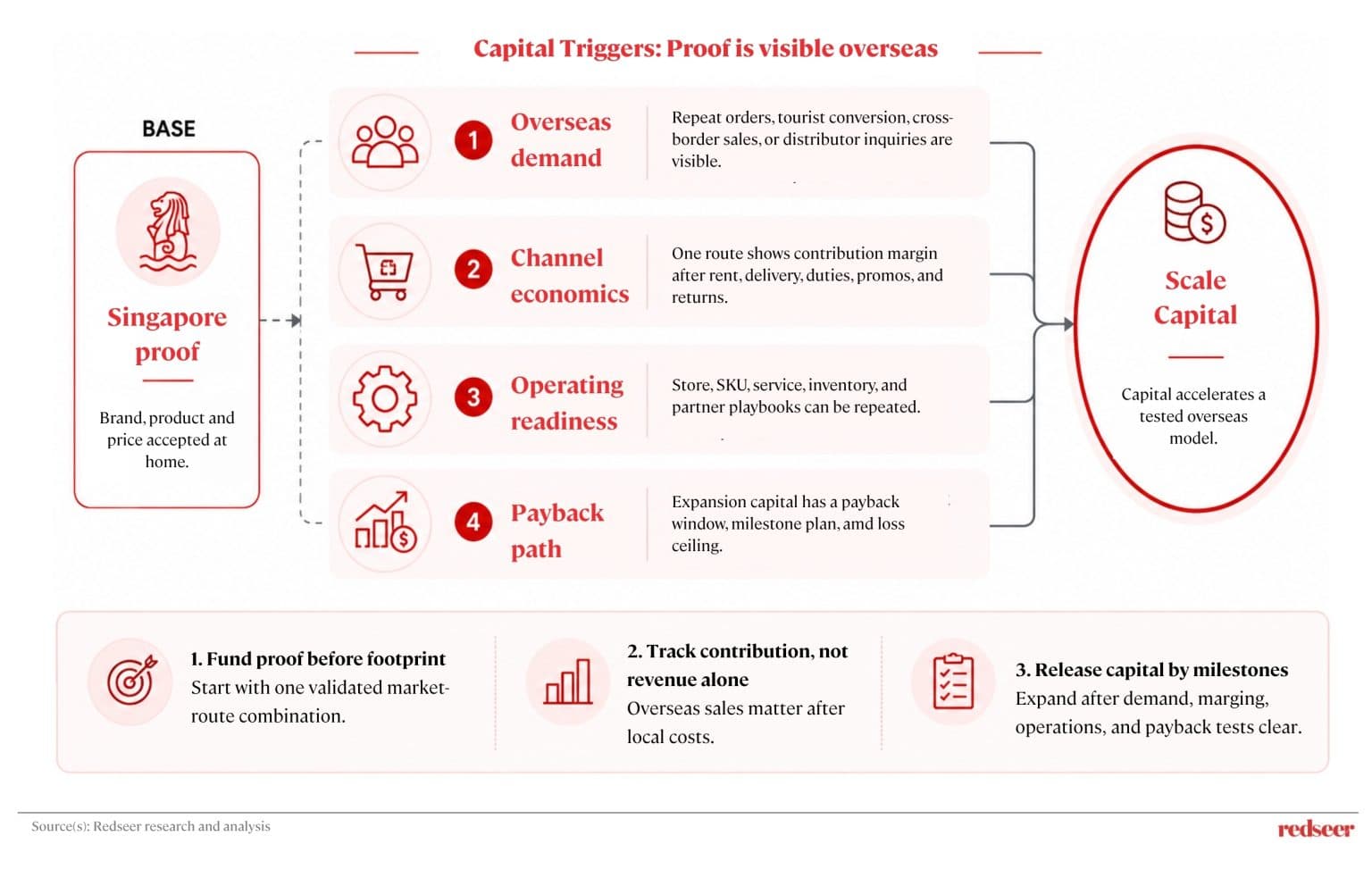
Scale capital fits brands that have moved beyond Singapore proof and can show evidence outside the home market. The strongest funding case has four triggers: overseas demand, channel economics, operating readiness, and a clear payback path.
Market-entry support can help a brand test new countries, but scale funding should accelerate a model with evidence behind it. Capital is most useful when the brand has proven that customers outside Singapore want the product, the route to market can work, and the operating system can support a larger rollout.
Singapore can be a serious launchpad for consumer brands, but expansion needs more than a strong home-market story.
For founders, that means choosing the route that matches the brand’s economics and team capacity.
For investors, it means backing overseas expansion after the proof is visible, while the brand still has room to compound.

Written by
Roshan Behera
Partner
Roshan is a Partner based in Singapore and focuses on Southeast Asia. His sector coverage includes e-commerce, logistics, fintech, eB2B, on-demand services, and other emerging sectors.


Viet-Nomics: Southeast Asias Rising Economic Star

USD 30 Bn Market in Motion: New Revenue Models Shaping Mobility & Delivery in SEA

Capability Is the New Brand: How Beauty’s Moat Moved Down the Value Chain

The Key to F&B Expansion: From Operating Control to Scalable Growth

Redseer helps an e-commerce enabler double down and rise as a full-stack leader.

From Local Fashion Brands to Regional Consumer Leaders

Rebuilding the Restaurant P&L: Reimagining Southeast Asian F&B

Quick Commerce: Winning SEA through Categories, Channels and Occasions

Southeast Asia Beverage’s Selective- Spending Moment

SEA Food Consumption: Where the Meal Earns the Bill

Artificial Intelligence (AI) GTM in Southeast Asia: How B2B Founders Can Turn Pilots Into Revenue
Dancing with Dragons: Southeast Asia’s Guide to Competing and Collaborating with Chinese Giants
Viet-Nomics: Southeast Asias Rising Economic Star
USD 30 Bn Market in Motion: New Revenue Models Shaping Mobility & Delivery in SEA
Capability Is the New Brand: How Beauty’s Moat Moved Down the Value Chain
The Key to F&B Expansion: From Operating Control to Scalable Growth
Redseer helps an e-commerce enabler double down and rise as a full-stack leader.
From Local Fashion Brands to Regional Consumer Leaders