
Artificial Intelligence (AI) GTM in Southeast Asia: How B2B Founders Can Turn Pilots Into Revenue

SEA buyers are testing AI, but buying discipline is rising faster than AI enthusiasm. Enterprises are testing copilots, agents, and workflow tools, but founders still face a commercial gap: pilots do not always turn into paid deployment.
The constraint is usually linked to the buyer’s confidence that AI can improve a workflow without creating data, risk, cost, or accountability problems. This changes the Go-to-Market (GTM) question.
Founders need to know which workflow has a clear owner, which data can be used, which approvals matter, and which metric will prove value.
This note lays out a practical sequence for AI-native B2B founders. Details follow.
Southeast Asian AI Buyers are moving toward workflow proof
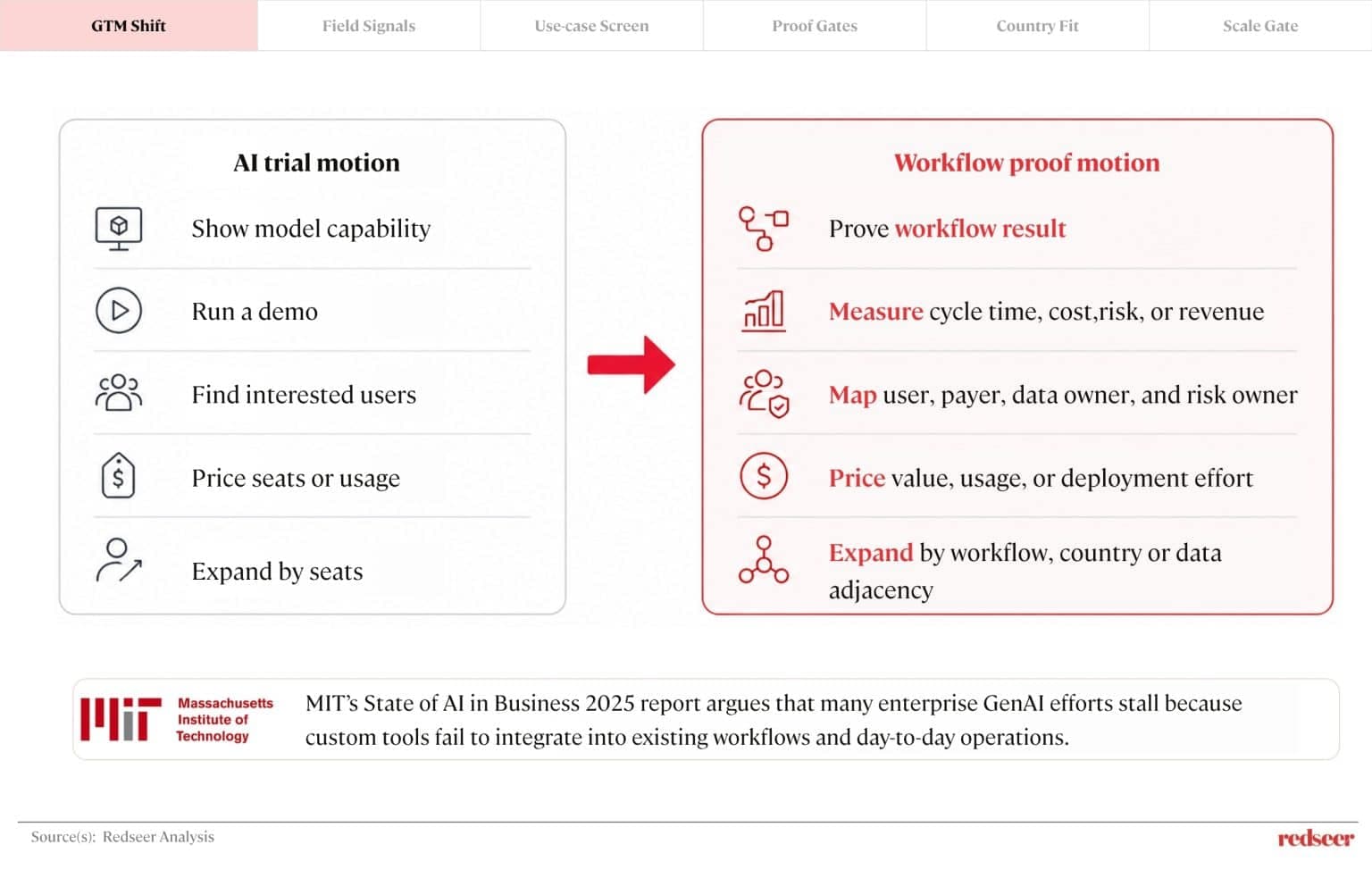
AI buyers in Southeast Asia are becoming more practical. A strong demo can open the door, but paid deployment needs a clearer link to the work being done.
Buyers want to see where AI reduces turnaround time, manual effort, cost leakage, error rates, or approval delays. That pushes founders to start with the workflow, not the product category. The first sales conversation should make the workflow visible: who owns it, what result matters, what data is needed, and how the buyer will know that the pilot worked.
Users’ Pain, Data, and Trust are defining the best entry points
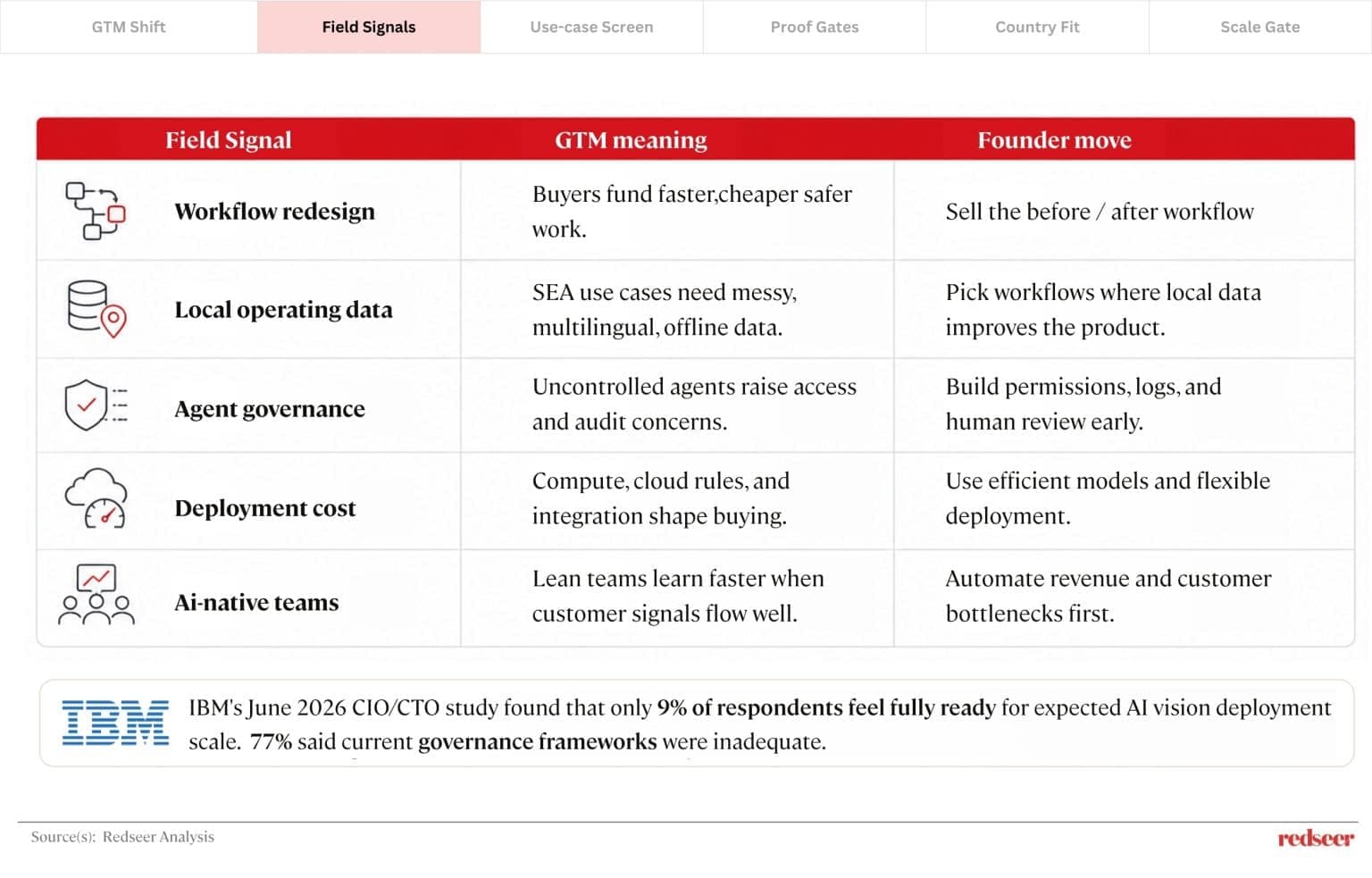
The most useful field signals point to a narrower opportunity map. Strong entry points sit where the workflow pain is felt often, the data path is workable, and the buyer can accept the risk controls.
In Southeast Asia, this often means local operating data, fragmented systems, multilingual users, and practical cost limits. Agents add another buying gate because enterprises need audit trails, permissions, and human review.
So, founders can better screen opportunities by pain, data, trust, and cost before investing sales time.
Winning teams are starting where the buyer owns the problem and the result is measurable
Want to get strategic guidance?
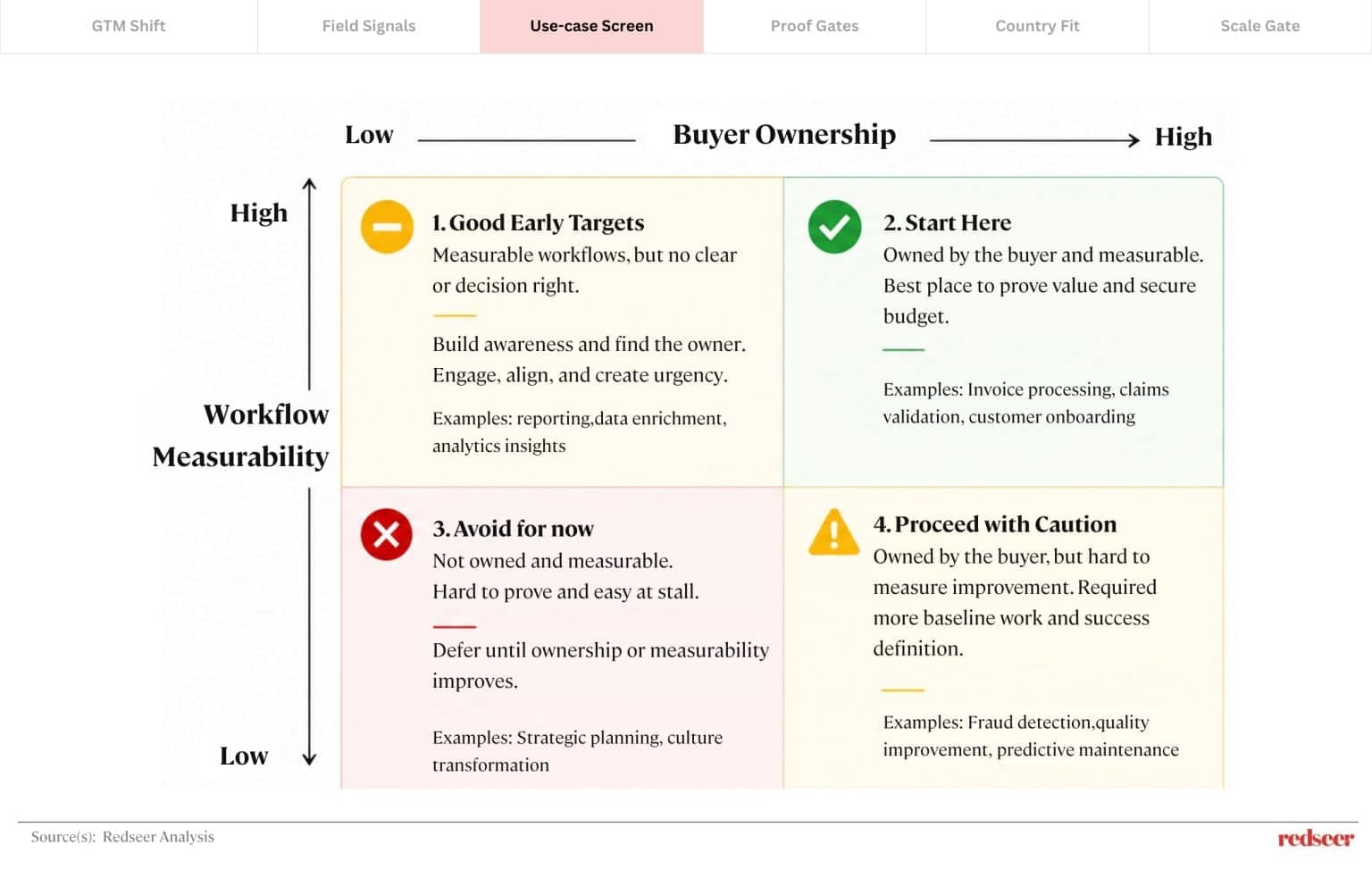
The first use case should sit where ownership and measurability overlap. Customer support, sales operations, and finance operations often work well because the result shows up in queues, backlog, response time, conversion, cost leakage, or error rates.
The best pilots qualify Budget, Data, Trust, and Payback
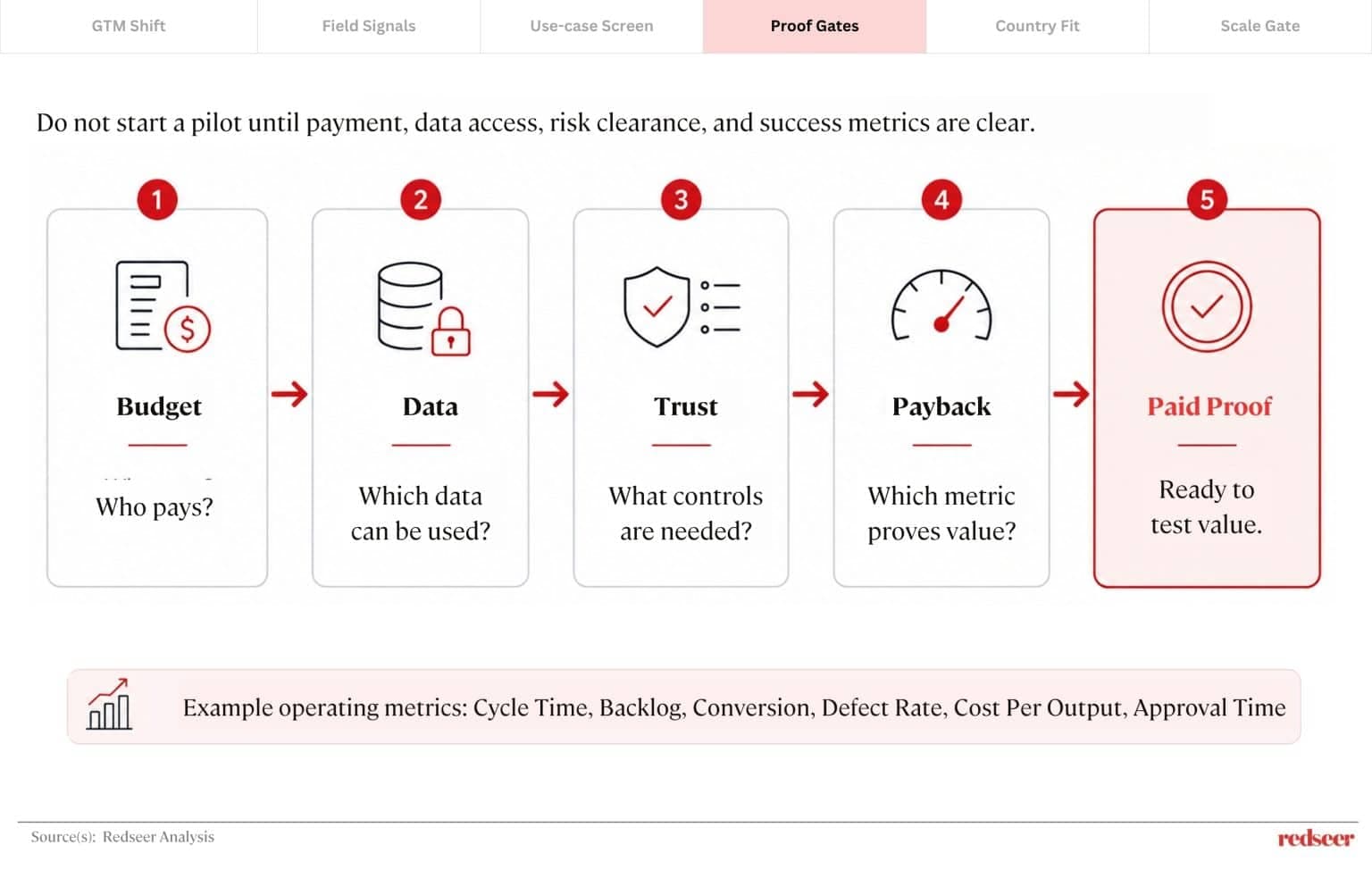
A pilot should begin only when four answers are clear: who funds it, which data can be used, what controls are required, and which metric proves value. Without these answers, the pilot becomes free implementation work rather than a path to paid deployment.
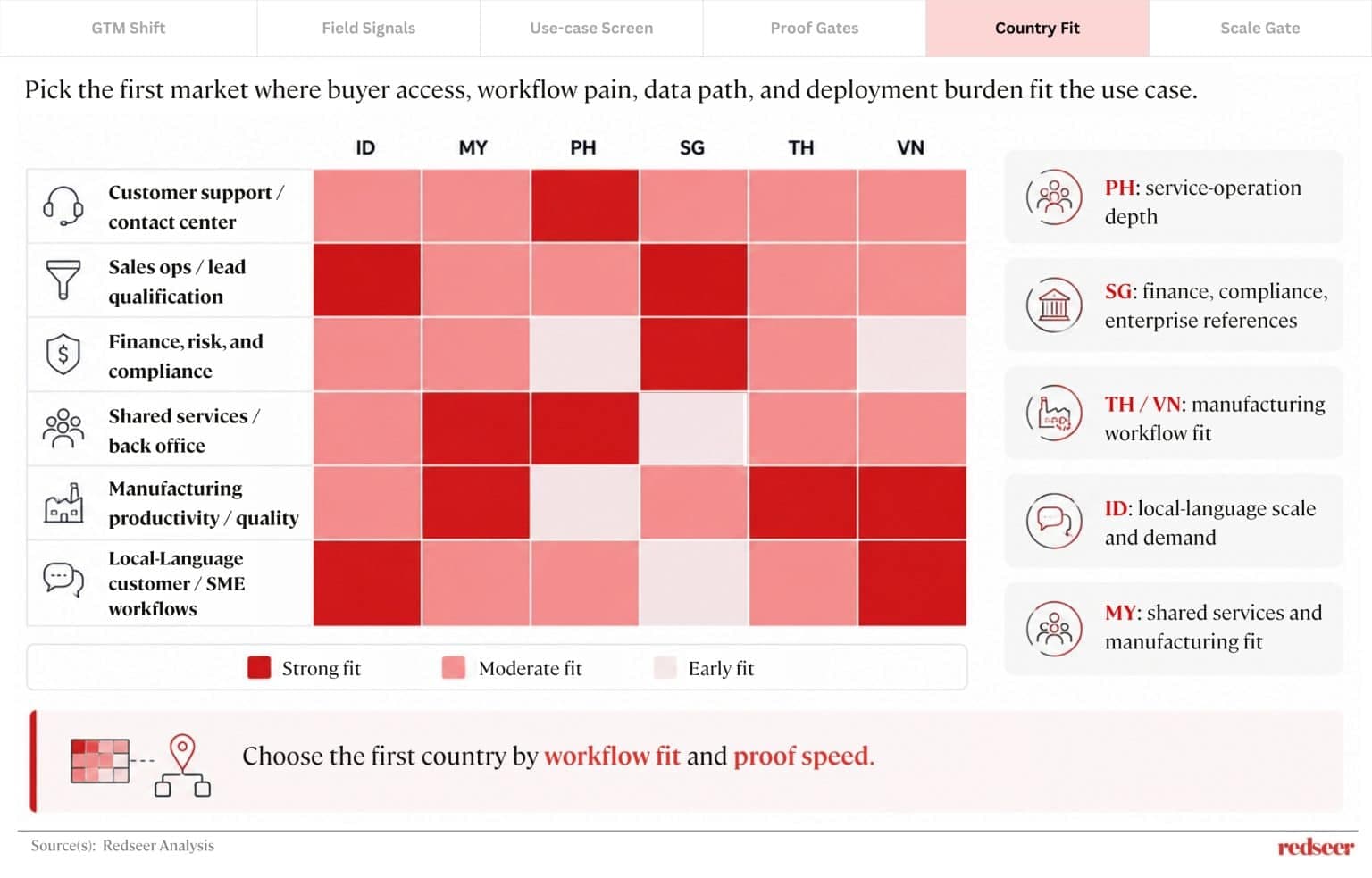
Workflow fit decides the first country
Country entry should follow the workflow being sold. Contact-center AI may point to the Philippines; compliance and finance workflows may suit Singapore; manufacturing tools fit Thailand or Vietnam; local-language SME automation may start in Indonesia; shared- services workflows may fit Malaysia. The best first country is where proof can be sold, delivered, trusted, and repeated.
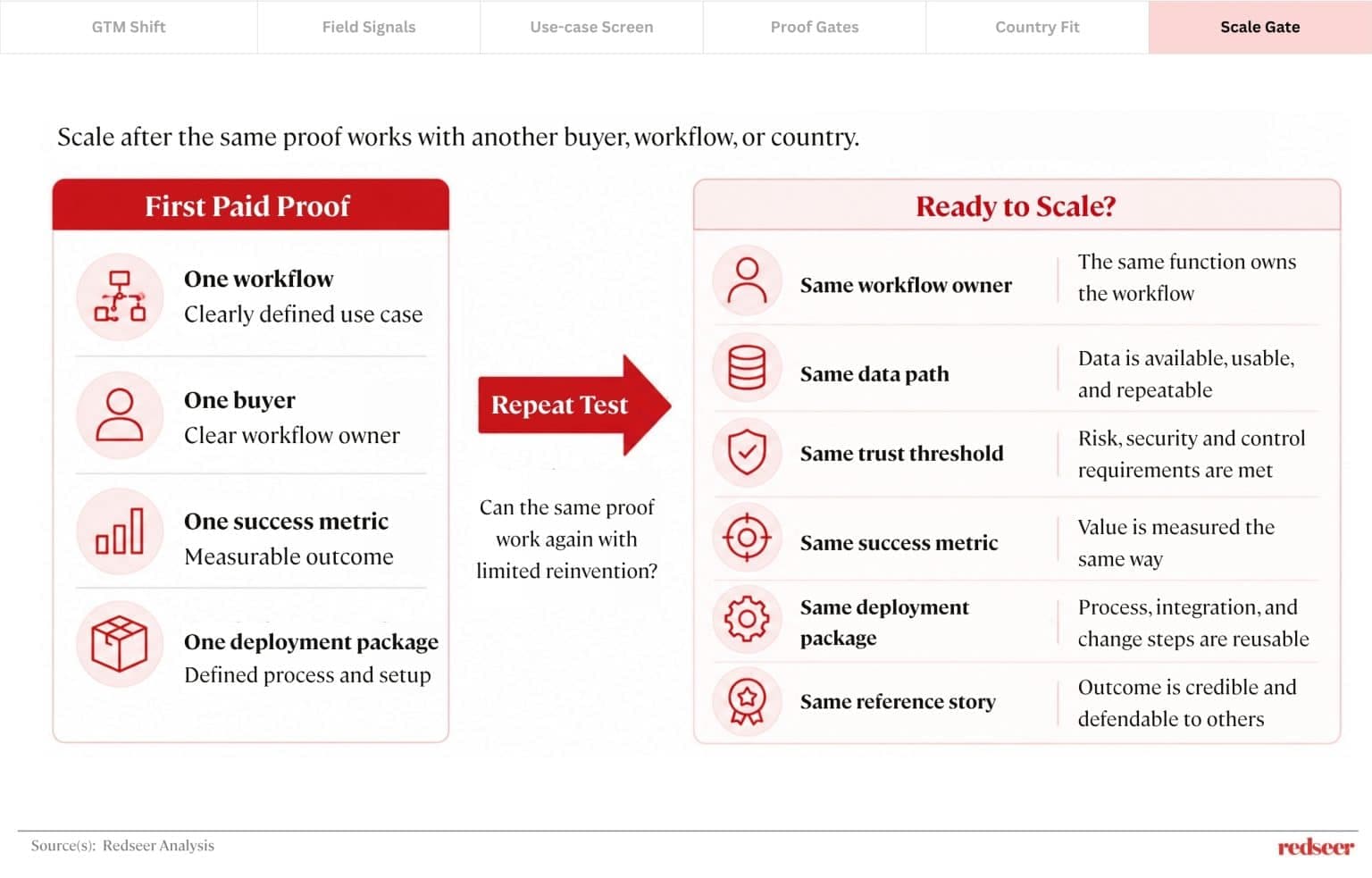
Scaling is possible when the proof can repeat
Expansion should wait until the first proof can be repeated. Interest from another country, function, or buyer type is useful, but not enough. It is important to confirm that the same workflow owner, data path, risk threshold, success metric, deployment package, and reference story can repeat. Otherwise, scale becomes custom delivery. Drop us a line if you want to discuss this topic in greater detail.

Written by
Roshan Behera
Partner
Roshan is a Partner based in Singapore and focuses on Southeast Asia. His sector coverage includes e-commerce, logistics, fintech, eB2B, on-demand services, and other emerging sectors.


Viet-Nomics: Southeast Asias Rising Economic Star

USD 30 Bn Market in Motion: New Revenue Models Shaping Mobility & Delivery in SEA

Capability Is the New Brand: How Beauty’s Moat Moved Down the Value Chain

Embedded Insurance in Southeast Asia

Southeast Asia’s Beauty Aesthetics Clinics Market

Artificial Intelligence: Everything, Everywhere, All At Once

The $6 Tn Question: Who Wins SEA’s Digital Payment War?

Delivering strategic insights and M&A identification for a regional SaaS player

Redseer helps an e-commerce enabler double down and rise as a full-stack leader.

Redseer Enables the Regional E-commerce Leader to achieve Competitive Differentiation via Logistics Partnership

The Singapore Launchpad: When local proof is enough to build an overseas consumer brand

Quick Commerce: Winning SEA through Categories, Channels and Occasions
Viet-Nomics: Southeast Asias Rising Economic Star
USD 30 Bn Market in Motion: New Revenue Models Shaping Mobility & Delivery in SEA
Capability Is the New Brand: How Beauty’s Moat Moved Down the Value Chain
Embedded Insurance in Southeast Asia
Southeast Asia’s Beauty Aesthetics Clinics Market
Artificial Intelligence: Everything, Everywhere, All At Once