Quick Commerce: Winning SEA through Categories, Channels and Occasions

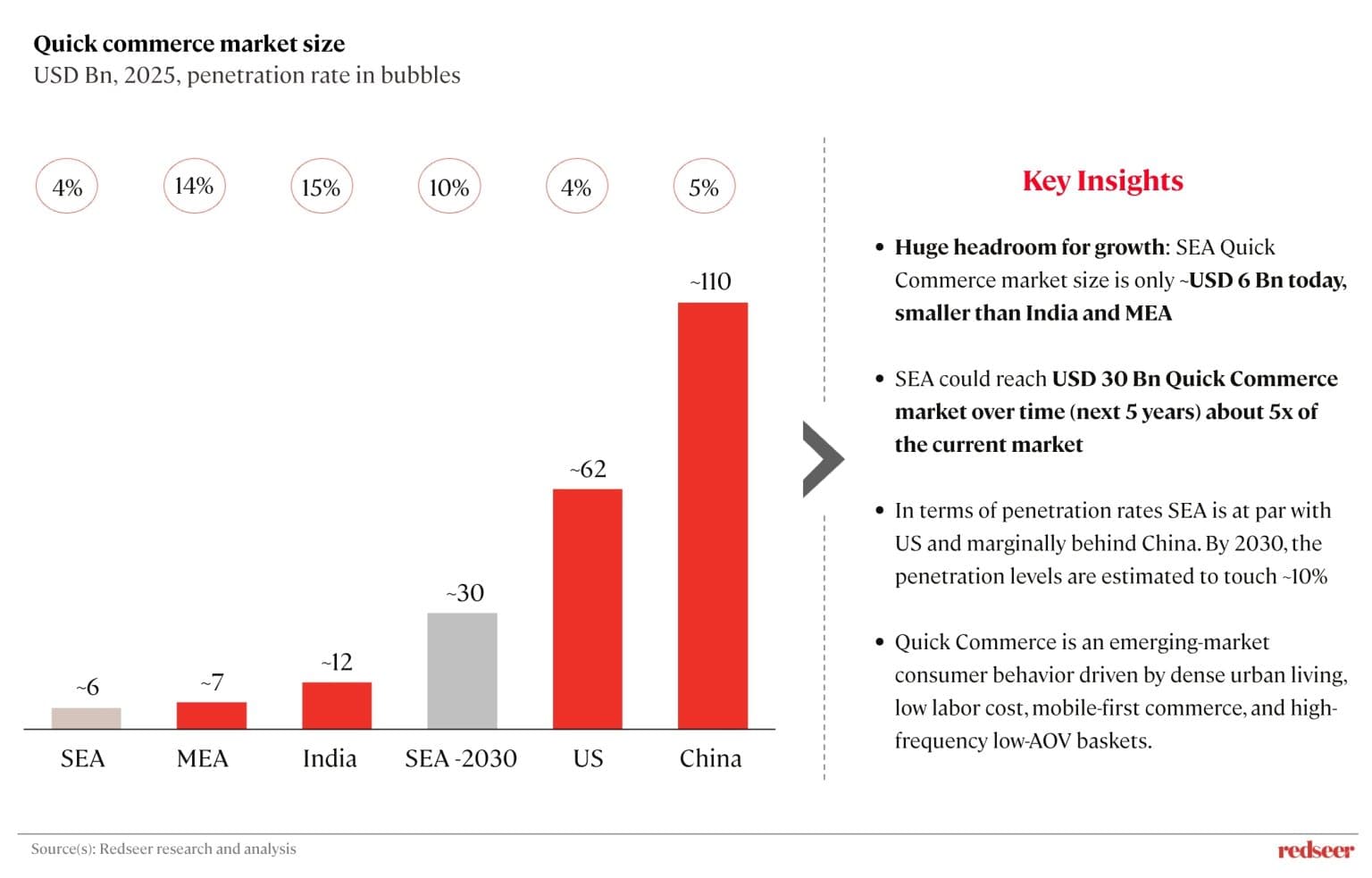
At ~USD 6 Bn today, Southeast Asia’s Quick Commerce (QC) market is smaller than those in India, the Middle East, the US, and China. Yet the foundations for rapid growth are firmly in place: dense urban catchments, mobile-first consumers, cost-efficient delivery networks, and high-frequency, low-basket-value purchasing behaviour.
Three models are competing to define the market: pure-play dark-store operators, marketplace-embedded Quick Commerce, and retailer-led O2O fulfilment. Each follows a distinct path to scale, operates with different economics, and creates different opportunities for brands.
Drawing on our latest primary research, we find that long-term winners will be those that can consistently balance speed, affordability, reliability, and basket economics while achieving profitable scale.
For consumer brands, success will require tailored channel strategies rather than a one-size-fits-all approach across Quick Commerce models.
SEA’s Quick Commerce market is relatively small at ~ USD 6 Bn, but structural conditions support a multi-year growth runway
At USD 6 Bn today, SEA’s Quick Commerce market is smaller than India and the Middle East, but the structural parallels- dense urban populations, low labour costs, mobile-first commerce, and high-frequency, low-AOV baskets remain.
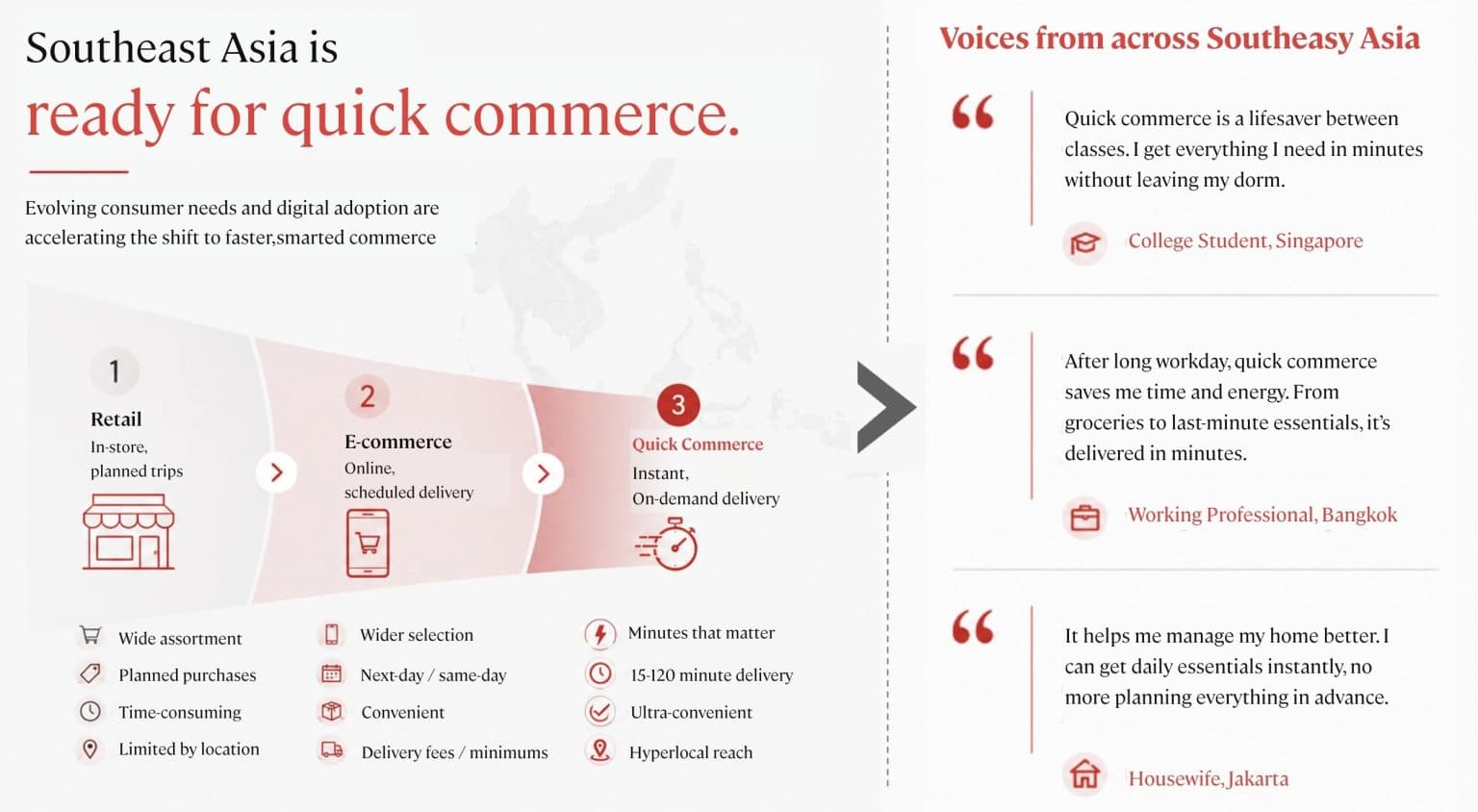
SEA consumers are ready for quick commerce, with convenience under time pressure emerging as a key growth driver
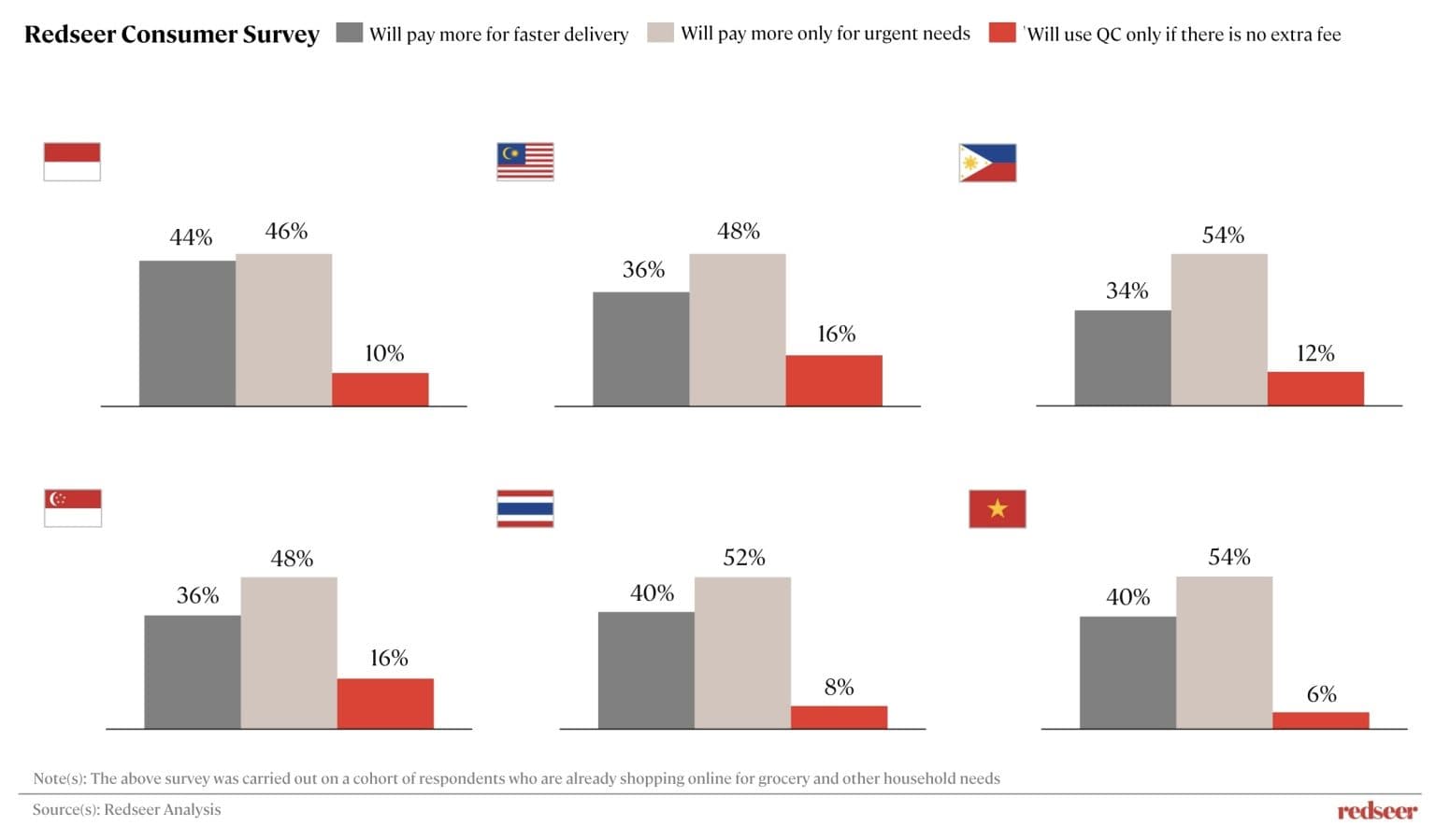
Speed has pricing power in SEA quick commerce, but urgency unlocks the larger premium pool
Want to get strategic guidance?
Across Southeast Asia, consumers value speed, but not as a universal premium proposition. While 34–44% of surveyed online shoppers are willing to pay more for faster delivery, a larger 46–54% will pay a premium only when the item is needed urgently. This points to an occasion-led model: QC players should monetize speed around high-intent missions, while keeping the broader proposition reliable, affordable, and convenient
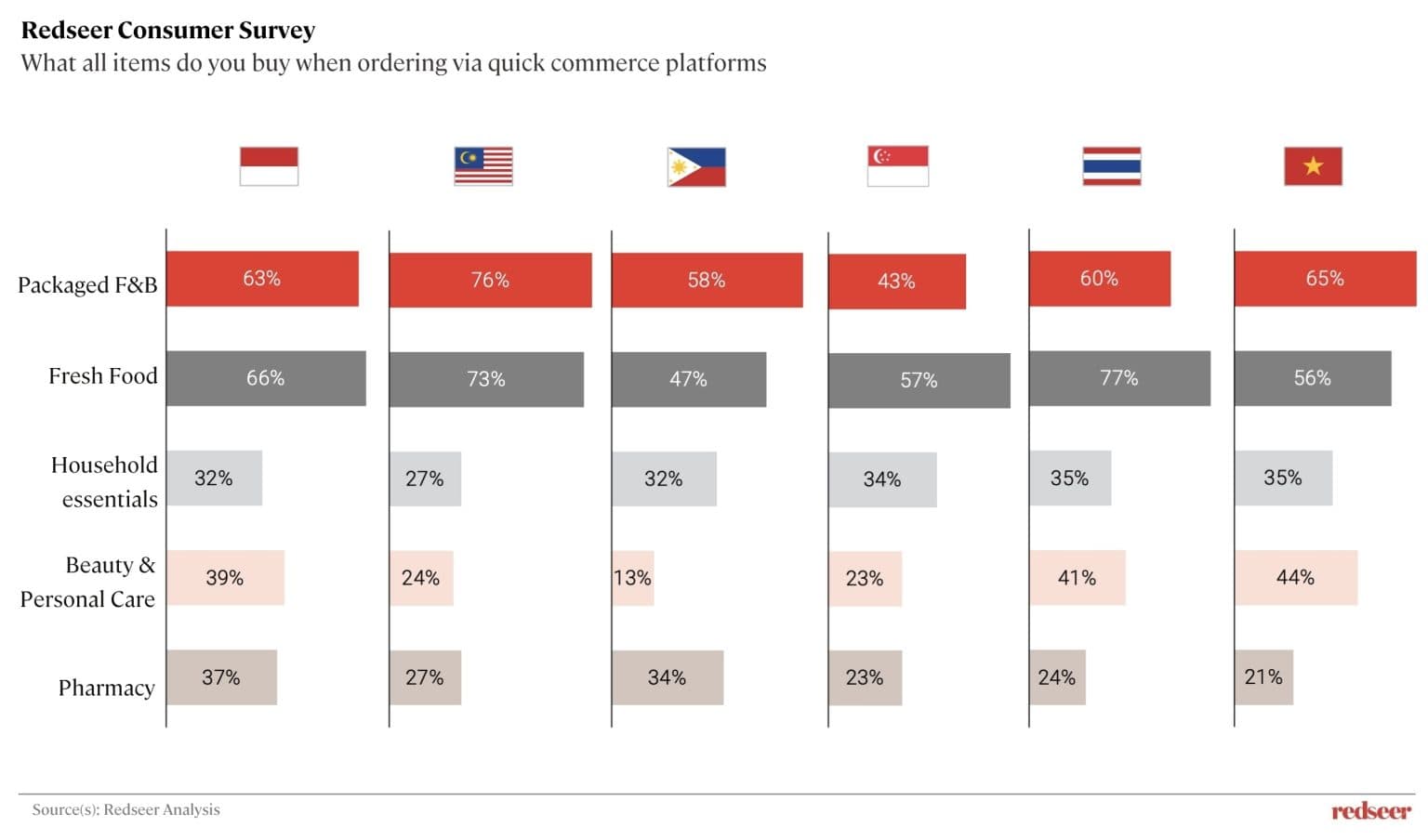
Fresh and packaged F&B create Quick Commerce frequency, while beauty and pharmacy offer higher-margin expansion pockets
Fresh food and packaged F&B are the undisputed anchor categories driving quick commerce adoption across all six SEA markets. The more interesting signal is beauty and personal care, at 41% in Thailand and 44% in Vietnam; this category is punching well above its traditional Quick Commerce weight, pointing to premiumization and impulse-purchase dynamics that brands should be actively exploiting. Philippines stands out as the most conservative market across all categories, likely reflecting infrastructure constraints and lower Quick Commerce maturity.
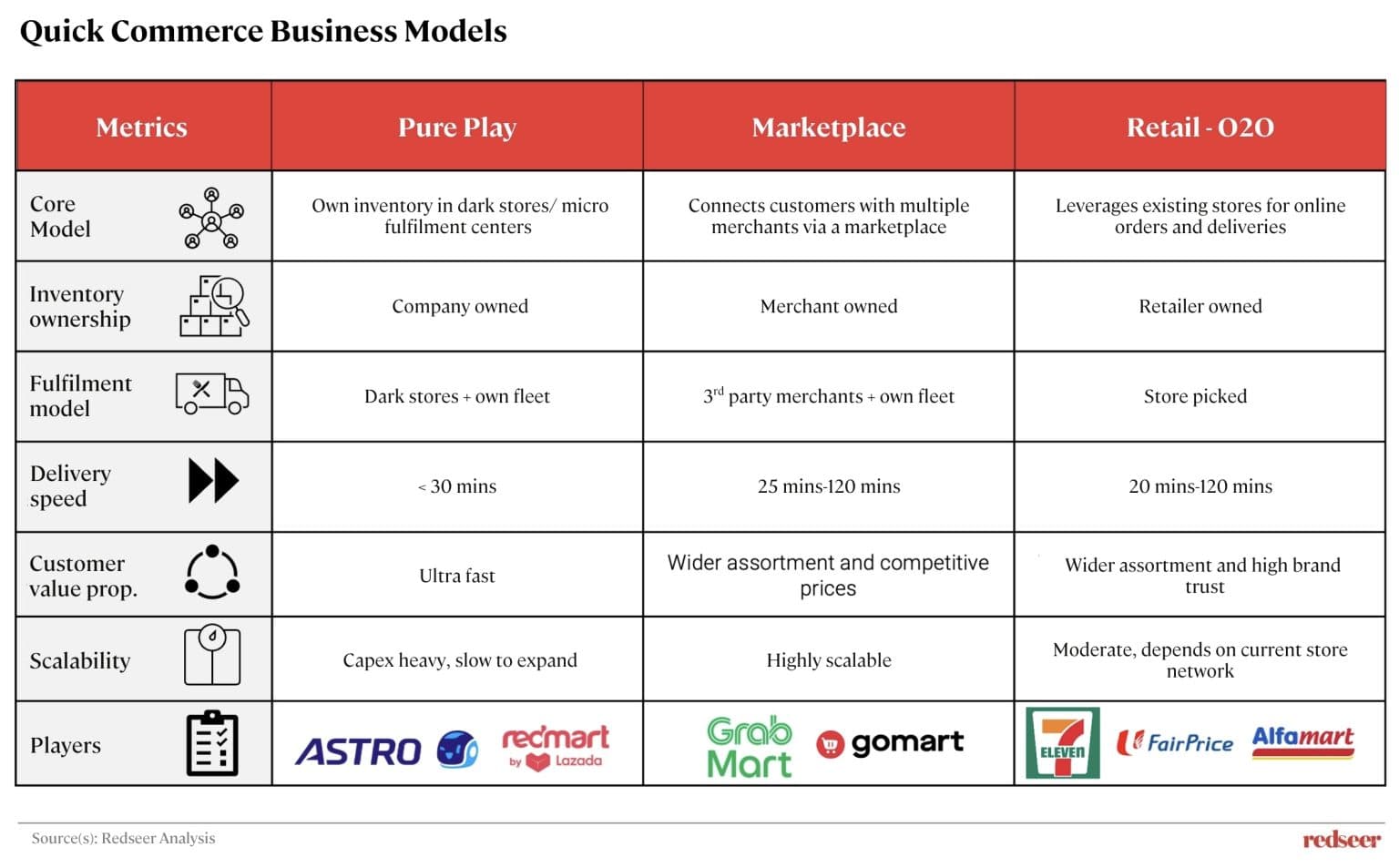
Marketplace and Retail (O2O) could emerge as the most resilient quick commerce models in Southeast Asia
Pure-play Quick Commerce (Astro, RedMart) offers the best consumer experience but is capex-heavy and burns cash until density thresholds are met, making it a high-risk, high-reward bet. Marketplaces like Grab Mart trade experience for capital efficiency: asset-light and highly scalable, but prone to weak loyalty. O2O retailers hold the most defensible position near-term by leveraging existing store infrastructure, though slower innovation and non-optimized store layouts cap their Quick Commerce ceiling
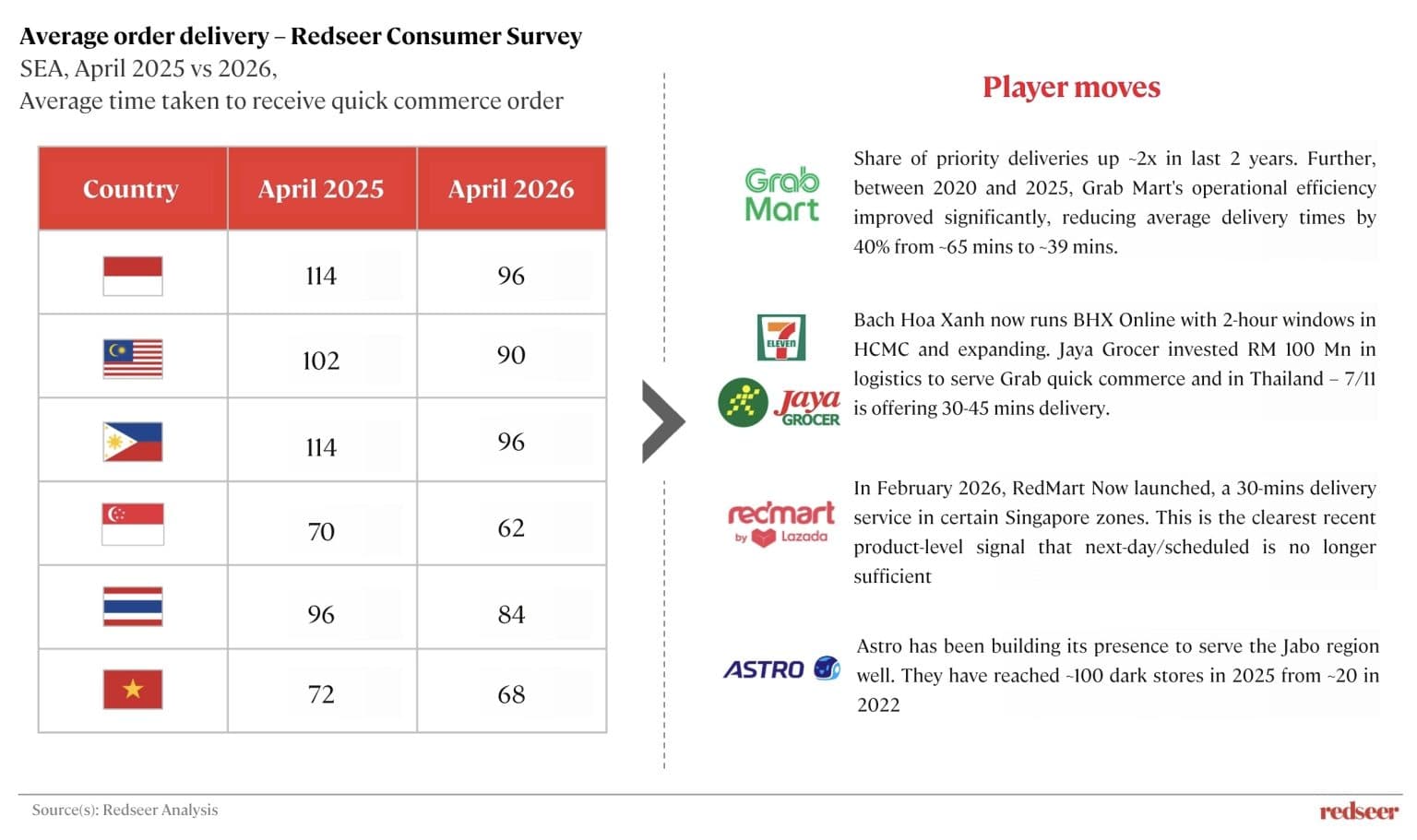
The next Quick Commerce battleground moves to fulfillment reliability as players look beyond headline delivery speed
Quick commerce players across Southeast Asia are investing in logistics, dark stores, and fulfillment capabilities to compress delivery times and improve service reliability. Average delivery times have reduced across markets over the past year, supported by targeted initiatives from leading players such as Grab, BHX, RedMart, and Astro. Notably, operators are moving beyond next-day delivery toward sub-hour fulfilment, reflecting growing confidence in demand for faster convenience. As consumer willingness to pay for speed strengthens, operational excellence is becoming a competitive differentiator in the region’s quick commerce race.
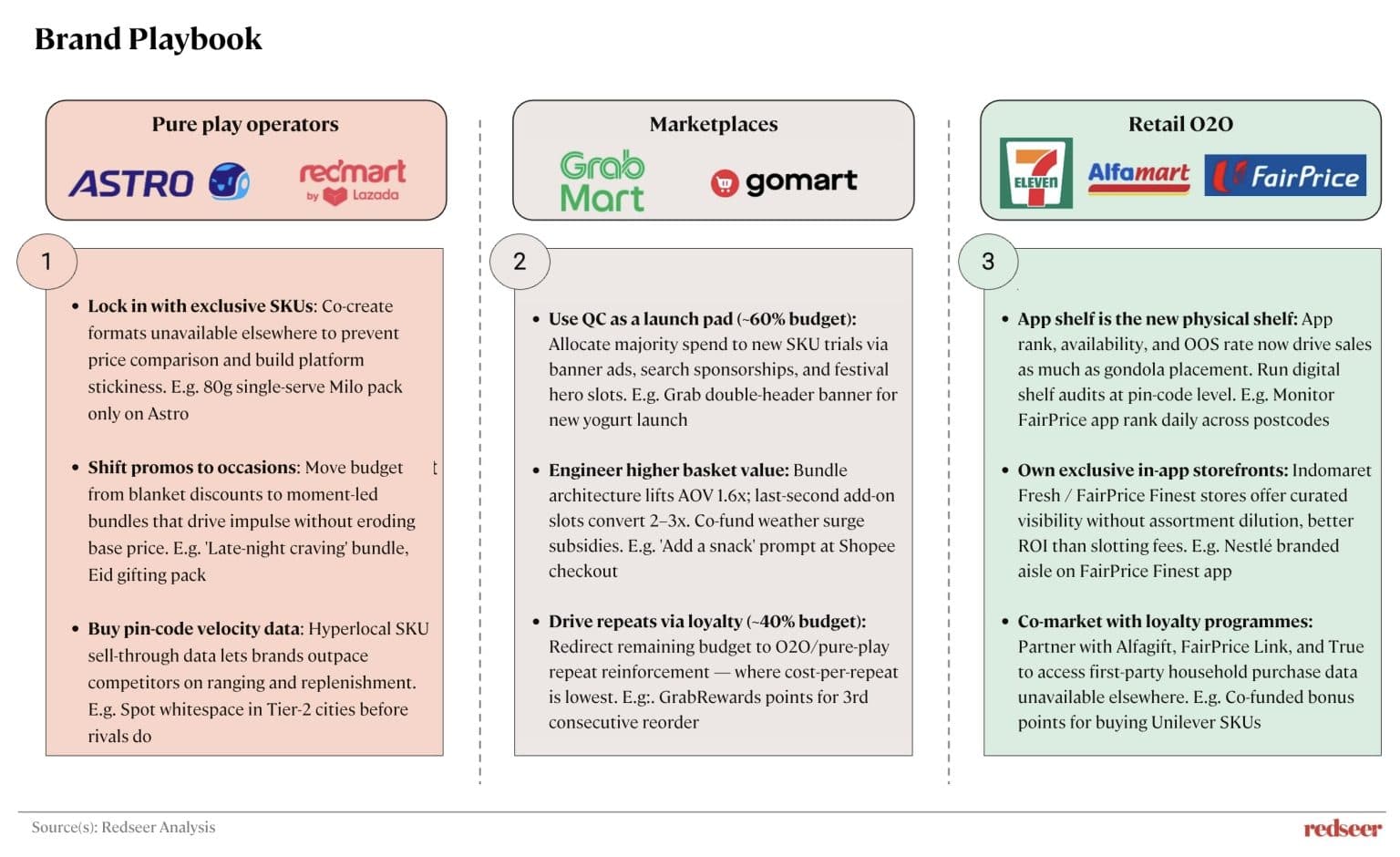
Brands need three Quick Commerce playbooks: exclusive range for pure-play, basket engineering for marketplaces, and digital shelf control for O2O
For brands, the winning brand playbook is therefore model-specific. Each model changes the levers of growth. Pure-play platforms reward exclusive SKUs and rapid assortment testing. Marketplaces reward launch visibility, bundling, and repeat incentives. Retailer-led O2O rewards app-rank control, in-stock discipline, and branded digital shelf presence, not channel-generic.

Written by
Roshan Behera
Partner
Roshan is a Partner based in Singapore and focuses on Southeast Asia. His sector coverage includes e-commerce, logistics, fintech, eB2B, on-demand services, and other emerging sectors.


Viet-Nomics: Southeast Asias Rising Economic Star

USD 30 Bn Market in Motion: New Revenue Models Shaping Mobility & Delivery in SEA

TikTok-isation of retail? Quick Commerce in Southeast Asia – the USD 35 Bn future of retail waiting to be unlocked!

Rebuilding the Restaurant P&L: Reimagining Southeast Asian F&B

Inside discount retail: Winning on thin margins

Quick Commerce in SEA: How Early Movers Are Building the Next $35B Giants

From Local Fashion Brands to Regional Consumer Leaders

The Singapore Launchpad: When local proof is enough to build an overseas consumer brand

Southeast Asia Beverage’s Selective- Spending Moment
Dancing with Dragons: Southeast Asia’s Guide to Competing and Collaborating with Chinese Giants

SEA’s USD 123 Bn Remittance Market: Fragmented Landscape, Focused Winners

SEA BNPL: Superior Unit Economics Powering Sustainable Growth
Viet-Nomics: Southeast Asias Rising Economic Star
USD 30 Bn Market in Motion: New Revenue Models Shaping Mobility & Delivery in SEA
TikTok-isation of retail? Quick Commerce in Southeast Asia – the USD 35 Bn future of retail waiting to be unlocked!
Rebuilding the Restaurant P&L: Reimagining Southeast Asian F&B
Inside discount retail: Winning on thin margins
Quick Commerce in SEA: How Early Movers Are Building the Next $35B Giants