UAE Tourism Under the Gulf Conflict: What Four Past Shocks Tell Us About the Road Back

Two weeks ago, we wrote about the UAE population shock and what the recovery actually looks like (full article here). This week, we turn to tourism, the UAE sector with the sharpest near-term hit in the current conflict setup, and also the one with the clearest historical reference set for how recoveries work.
We looked across past conflicts, shocks, and single incidents and picked four that are genuinely useful for thinking about UAE 2026: London 7/7, 9/11, the Egypt Metrojet bombing, and Covid. Between them, they cover the full range of what recovery can look like. Taken together, they make one point consistently. Tourism always recovers. What changes is the shape and the timing, and both come down to two things: how long the event runs, and how long outside perception takes to reset.
Ahead of our webinar this Thursday, here is what the evidence is pointing toward for UAE tourism in 2026 and beyond.
Tourism is carrying the sharpest UAE sector hit this time
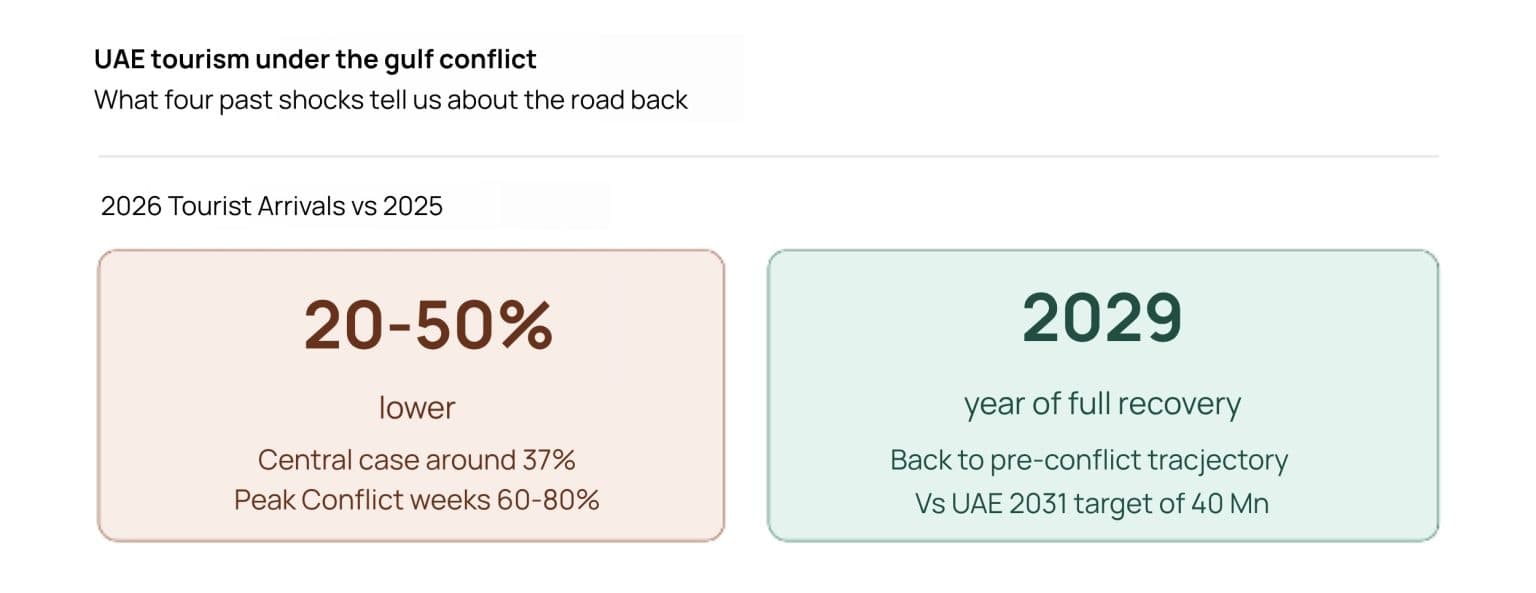
Our current modelling puts 2026 UAE tourist arrivals between 20% and 50% below 2025 levels, depending on how the conflict resolves. The central case sits at around 37% lower, with full recovery to pre-conflict trajectory by 2029.
Peak conflict weeks are steeper. Our wave 1 consumer research and airline capacity data point to a 60% to 80% drop in tourist arrivals during the most intense periods. This is not unusual. Every benchmark we looked at shows peak drops are always steeper than annual averages.
A few specific reasons tourism sits at the sharp end in the UAE:
- Travel advisories move quickly and lift slowly. Airlines cut capacity within days of an escalation and add it back over months, not weeks.
- Leisure travel is easier to cancel than it is to rebook. Once a booking is moved to another destination, the original destination has to win the customer back, not just wait for them to return.
- External perception is the slowest cluster to deteriorate and the slowest to repair. Even after a clean resolution, source markets take time to feel comfortable again.
The first two points can be solved quickly once conditions improve. The third is what stretches recovery timelines, and it is the part that gets underestimated when people look only at the immediate impact.
“Tourism recovery is a function of two variables: how long the disruption lasts, and how quickly perception resets. The outcome follows from these. Based on current signals, the UAE is tracking toward a mid-cycle recovery where we need to keep track of signals of perception change, once conflict resolution is complete.”
Akshay Jayaprakasan, Associate Partner, Redseer MEA
History gives us useful reference points
Across very different events, one pattern holds up reliably: recovery shape depends on conflict duration and perception reset, not on how severe the peak drop was.
The four most useful reference points:
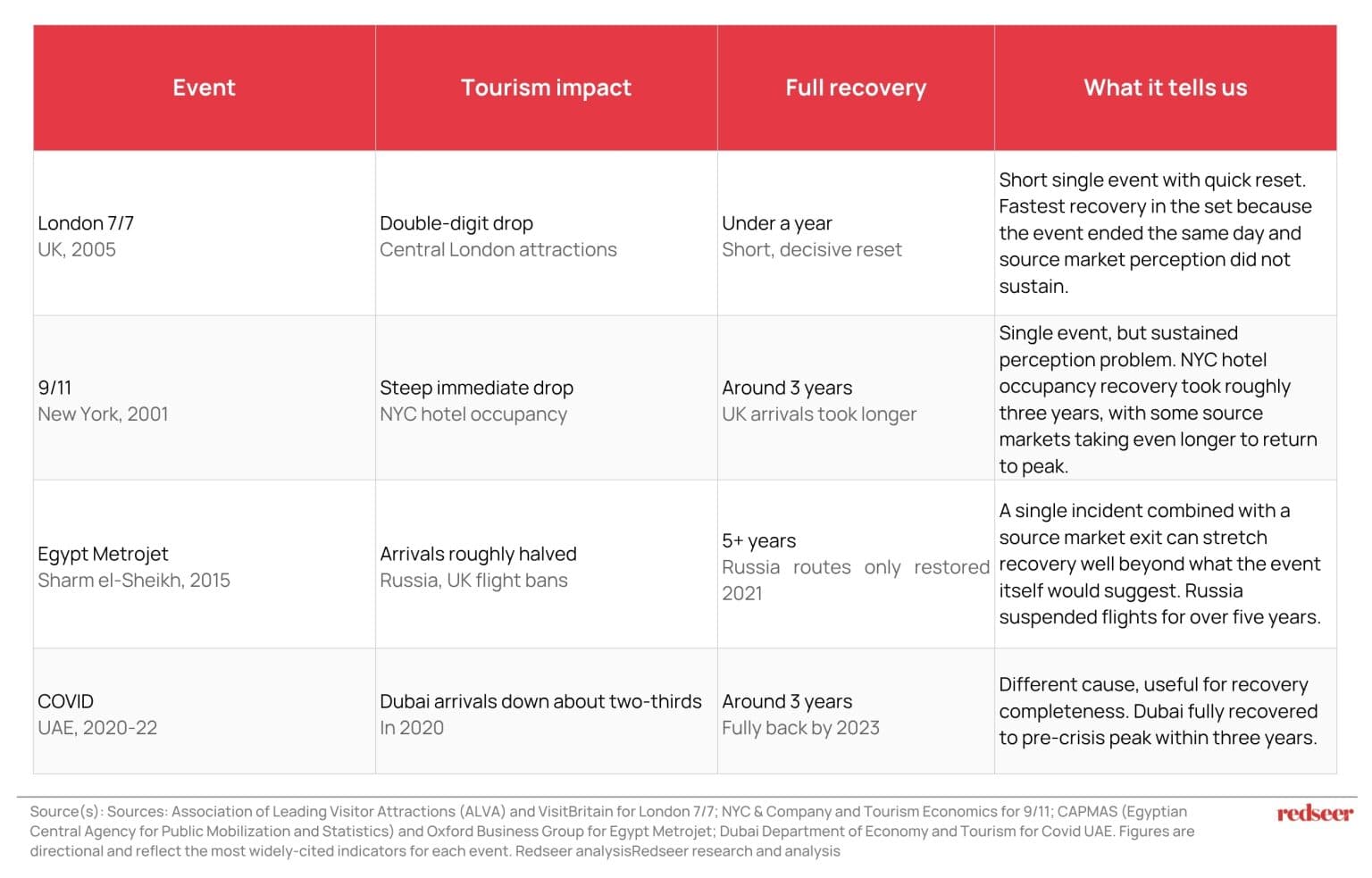
A few things stand out when you look across these:
- Events with clear endpoints and no lingering perception issue recover fastest. London 7/7 is the clearest example. The event lasted one day and recovery took well under a year.
- Sustained perception problems stretch the tail. 9/11 had no ongoing event after the first day, but NYC hotel occupancy took roughly three years to fully recover and some source markets took even longer.
- Source market exits can stretch recovery further than the event itself would suggest. Egypt Metrojet is the clearest example. Russia suspended flights for over five years. The recovery did not complete until the source market returned, not when the security issue was resolved.
- Recovery does complete. In every benchmark we looked at, tourism returned to or beyond pre-shock levels. The question has always been when, not whether.
The UAE’s own Covid recovery is the most recent local data point. Dubai arrivals dropped by around two-thirds in 2020 and fully recovered by 2023. Different cause, but the recovery completeness is what matters. The infrastructure, the source markets, and the destination appeal were all still there when conditions normalized.
What decides which path the UAE follows
Three variables matter most for how UAE tourism recovers from here:
- Conflict duration. A resolution in the next four to six weeks puts us on a London 7/7 style fast reset. A sustained low-intensity environment through 2026 stretches the tail significantly.
- Travel advisories and airline capacity. These are the fastest indicators to track. UK FCDO and US State Department advisory levels, plus airline seat capacity into DXB and AUH, tell us in real time which source markets are coming back.
- Source market perception. This is the slowest variable. Hotel occupancy and arrivals from core markets (UK, India, GCC, Europe) will reveal whether perception is resetting at the pace the other two variables suggest. This is also where the Egypt Metrojet lesson matters most. Losing a major source market for a prolonged period is the single biggest factor in stretching recovery beyond what the event itself would suggest.
Our current read is that UAE is tracking toward a regional stress pattern where there wouldn’t be either a quick upside or a sustained downside. Full tourism recovery under this scenario lands in 2029, with the long tail driven by source market perception rather than any ongoing event.
Tourism is the sector with the cleanest data and the clearest historical reference set. Retail, food services, real estate, and channel shifts all have their own recovery patterns, and they do not all move together. Some are already shifting. Some will move structurally in ways that do not reverse even after the conflict ends.
Join us on Thursday
We are presenting the full cross-sector picture in our webinar this Thursday, 30 April at 3 pm GST.
What Disruption Teaches Us: A Strategic Briefing on the Gulf Conflict Impact in the UAE
40 minutes. 30-minute presentation, 10 minutes Q&A. Online.

Written by
Akshay Jayaprakasan
Associate Partner
Akshay brings over a decade of experience across consulting and technology, with deep exposure to India, Southeast Asia and the Middle East. He has delivered multiple keynotes, served on industry panels, and is frequently quoted by leading Middle East media on the digital economy.


Impact of the Gulf Conflict on UAE Consumer Economy

Unlocking the Next Wave of MENA E-commerce Growth

Ramadan Rush: Increased Excitement Set to Fuel Spend in UAE
Digital Disruption: UAE is shaping the future of business

What Does the Current Geopolitical Situation Mean for the UAE Consumer Economy?
UAE Population Shock: What the Recovery Actually Looks Like
UAE property market is entering a pause, not a panic

KSA and UAE Tourism – A $250+ Bn Opportunity by 2030

The $150 Billion Family Wallet Children Influence

UAE’s Tourism: Boosting Retail, Hospitality, and Economic Gains

How Devaluation Forced Egypt’s Online Fashion Market to Go Local. And Win.

36% Growth. Falling Profits. Compressed Valuations. What Changed in KSA Food Delivery in 2025?
Impact of the Gulf Conflict on UAE Consumer Economy
Unlocking the Next Wave of MENA E-commerce Growth
Ramadan Rush: Increased Excitement Set to Fuel Spend in UAE
Digital Disruption: UAE is shaping the future of business
What Does the Current Geopolitical Situation Mean for the UAE Consumer Economy?
UAE Population Shock: What the Recovery Actually Looks Like