The internet’s most expensive mismatch


People spend most of their time online across a vast, open internet. But when brands advertise, the overwhelming majority of their budgets flow to a small number of closed platforms, like Google, Meta, and Amazon, that sell advertising within their own ecosystems. The industry calls them walled gardens. This mismatch, more than any other single fact, explains the shape of the advertising industry today and who is fighting to reshape it.
Global advertising spend crossed $1020-1060Bn in 2025. But dig a bit deeper, and a dichotomy emerges; advertisers spend only 20-30% of their budgets on the open ecosystem even though users spend 55-60% of their time there. Whereas walled gardens hosting the minority of attention collect 70-80% of programmatic ad spend. This gap has held stable for five years, survived multiple rounds of regulatory scrutiny and shows no sign of shifting, because the interventions so far have reinforced the equilibrium rather than broken it.
Why the internet runs on ads
Consider what the consumer internet actually is. Search, social feeds, news, video, maps, email, the overwhelming majority of it is free at the point of use and paid for, almost entirely, by advertising.
Alphabet (Google’s parent firm) and Meta together generated approximately $500 billion in advertising revenue in 2025. Two companies, half a trillion dollars, one underlying product: access to consumer attention. The top 5 consumer brands in the world spent a cumulative ~$40 billion on advertising across the same year, allocating between 5% and 15% of their revenues. By any measure, the platforms that carry advertising have grown into a category of their own.
The business model of the modern internet is, fundamentally, an advertising model. More than half of all media time in 2025 was ad-supported, meaning the content people read, watch, and listen to for free exists because brands are paying to reach them while they do it.
Ad spend grew approximately 9% in 2025 while real GDP grew around 3%. This 3x multiple has sustained over a decade. Advertising’s share of GDP now sits at approximately 0.9% globally and approximately 1.4% in the United States, up from around 1.0% ten years ago. An industry already this large is still taking a larger share of the economy every year.
Precision over reach
For most of digital advertising’s history, reach was the biggest constraint. Getting in front of enough people required a scale that only a handful of publishers could offer. That constraint no longer exists in any meaningful sense.
In 2025, more than 6 billion people spent an average of over 6.5 hours a day online, but their attention has spread thinner. The average user now navigates over 30 unique apps every month across multiple devices. A massive surge in content and app supply is further accelerating this fragmentation.
For advertisers, this means that broad reach has become a commodity that is easy to buy but difficult to use effectively. Precision has replaced reach as the scarce resource.
The 300-millisecond machine
As advertising inventory multiplied across thousands of publishers and surfaces, programmatic advertising became the default infrastructure for buying and selling it. Programmatic is what happens between you clicking a link and the page finishing its load: an auction, lasting roughly 300 milliseconds, about the time it takes to blink. It functions like a hyper-efficient stock exchange, except instead of trading equities, it trades consumer attention. The scale is massive, too. Demand-side platforms and ad exchanges, the technical infrastructure that connects publishers to advertisers, run more than 50 trillion such auctions annually.
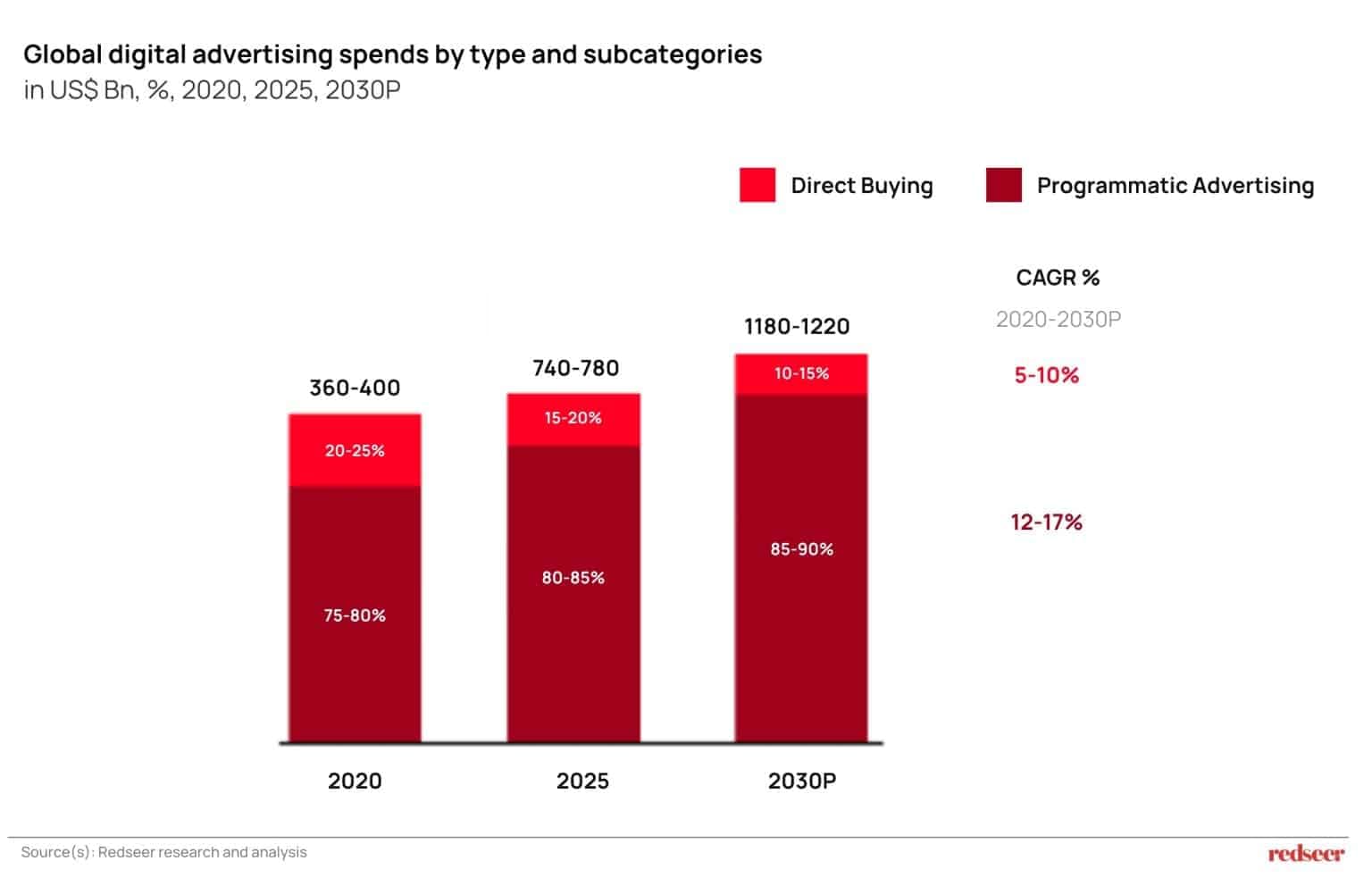
Programmatic advertising now accounts for 80-85% of global digital ad spend, with its share projected to reach 85-90% by 2030.
However, the economic structure of this market is where the details matter. Of every dollar an advertiser spends, publishers typically receive 45-55 cents. The remaining 45-55 cents moves through the intermediary layer: 5-10% to agencies, 15-25% to demand-side platforms, 15-25% to supply-side platforms, and exchanges.
There is more to the nature of these spends than where the money goes. Mobile commands 65-70% of all digital ad spend, and within that, in-app advertising accounts for 80-85% of mobile spend in the United States, with apps converting users at roughly 2-3 times the rate of mobile websites.
The two internets
Walled gardens, such as Google, Meta, and Amazon, capture 70-80% of all programmatic spend. Their advantage lies in owning the entire stack: the inventory, the audience data, and the measurement tools. This allows them to offer operational simplicity and high targeting precision. The open internet, where independent publishers and platforms trade via a shared infrastructure, accounts for the remaining 20-30% of spend.
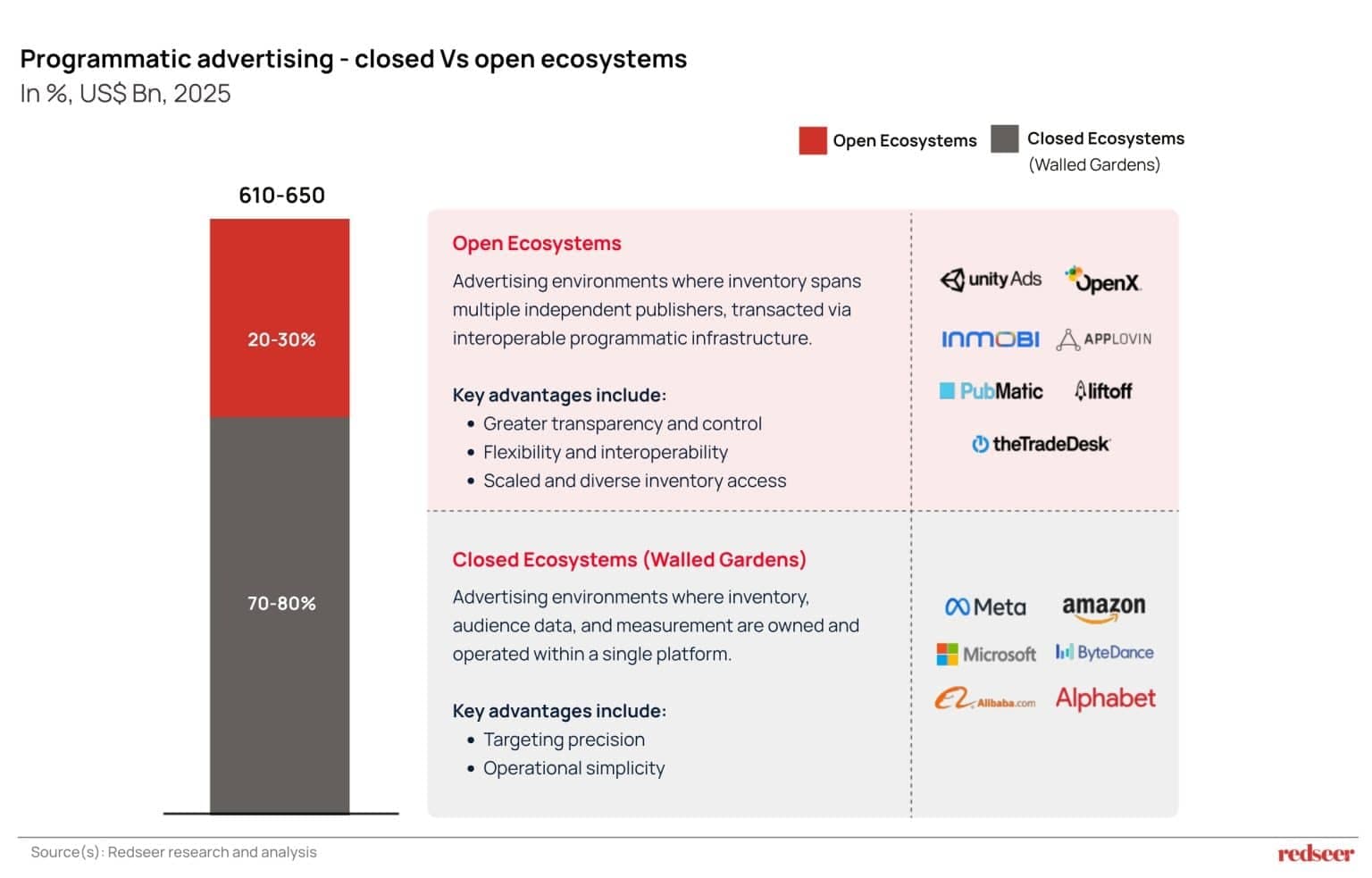
Walled gardens have held their position for a reason. First-party data gives them an identification layer that independent platforms simply cannot match — especially as third-party identifiers continue to erode. Measurement stays contained within a single ecosystem, which makes attribution cleaner and harder to argue with. And then there is the convenience factor: one buying interface, one relationship, one invoice. For most advertisers, that is an easier conversation internally than managing five separate platforms. The EU Digital Markets Act and US Department of Justice proceedings have constrained how these platforms compete at the margins, but these measures have reinforced the broader equilibrium instead of disrupting it.
The open ecosystem is undergoing a different set of changes. Independent ad technology companies that once operated as specialists, buying only, selling only, or exchanging only, have largely merged into a smaller number of full-stack players that do all three. The capital and data volumes required to train competitive bidding models have forced this consolidation. A once-fragmented landscape has compressed into a smaller number of scaled competitors, though the spend gap with walled gardens has still not budged.
Three forces redrawing the map
Over the next five years, three converging forces will rewrite the rules of the industry.
The first is a privacy revolution dismantling legacy targeting infrastructure. Third-party cookies are gone, consumer opt-out behaviour is rising, and traditional methods of tracking users across the open web are no longer viable. Their replacements, clean rooms, cohort-based targeting, and on-device processing, require direct audience relationships; an investment that many organisations have not yet made.
The second shift is AI — not as a feature bolted onto existing infrastructure, but as a ground-up rebuild of how the ad stack works. Generative AI can already produce creative variations across thousands of formats and languages in the time it once took to brief an agency. Production bottlenecks are dissolving, and the constraint now is strategic thinking, not output.
The third is what that divide looks like in practice. Organisations that embed AI natively across their full stack will compound advantages over every campaign cycle, while those on legacy tools fall further behind with each one. Redseer’s next report addresses four open questions worth tracking: whether AI agents run the ad stack end-to-end by 2030; how much current AI use cases are moving core metrics; whether AI-native surfaces concentrate value further or open it up; and whether better signal quality shifts the model from buying impressions to paying for outcomes..
What to do, depending on who you are
Publishers have a value problem that scale alone cannot fix. Undifferentiated display supply continues to fetch floor pricing. Partnerships with ad platforms, advanced targeting and yield optimisation tools become essential to extract full value from existing inventory. Newsletters, memberships, and gated content help the conversion of anonymous traffic into owned audiences. Other key priorities will be diversification beyond programmatic display into commerce media, events, and branded content, and using AI to publish faster.
Ad platforms are being asked to solve problems that did not exist five years ago. Building for a cookie-less environment is the most urgent one. Treating AI as a feature addition misses the point — it needs to run through creative, modelling, and decisioning at the foundation level. Measurement transparency, specifically multi-touch attribution, verified delivery, and auditable audience data, is moving from a differentiator to a baseline expectation.
For brands, the most consequential strategic choice is how seriously they treat first-party data. Third-party identifiers cannot be relied upon as the sole source for consumer data. Brands require a robust mechanism to collect and activate first-party data through multiple touchpoints. For advertising, concentration also needs to be calibrated. Brands that rely heavily on a small number of walled garden platforms are exposed in a world where consumer attention is spreading across a much wider set of environments, and that balance is worth actively correcting.
The next decade of advertising will not be decided by who has the biggest budget. It will be decided by who understands the machine, its changing parts and who moves first to rebuild it.
The central theme running through the next phase of advertising, as in most industries, will be artificial intelligence. Its effects are already visible in parts of the stack, but the fuller picture is still forming. Redseer’s next report will examine how, where, and to what extent AI reshapes the industry, and for whom.
Written by


Senior Consultant

Advertising Unlocks Scale for the Next Generation of Consumer Platforms

Advertising Is the Oil Powering The Digital Economy

Artificial Intelligence: The Next Growth Catalyst in Advertising

Digital Disruption in Home Category: Whitespace to Market Leadership

India’s Internet Economy: Built for Scale, Ready for Capital

The AVOD Imperative: Monetising Serialised Content at Scale in India

Micro-Drama’s J-Curve Moment: What Marketers, Platforms, and Investors Need to Know

The Indian Consumer at 2030: Redefining Aspirations, Choices, and Markets

AI is the Next Growth Catalyst in Advertising

Breaking barriers: Rise of challenger platforms in digital advertising landscape

Digital Advertising in India and disruptive trends

The World’s Largest Advertisers Now Spend Like Investors
Advertising Unlocks Scale for the Next Generation of Consumer Platforms
Advertising Is the Oil Powering The Digital Economy
Artificial Intelligence: The Next Growth Catalyst in Advertising
Digital Disruption in Home Category: Whitespace to Market Leadership
India’s Internet Economy: Built for Scale, Ready for Capital
The AVOD Imperative: Monetising Serialised Content at Scale in India