What Actually Wins Ranks in India’s Test-Prep Market

For millions of Indian families, a child’s future turns on one outcome: the right rank in a competitive exam. That single belief shapes India’s test-prep market, which Redseer estimates at ~$14.8 Bn in FY26.
Test prep in India cuts across the whole student journey, spanning undergraduate entrance, postgraduate entrance, government recruitment and professional certification exams
At the undergraduate level, the stakes are highest. Families commit several lakhs over two to three years, knowing the odds: about 3% for preferred government medical seats and about 1% for top IITs.
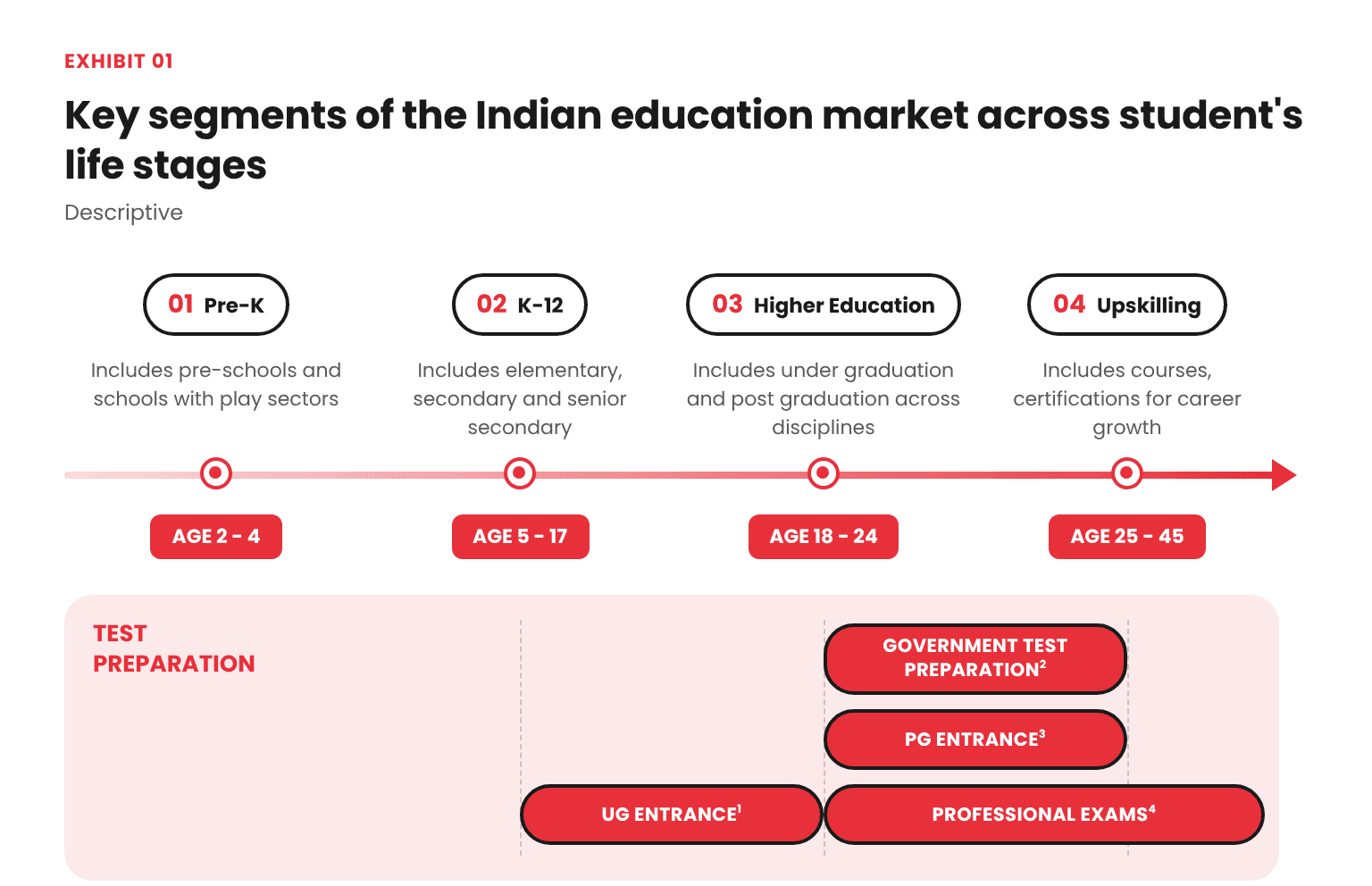
That scarcity is what the market is built on, and alongside more aspirants and rising spend per aspirant, it helps explain why Redseer projects the market to reach $ 23-26 Bn by FY30, growing at 12-15% a year.
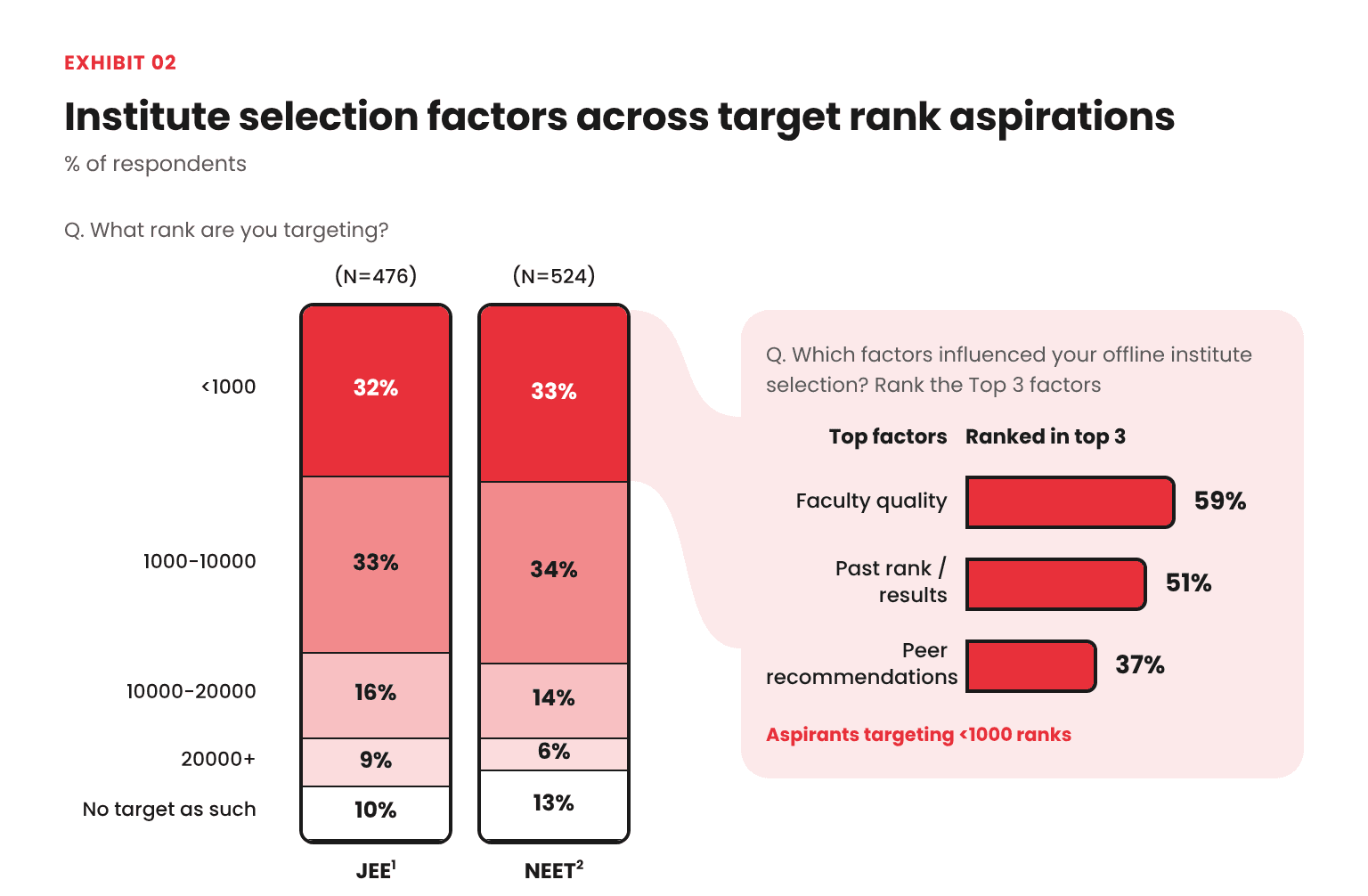
As far as students go, they are being selective. We found that 57% of students pursuing studying their preparations offline prioritised picking the right teacher in their top three selection factors when picking a centre for their coaching, while 44% rank past results. Fees sit well below both.
But the results don’t follow just the teacher. National institute chains account for 88-93% of the top-100 ranks in JEE Advanced 2026 and 76-78% in NEET UG 2026. Distribution-first online platforms, with enrolments in the millions, account for 0-2%.
Redseer’s analysis finds that faculty, testing and reach alone do not explain the gap. Most established institutes have access to all three. What separates the leaders is an operating system that links them into a self-correcting loop: institutionalised pedagogy, structured evaluation and targeted intervention, with technology as the layer that lets it run across thousands of students and many centres.
Mera Main Coaching: Centring decision-making around one key institute
The beginning of most student’s educational life cycle begins by picking one key institution as a key goal, which informs their study calendar. We found that among aspirants targeting ranks below 1,000, 59% rank faculty quality and 51% rank past results in their top three.
Families are willing to spend whatever it takes for a desired outcome
Fee sensitivity has not disappeared, but families increasingly trade cost for outcome credibility. The trade-off is sharpest at undergraduate entrance, which households see as the first major inflection point in the education journey. That makes it the highest-stakes segment, with preparation beginning as early as Class 8 or 9.
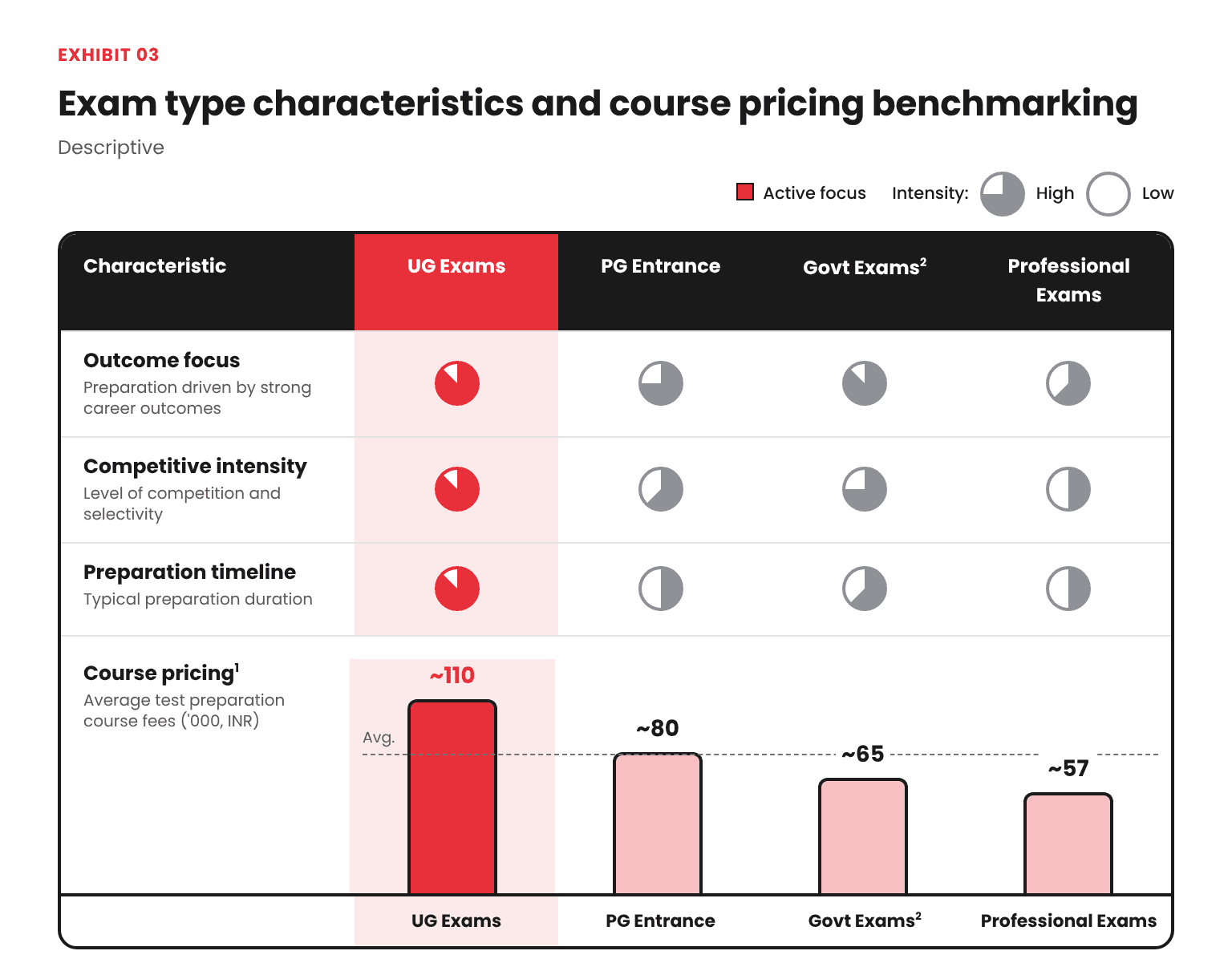
Programmes priced above ₹1 lakh a year have grown faster than the overall market, and premium offerings already sit at ₹1.5-2 lakh. At this stage, the ceiling is not determined by what the programme costs to deliver; rather, the perceived outcome.
Systems are beginning to migrate to meet students where they are
For two decades, UG test prep concentrated in three key hubs: Kota, Hyderabad and Delhi. They gathered academic talent and institutional infrastructure in ways smaller cities could not match, and their outcomes remain strong. What is changing is that local markets are deepening fast.
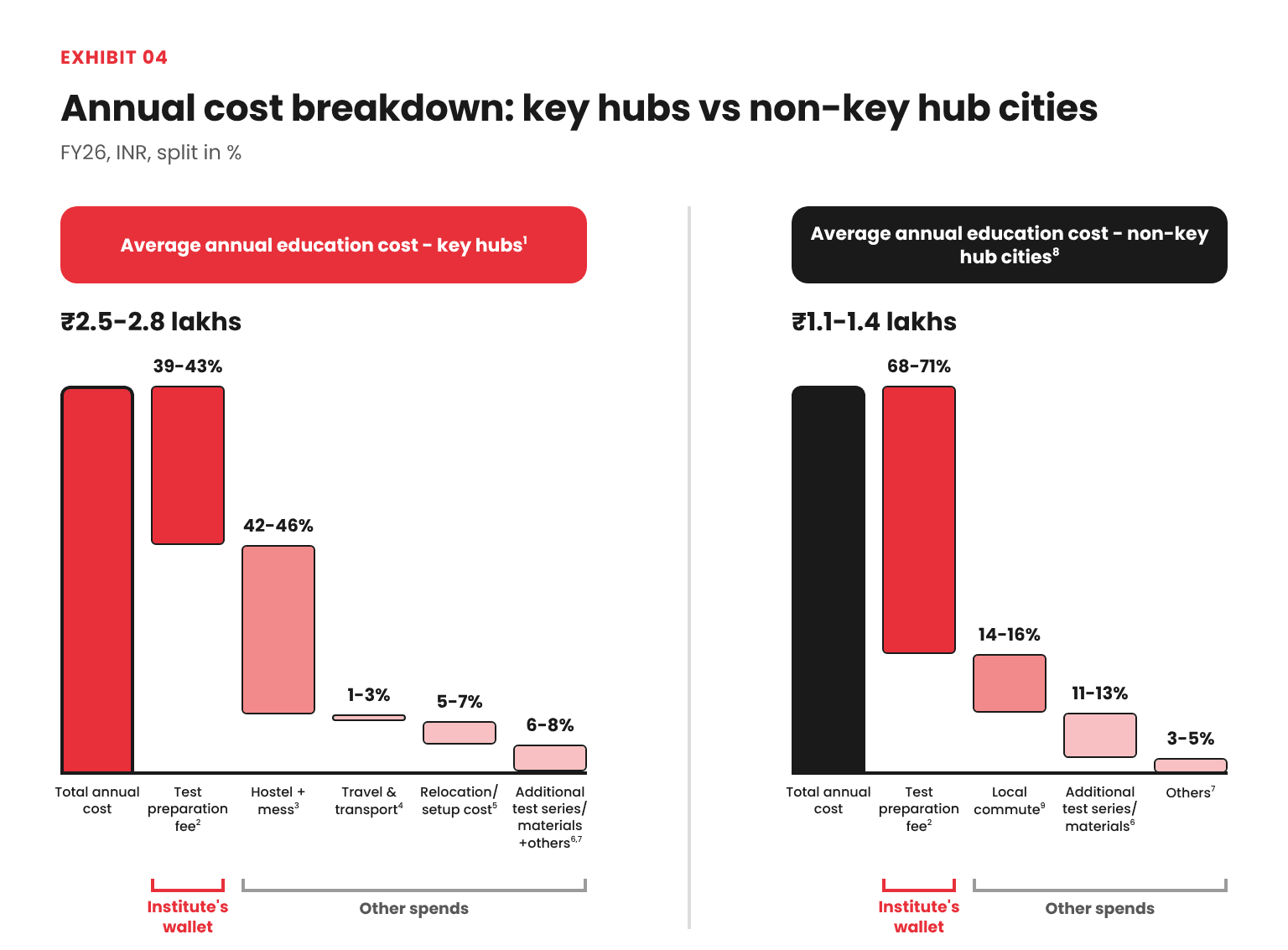
One aspirant Redseer spoke with mentioned that they had considered relocating to Kota but changed their mind once they realised that big brands were opening up locally. Our analysis points the same way: 71% of aspirants in Tier 1 cities and 67% in Tier 2+ cities say they are not willing to relocate to a key hub.
By choosing not to relocate to a hub, families stand to gain as well. A year in a key hub costs ₹2.5-2.8 lakh against ₹1.1-1.4 lakh in a non-hub city. The curious development here is that local markets, which previously were unable to attract talent compared to these hubs, are now able to sustain serious prep ecosystems.
Our report finds that for national institutes, geographic expansion into Tier-2+ cities is not a dilution of quality but an unlocking of demand that was previously inaccessible. The brands that can deliver consistent outcomes outside traditional key hubs will capture the next wave of market growth. [Text Wrapping Break]
Redseer’s Advisory
Online platforms and the spread of national centres beyond the hubs have both widened access to serious preparation. In the next phase, access is table stakes and consistency is the test
For Institutes, Tier 2+ expansion unlocks demand only if outcomes hold in the new centres. Regional institutes show the risk: results built on a specific faculty and the founder’s direct involvement tend to thin out as they expand. The answer is a system that does not depend on who is in the room: pedagogy owned centrally, continuous evaluation with targeted intervention, and technology that lets the loop run across centres and formats.
For Investors, the useful measure is the share of an institute’s enrolled base that uses it as their primary institute, since most online enrolments are supplementary or casual. The next questions are whether outcomes hold in newer centres and formats and, for online players, whether their learner data is deep enough to sustain the loop

Written by
Mukesh Kumar
Associate Partner
Mukesh is a go-getter with an analytical approach who enjoys solving challenging business issues. He has worked extensively in the retail, TMT, public policy, and private equity sectors and specialises in research and growth initiatives.


Outcome is King: India’s UG Test Preparation Market Rewards Credibility Over Scale

India’s Internet Economy: Built for Scale, Ready for Capital

India’s Digital Investment Market Report

The Indian Consumer at 2030: Redefining Aspirations, Choices, and Markets

Redseer Enabled a Global Investor to Find Conviction in India’s F&O Market

Redseer Charted a Leading Food Delivery Platform’s Path to Leadership in Southern India

Indian EdTech industry analysis: Online education sector to create $ 1.7 BN market by 2022

How we helped a global gaming & interactive media investor read the India opportunity.

We enabled a leading e-commerce player with decision-grade intelligence on India’s online grocery market

Redseer helped a leading home services platform decode the technology-led transformation of the sector

Redseer helped a leading Indian food delivery platform identify a path to market leadership in South India

India’s IPO Reset: Why Readiness Matters More Than Hype
Outcome is King: India’s UG Test Preparation Market Rewards Credibility Over Scale
India’s Internet Economy: Built for Scale, Ready for Capital
India’s Digital Investment Market Report
The Indian Consumer at 2030: Redefining Aspirations, Choices, and Markets
Redseer Enabled a Global Investor to Find Conviction in India’s F&O Market
Redseer Charted a Leading Food Delivery Platform’s Path to Leadership in Southern India