Why This is The Decade Global Apparel Brands Can’t Sit India Out

EXECUTIVE SUMMARY
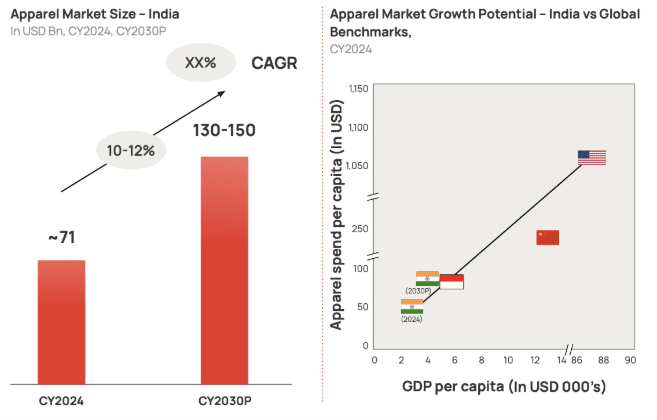
India’s apparel market is projected to grow to ~$130-150 Bn by CY30, at 10-12% a year, more than double China’s growth rate and well ahead of Japan, Europe, and the US. India as “the next big apparel market” is not a new pitch. What has changed is that five separate structural trends are now converging at once, and that convergence, more than the market’s size, is what makes this decade different from the last two.
India has worn the label of being the ‘next big apparel market’ for twenty years. It finally fits with the data catching up.
India’s apparel market stood at $71 Bn in CY24. It is projected to reach ~$130-150 Bn by CY30, with a CAGR of ~10-12% a year. China’s apparel market is expected to grow at ~4-5%, with Japan, Europe and the United States below ~5%. India is not just a large market for global apparel. It is the fastest-growing market with a wide margin.
Treating India as the number one drives us to the question: who is driving this growth and is the growth a temporary spike? While none of them are new questions, it is worth noting that brandification and distribution formalisation are familiar concepts in global apparel markets generally. What makes it different this time is that rapid brandification, growing openness to new brands, wardrobe expansion, trend-first decisioning, and the formalisation of distribution are growing simultaneously. All five trends are driving the growth together, rather than a single trend working on its own.
1. Brandification
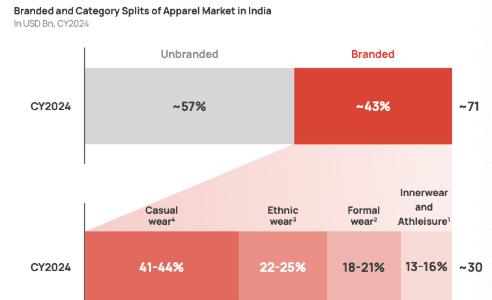
In India, branded apparel is growing from 1.5-2 times the pace of unbranded apparel. Branded spends are expected to cross half of total apparel spend by CY30. Consumers are not just buying clothes. They are actively choosing to pay for a brand name over unbranded items at a similar price point.
This is important because wardrobe expansion, trend-led buying, and distribution formalisation translate into revenue for a brand if the consumer is willing to pay for the brand in the first place. Brandification is the demand-side foundation the other four trends build on.
2. Exploration of new brands
New brands in India’s global apparel market such as Zudio, Uniqlo and H&M have launched in the past decade. A wave of home grown direct-to-consumer labels have all found footing in a short window.
This signals that being unknown comes with the cost of falling behind. A brand requires a reasonable product and a distribution footprint, not just recognition from an Indian consumer.
3. Wardrobe expansion
It is not just one category anymore. Indian consumers are buying apparel for weddings, sports, travel and social gatherings. These categories are expanding everyday, apart from work wear. Every occasion demands a new dedicated apparel purchase. This grows with brandification. A consumer willing to pay for a brand now has to purchase for five occasions instead of two. They become bigger customers. With brand assortment availability for a consumer, it increases the odds that a trial will convert into a habit.
4. Trend-first decisioning
Quality and price remain top purchase priorities for consumers in India, just as they do everywhere. But what has changed is trend relevance has come into the picture as a decision-making factor. Consumers across multiple age cohorts are increasingly questioning if the product is current, not just affordable and well-made.
Trend-first decisioning rewards brands with frequent newness in assortment. This is why global casual wear brands with recognisable aesthetics have found more traction today than they would have a decade ago.
5. Formalisation of distribution
Earlier, the hardest part of entering India was not about having demand. It was to find a credible way to reach and access the demand. Now, it is not the case. Exclusive brand outlets (EBOs), multi-brand outlets (MBOs), and organized retail are rapidly expanding and reducing operational barriers for new entrants to scale distribution rather than spending years to build a footprint from scratch.
This trend converts the first four into revenue. A consumer who is willing to pay for a brand, with multiple occasion purchases, including trends still requires someplace to complete the purchase. That is where formalized distribution comes into picture, completing it entirely.
Why shift convergence is the story here.
None of the five trends in isolation will justify a structural break. It is about a consumer willing to pay for a brand name, multiple-occasion purchase, price point decision, being open to unfamiliar names, and being able to access those names through formal channels existing in the market at the same time. This changes the calculi for global brands on when to enter the market.
India’s apparel spend per capita remains below China and the United States, pointing to significant room for growth. Cultural signals imply that streetwear has gone mainstream through homegrown labels combining global style cues with local identity (Jaywalking and Bluorng).
India has been a plausible market for global apparel for years. What has changed is that these conditions are now converging, rather than arriving one at a time over successive decades.

Written by
Kushal Bhatnagar
Partner
Kushal has worked with funds as well as corporates across the eHealth, Hyperlocal, eGrocery, Fintech and beauty & personal care verticals. He gained immense experience in global healthcare consulting and has been able to bring that knowledge to build the digital healthcare practice here.

India’s Internet Economy: Built for Scale, Ready for Capital

India Online Retail 2026: The Fastest Year in Five, and the New Engines Behind It

Why Global Apparel Players Are Betting Big on India!

Value Grocery Commerce: The Bharat Unlock

India Hair Growth Market Report 2026

The Indian Consumer at 2030: Redefining Aspirations, Choices, and Markets

India’s $40Bn Beauty & Personal Care Market: Growth, Shifts and Opportunities for 2030

New-Age vs Legacy: The Future of Fashion in India and the Battle for Consumer Loyalty

Beyond Prestige: The Next Chapter of Indian Luxury

India’s Got Retail: A Tale of Fragmented Supply & Consolidating Distribution

Festive Season 2025: What to Expect? What to Action?

India’s Festive E-Commerce Market 2024: Unveiling Growth Trends and Emerging Opportunities
India’s Internet Economy: Built for Scale, Ready for Capital
India Online Retail 2026: The Fastest Year in Five, and the New Engines Behind It
Why Global Apparel Players Are Betting Big on India!
Value Grocery Commerce: The Bharat Unlock
India Hair Growth Market Report 2026
The Indian Consumer at 2030: Redefining Aspirations, Choices, and Markets