What the Rise of India’s New-Age Ecosystem Means for Businesses in 2026 and Beyond
India’s new-age ecosystem has grown into a significant part of the country’s economic landscape, with scale, maturity, and market relevance becoming more visible across sectors.
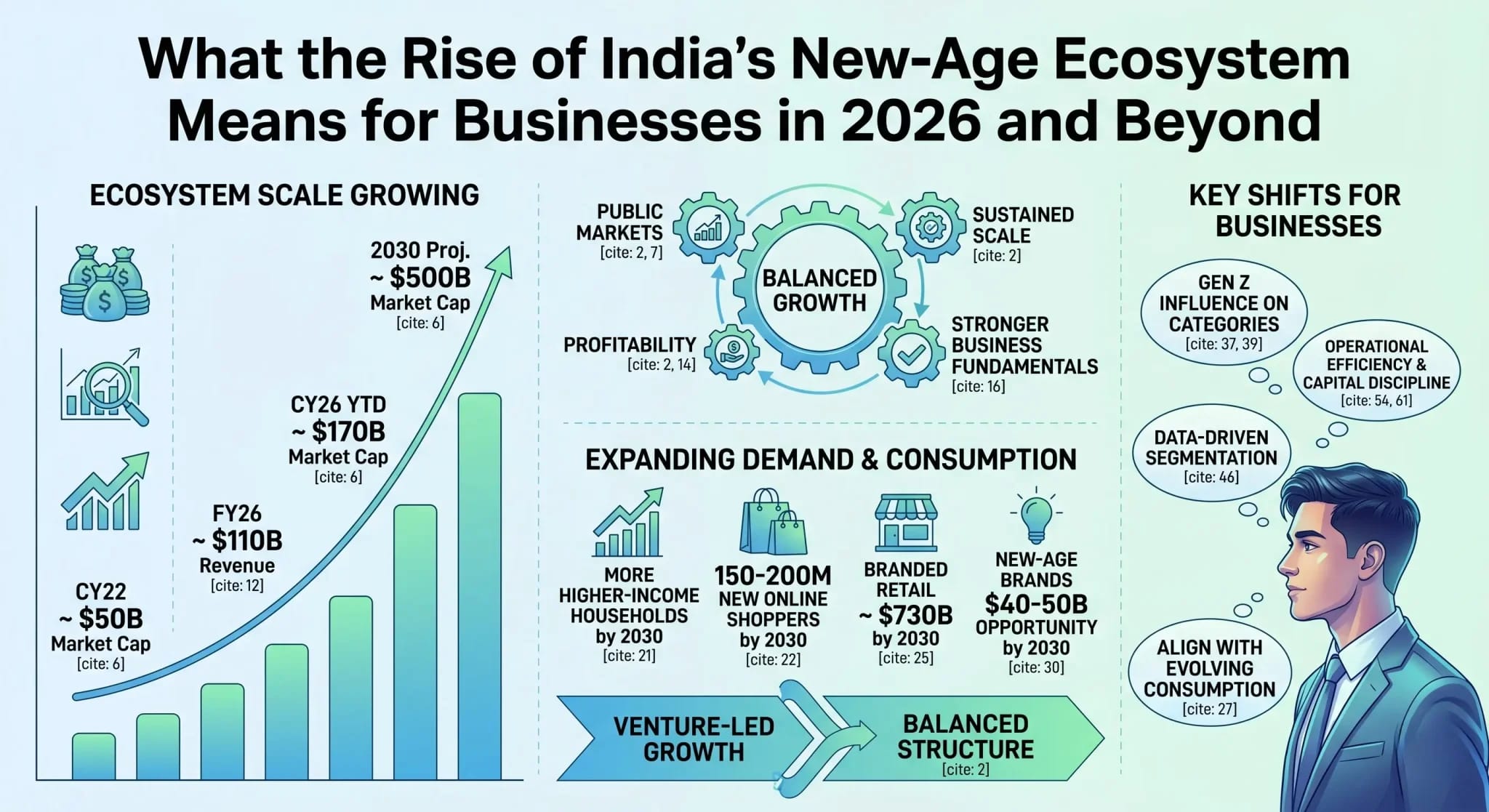
Over the past few years, the ecosystem has transitioned from a venture-led growth engine to a more balanced structure where public markets, profitability, and sustained scale are becoming equally important.
For businesses, investors, and platforms operating in this space, the question is no longer about participation. It is about positioning for the next phase of growth.
From Expansion to Scale: A Structural Shift
The scale of India’s new-age ecosystem has expanded significantly. Market capitalisation has grown from approximately $50 billion in CY22 to around $170 billion in CY26 year-to-date, with projections pointing towards $500 billion by 2030.
At the same time, public markets are playing a larger role in funding this growth. A meaningful share of capital is now coming from public investors, reflecting increasing confidence in the long-term viability of these businesses.
This shift indicates a structural change. New-age companies are no longer being evaluated only on growth potential, but on their ability to operate as sustainable, large-scale businesses within public market frameworks.
Scale Is Becoming the Norm, Not the Exception
What was once considered scale in India’s startup ecosystem is now becoming more common.
The ecosystem is expected to reach approximately $110 billion in revenue by FY26. The number of companies crossing ₹100 crore in revenue continues to rise, and more businesses are moving into the ₹1000 crore bracket.
Alongside this, a growing proportion of companies are achieving profitability at the EBITDA level.
This combination of scale and improving financial discipline suggests that new-age businesses are becoming more operationally robust. Growth is increasingly supported by stronger business fundamentals rather than expansion alone.
For a strategy consulting firm in India, this shift changes the nature of engagement. The focus moves from market entry and early growth to scaling operations, improving unit economics, and building long-term competitive advantage.
Demand Tailwinds Are Expanding the Opportunity
The growth of the new-age ecosystem is closely linked to underlying changes in India’s consumption landscape.
By 2030, a significantly larger share of households is expected to move into higher income brackets, with millions entering the ₹5-10 lakh and ₹10 lakh+ annual income segments. At the same time, India is expected to add between 150 and 200 million new online shoppers.
This expansion is not just increasing the size of the market. It is also accelerating the shift towards branded and organised consumption.
Branded retail is projected to reach approximately $730 billion, with organised retail increasing its share through both modern trade and online channels.
For companies operating in the ecosystem, this creates a broader and more structured demand base. For any business consulting firm in India, it also highlights the need to align growth strategies with evolving consumption patterns rather than relying on historical market assumptions.
New-Age Brands Are Becoming a Meaningful Layer of Consumption
Within this expanding retail landscape, new-age brands are establishing themselves as a distinct and growing segment.
By 2030, these brands are expected to account for a $40–50 billion opportunity within India’s branded retail market, increasing their share from approximately 2% to 6%.
The number of scaled brands has also grown, with dozens already crossing significant revenue thresholds across categories such as fashion, beauty and personal care, food and beverage, and electronics.
Importantly, the time taken to scale has reduced. New-age brands are reaching meaningful revenue milestones much faster than earlier cohorts.
However, rapid scaling does not automatically translate into long-term success. The transition from mid-scale to large-scale remains uneven, highlighting the importance of execution, differentiation, and capital discipline.
This is where consumer strategy consulting in India is increasingly focused, helping brands navigate scale without compromising on profitability or positioning.
Gen Z Is Reshaping Demand Across Categories
A key driver of this ecosystem is the rise of Gen Z as a dominant consumption cohort.
By 2030, Gen Z and younger consumers are expected to account for a significant share of overall retail spending. Their preferences are already influencing categories such as beauty, fashion, fitness, food, and digital services.
Their behaviour reflects a different approach to consumption:
- higher category exploration
- stronger focus on self-expression
- willingness to engage across multiple platforms
- and increasing allocation of spend towards lifestyle and experiences
For businesses, this requires a shift in how products are built, packaged, positioned, and scaled. Traditional segmentation approaches are often insufficient to capture the nuances of this cohort.
Retail strategy consulting in India is, therefore, increasingly centred around understanding these behavioural shifts and translating them into actionable growth strategies.
Faster Growth, Stronger Discipline
Another defining characteristic of the current phase is the balance between growth and financial discipline.
Many new-age companies are now able to sustain high growth rates while improving profitability. Median EBITDA margins across consumer-focused businesses have shown improvement, and a larger share of companies are managing both expansion and efficiency simultaneously.
This marks a clear departure from earlier phases where growth often came at the cost of financial sustainability.
At the same time, not all companies are able to sustain momentum as they scale. The progression from early growth to sustained scale remains selective, reinforcing the importance of strategic clarity and operational execution.
What This Means for Businesses Operating in India
India’s new-age ecosystem is entering a phase where scale, profitability, and market structure are becoming tightly interconnected.
For companies, this changes how growth needs to be approached:
- expanding into new markets is no longer sufficient without clear unit economics
- category participation must be supported by differentiation and brand strength
- scaling requires deeper alignment with evolving consumer cohorts
- and capital efficiency is becoming as important as topline growth
For a strategy consulting firm in India, this phase presents a different set of opportunities. Businesses are no longer looking only for growth acceleration. They are seeking clarity on where to play, how to scale sustainably, and how to build long-term competitive advantage within a rapidly evolving ecosystem.
Conclusion
India’s new-age ecosystem has reached a point where scale is visible, demand is expanding, and capital is more structured.
The next phase will be defined by how effectively companies convert this scale into durable, profitable growth.
The opportunity is large. But the outcomes will depend on how well businesses navigate complexity, competition, and changing consumer expectations.