What Quick Commerce Means for Beauty & Personal Care Strategy in India?
India’s online Beauty & Personal Care (BPC) market has expanded rapidly in recent years, growing from roughly ₹21,000 crore in CY22 to around ₹52,000 crore in CY25. While this growth reflects the broader digitalisation of beauty consumption, the distribution of that growth across channels has been uneven.
Quick commerce has emerged as the fastest-scaling channel within the ecosystem. What began as an emergency fulfilment model for groceries is now becoming an increasingly important access point for everyday personal care purchases
For BPC brands, retailers, and investors navigating India’s consumer internet landscape, this shift raises important strategic questions. Increasingly, companies are working with a strategy consulting firm in India to understand how quick commerce is reshaping category behaviour, channel economics, and long-term growth opportunities within the beauty and personal care industry.
Quick Commerce Is Scaling Faster Than the Category
The scale-up of Beauty & Personal Care within quick commerce has been significant over the past three years. Between CY22 and CY25, BPC GMV within quick commerce expanded roughly 22.5x, making it one of the fastest-growing segments in the channel.
During the same period, the share of BPC in total quick commerce GMV increased from around 2.8% in CY22 to approximately 8.5% in CY25, according to Redseer analysis. This positions beauty and personal care as the second-largest category within quick commerce after grocery, highlighting the structural role BPC is beginning to play in the ecosystem.
Across the broader online beauty market, quick commerce’s share has also increased rapidly, expanding from around 2% of online BPC spending in CY22 to nearly 16% in CY25. This indicates that growth within the category is becoming increasingly concentrated in newer digital retail channels.
For companies operating in India’s BPC sector, these shifts are not simply operational changes. They represent strategic inflection points in distribution, consumer behaviour, and channel economics, areas where a specialised beauty and personal care consulting firm in India can provide valuable guidance.
Where Quick Commerce Fits in the Online Beauty Ecosystem
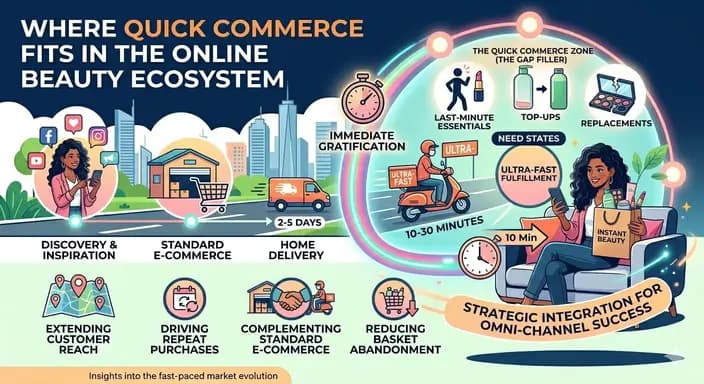
Despite its rapid growth, quick commerce does not compete directly with every online beauty channel.
Vertical beauty platforms remain important for discovery-driven segments such as makeup, where consumers browse new brands, explore routines, and experiment with emerging products.
Quick commerce, by contrast, is capturing replenishment-led demand. Categories such as skincare, haircare, and bath & body, where repeat purchase behaviour is high, account for a large share of BPC spending on quick commerce platforms.
In many ways, the category composition of quick commerce now resembles that of horizontal marketplaces rather than specialised beauty platforms. The difference lies in the consumer mission. Purchases on quick commerce are typically driven by immediacy and convenience, often as part of broader baskets that include groceries or daily essentials.
Understanding how these channel roles evolve is increasingly important for brands designing omnichannel distribution strategies in India’s rapidly changing beauty market.
The Rise of the Everyday Beauty Mission
The rapid adoption of BPC in quick commerce reflects the growing role of the channel in everyday consumption.
Consumers are increasingly turning to quick commerce platforms for routine personal care purchases such as shampoos, face washes, deodorants, oral care products, and moisturisers. These are categories where purchase behaviour is frequent, decision-making is relatively quick, and replenishment cycles are predictable.
As platforms expand their assortments and improve availability across SKUs, this behaviour becomes easier to sustain. Consumers can rely on quick commerce not only for urgent needs but also for regular replenishment.
For BPC brands, this shift is reshaping how everyday products are distributed, priced, and promoted. Many companies now work with a business consulting firm in India specialising in consumer internet and retail strategy to determine how quick commerce should fit into their broader channel architecture.
Category Expansion Is Supporting the Shift
The broader quick commerce ecosystem is evolving in ways that support BPC growth.
Recent market data shows that non-grocery categories are expanding roughly 1.6x faster than grocery, indicating that consumer use cases for quick commerce are expanding beyond food and daily essentials.
Within this expansion, several categories have gained traction. Beauty & Personal Care has grown by approximately 140% year-on-year, while segments such as baby care and books, games, and music have also seen strong growth.
This expansion suggests that quick commerce platforms are increasingly functioning as multi-category retail ecosystems rather than purely grocery delivery services.
For companies evaluating long-term category potential, these developments are shaping strategic decisions around inventory planning, distribution partnerships, and channel prioritisation.
Experience Is Becoming a Differentiator
While convenience remains the core proposition of quick commerce, platforms are gradually investing in features that deepen engagement.
Visual merchandising, recommendation engines, and curated product collections are increasingly being used to convert browsing behaviour into purchase decisions. Some platforms are also experimenting with influencer-led content, bundled offerings, and seasonal campaigns that encourage higher basket sizes.
These developments allow quick commerce platforms to support a broader set of beauty purchase missions. While replenishment remains dominant, experience-led discovery is slowly emerging as an additional driver of engagement.
For BPC brands, these evolving capabilities create opportunities to experiment with new launch formats, product bundles, and targeted promotions tailored to quick commerce environments.
Infrastructure and Scale Are Improving
The rapid growth of BPC in quick commerce is also supported by improvements in the underlying supply infrastructure.
India’s quick commerce ecosystem now operates thousands of dark stores across major cities, enabling faster fulfilment and deeper geographic coverage. At the same time, improvements in operational efficiency have allowed platforms to handle higher order volumes without diluting productivity.
As the network expands and matures, platforms are able to support wider assortments and more specialised product categories, which further strengthens the relevance of quick commerce for beauty and personal care brands.
These structural shifts are prompting many companies to work with a strategy consulting firm in India focused on the consumer internet and retail sectors to assess how infrastructure expansion will shape the next phase of digital commerce growth.
The Strategic Implications for BPC Brands
Quick commerce is gradually transitioning from a convenience service to a routine purchasing channel embedded in everyday consumer behaviour.
For Beauty & Personal Care, this shift is particularly important because the category is driven by frequent replenishment and repeat consumption. As quick commerce platforms expand their assortments and strengthen their logistics infrastructure, they are likely to capture a growing share of these everyday purchases.
For brands, the key question is no longer whether quick commerce should be part of their channel mix. The more important challenge is designing strategies that align product portfolios, pricing structures, and supply chains with the distinct purchasing behaviour the channel supports.
In an increasingly complex retail environment, many companies are turning to specialised strategy consulting firms in India to navigate these decisions and identify where long-term growth will concentrate.
Conclusion
India’s quick commerce ecosystem is entering a new phase of maturity. Growth is no longer driven solely by grocery frequency but by the expansion of new categories and consumer use cases.
Beauty & Personal Care has emerged as one of the most important of these categories. Rapid GMV growth, rising channel share, and strong repeat purchase behaviour are positioning BPC as a structural contributor to quick commerce expansion.
For brands and platforms operating in India’s beauty industry, understanding this shift requires a deeper view of how consumer behaviour, channel economics, and supply infrastructure are evolving together.
This is where working with an experienced strategy consulting firm in India can help businesses translate market insights into actionable growth strategies.
In India’s fast-evolving digital retail market, identifying where consumer relevance, purchase frequency, and category growth are concentrating will increasingly shape competitive advantage.