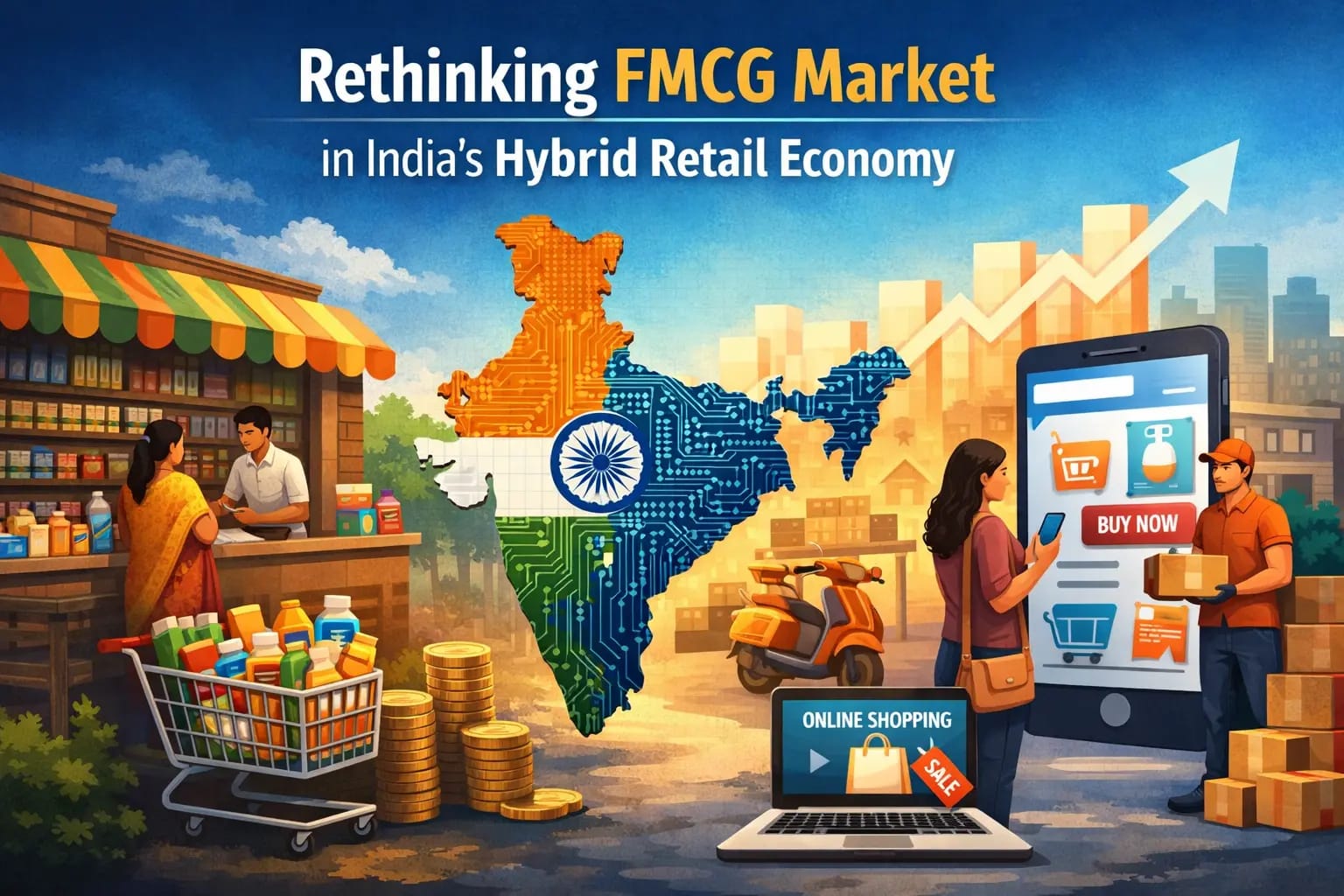
Rethinking FMCG Market in India’s Hybrid Retail Economy
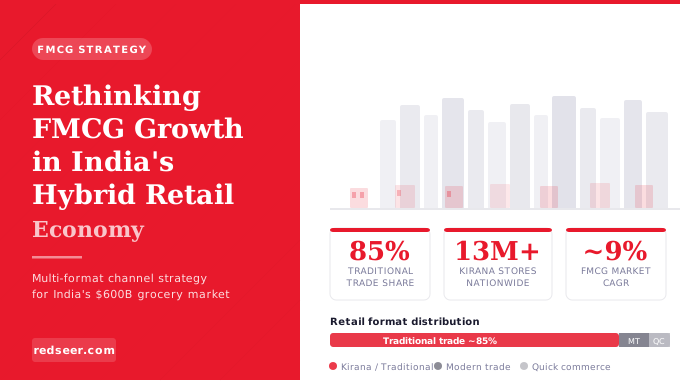
Grocery market in India continues to expand across formats, yet ~85-90% of mass grocery retail is still driven by traditional trade, according to Redseer’s analysis.
With an estimated 13-14 million kirana stores across the country, neighbourhood retail remains the dominant engine of FMCG distribution. Organised retail and quick commerce are scaling rapidly, but from a much smaller base.
For leadership teams navigating the FMCG market in India, this complexity requires structured thinking. This is where strategy consulting firms in India bring value, helping businesses interpret structural demand patterns rather than reacting to surface-level growth trends.
The question is not which format will dominate. The question is how growth must be structured across multiple formats simultaneously.
India’s Grocery Market Remains Structurally Decentralised
India’s mass grocery ecosystem remains highly decentralised, with kirana stores forming the backbone of neighbourhood consumption across urban and semi-urban clusters.
Redseer’s report outlines that high retail density, small average basket sizes, and frequent purchase cycles continue to favour hyperlocal formats. In many catchments, consumers purchase daily or near-daily essentials rather than weekly bulk baskets, reinforcing the viability of proximity-based retail.
Modern trade penetration is growing, but the underlying retail density across India remains structurally high, particularly outside top metros. This makes rapid consolidation difficult and explains why kirana-led distribution continues to anchor FMCG growth.
For strategy consulting firms in India, this implies that channel strategy must account for coexistence, not displacement. Corporate strategy must reflect how formats interact within clusters rather than assuming one will eliminate the other.
Kirana Economics Remain Structurally Competitive
Kirana stores operate on a low fixed-cost model supported by small-format real estate, family-run labour structures, and highly localised assortment decisions.
Redseer’s analysis highlights that this cost structure enables rapid inventory turns and working capital efficiency. Informal credit relationships with neighbourhood customers further strengthen loyalty and repeat purchase frequency. Modern trade formats, in contrast, operate with higher overheads and require consistent footfall and larger basket sizes to sustain margins.
The divergence in economics explains why format growth does not automatically lead to format substitution. For strategy consulting firms in India, understanding these unit economics is central to advising FMCG brands on channel prioritisation and distribution investment.
Digital Growth Varies by Cluster and Category
Quick commerce and e-commerce have scaled rapidly in dense urban micro-markets where order frequency and basket economics support dark-store infrastructure. However, penetration remains uneven across Tier 2 and Tier 3 clusters. Redseer’s broader retail ecosystem insights show that digital growth curves differ significantly by geography, income bracket, and category type.
High-frequency essentials behave differently from discretionary or bulk categories. In several non-metro markets, kirana stores continue to dominate top-up purchases due to immediacy and relationship-based credit access.
For strategy consulting firms in India, this reinforces the need for micro-market modelling – national averages obscure cluster realities. Growth modelling must be geography-specific, and capital allocation must follow demand density.
Capital Allocation in a Multi-Format Retail Economy
FMCG growth in India is projected at a ~8-10% CAGR, but most incremental volume continues to flow through traditional trade.
In a hybrid retail environment, misaligned investments, whether in warehousing, distribution partnerships, or format expansion, can dilute returns. Redseer’s analysis suggests that growth trajectories differ meaningfully by cluster, making capital sequencing a structural decision rather than a linear rollout plan.
Strategy consulting firms in India play a critical role here by:
- Mapping channel profitability at a granular level
- Evaluating distribution ROI across formats
- Stress-testing expansion assumptions
- Aligning capital deployment with structural demand
In a retail ecosystem where 85%+ of sales still flow through kiranas, capital discipline matters more than narrative momentum.
The Corporate Strategy Imperative
India’s grocery market remains structurally multi-format. Kirana stores continue to anchor mass consumption, while modern trade and digital formats expand selectively based on geography and category.
For companies operating in India’s FMCG market, long-term advantage will depend on designing growth strategies that reflect coexistence across formats rather than assuming rapid consolidation. Partnering with experienced strategy consulting firms in India enables leadership teams to address this complexity through structured modelling, cluster-level insights, and disciplined capital allocation.
Because in India’s grocery ecosystem, scale without structural alignment rarely sustains.
India’s grocery market continues to scale across formats, yet ~85–90% of consumption remains anchored in traditional trade, as highlighted in Redseer’s benchmarks. While organised retail and quick commerce are growing rapidly, they operate from a smaller base. With ~13–14 million kirana stores, neighbourhood retail continues to underpin FMCG distribution—making this a story of coexistence, not substitution.