Four Different Buyers. Only One Channel.

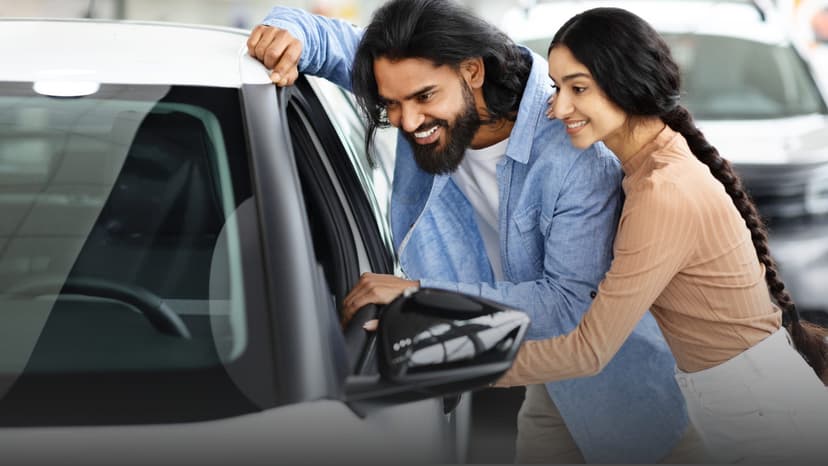
When Satyam Prasad drove his first car into his home village in Ajmer, his family gathered around it like it was a new family member. It had a few years of the previous owners on it and a price tag well within his INR 4 lakh budget. None of that mattered. What mattered was that he had arrived in every sense of the word.
Satyam is one of six million Indians who buy a used car. And his story is far more representative of this market than the budget-first narrative that usually surrounds it. The used-car market is not casual. Every transaction carries weight: financial, emotional and social.
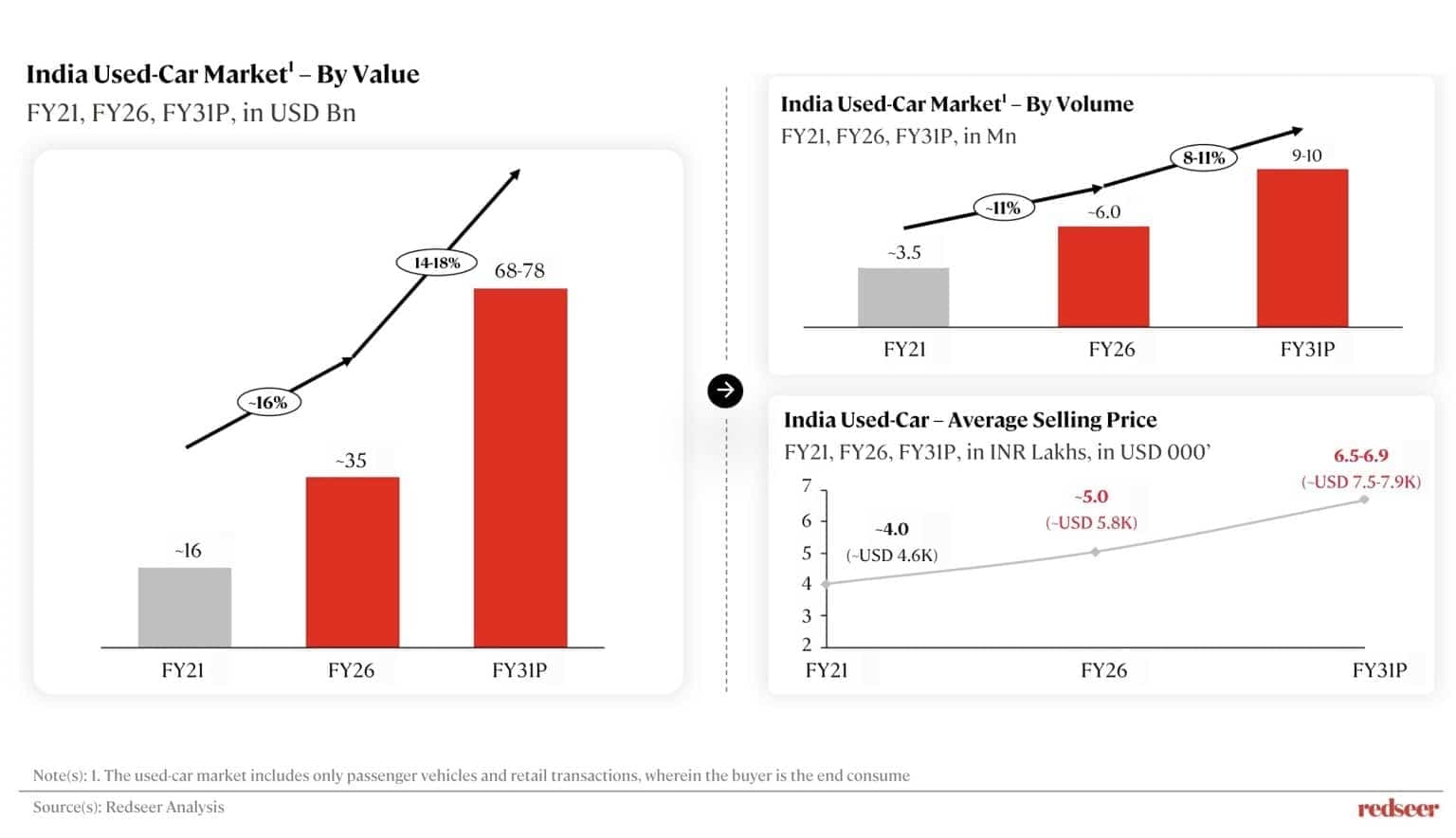
Behind each of the six million buyers, there sits a specific need, a particular budget and what value it represents. Understanding who they are, and what they need is where the market’s story begins.
Six Million Buyers – One Question: Buying a New vs Used Car?
This single question divides India’s used-car market.
Those who can buy but choose not to make a conscious decision to optimise. While those who cannot make an access decision. Within these two groups, motivations divide them into four different buyer cohorts.
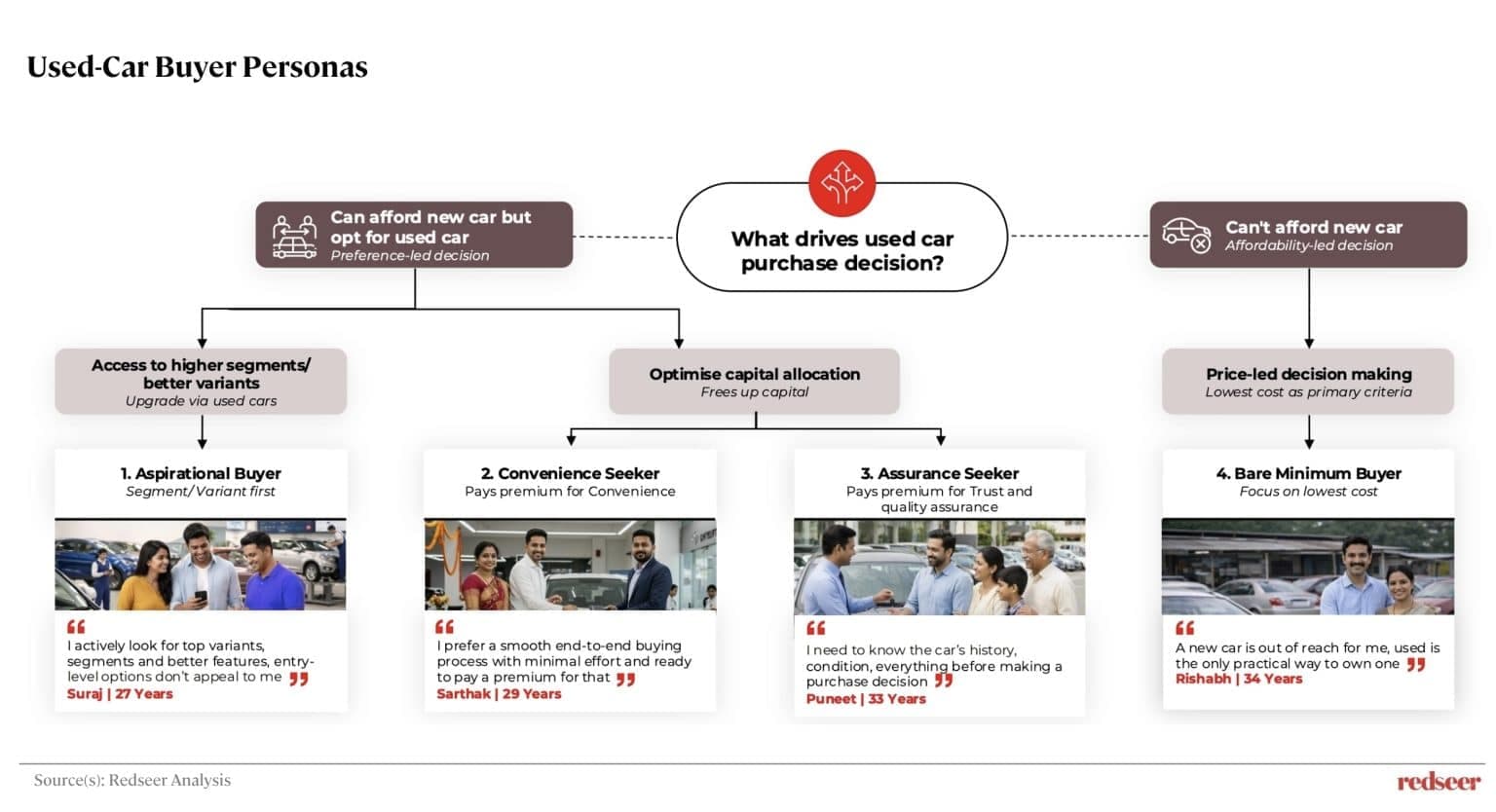
The Bare Minimum Buyer comes from a single-income household earning INR 3–11 lakhs, stretching to INR 3–5 lakhs for an entry-level hatchback. The decision is driven entirely by necessity. Despite being the most budget-constrained cohort, they conduct the most thorough research of all with 8–10 pre-visit contacts, 4–6 physical visits, and third-party inspections in 45–55% of cases. Every rupee matters. Price and financing access are non-negotiable. Without both, the purchase cannot happen.
The Assurance Seeker comes from a risk-averse household earning INR 8–25 lakhs, with a ticket size of INR 4–7 lakhs. Pallav Kumar, 40, from Bengaluru, needed a car for weekend outings and family errands and wanted to stop relying on favours. He visited multiple dealers, compared options and sought certification before committing. His decision cycle was the longest of any cohort: 4–8 weeks, 3–5 physical visits, third-party inspection in 30–40% of cases. Trust and price fairness are non-negotiable. He will not close until both are established.
The Convenience Seeker also earns 20 lakhs or more and spends INR 4–9 lakhs. They are segment agnostic, flexible across SUVs, sedans and hatchbacks. What they are not flexible about is the process. They explore only 1–2 channels, take 1–2 test drives and make the fastest purchase decision of all four cohorts. Any friction with paperwork, delays, poor digital experience, and they disengage entirely. A seamless buying experience is non-negotiable.
The Aspirational Buyer earns INR 20 lakhs or more and spends INR 5–12 lakhs on mid-premium SUVs, sedans and hatchbacks. They are not buying used cars because they cannot afford new. They are buying used cars to access a better segment or brand than their budget would allow. Laksh Mehta, 29, from Gurgaon, put it simply: the first SUV in his entire family; people started noticing his car in the office parking. For the Aspirational Buyer, limited inventory is a dealbreaker. Assortment and variant depth are non-negotiable.
Different cohorts are opening different doors into the used-car market. For each of them, the purchase marks something beyond a transaction: it is a step forward. But the market they work in does not know that.
No Channel Was Built to Serve All Four.
Behind every NPS score is a buyer who needed something the channel could not give. And across four very different cohorts, that failure looks in four very different ways.
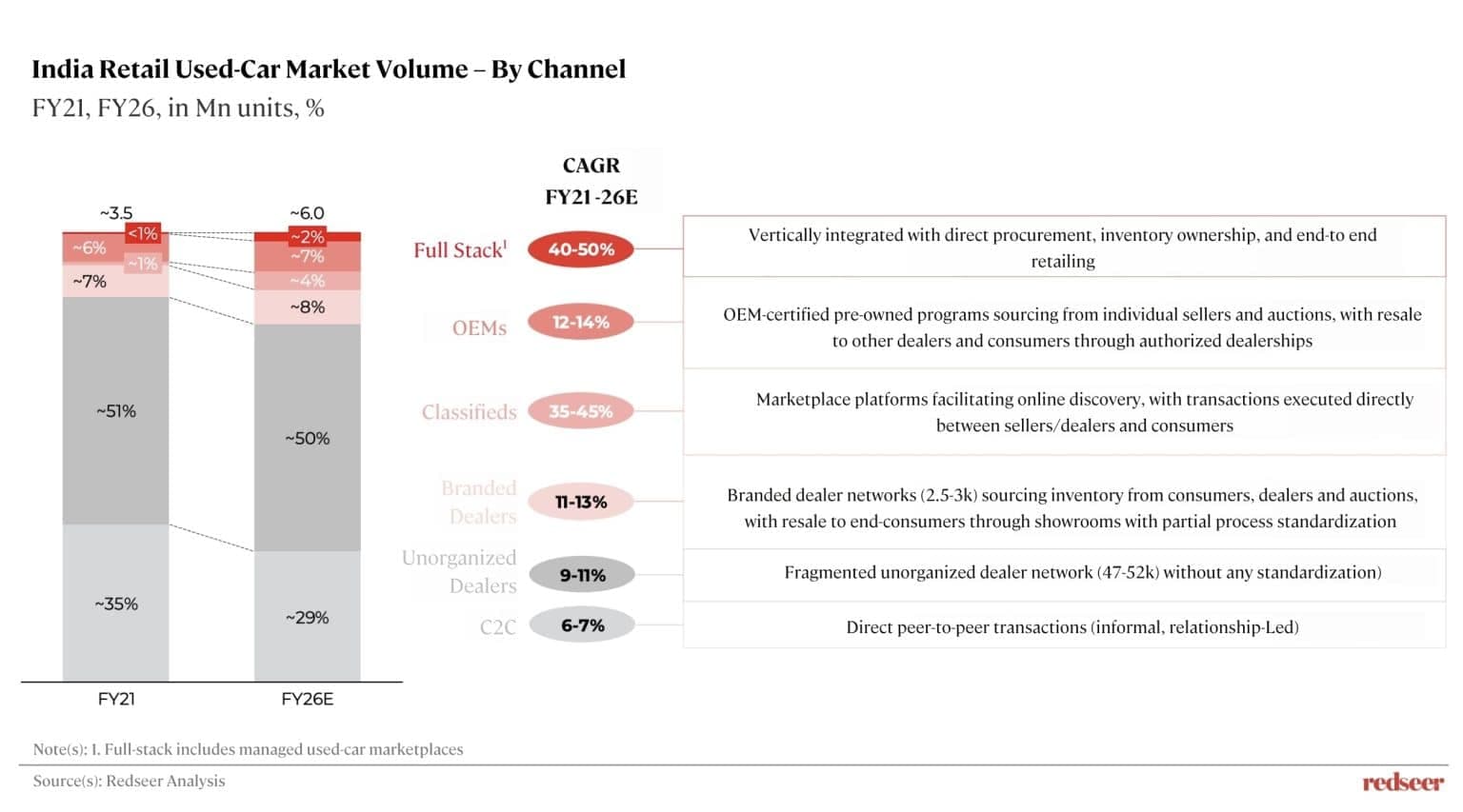
Unorganised dealers, C2C, Classifieds, OEMS and Branded dealers aren’t designed for such buyers. Yet, Unorganised dealers and C2C dominate this market. And their NPS scores are reported at 19%-37% and 11-50%, respectively. The pattern is evident: the larger the share, the worse the experience.
“3.6 million buyers walked away from a financially and emotionally significant purchase and told nobody about it.”
- The Aspirational Buyer walks into inconsistent quality and limited inventory.
- The Convenience Seeker experiences delay, a poor buying experience and no digital tracking.
- The Assurance Seeker struggles with a lack of clarity regarding pricing and vehicle condition.
- The Bare Minimum Buyer cannot access reliable financing at all.
The used-car market is growing despite the channels, not because of them.
The six million buyers in this market are not asking for perfection. They are asking for an experience that matches the weight of the decision they are making. Only 40% would actively recommend what they got. That means 3.6 million buyers walked away from a financially and emotionally significant purchase and told nobody about it. The market does not have a demand problem. It has a trust problem. And trust requires a different kind of channel entirely.
And now, the market does not have to wait anymore
“The market does not have a demand problem. It has a trust problem.”
There’s a New Hero in Town.
What this market needed was not a better dealer or a smarter classified platform. It needed end-to-end ownership of the entire experience from the moment a seller decides to sell, to the moment a buyer drives away. Full-stack operators are exactly that.
Full-stack operators control end-to-end, from sourcing, refurbishment and sales to finance, delivering an NPS above 75%. They don’t do well because they’re addressing one concern. They’re built to address everything, enabling a smoother experience.
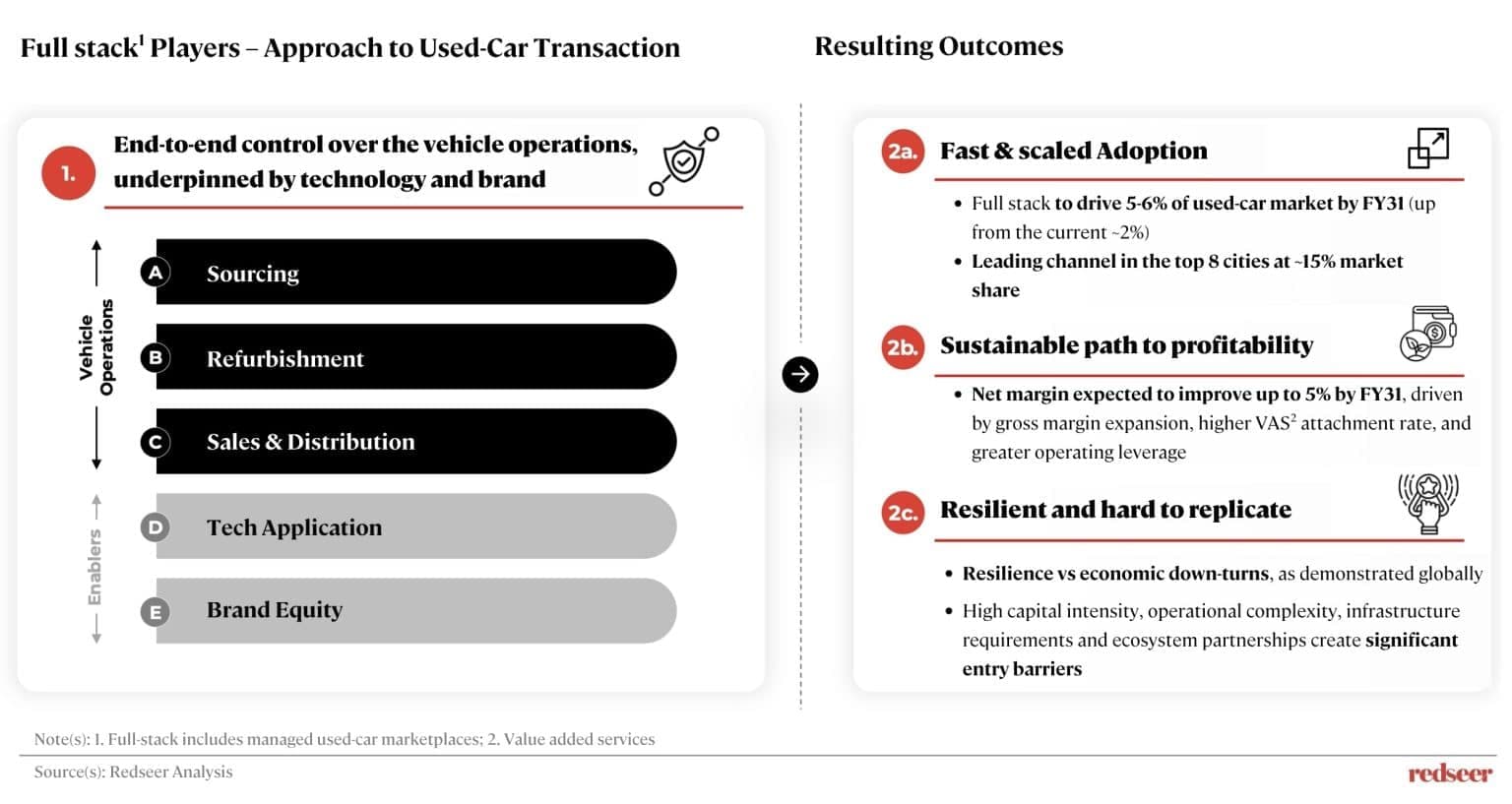
The numbers tell the story. Unorganised and C2C channels hold the largest share of this market. They also hold the worst NPS scores, 19–37%, and 11–50% respectively. Full-stack operators, with a fraction of the volume, are running at double the satisfaction rate. The market is not short on buyers. It is short on operators who can be trusted.
The Strategic Implication
Six million buyers enter this market every year. 3.6 million of them complete a transaction they will not recommend. That gap is not a satisfaction problem; it is a market-capture problem, and it will be won by operators who understand what each cohort actually needs.
- The Bare Minimum Buyer needs financing access. Without it, the purchase cannot happen, no matter how competitive the price.
- The Assurance Seeker needs transparent pricing and verified vehicle condition. Trust is not a feature. It is the entry ticket.
- The Convenience Seeker needs a frictionless end-to-end process. One point of delay, one missing document, one unresponsive touchpoint, and they exit entirely.
- The Aspirational Buyer needs depth of inventory. The right variant, in the right segment, at the right time. Scarcity is a dealbreaker, not a negotiating tool.
No unorganised dealer, classified platform, or OEM channel is structurally built to serve all four. Full-stack operators are. That is not a positioning claim; it is a capability gap that the market has already begun to price in.
For investors: the used-car market is not a bet on demand. Demand is not in question. Six million buyers a year, growing. The bet is on who captures the trust dividend, and the data suggests full-stack operators are the only structural answer. The NPS gap between channels is not closing; it is widening as buyer expectations rise.
For full-stack operators: the cohort framework is the product roadmap. Serving all four buyers from a single platform is the moat. Financing depth for the Bare Minimum Buyer. Certification rigour for the Assurance Seeker. Digital-first process for the Convenience Seeker. Variant assortment for the Aspirational Buyer. Miss one cohort, and a competitor inherits it.
The market does not have a demand problem. The players need to solve the friction points and trust gap at scale, and whoever does this fastest and best will gain a larger market share.

Written by
Kushal Bhatnagar
Partner
Kushal has worked with funds as well as corporates across the eHealth, Hyperlocal, eGrocery, Fintech and beauty & personal care verticals. He gained immense experience in global healthcare consulting and has been able to bring that knowledge to build the digital healthcare practice here.


Buying with Confidence: Bridging the Trust Deficit in India’s USD 70 Bn Used-cars Market

India’s Internet Economy: Built for Scale, Ready for Capital

Digital Disruption in Home Category: Whitespace to Market Leadership
India’s Digital Lending Report 2026: Value Beyond Acquisition

India’s Digital Investment Market Report

Value Grocery Commerce: The Bharat Unlock

The Next Battleground: Winning India’s Intracity Logistics Market Through Trust, Tech & Transparency

The Indian Consumer at 2030: Redefining Aspirations, Choices, and Markets

Beyond Prestige: The Next Chapter of Indian Luxury

Redseer Enabled a Global Investor to Find Conviction in India’s F&O Market

Redseer enabled a leading Indian fashion marketplace to harden seller experience as a strategic moat

We enabled a leading e-commerce player with decision-grade intelligence on India’s online grocery market
Buying with Confidence: Bridging the Trust Deficit in India’s USD 70 Bn Used-cars Market
India’s Internet Economy: Built for Scale, Ready for Capital
Digital Disruption in Home Category: Whitespace to Market Leadership
India’s Digital Lending Report 2026: Value Beyond Acquisition
India’s Digital Investment Market Report
Value Grocery Commerce: The Bharat Unlock