India’s used car market is a $4 Billion Opportunity.

Currently valued at $53 billion, India’s used-cars market is projected to reach $68-78 billion by FY 31. India will be the third-largest used-car market in the world, following the US and China.
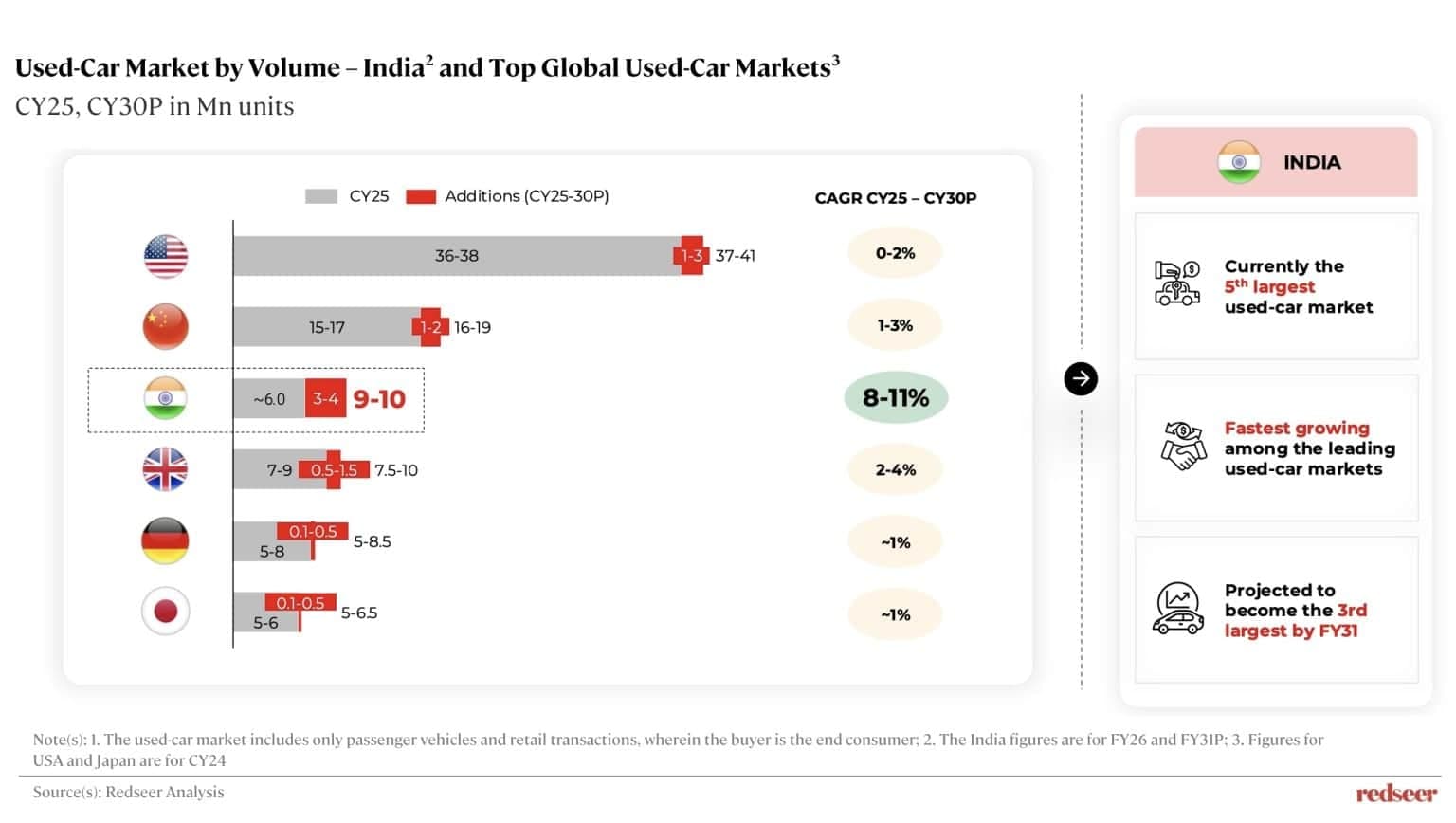
“The growth is at 14-18% CAGR.”
It’s not just the market size. 65% of Indian’s used-car buyers are purchasing their first car. 28% are replacing existing vehicles. 7% are adding a second car to their household.
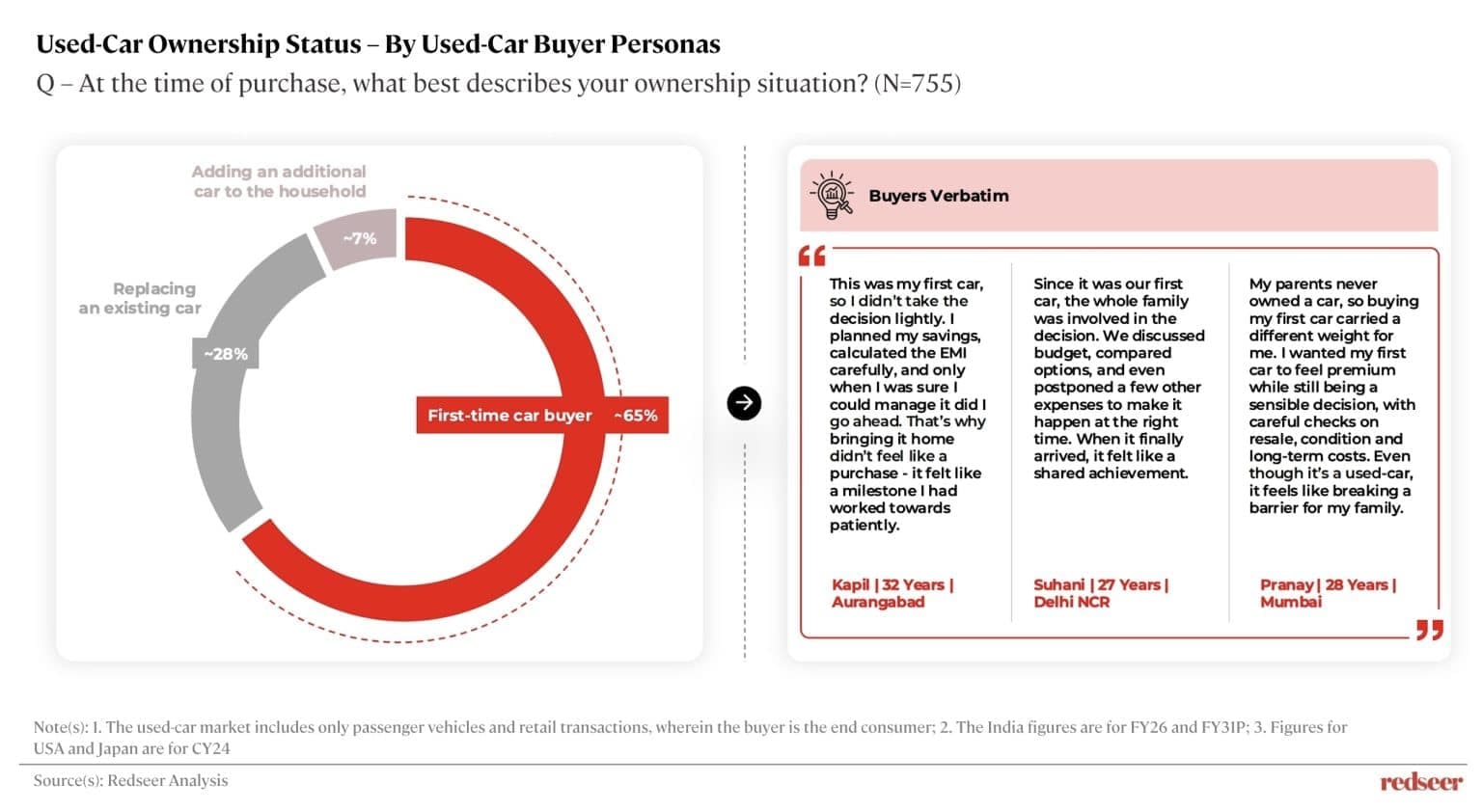
“Used-car buyers allocate 8-13% of monthly income for used-car EMIs.”
The Gap and a Broken Experience
Purchasing carries an emotional and financial weight. And the experience doesn’t match it. This gap is the defining story of India’s used-car market today. Closing this gap is the largest growth lever. Trust is a very crucial gap to close out.
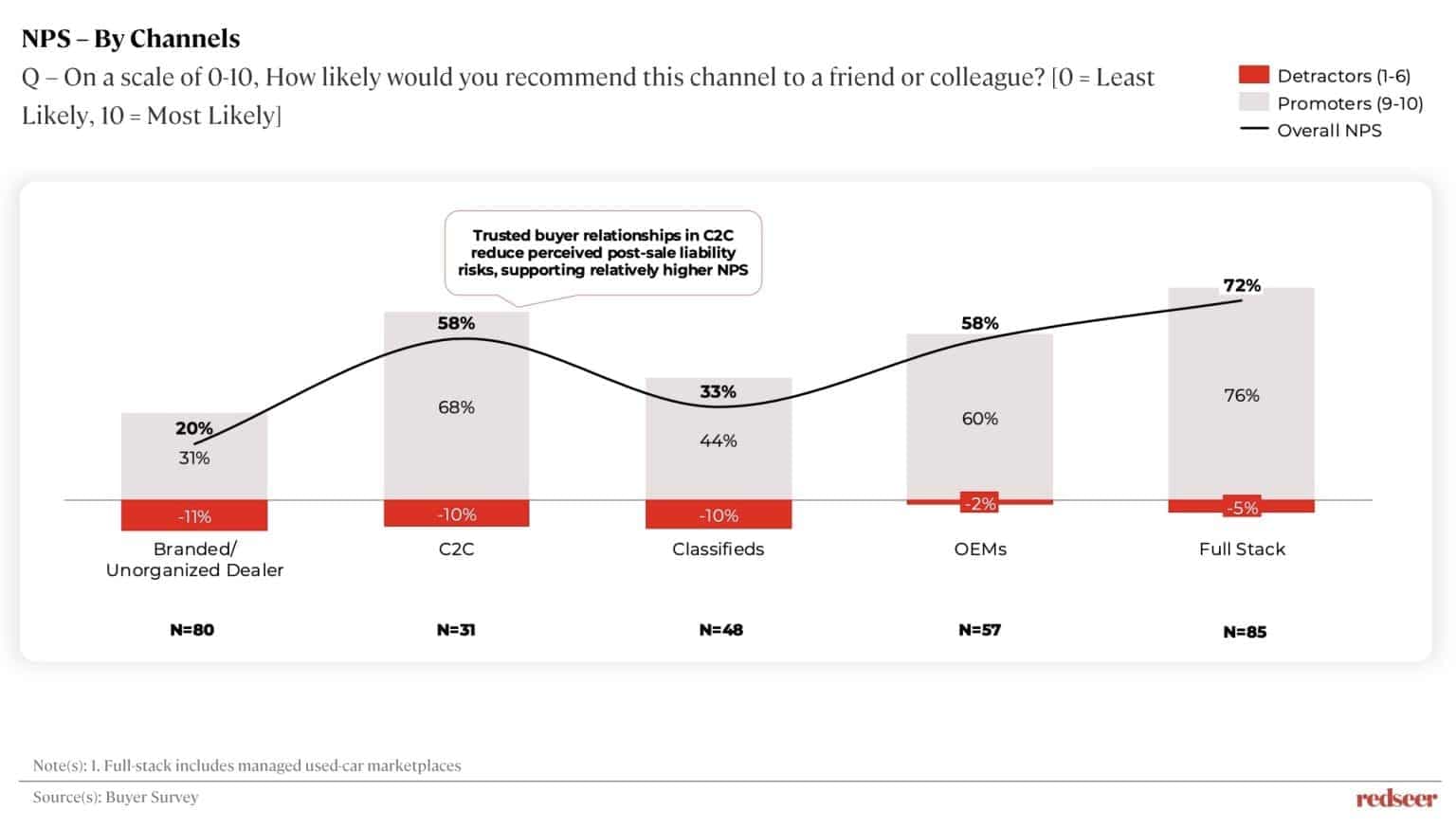
Nearly 79% of India’s used-car transactions still flow through unorganized channels. The satisfaction data is unambiguous
“Improving NPS from today’s 40% promoter share to 70% could unlock 3–5 million additional units by FY31, pushing market growth to 15–20% CAGR.”
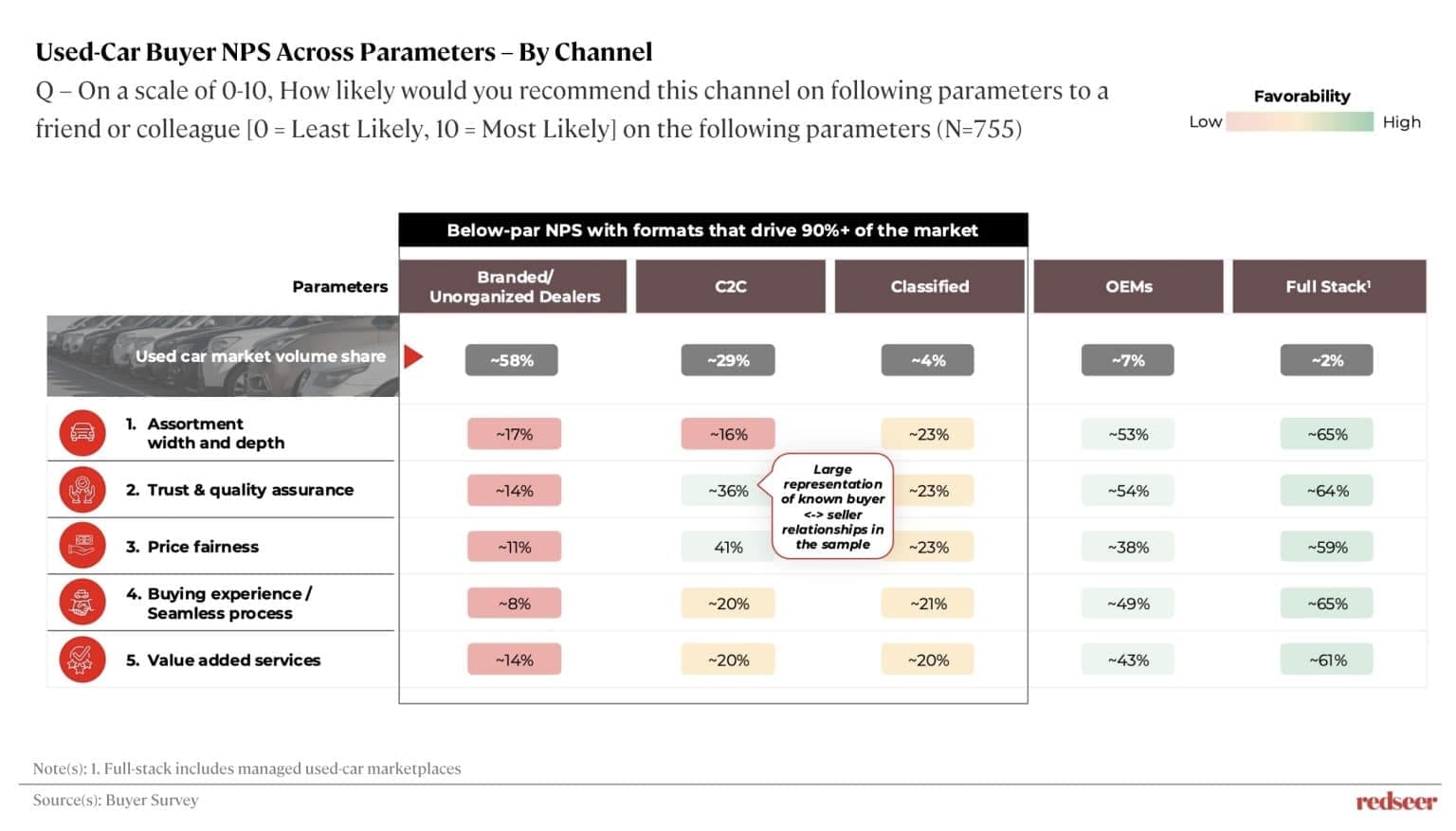
The channels that dominate this market were never built for the buyers in it. Unorganized and branded dealers accounting for roughly 58% of volumes deliver NPS scores between 8% and 26%. C2C transactions, at 29% of volumes, score between 11% and 57%. Classifieds, at 4%, score between 35% and 44%. The pattern is consistent and damning: the larger a channel’s share of the market, the poorer the experience it delivers.
The Market Didn’t Wait for Permission. It’s Already Moving.
Supply Improvement:
Replacement cycles are shortened from 7-8 years in FY21 to 4-5 years by FY31. This results in a used-car market receiving younger, more premium car inventory without intervention from the organized channel. SUV volumes in the used-car market are growing between 13-17% CAGR. And speaking of inventory, cars aged 0-3 years are the fastest growing inventory segment at 13-15% CAGR.
Financing has finally caught up:
Used-car financing has been the biggest structural barrier for growth. Now, NBFC loan sanctions have grown to 70% between FY22 and FY24. Financing penetration is rising from 20–30% today to 30–40% by FY27. Digital KYC, real-time vehicle evaluation, and integrated resale channels on one platform are making the used-car market more accessible.
Digital infrastructure is dismantling information asymmetry:
With 880–950 million digital transactors projected by FY31, India’s broader digital economy is solving one of the used-car market’s oldest problems: the information gap between buyer and seller. Online price benchmarking, 360-degree vehicle imaging, digital inspection reports, embedded financing and doorstep delivery are collectively making the used-car transaction more transparent, more accessible and more trustworthy than ever before. The infrastructure for a formalized market is being built, and organized players are the primary beneficiaries.
Regulation is moving in the right direction:
The Vehicle Scrappage Policy is accelerating replacement cycles. Online RC transfers and VAHAN digitization eliminate post-sale anxiety. Simplified hypothecation and e-KYC make financing faster, and more accessible.
The Full-Stack Model is the $4 billion Opportunity.
With control over sourcing, refurbishment, sales and financing, full-stack operators are delivering NPS scores above 75% across every individual. Their awareness among used-car buyers stands at 85%, ahead of both OEMs and Classifieds at 65% and 60% respectively.
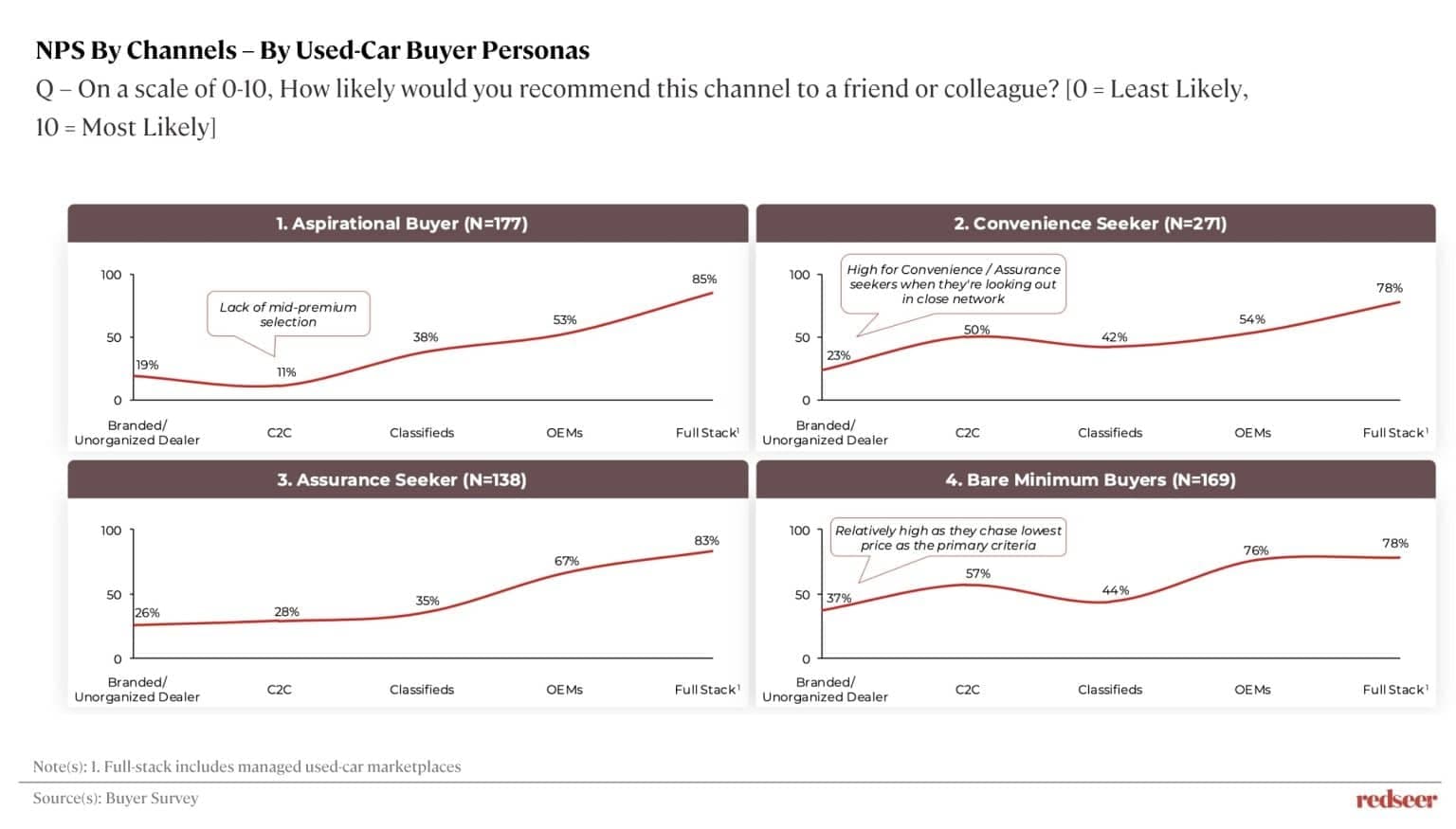
The entire transaction is controlled, that’s why it works. Direct consumer sourcing accounts for 80-90% of their inventory. This ensures quality at acquisition. In-house refurbishment with buy back rates below 5% and warranty claims at 3-5%; quality is ensured at delivery. Trained sales consultants, test-drive infrastructure and end-end digital documentation aren’t just added benefits.
“Full-stack players deliver at every step as part of the experience, not as an afterthought.”
Net margins for full-stack operators sit at roughly 0.5% today, but are projected to reach 4-5% by FY31, an 8-10x improvement in profitability. The path there is straightforward: gross margins expanding from 14% to 15-16%, VAS margins growing from 2% to 3-4% as financing and warranty attach rates improve, refurbishment costs declining from 3% to 2-3% through scale and standardization, and marketing spend dropping from 2% to 1-2% as brand equity compounds over time.
Carvana in the US has already walked this path by growing from 44,000 units in 2017 to 597,000 in 2025, surviving a $6.6 billion debt crisis, and expanding gross profit per unit from $206 to $7,026. The margin expansion came from the same drivers India’s full-stack players are building toward: financing and ancillary services scaling to nearly 40% of gross profit, fixed costs spreading across growing volumes, and brand maturity reducing customer acquisition costs over time. India’s full-stack players are early on the same trajectory. The model is proven. The question is execution speed.
The barriers to entry are not a warning. They are an opportunity.
The full-stack model’s most important characteristic is defensibility, not just its NPS score. Refurbishment infrastructure, pricing, inspection, last-mile delivery, proprietary technology, and managing sourcing are entry barriers. Players who can build, develop, and execute this infrastructure will be at an advantage compared to those who are late entrants. The infrastructure will be difficult to replicate.
The barriers to entry are structural and compounding. Working capital intensity means ongoing inventory commitment limits casual entry. Refurbishment infrastructure takes years to build at consistent quality. Proprietary technology spanning pricing engines, inspection tools and inventory systems cannot be bought off the shelf. And operational complexity requires sourcing, inspection, pricing and last-mile delivery to work simultaneously. Each of these is hard alone. Together, they make the model nearly impossible to replicate quickly.
The same complexity that keeps competitors out is what drives the returns.
The market opportunity reflects this defensibility. Full-stack currently holds approximately 2% of India’s used-car market. By FY31, it is projected to reach 5–6% nationally and 14–16% in India’s top eight cities unlocking nearly USD 4 billion in addressable GMV, growing at 36–44% CAGR. For context, the broader market is growing at 14–18%.
Digital infrastructure is maturing, financing access is widening, supply quality is improving, and regulatory reform is reducing friction. The market is waiting for players who can capture this moment and convert demand into transactions.At USD 4 billion, this market is more than worth building.

Written by
Kushal Bhatnagar
Partner
Kushal has worked with funds as well as corporates across the eHealth, Hyperlocal, eGrocery, Fintech and beauty & personal care verticals. He gained immense experience in global healthcare consulting and has been able to bring that knowledge to build the digital healthcare practice here.


Buying with Confidence: Bridging the Trust Deficit in India’s USD 70 Bn Used-cars Market

India’s Internet Economy: Built for Scale, Ready for Capital

Think Quick Commerce: Unlocking the $90Bn Opportunity

Value Grocery Commerce: The Bharat Unlock

Powering India’s EV Future: The Charging Infra Playbook

Why Global Apparel Players Are Betting Big on India!

The Next Lever of Growth in India’s Wealth Tech

Four Different Buyers. Only One Channel.

Two Engines, One Basket: How Quick & Value Commerce are Rewriting India’s Retail Story

India’s Intra-City Parcel Market Growing at 40–50% CAGR: Two Archetypes Racing for the 2 Bn Order Opportunity

Why This is The Decade Global Apparel Brands Can’t Sit India Out

The Bharat Unlock: India’s Next Grocery Growth Engine Lies Beyond Quick Commerce
Buying with Confidence: Bridging the Trust Deficit in India’s USD 70 Bn Used-cars Market
India’s Internet Economy: Built for Scale, Ready for Capital
Think Quick Commerce: Unlocking the $90Bn Opportunity
Value Grocery Commerce: The Bharat Unlock
Powering India’s EV Future: The Charging Infra Playbook
Why Global Apparel Players Are Betting Big on India!