The 3 Step Blueprint to Winning India’s Hair Growth Market


India’s hair growth industry is growing faster than almost every comparable BPC category. The headline projection is that the market will double in just five years, reaching $546 million by 2028, at a 14-15% CAGR. While this paints an optimistic picture, the category’s internal dynamics are far from linear.
The significant format-level divergence: the legacy category-builder, topicals, is lagging at 8% growth, while supplements and medicated solutions are compounding at nearly double that rate. This indicates that the market has moved past ‘generalist’ solutions toward a more clinical and holistic consumer demand.
Meanwhile, out of the 82 million urban Indians facing hair loss, only 5 million are using any structured product to address it. The other 77 million are using home remedies or nothing. The potential is immense, but three unsolved conditions – price, format, and patience – are sitting between the current products and this demand.
Closing the Indian price gap
“90% of the 82 million people spend under INR 1,000 per month on hair loss solutions.”
The Indian hair growth market is structured around two models – D2C personalized products and doctor-prescribed treatments. Both categories carry an average consumer spend of INR 1,599 to INR 1,690 a month. Compared to the international benchmark, where consumers spend roughly INR 9,800 per month on hair growth products, India has largely solved the affordability problem through innovative product engineering. However, even these price points remain nonviable to most Indian consumers.
The broader retail segment and consumers’ willingness to pay sit well below this – at under INR 1,000 per month. 90% of the 82 million people that are affected spend under INR 1,000 per month on hair loss solutions. Every brand currently defining the category is priced above the band where the majority of the addressable base lives.
This is further reflected in what prevents consumers from opting for specialised products. 39% of consumers abandon their purchase plans at price points. Price is the single largest objection in the category. Effectiveness stands at 32% and Side effects at 16%.
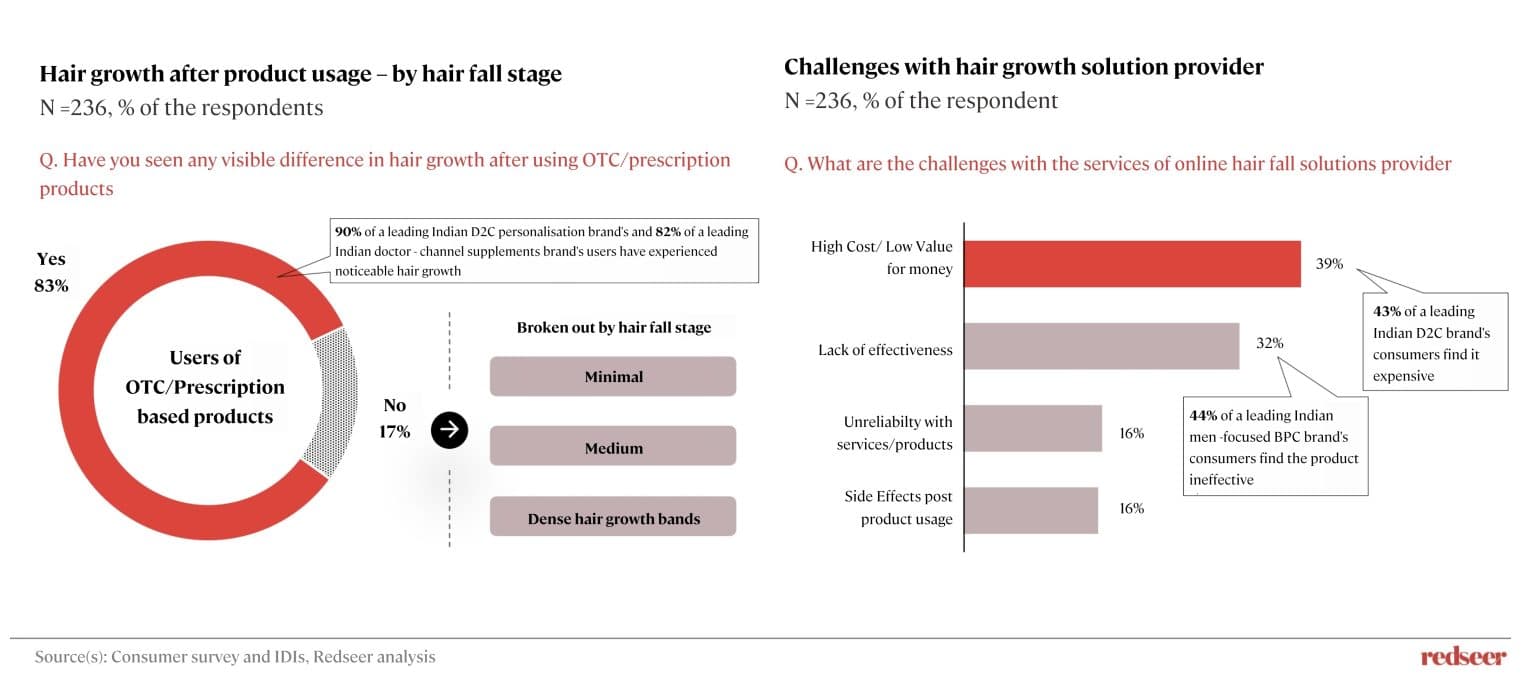
This makes the INR 500 to INR 1,000 band a low-effort, high-yield opportunity for BPC and FMCG players. They structurally carry the procurement scale, packaging efficiency, and distribution leverage to make this price range work at a unit economics level. A value-led entrant with considerable scale has significant room for growth.
Format is set by regulation, not brand strategy
For most brands entering the hair growth category, format is a downstream decision — something that gets decided after the target consumer and brand positioning are ironed out. Brands should be aware of the regulatory structure they operate in. Regulation determines the point of sale and the constraints involved.
“60% of both the supplements and medicated products market sits outside the top five players, with no category having a dominant leader.”
The hair growth market has three out of four characteristics that work in favour of FMCG and BPC companies. First, the current multi-product kit architecture can be reduced to two or three SKUs without losing clinical credibility. Second, procurement and distribution synergies at scale can bring down monthly cost to roughly half the doctor-channel equivalent, which is already lower than the high customer acquisition costs of the D2C channel. Third, room-temperature storage works across supplements and most topicals, which removes cold-chain logistics as a barrier.
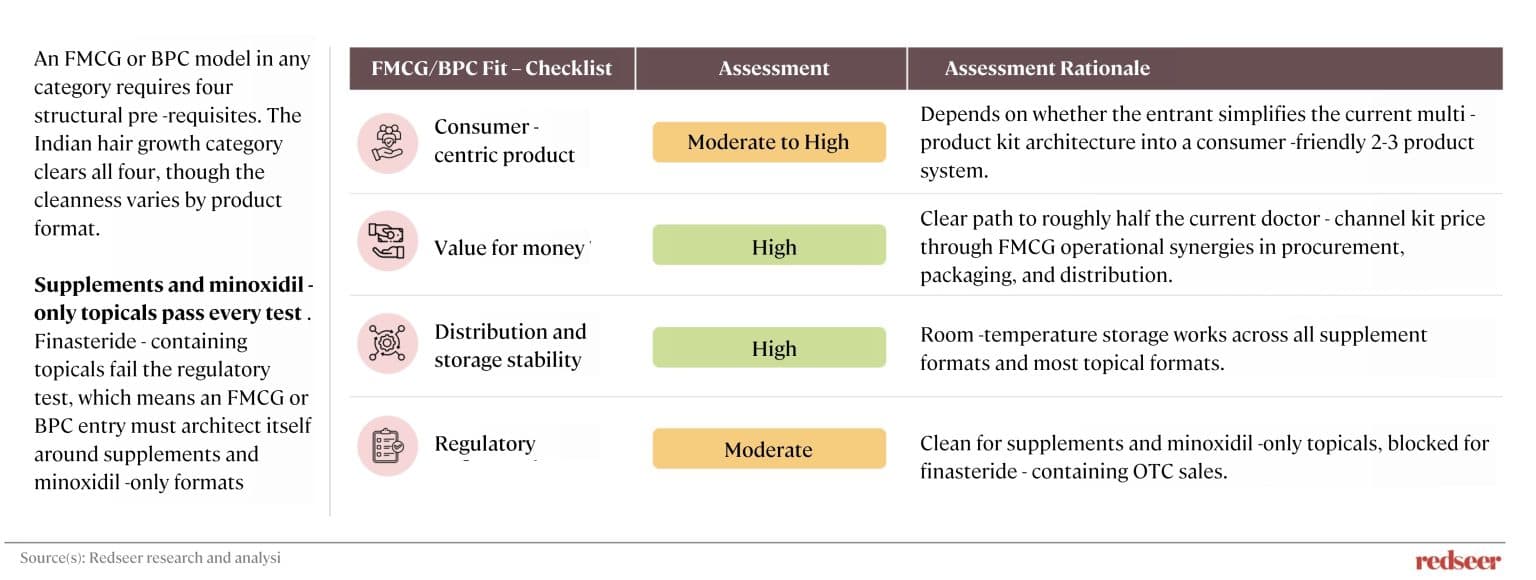
The fourth is regulatory clearance – this is where the decision gets made for you. Supplements and minoxidil-only topicals have the green light for OTC sales. But finasteride-containing topicals remain prescription-only. Any brand building for OTC must design its product line around this constraint from day one.
Time is the real cost
What’s actually stopping FMCG players from entering? Channel is not the answer. Retail, pharmacy, online marketplaces, quick commerce, and D2C all exist. Incumbent FMCG and BPC brands already have active listings across most of them. Distribution infrastructure is not what stands between five million current users and the 82 million addressable base.
The real barrier is consumer behaviour.
Most nutraceutical consumers buy at a pharmacy, not off a retail shelf. Picking up a hair supplement the way one picks up a shampoo or a cereal is not how most consumers in this category think. And no amount of distribution solves that.
A Mumbai retailer interviewed for Redseer’s research put it directly, “I do carry some multi-vitamins, and they do sell, but they are slow-moving products, and I usually order them precisely. But I don’t mind taking on newer brands if I get good margins on them.”
The challenge and the solution are clearly formulated.
The consumer needs a reason and the confidence to pick this up off a shelf. The retailer needs the margin to stock it prominently. Neither is in place today, and neither arrives without a deliberate, sequenced marketing build.
The sequence that has worked globally and in early Indian evidence follows three stages. Doctor-led endorsement first, to establish clinical credibility before the brand has shelf presence. Then communication that frames supplements as a daily wellness habit rather than a prescribed course. Then retailer margin incentives to earn the shelf position.
Nutrafol, the US supplements brand that scaled from USD 50 million to USD 150–175 million before being acquired by Unilever, ran exactly this sequence: clinical and salon credibility first, retail access second. Its acquisition validated the playbook for every strategic acquirer now looking at India.
The realistic timeline for this build in India is 24-36 months of sustained marketing investment, with no expectation of category-level returns in year one. That is capital only an FMCG or BPC scale entrant can commit. The M&A signals make the same argument. HUL’s acquisition of Oziva. HUL’s 19.8% stake in Wellbeing Nutrition. Marico’s 58% stake in Plix for INR 369 crore. Tata Consumer Products’ acquisition of Organic India.
None of these is exploratory. These are conviction signals from brands that have run the numbers. They know this path – taking a category from pharmacies to retail shelves, and they are betting it works again.
The way forward
India’s hair growth market is structurally ready. The price gap exists, the channels are established, and the format regulations give clear direction. What remains is the sustained marketing commitment to make it happen.
For any FMCG or BPC brand evaluating this category, the sequence is the strategy. Get the price architecture into the INR 500 to INR 1,000 band. Build the product around supplements and proven formats from day one. Then commit the 24 to 36 months of sustained marketing needed to make a hair supplement feel like something a consumer picks off a shelf because they want to, not because a doctor told them to.
The winner will be the player who gets all three right. We expect them to emerge within the next few years.
Written by


Engagement Manager

India Hair Growth Market Report 2026

India’s Internet Economy: Built for Scale, Ready for Capital

Digital Disruption in Home Category: Whitespace to Market Leadership

Think Quick Commerce: Unlocking the $90Bn Opportunity

India’s $40Bn Beauty & Personal Care Market: Growth, Shifts and Opportunities for 2030

State of India’s Food Services Market

Value Grocery Commerce: The Bharat Unlock

The Body Lotion Opportunity in Indian E-Commerce

Reinventing Packaged F&B with Quick Commerce

Why Global Apparel Players Are Betting Big on India!

India’s Beauty Industry : Transforming boundaries across Audiences and Categories

New-Age vs Legacy: The Future of Fashion in India and the Battle for Consumer Loyalty
India Hair Growth Market Report 2026
India’s Internet Economy: Built for Scale, Ready for Capital
Digital Disruption in Home Category: Whitespace to Market Leadership
Think Quick Commerce: Unlocking the $90Bn Opportunity
India’s $40Bn Beauty & Personal Care Market: Growth, Shifts and Opportunities for 2030
State of India’s Food Services Market