India’s Intra-City Parcel Market Growing at 40–50% CAGR: Two Archetypes Racing for the 2 Bn Order Opportunity


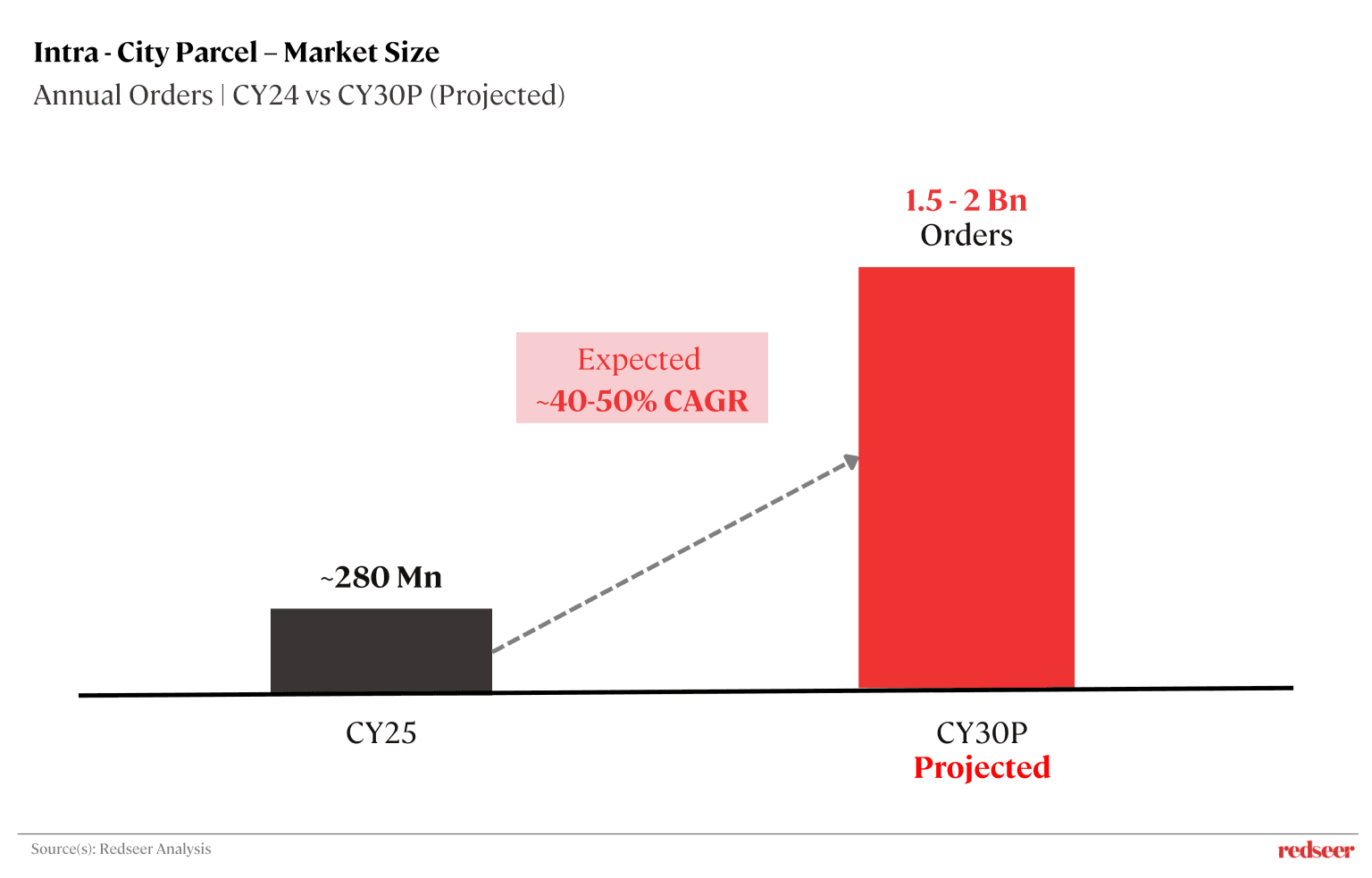
India’s intra-city parcel market processed approximately 280 million orders in CY25. By CY30, that number will reach 1.5 to 2 billion, growing at 40 to 50% a year. The opportunity is real. Capturing it requires understanding what is actually driving it.
There are two growth engines that are functioning simultaneously. With SMEs, large volumes of business demand still move through unorganised channels. Digital platforms provide on-demand dispatch, real-time tracking and transparent pricing. With C2C, the use case is still a work in progress, while ride-hailing platforms are widening the consumer base by converting their existing bike taxi user base into parcel senders.
Factors Driving Growth
Two key segments are driving growth in this market
- SME’s demand for formalisation and vehicle upgrade:
A substantial portion of business delivery demand still moves through unorganised channels. Digital platforms offer real-time tracking, on-demand dispatch, and transparent pricing that informal operators cannot match, with conversion spreading through peer referral rather than marketing spend. As SME relationships deepen on-platform, delivery profiles shift toward higher-value vehicle categories. LCVs and trucks carry five to ten times the revenue per trip of a two-wheeler. This multiplies revenue per customer without proportional volume growth.
- C2C expansion and ride-hailing supply leverage
Organized C2C parcel penetration remains low, and the use case is still building. Parcel-first platforms have served C2C from the beginning. Ride-hailing platforms are a recent catalyst. This widens the consumer base because it converts monthly bike taxi users into parcel senders at near-zero acquisition cost. 45-55% of bike taxi captains use their idle time and complete more deliveries. This strengthens worker retention without significant additional investment.
Vehicle Mix Shaping the Market Structure
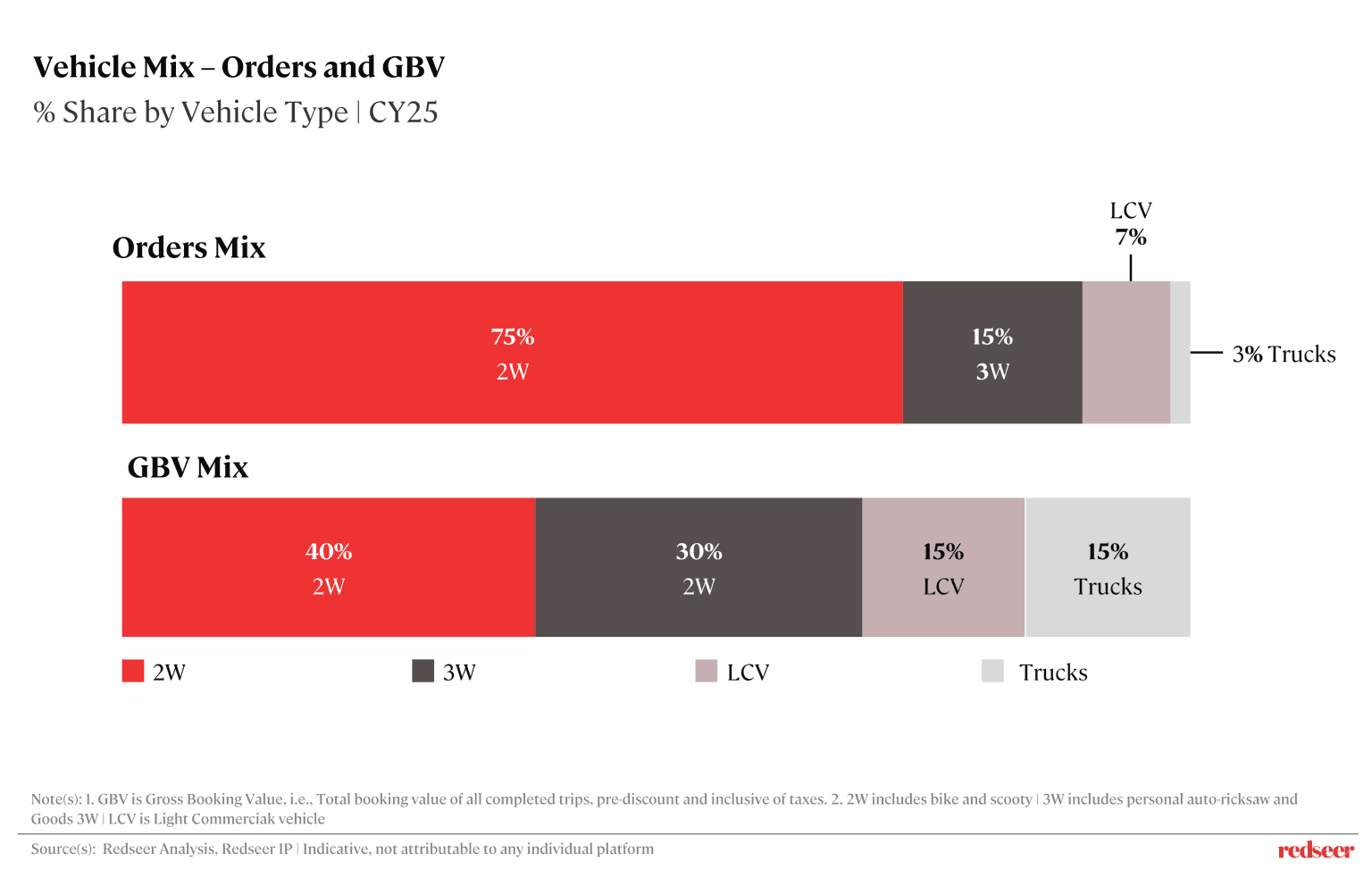
Two-wheelers are volume, and a non-two-wheeler is value: Two-wheelers account for ~75% of completed orders but bring in only 40% of GBV. Non-two-wheelers account for ~25% of completed orders across three-wheelers, LCV and trucks. Together, their delivered GBV is ~60% from just ~25% of order volume.
A full-stack vehicle capability becomes the differentiating product: Platforms that offer multiple vehicles right from two-wheelers to trucks, to access both volume and revenue from a single customer relationship. Two-wheelers establish frequency and trust. Ride-hailing platforms should close the gap between revenue and volume to improve revenue quality.
Customer Mix Shaping the Market Structure
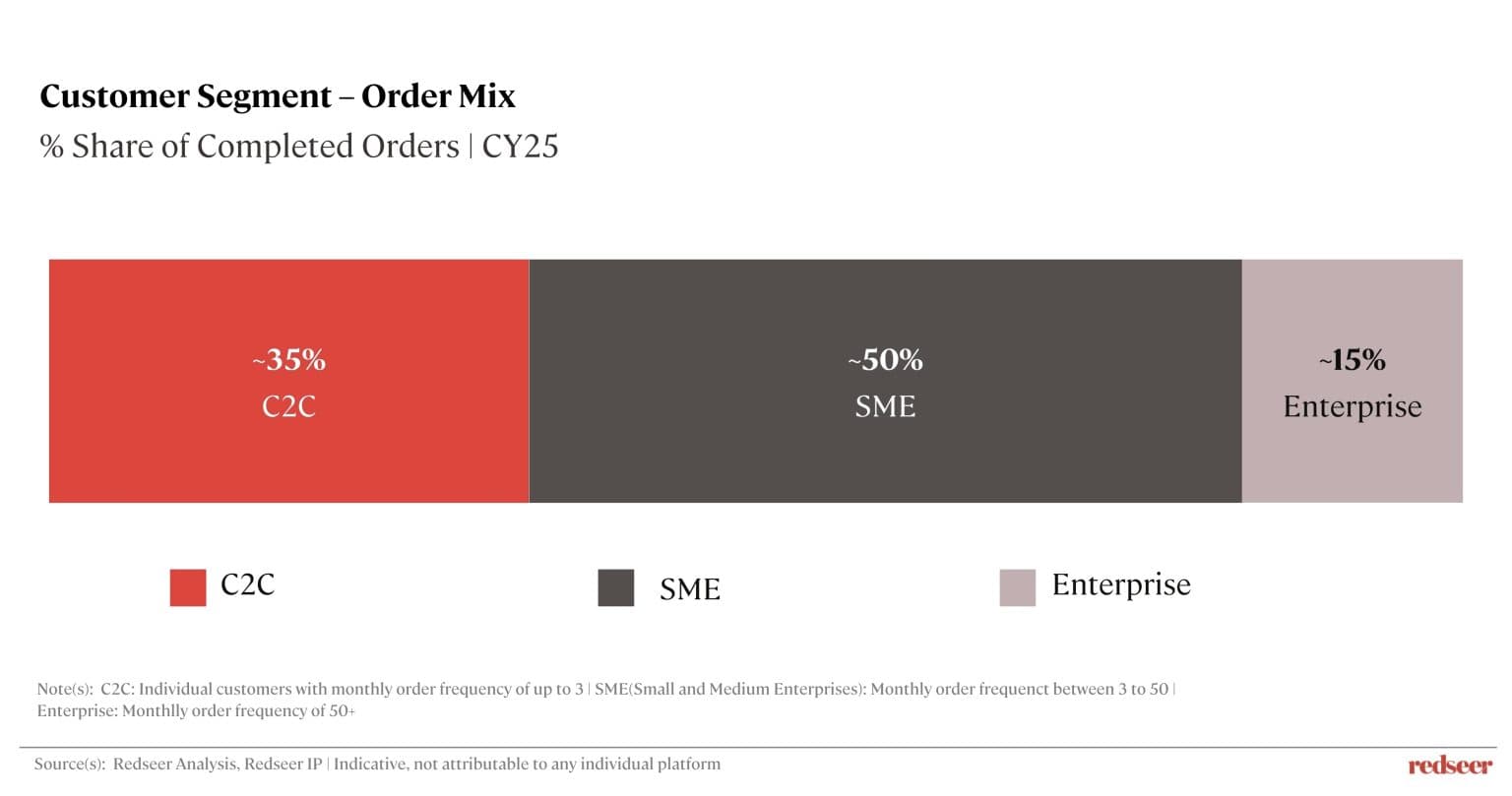
Enterprises are growing at 90%+ year on year. Driven by reliability, SLA accountability and billing retention, FMCG distributors, retail chains, and supply chains are formalising recurring intra-city delivery onto platforms at scale. Once they’re onboarded via API and central billing, switching becomes an operational decision, not a price comparison. This makes them the segment with the highest retention, highest LTV and the hardest to win.
SMEs are growing at 50-60% year on year. They are the largest segment by order share. Trust and peer referral within the trade community drive their decision to stay or to switch. It’s not about marketing spends. They order out of business necessity and are highly price resilient. Their operational dependency deepens over time.
C2Cs are growing at 80%+ year on year. They’re served by both parcel-first and ride-hailing platforms. Their growth acceleration is largely driven by ride-hailing platforms, which widen their consumer base. Customers are price-elastic, switch easily and are irregular. They belong to a volume and awareness funnel, not a defensible revenue base.
“Parcel-first platforms are absent from Tier 2 and Tier 3 cities. SME demand is building here, and ride-hailing platforms already have their footprint.”
Two Archetypes, One Market Opportunity.
Parcel-first platforms are built for logistics and trusted by businesses. They grew through SME and Enterprise referral networks. Multi-vehicle availability, SLA tracking, named account management and enterprise billing integration form key aspects of their platform.
They’re sustained by consistent SME order density, and their depth runs into approximately 25 cities at an 85-90% fulfilment rate.
- Full-time captains earn from an 8 AM to 6 PM window.
- Blended ARV is approximately 3x that of ride-hailing-first platforms.
- SME loyalty is earned through years of consistent service.
- Platforms are recommended within business communities at a price premium.
These dynamics cannot be replicated by capital alone. API integration, central billing and turning switching into an operational decision lock enterprises with high multi-year retention. Their primary gap is city reach.
Ride-hailing-first platforms supply at near-zero marginal cost. 45-55% of bike taxi captains work as parcel delivery partners. There’s no need for incremental recruitment or additional onboarding. ~15% of monthly transacting customers is a conversion rate that grows with developing product visibility sans a separate acquisition funnel. Tier 2 and Tier 3 cities account for a growing share of parcel trips. Moving into SME requires capabilities that do not come from mobility operations organically.
“C2C brings in the structural gap with revenue. 85-95% of parcel orders are C2C.”
The Market is Moving – Are You?
Intra-city parcel is projected to reach 1.5-2 billion annual orders by CY30. Four vectors will determine value distribution across players, and why the positioning window is becoming narrower than a five-year horizon.
- Tier 2 and Tier 3 cities will carry the next wave of the largest untapped SME demand. While ride-hailing platforms have a head start, parcel-first platforms are also expanding along SME trade routes where suppliers’ relationships already exist.
- By providing two-wheelers to higher vehicle categories, vehicle mix and GBV will be driven by this shift. Platforms with this offering will protect themselves from the existing margin compression in two-wheelers.
- FMCG distributors, supply chains and retail chains represent a big, underpenetrated pool. To capture this segment, a product-specific stack is required. Platforms that develop a specific product stack with multi-order dispatch, SLA accountability and API-integrated billing will be immune to price competition.
- While parcel-first platforms are extending city reach, ride-hailing-first platforms are investing in vehicle diversification and SME product. Structural changes can be made today. Over time, they become more expensive and harder to establish, especially in 24 months.
Two years from now, the cost of establishing a position in this market will be significantly higher. The time to move is now.
The insights have been derived from Redseer’s Benchmarks, the most trusted insights platform on the Indian internet landscape. Its proprietary consumer internet data allows us to make granular and long-term comparisons that reveal underlying trends and shifts in consumer behaviour.
Benchmarks track city-level utilisation, expansion mix, and maturity trends across major quick commerce and consumer internet companies, offering its investors, brands, and platforms a clearer lens on how reported growth aligns with underlying economics.
Written by



Think Quick Commerce: Unlocking the $90Bn Opportunity

India Online Retail 2026: The Fastest Year in Five, and the New Engines Behind It

State of India’s Food Services Market

Value Grocery Commerce: The Bharat Unlock
The Next Battleground: Winning India’s Intracity Logistics Market Through Trust, Tech & Transparency
Express Logistics in Motion: Market Update & Outlook

Capturing the Growth Potential in India’s 3PL Market
Delivering the future: How New-Age Logistics is Transforming Brand Success

Value Grocery – Unlocking India’s Next 100 Mn Shoppers

Quick Commerce vs Kiranas vs Hypermarkets, who will win the Indian Grocery Market?

Urban Company’s growth journey shaped by Redseer strategy consulting

How Redseer Helped India’s Leading Ride Hailing Player Develop and Implement its 2-Wheel Taxi Offering
Think Quick Commerce: Unlocking the $90Bn Opportunity
India Online Retail 2026: The Fastest Year in Five, and the New Engines Behind It
State of India’s Food Services Market
Value Grocery Commerce: The Bharat Unlock
The Next Battleground: Winning India’s Intracity Logistics Market Through Trust, Tech & Transparency
Express Logistics in Motion: Market Update & Outlook