
How AI is restructuring India’s commercial real estate strategy
 Chhavi Singh
Every wave was expected to destroy jobs, but each created more work than it eliminated. The AI wave adds a stranger twist: fewer routine jobs should, by intuition, shrink office demand, yet in India the workspace stack is set to expand alongside AI-led hiring.
Deployment here has only just begun, and the country, ranked second globally for growth in AI talent concentration, is hiring the mid-level and senior specialists who take AI from pilots to scale. 96% of AI-native firms and 75% of GCCs expect a more senior-weighted workforce within five years.
This workforce does not need bigger desks; it needs high-spec, collaborative space built for coordination and judgement, not rows of execution seats. But the same shift makes teams harder to plan for. With AI reshaping roles quarter to quarter, companies no longer hire to a fixed number, leaving them needing more premium space yet less able to commit to it long-term. That tension, better workspaces for a headcount no one can pin down, is quietly rewriting how India leases offices.
The Pyramid is Inverting
Companies prefer to hire AI for entry-level jobs in the execution layer, which involves coding, testing, and validation. While the base of the pyramid is eroding, the jobs available will be mid-level to senior roles: to supervise, validate and make judgment calls that AI cannot.
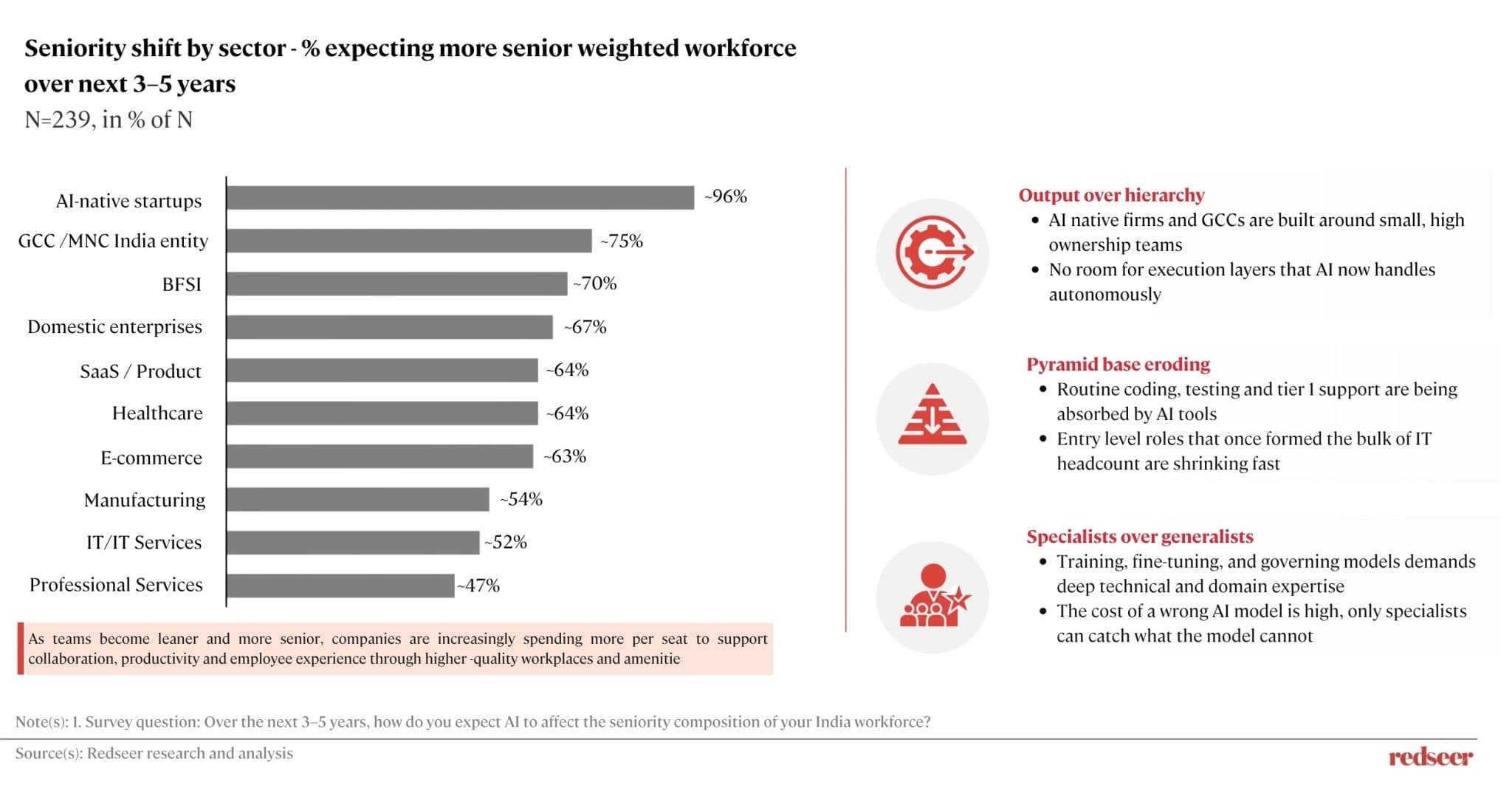
Across every sector surveyed, the mid-level to senior hiring is heading in the same direction. BFSI at 70%, domestic enterprises at 67%, and SaaS and product companies at 64% – all planning to increase the weighting of hiring of senior workforce in three to five years. This marks a structural change because while teams are leaner, they are more senior-heavy and expert-heavy, changing what an office should be.
Why Seniors Need More from an Office Space
A leaner team does not mean less office space. And that is the central irony of the AI-driven workforce shift. Senior employees need infrastructure, not rows of desks. The workspace data is unambiguous:
- The spend per seat increases: While heads are fewer, each head stands for one premium space instead of a desk. Even if the seats count flattens, the cost per seat goes up.
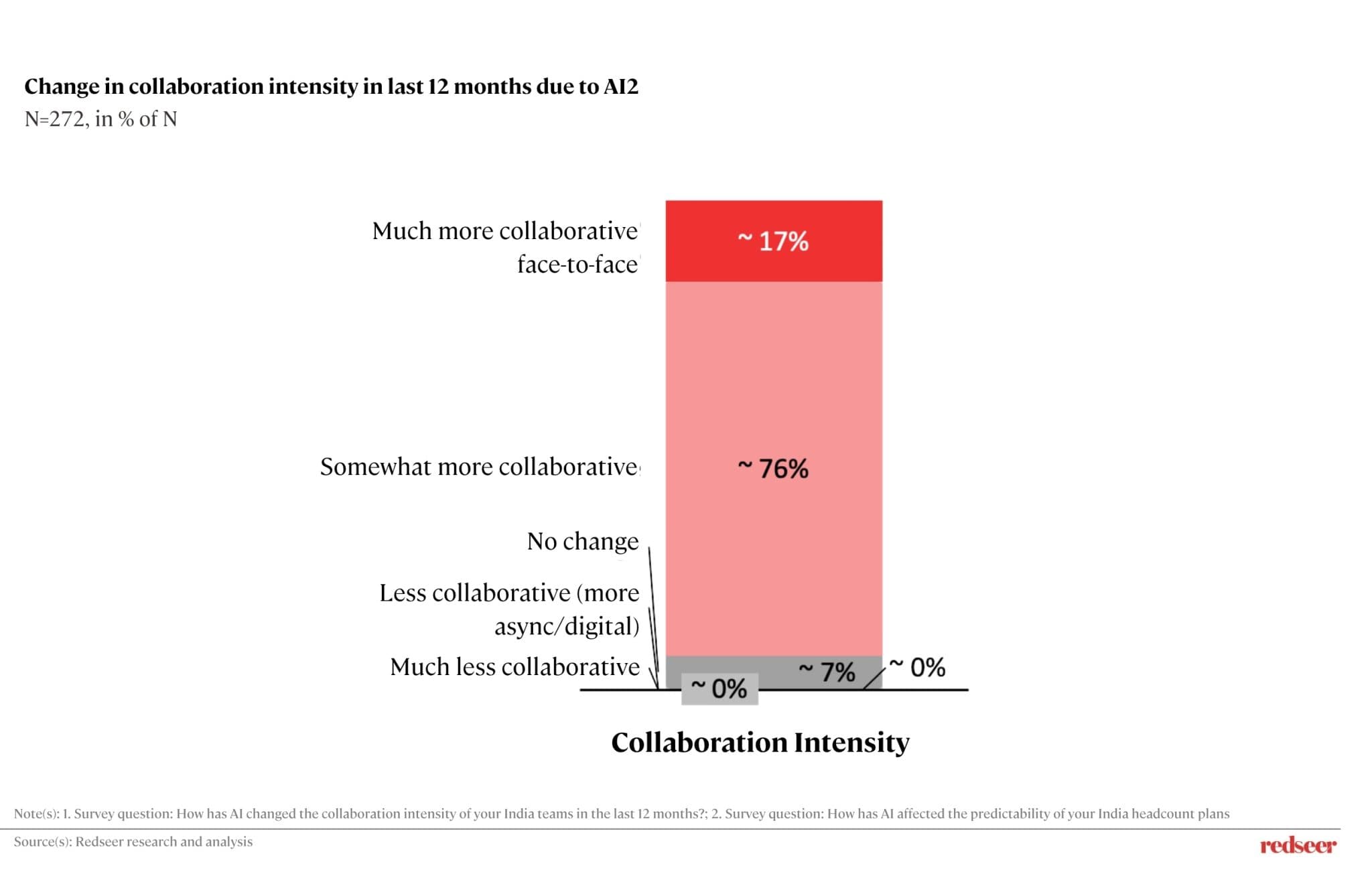
- Work becomes collaborative: Mid-level to senior staff validate, coordinate, and supervise the workflow. They do not execute solo.
- The demand for meeting rooms is up from +30% to 50%.
- ~78% of firms cite high-speed connectivity as a top workspace priority.
- ~62% cite video-conferencing infrastructure (to operate across time zones)
- ~50% cite large collaboration and workshop spaces.
Location becomes a hiring tool: Since senior talent is both expensive and scarce, the quality of a workspace has become a hiring leverage. ~17% of firms cite location as an important factor. ~89% of firms say that location matters now more than it did two years ago, and ~82% use location as leverage to pitch to AI talent.
AI has definitely made our work faster, but it’s made us work together more. We’re constantly checking, validating, and aligning, especially on the tricky cases. So yes, more collaboration now than a year ago.
– Pankaj, GCC
Unpredictable Headcount
Until CY20, long-term leases dominated the industry, and that was because the workforce was relatively predictable. Offices were optimized for seat capacity and efficiency. Timelines were set up and aligned with multi-month planning cycles. ~40% of firms were in long-term leases for 5+ years.
AI has broken the calculus. With these structural changes, firms are no longer planning real estate for the long-term. With roles, team sizes and skill requirements shifting from quarter to quarter, a long-term lease becomes a liability. The market has already moved to flexible workspaces.
Currently in CY25, planning horizons have compressed to three years for ~75% of enterprises. Long-term leases are no longer the default option.
AI is changing roles faster than we plan for them. Teams, skill requirements, and hiring priorities are evolving quarter to quarter, which makes long-term headcount planning much less predictable.
– Rohan, BFSI
The Office Has a New Brief
The office will no longer work on headcount. It will be infrastructure for a leaner, more senior and globally connected workforce.
With AI in India’s workspace, the shift is towards core and flexible models, from ~70-80% to flexible models. Senior hiring has not just created demand for flex but rewritten flex economics itself.
- The rising space per seat has gone up from 80-90 sq ft today to 95-100 sq ft by 2028.
- ~49% of firms cite 24/7 access since they work across global time zones that do not follow standard business hours.
- ~25% of firms cite soundproof focus rooms (deeper collaboration, quieter space to concentrate)
The flexible workspace in India stays resilient even if the team size becomes leaner because even a ~10% fall in seats is absorbed by ~10% pricing growth. AI-led hiring is projected to drive around ~31% of flex seat leasing by 2030. Seniority is what makes flex demand durable rather than a passing reaction to a hiring cycle.
Workplace strategy is increasingly being aligned to business volatility and talent mobility. Flex enables faster market entry, decentralized hiring, and premium employee experience with significantly lower operational complexity
– Sandeep IT/BPO
The Occupancy Economics/The Flex Workspace Economics
Flexible workspaces in India and AI hiring have changed the structure of office costs. While traditional leasing is priced by area, once you commit to ~30,000 sq ft regardless of how many employees occupy it on any day, you are bound by greater capital commitment and reduced financial flexibility.
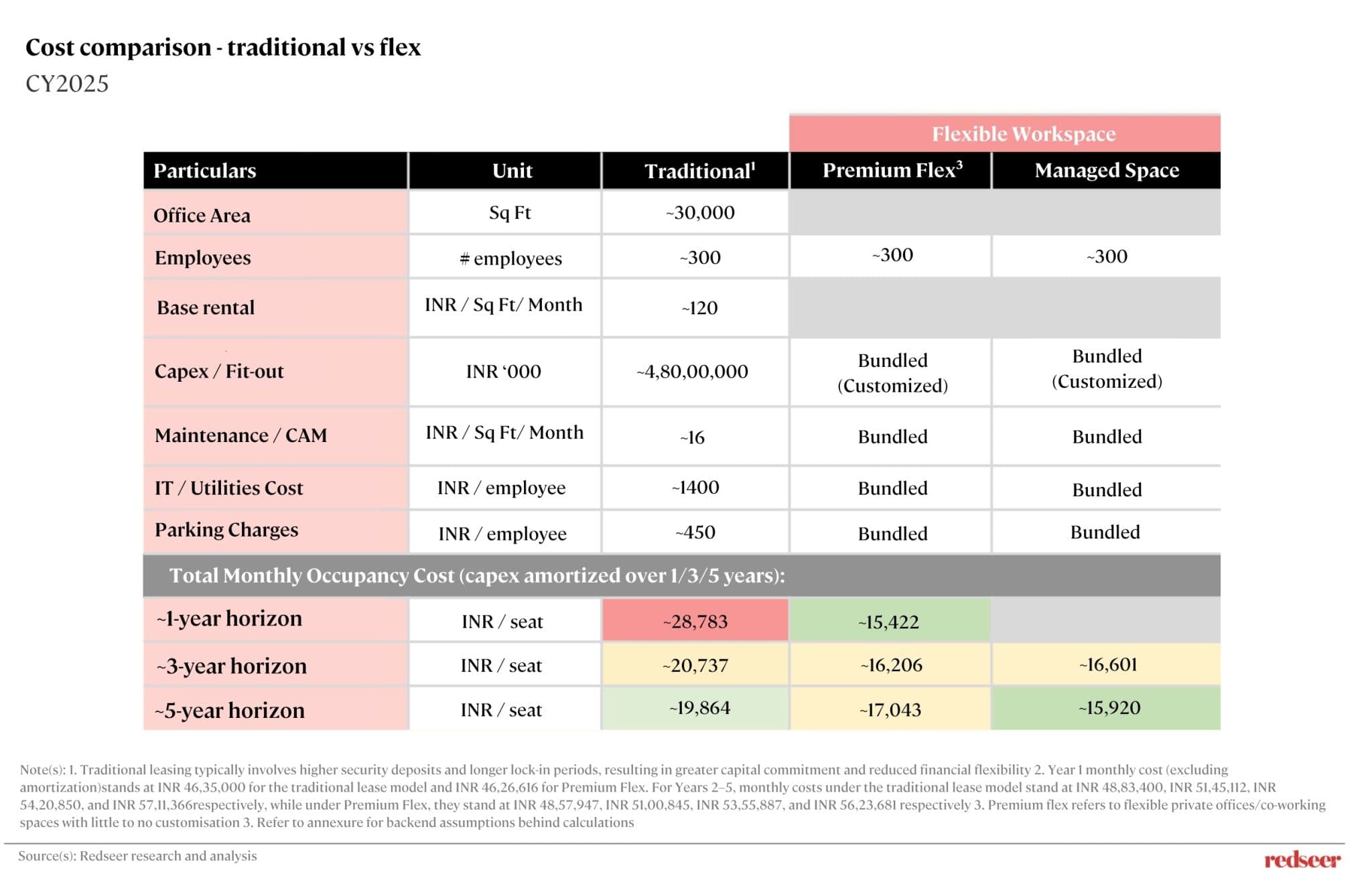
Flexible workspaces remove the largest entry barrier, which is ~INR 30M capex, enabling faster expansion without capital allocation tradeoffs. For teams that cannot forecast a certain headcount number, this makes an enormous difference cost-wise.
- Traditional leasing at one-year costs ~INR 28,783, while premium flex is at ~ INR 15,422.
- At five years, traditional leasing is ~INR 19,864 while premium flex is at ~INR 17,043.
Flexible workspaces are more cost-effective than traditional leasing across a timeline of one to five years.
The Shift is Underway
The claim is that AI will end the office story with headcount by cutting out jobs, but that is not what will happen. AI will not end the story; AI will reprice and reshape the story.GCC flex leasing is growing 1.7 times faster than other segments, with GCCs projected to drive approximately 55 million sq ft of gross annual leasing by 2030.
- The GCC share of overall office leasing is projected to rise from 38% in 2025 to 48% by 2030.
- AI-led hiring is expected to account for 31% of flex seat leasing by 2030.
Team sizes will become smaller, more senior weighted, and harder to plan for. What the teams need from an office is space to collaborate, premium infrastructure, and no ten-year commitments. This is what Flex delivers. A workplace stack that was built for ten-year leases is not built for today’s work. Flex is.

Written by
Chhavi Singh
Associate Partner
Associate Partner at Redseer with 14+ years across consulting, health-tech, e-commerce, and entrepreneurship. Previously at Bain & Company, Flipkart, and THB. MBA from IIM Ahmedabad.
Talk to me

AI and The Future of Workspaces in India

Artificial Intelligence: The Next Growth Catalyst in Advertising

India’s DeepTech Renaissance: The Convergence of Defence, Robotics & Innovation Opening New Opportunities

Micro-Drama’s J-Curve Moment: What Marketers, Platforms, and Investors Need to Know

The Gaming and Interactive Media Opportunity in India

Why AI Is Accelerating the Flex Workplace Era

Redseer helped a leading home services platform decode the technology-led transformation of the sector

How we helped a global gaming & interactive media investor read the India opportunity.

Urban Company’s growth journey shaped by Redseer strategy consulting

IPO consulting services for Wakefit IPO: what and how

IPO consulting services behind Groww’s public market readiness

Insights from our consulting on India’s leading conversational engagement platform scale-up journey
AI and The Future of Workspaces in India
Artificial Intelligence: The Next Growth Catalyst in Advertising
India’s DeepTech Renaissance: The Convergence of Defence, Robotics & Innovation Opening New Opportunities
Micro-Drama’s J-Curve Moment: What Marketers, Platforms, and Investors Need to Know
The Gaming and Interactive Media Opportunity in India
Why AI Is Accelerating the Flex Workplace Era
Redseer helped a leading home services platform decode the technology-led transformation of the sector
Related Redsights

AI and The Future of Workspaces in India

Artificial Intelligence: The Next Growth Catalyst in Advertising

India’s DeepTech Renaissance: The Convergence of Defence, Robotics & Innovation Opening New Opportunities

Micro-Drama’s J-Curve Moment: What Marketers, Platforms, and Investors Need to Know

The Gaming and Interactive Media Opportunity in India

Why AI Is Accelerating the Flex Workplace Era

Redseer helped a leading home services platform decode the technology-led transformation of the sector

How we helped a global gaming & interactive media investor read the India opportunity.

Urban Company’s growth journey shaped by Redseer strategy consulting

IPO consulting services for Wakefit IPO: what and how

IPO consulting services behind Groww’s public market readiness

Insights from our consulting on India’s leading conversational engagement platform scale-up journey