How the $1 Trillion Digital Advertising Market Is Changing and What It Means for Businesses
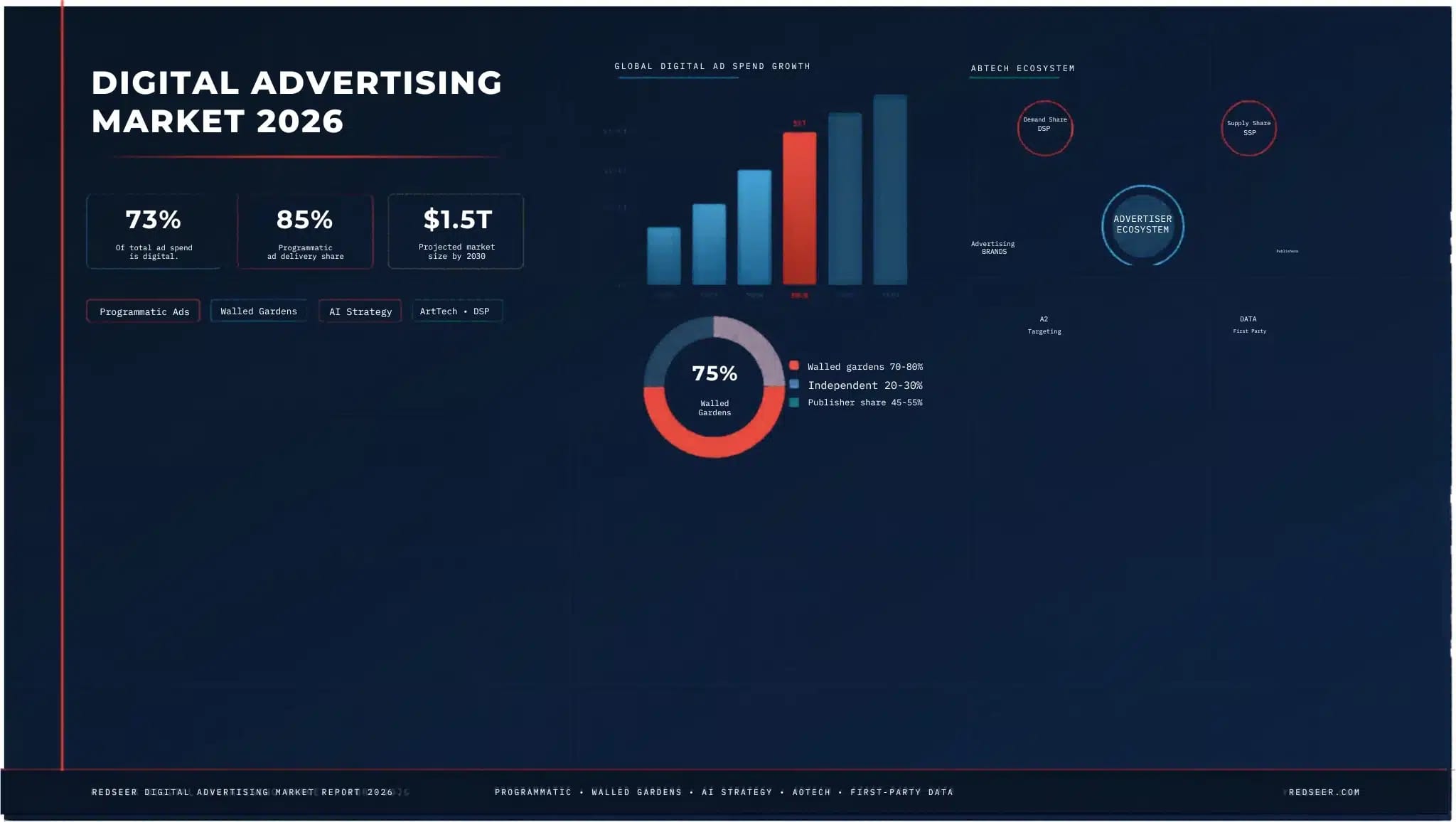
Global digital advertising is growing at scale. Ad spending has crossed $1 trillion and is expected to reach $1.5 trillion by 2030. Digital already accounts for nearly three-quarters of total advertising spend and continues to grow significantly faster than global GDP. These shifts are widely covered in Redseer’s digital advertising market report 2026 and are shaping how the digital advertising market 2026 is being understood.
At a surface level, this points to a market with strong momentum. But the underlying structure is becoming more complex. For brands, platforms, and investors, the challenge is no longer access to reach. It is understanding where value sits within the system and how to operate within it, something increasingly highlighted in our comprehensive digital advertising market report.
This is where digital advertising strategy is evolving, and where strategy consulting firms are increasingly helping businesses make sense of the shift.
More Attention, More Platforms, Less Clarity
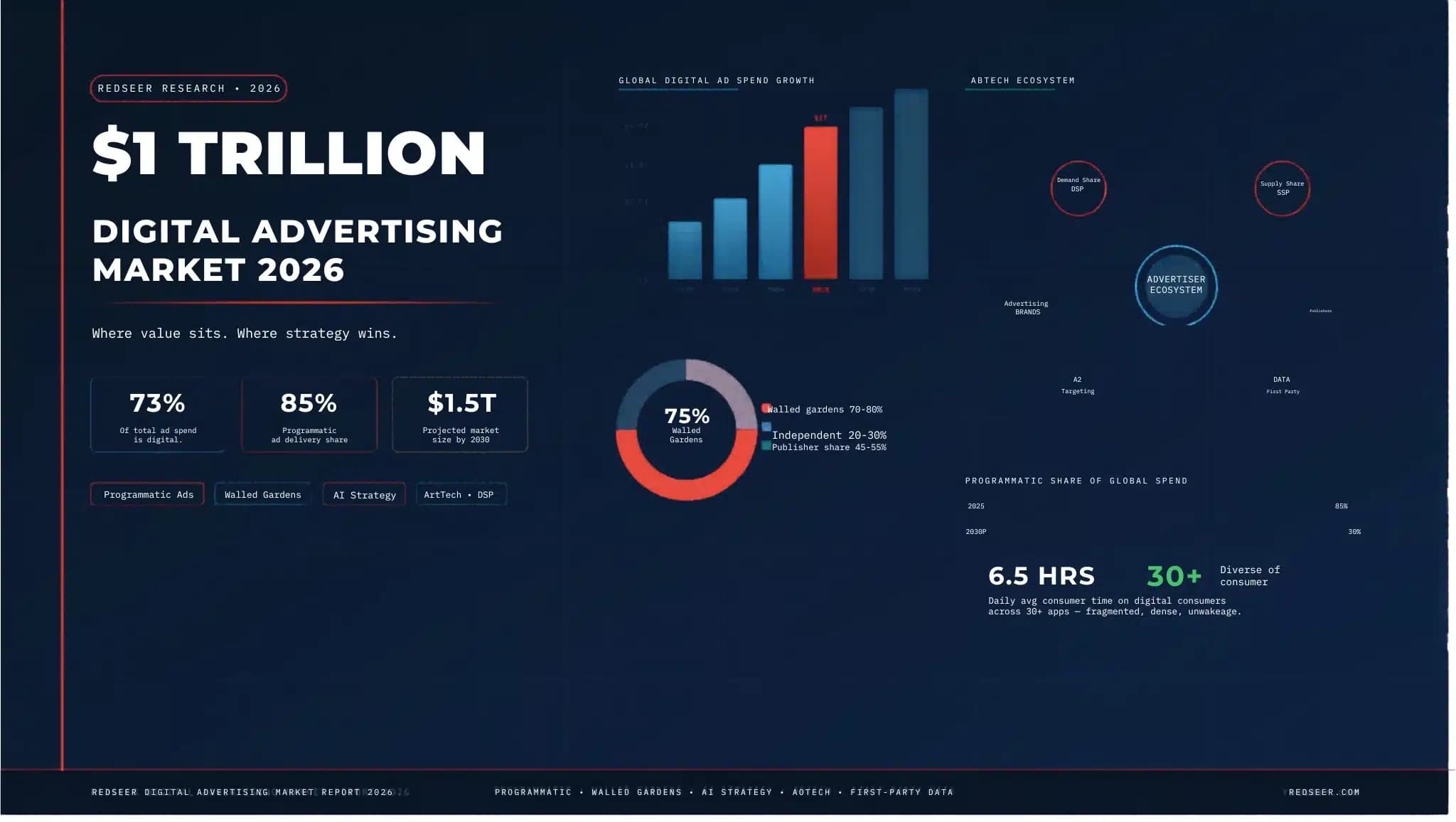
Consumers today spend close to 6.5 hours a day on digital platforms. That time is distributed across more than 30 apps, multiple devices, and different content formats. While total attention has increased, it is fragmented across ecosystems that operate independently, one of the defining digital advertising trends of 2026.
For brands, this creates operational complexity:
- Audiences are harder to track consistently
- Messaging needs to adapt across platforms
- And measurement becomes less reliable
Digital advertising strategy today involves navigating fragmentation and maintaining relevance across multiple touchpoints.
This is where marketing strategy consulting and consumer strategy consulting in India are increasingly focused, helping brands map consumer journeys that no longer sit within a single platform.
Control in the Digital Advertising Market Is Concentrating
One of the most important shifts in the digital advertising market 2026 is the concentration of control.
Walled gardens, large closed ecosystems, now account for approximately 70-80% of total ad spend. These platforms control:
- user identity
- targeting infrastructure
- measurement frameworks
- and inventory supply
For advertisers, this creates both scale and dependency. At the same time, publishers capture only around 45-55% of advertiser spending, highlighting inefficiencies in how value flows across the advertising value chain, as observed in Redseer’s digital ad spend reports.
Understanding these dynamics is critical for any business operating in digital advertising today. Strategy consulting firms in India and globally are increasingly helping brands and platforms evaluate where value accrues and how to optimise their participation within this structure.
Programmatic Advertising Has Become Core Infrastructure
Programmatic advertising
Programmatic advertising has become the default infrastructure through which digital advertising operates, and it accounts for the majority (80-85%) of the global digital ad spend in 2025, and its share is projected to grow further to 85-90% by 2030P.
Programmatic advertising enables real-time bidding, automated targeting, and large-scale campaign execution. However, as programmatic systems scale, they also introduce:
- multiple intermediaries
- limited transparency
- and measurement complexity
Together, these factors influence how efficiently advertising budgets are deployed across platforms.
For brands, this means that digital advertising strategy must go beyond platform selection. It requires a deeper understanding of how programmatic systems function and where inefficiencies may exist.
AdTech consulting firms and strategy consulting firms play a key role here by helping businesses audit their advertising stack and improve capital allocation.
AI Is Reshaping Digital Advertising Strategy
Artificial intelligence is becoming central to how digital advertising operates. It is influencing areas such as targeting precision, campaign optimisation, creative generation, and performance measurement.
At the same time, privacy regulations are reducing access to third-party data. This is pushing the ecosystem toward first-party data strategies, contextual targeting, and more AI-driven decision-making.
For brands, this shift creates both new opportunities and additional complexity in how digital advertising strategy is executed.
The opportunity lies in improving efficiency and personalisation. The challenge lies in building the infrastructure required to support these capabilities.
This is where business consulting firms in India and marketing strategy consulting teams are increasingly involved, helping organisations transition from legacy data models to AI-enabled systems.
What This Means for Brands, Platforms, and Investors
As the digital advertising market grows, its structure is becoming more layered.
For brands, this means:
- Rethinking how ad spend is allocated across platforms
- Investing in first-party data and analytics capabilities
- And adapting to a more fragmented attention environment
For platforms and publishers, it means:
- Strengthening control over identity and supply
- Improving measurement capabilities
- And finding ways to capture a larger share of advertiser spending
For investors, the focus is shifting toward:
- Understanding where value concentrates across the advertising stack
- Identifying scalable business models within AdTech
- And evaluating long-term sustainability beyond topline growth
These are not tactical adjustments. They require structural changes in how businesses approach digital advertising.
The Role of Strategy Consulting in Digital Advertising
As the advertising ecosystem becomes more complex, the role of strategy consulting firms is expanding.
Strategy consulting firms in India and globally are helping businesses:
- Define digital advertising strategy in fragmented ecosystems
- Identify where value sits across the advertising value chain
- Build first-party data and AI-driven capabilities
- Optimise marketing spend across platforms
- And align advertising strategy with broader business goals
For companies operating in a $1 trillion market, clarity on these decisions becomes a competitive advantage.
The Shift Ahead
The digital advertising market will continue to grow over the next decade. What is changing is how that growth is distributed, who controls it, and how effectively it can be monetised, key themes across Redseer’s recent digital advertising trends 2026 analysis.
The Adtech market is witnessing a decisive shift toward vertical integration since 2020, as platforms
increasingly seek to own both demand and supply infrastructure. One scaled independent platform
exemplifies this model, operating across DSP and supply layers, and reinforcing its stack through
acquisitions in attribution data and supply-side reach. A second major player follows a similar
demand-supply spanning architecture. In contrast, the largest independent DSP has deliberately
stayed demand-only, betting on neutrality as its core value proposition.
The consolidation impulse in the market is further visible in landmark combinations across game
engines, mediation platforms, and performance networks, reflecting a broader industry trend where
owning more of the value chain translates directly into margin and data advantage.
For businesses, this means moving beyond scale-led thinking and focusing more on structure, efficiency, and control. Digital advertising strategy is no longer defined by reach alone. It is shaped by data ownership, platform dynamics, and the ability to operate within a fragmented ecosystem.
To understand these shifts in more detail, explore Redseer’s latest digital advertising market report 2026, which breaks down where value is concentrated, how the ecosystem is evolving, and what it means for brands, platforms, and investors.
Redseer works with businesses to decode digital market shifts, build data-driven strategies, and navigate complex ecosystems through structured strategy consulting and market analysis.