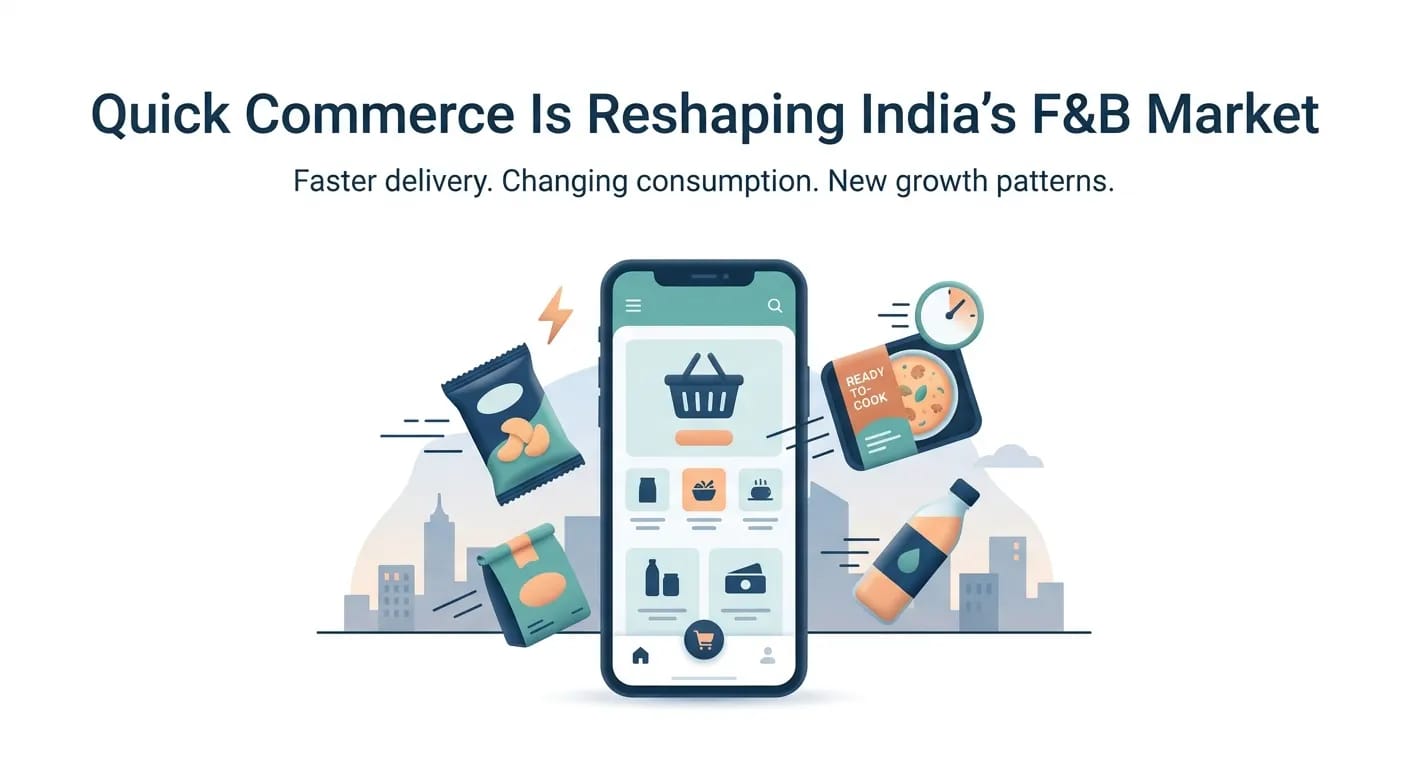
How Quick Commerce Is Reshaping India’s Packaged F&B Market
India’s packaged food and beverage market is entering a new phase of growth, shaped as much by changing consumer habits as by evolving distribution channels.
The market, already valued at over $100 billion, is expected to grow to approximately $150 billion by 2030. Alongside this, quick commerce is emerging as a significant force, with gross merchandise value projected to expand from around $4 billion today to over $25 billion by the end of the decade.
This shift is not limited to faster delivery. It is changing what consumers buy, when they buy, and how brands need to approach growth.
For businesses navigating this transition, the implications go beyond channel strategy. They require a rethink of product design, pricing, and consumer engagement. This is where a strategy consulting firm in India can help translate these shifts into actionable growth decisions.
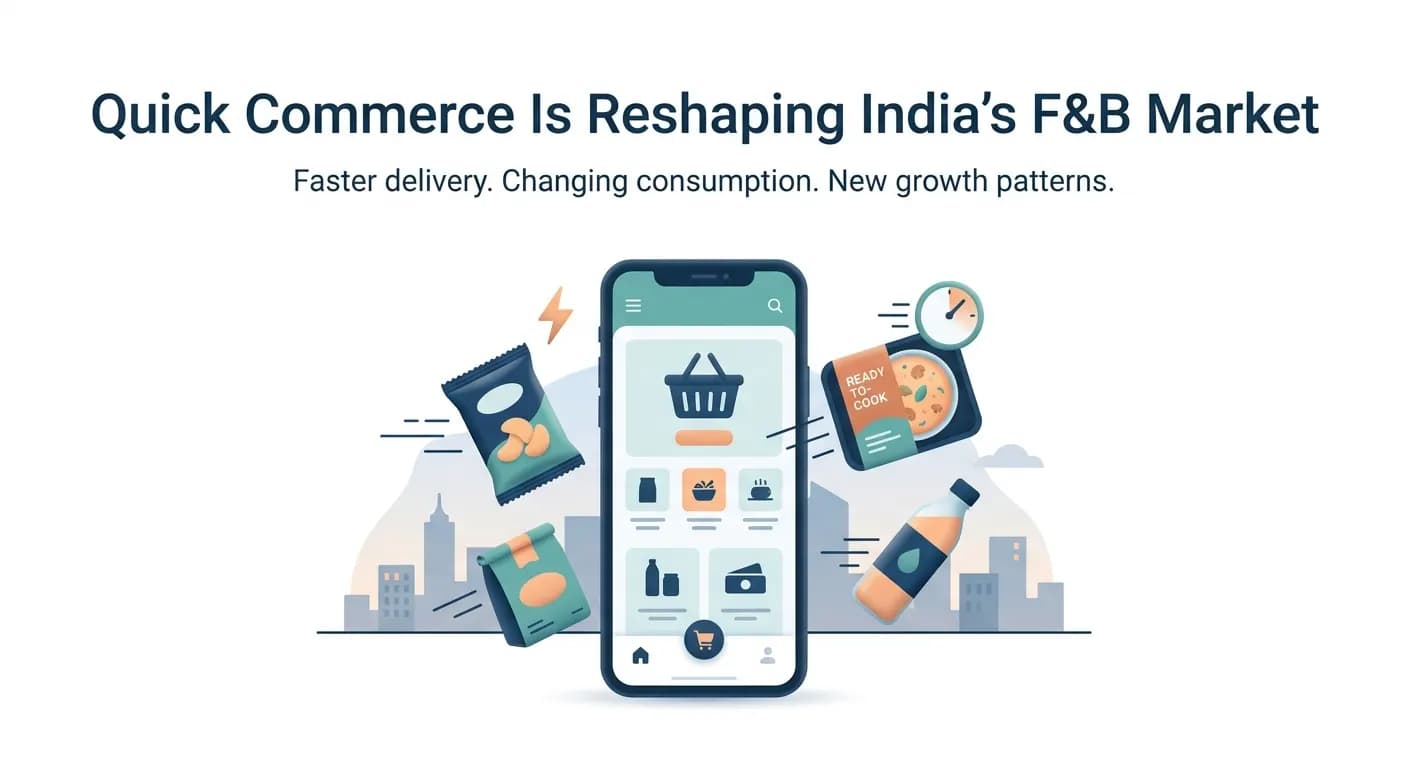
Quick Commerce Is Becoming Central to F&B Distribution
Quick commerce is moving from a convenience layer to a core distribution channel within packaged F&B. Its growth is being driven by increasing urban density, more frequent consumption patterns, and a growing expectation for immediate access to everyday categories.
Unlike traditional e-commerce, quick commerce is built around high-frequency, low-consideration purchases. This makes it particularly relevant for food and beverage categories where repeat consumption is high.
As a result, brands are beginning to prioritise quick commerce not just for incremental sales, but as a primary route to market.
For any business consulting firm in India, this represents a shift from channel expansion strategies to channel prioritisation strategies.
Consumption Is Becoming More Occasion-Led
One of the most visible changes in the report is how consumption is being reorganised around specific use cases rather than broad categories. Quick commerce is enabling behaviours such as late-night snacking, impulse indulgence, last-minute meal preparation, and smaller, high-frequency purchases. This has direct implications for how packaged F&B categories are evolving.
Products are no longer competing only within their category. They are competing within specific consumption moments.
For example:
- Ready-to-cook products align with convenience-driven meal occasions
- Indulgent snacks align with impulse and late-hour consumption
- Functional beverages align with lifestyle and health-driven moments
This shift is subtle but important. It requires brands to think in terms of when and why a product is consumed, not just what it is.
Three Categories Are Seeing Disproportionate Momentum
The report highlights three segments where growth is particularly strong:
1. Ready-to-Cook (RTC) Products
The ready-to-cook segment is benefiting from:
- Time constraints in urban households
- Increasing preference for semi-prepared meals
- And higher adoption among younger consumers
It sits at the intersection of convenience and familiarity, making it well-suited for quick commerce distribution.
2. Better-for-You and Functional Beverages
Health-oriented consumption is becoming more visible, especially among Gen Z and millennial consumers.
Within beverages, there is a shift towards:
- Functional benefits
- Perceived health value
- And differentiated ingredients
These products are gaining traction over traditional ready-to-drink formats in certain segments.
3. Indulgent Food Categories
Indulgent categories such as chocolates continue to see strong demand, particularly within impulse-driven consumption occasions.
Quick commerce amplifies this behaviour by:
- Reducing friction in purchase
- Enabling late-hour ordering
- And increasing visibility through app-based discovery
Consumer Cohorts Are Driving Category Outcomes Differently
The report highlights clear differences in consumption patterns across Gen Z, millennials, and Bharat households. Each of these cohorts interacts with packaged F&B differently, shaped by variations in price sensitivity, product preferences, and purchase frequency.
For example:
- Younger urban consumers tend to drive experimentation and premium formats
- Bharat households contribute to volume growth in value-driven categories
This divergence means that growth is not uniform across segments. What works for one cohort may not translate directly to another.
Consumer strategy consulting in India is increasingly focused on helping brands identify which cohorts are driving growth within specific categories and how to tailor offerings accordingly.
Quick Commerce Is Changing Go-To-Market Strategies
The rise of quick commerce requires brands to rethink traditional go-to-market models.
Key changes include:
- Portfolio design: SKUs need to be optimised for smaller baskets and faster consumption cycles
- Pricing strategy: products must fit within impulse-friendly price bands
- Visibility and placement: digital shelf positioning becomes critical
- Supply chain alignment: faster replenishment cycles and localised inventory
Quick commerce also gives brands more detailed visibility into how consumers behave, including when orders are placed during the day, how often purchases are repeated, and what typically goes into each basket. This creates opportunities for brands to refine their strategies continuously.
For a strategy consulting firm in India, this is where analytics, category understanding, and channel strategy come together.
What This Means for F&B Brands
The expansion of quick commerce is not just creating a new sales channel. It is redefining how growth is distributed across categories.
For brands, this means:
- identifying which categories are structurally aligned with quick commerce
- aligning product formats with high-frequency consumption
- building relevance across specific consumer cohorts
- and optimising execution at the channel level
The opportunity is significant, but it is also becoming more competitive as more brands enter these high-growth segments.
The Road Ahead
India’s packaged F&B market will continue to expand over the next decade. Quick commerce will play an increasingly important role in shaping how that growth unfolds.
For brands, this means paying closer attention to how consumption is shifting, where growth is actually concentrating across categories and consumer preference towards health and taste without compromising on either of them. Brands need to align their strategies with these changes.
In a market where both demand and distribution are evolving at the same time, clarity of execution will matter as much as scale.
For businesses looking to navigate these shifts, Redseer’s strategy consulting expertise in India helps translate evolving consumer behaviour and channel dynamics into clear, actionable growth strategies.