
Beyond Acquisition: Where Growth Sits in India’s Digital Lending Landscape


The central narrative around digital lending in India has been indexed on a single metric: acquisition. However, as the number of onboarded customers reaches an all-time high, different stages in their journey create distinct opportunities to improve retention, increase ticket size, and maximise lifetime value of a borrower.
Redseer’s analysis of India’s digital-loan borrowers in its recent report suggests that the acquisition contest might be ending, and next battle will be about who wins the customer the next time they are wanting a loan.
A market that has outgrown its trial phase
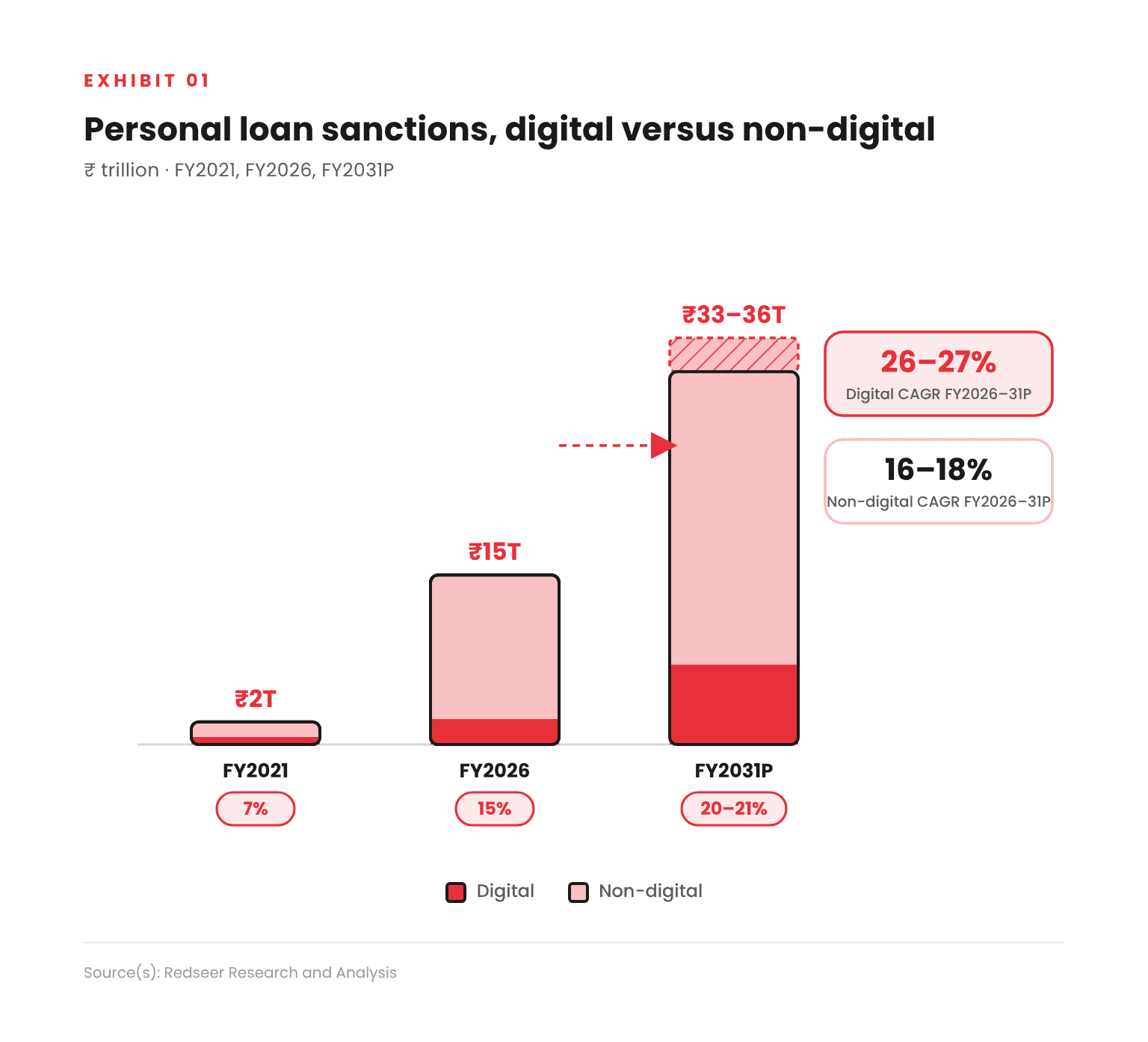
Before understanding where lending is headed, it’s hard not to acknowledge the scale that acquisition has delivered. Digital personal-loan sanctions grew roughly 13X between FY2021 and FY2026 and is set to outpace the personal lending market. Demand, in other words, is no longer being created so much as reserved. Competition is shifting from reach and onboarding speed to setting limits, retention, and the cost of deepening an existing relationship. According to Redseer’s survey, 77% have been active on lending apps for over a year, 69% have borrowed more than once, and half hold multiple active loans. Debt-cycling, where new loans are taken to clear old ones, stays a small minority.
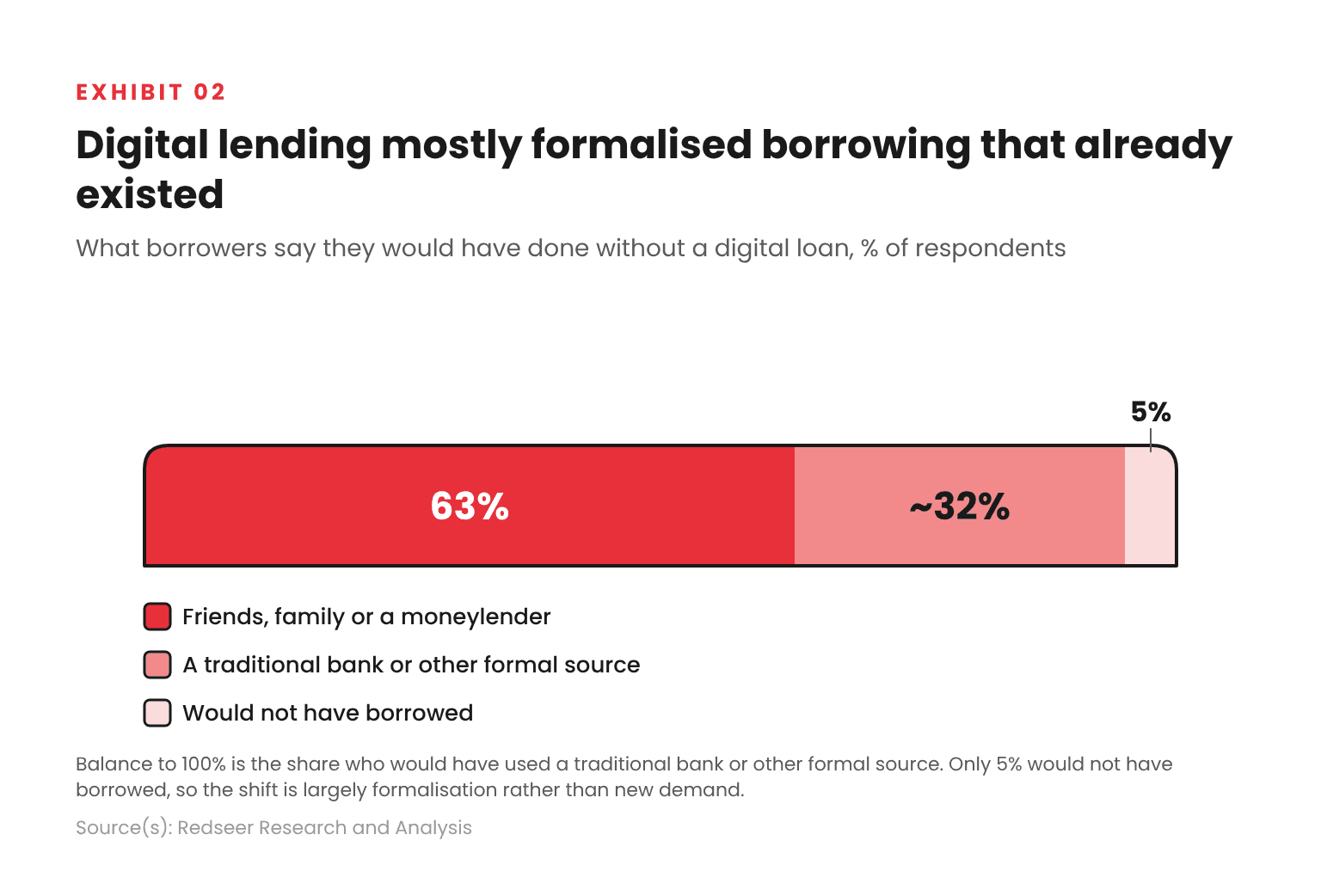
A larger change brought about by digital lending was moving borrowing out of informal channels and into the formal financial system. When asked what they would have done without a digital loan, 63% of respondents said they would have turned to friends, family or a moneylender. Each of those loans now leaves a repayment record, creating a borrower base that banks previously could not see. Only 5% would not have borrowed at all, so this was mostly formalization rather than new demand.
According to one respondent to the survey, saving time on paperwork was part of the reason why they preferred these apps to traditional banking. “My bank would have said yes eventually, but the paperwork and the wait were not worth it that week. I chose the app for the timing, not for lack of options,” a salaried professional from Pune said.
A Tale of Two Borrowers: Credit Climbers & Cautious Borrowers
As a sector hits maturity, cohortisation is a natural emerging element that accompanies it. Within digital lending, it can be viewed through the lens of two cohorts emerging: Credit Climbers and Cautious Borrowers. They share nearly the same profile in age, income, and city tier. Targetting demographics reac both equally and serves neither well. Behaviour is the only reliable signal.
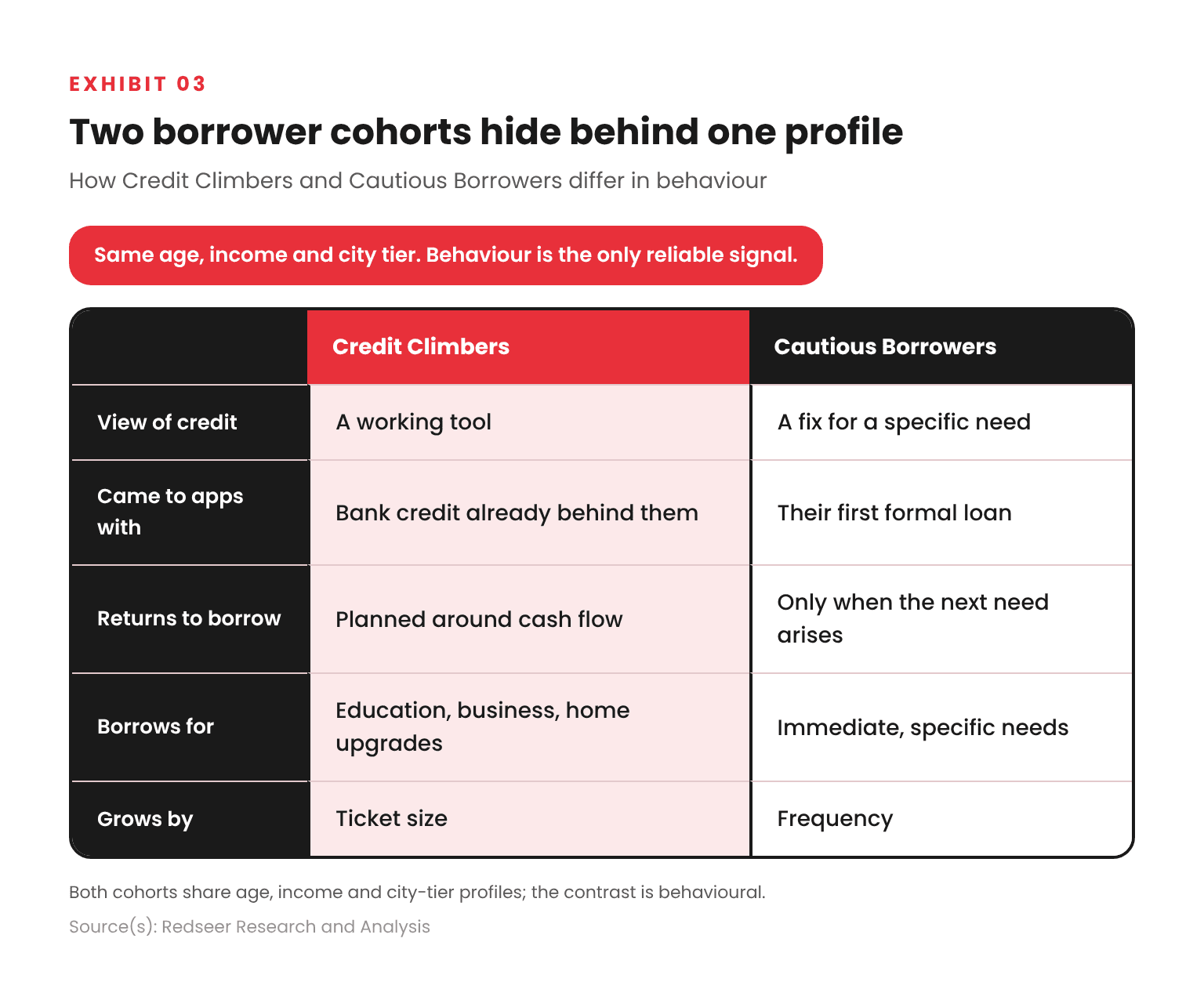
The Climber treats credit as a working tool. They plan borrowing around cash flow, came to apps with bank credit already behind them, and borrow for education, business and home upgrades.
The Cautious Borrower treats credit as a fix for a specific need. For many, the app was their first formal loan, and they return only when the next need arises. One grows by ticket size and the other by frequency.
Servicing Two Distinct Cohorts of the Digital Lending Market
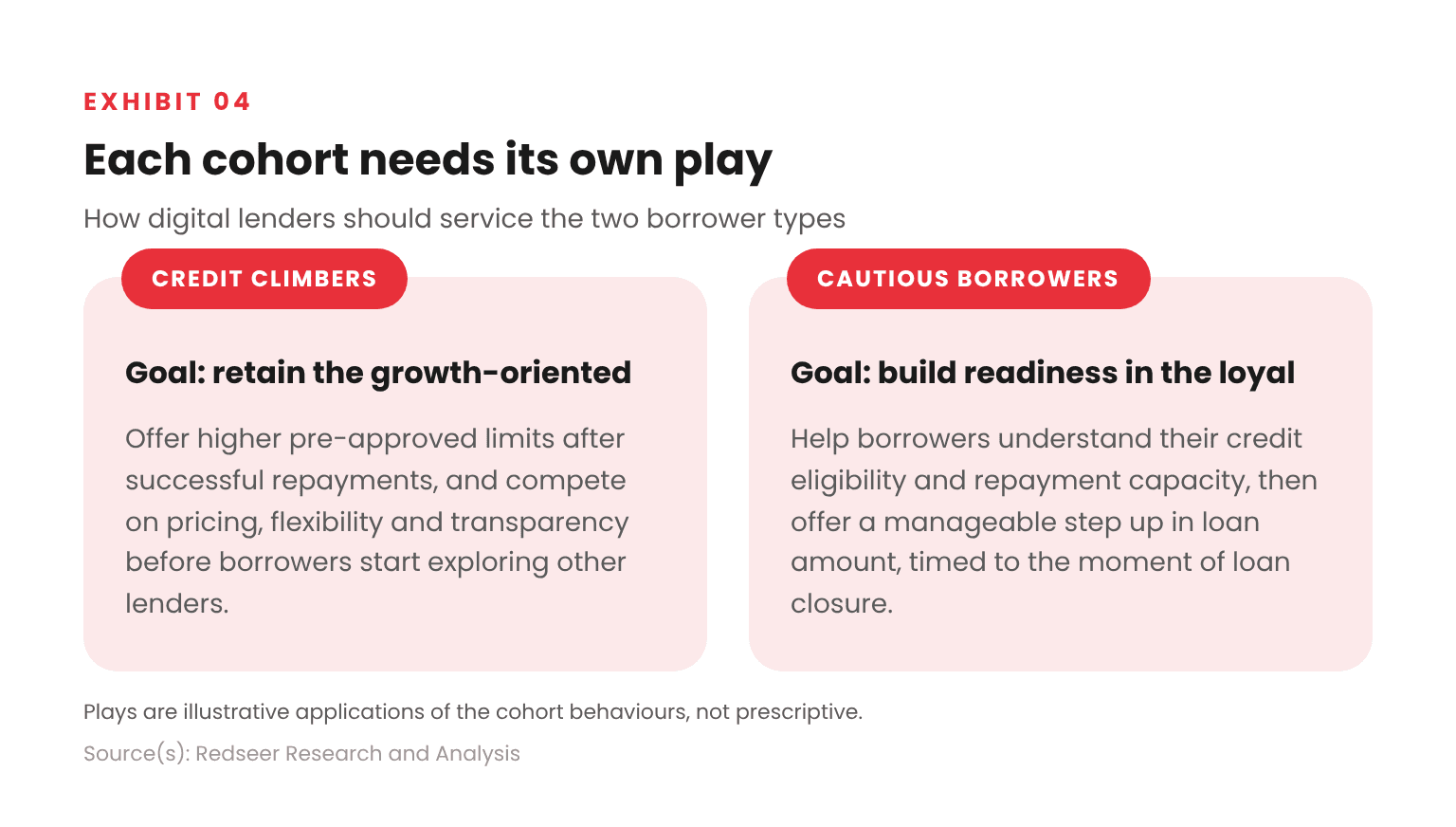
Since Climbers and Cautious Borrowers exhibit distinct behaviours, digital lenders will have to tailor their approach to understanding the needs of the Credit Climber and Cautious Borrower simultaneously.
The goal should be to retain Credit Climbers who are typically more growth-oriented and use credit to fund future goals. One play would be, for instance, to offer higher pre-approved limits after successful repayments and compete on pricing, flexibility, and transparency before borrowers explore other lenders.
It’s pretty much the opposite for the Cautious Borrower, who are more needs-driven and borrow for immediate needs. The play for this cohort, for instance, would be to, help borrowers understand their credit eligibility and repayment capacity before offering a higher loan amount during the time of loan closure.
Redseer Advisory
The first loan is now table stakes. Digital lenders have shown they can acquire borrowers at scale, and in the next phase the value lies in what happens after approval. The winners will be the lenders that read each borrower’s journey best and respond to it early.
For Lenders, the focus shifts from acquiring borrowers to growing the relationships they already have. Since the market is nearing maturity, it is clear that different borrowers need different approaches.
- Retain borrowers who are scaling up. These borrowers move on when their current lender cannot support their next loan. Anticipating their needs with higher limits before they start comparing options, keeps them.
- Build readiness among loyal but cautious borrowers. These borrowers are already loyal but often unsure of what they qualify for. Helping them understand their eligibility and repayment capacity, and offering a step up that is manageable, turns that loyalty into larger loans.
- Compete on price and terms. As borrowers mature, approval is assumed. Transparent pricing and flexible repayment become the real differentiators.
Written by


Engagement Manager

India’s Digital Lending Report 2026: Value Beyond Acquisition

India’s Digital Investment Market Report

Designing for Her: Unlocking Women’s FinTech Adoption in India

Unlocking Growth: India’s Digital SME Credit Gap and Economic Potential

The Next Lever of Growth in India’s Wealth Tech

How Redseer provided Strategic Advisory to leading education-focused NBFC for its Market Position Expansion and Business Growth

IPO consulting services behind Groww’s public market readiness

How Quick Commerce Can Win Bharat

BigBasket’s business growth enabled by Redseer Consulting

The New Rules of Growth in India’s $150 Bn Packaged F&B Market

Redseer enabling Credila Financial Services’ growth path

Enabling Pine Labs’ high-impact growth decisions
India’s Digital Lending Report 2026: Value Beyond Acquisition
India’s Digital Investment Market Report
Designing for Her: Unlocking Women’s FinTech Adoption in India
Unlocking Growth: India’s Digital SME Credit Gap and Economic Potential
The Next Lever of Growth in India’s Wealth Tech
How Redseer provided Strategic Advisory to leading education-focused NBFC for its Market Position Expansion and Business Growth