4 Trends Unlocking Growth in India’s $150 Bn+ Packaged F&B Market


India’s consumption story is at a major inflection point. Compared with six years ago, retail has diversified significantly. For instance, in quick commerce alone have a presence in over 250 Indian cities.
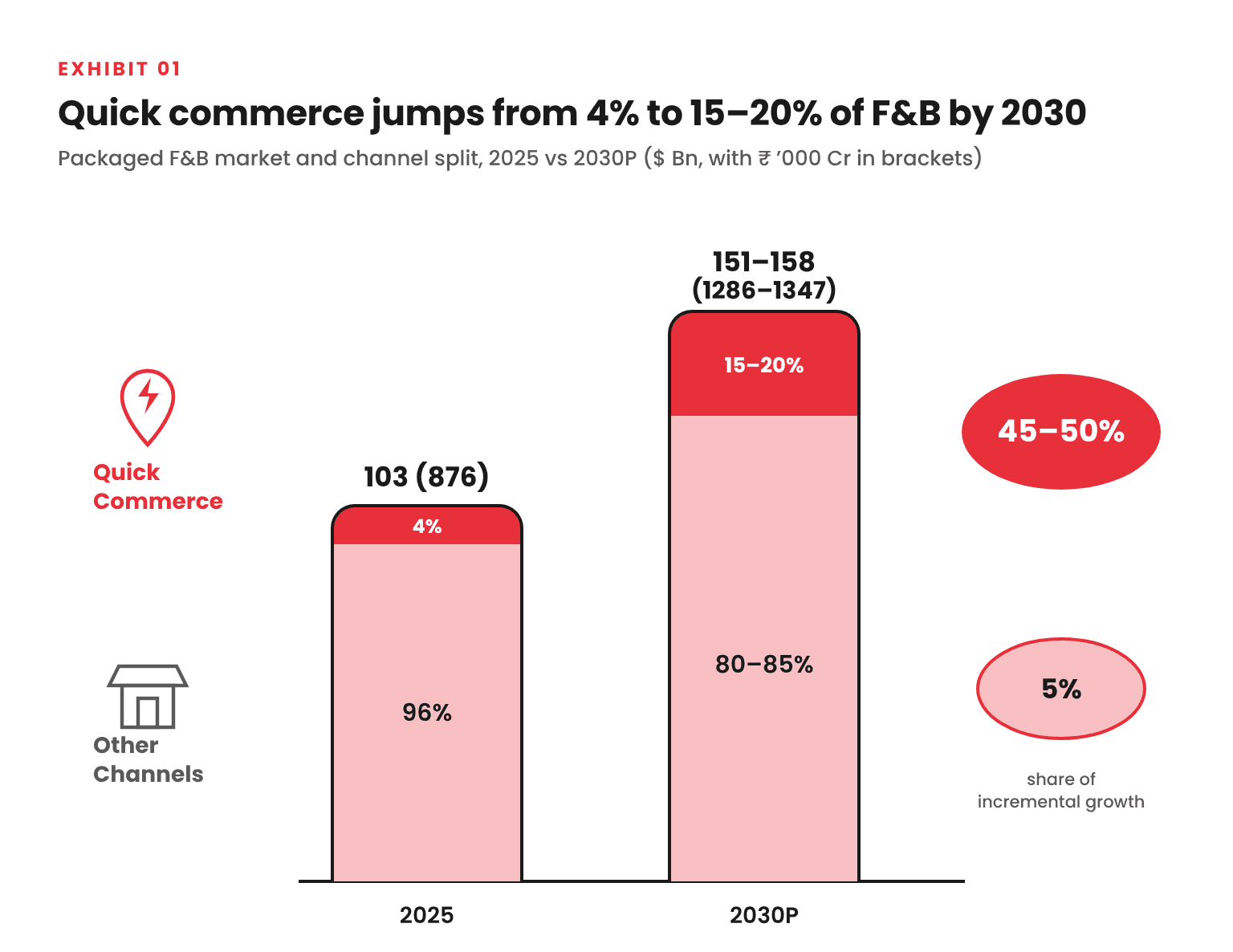
To this end, some larger macroeconomic factors are at play, making this a structural shift rather than a cyclical one. India is on track to become the world’s third-largest consumer market by FY30, and packaged food and beverages are riding that wave. A $103 Bn market in CY25 is set to grow to roughly $150 Bn by CY30, with half the market’s current value set to be added over the next five years.
This income pyramid explains how India consumes and it is changing at the top and the middle at once.
India 1, households (> ₹10 lakh) consumer group drives about 35% of total retail and about 60% of branded consumption
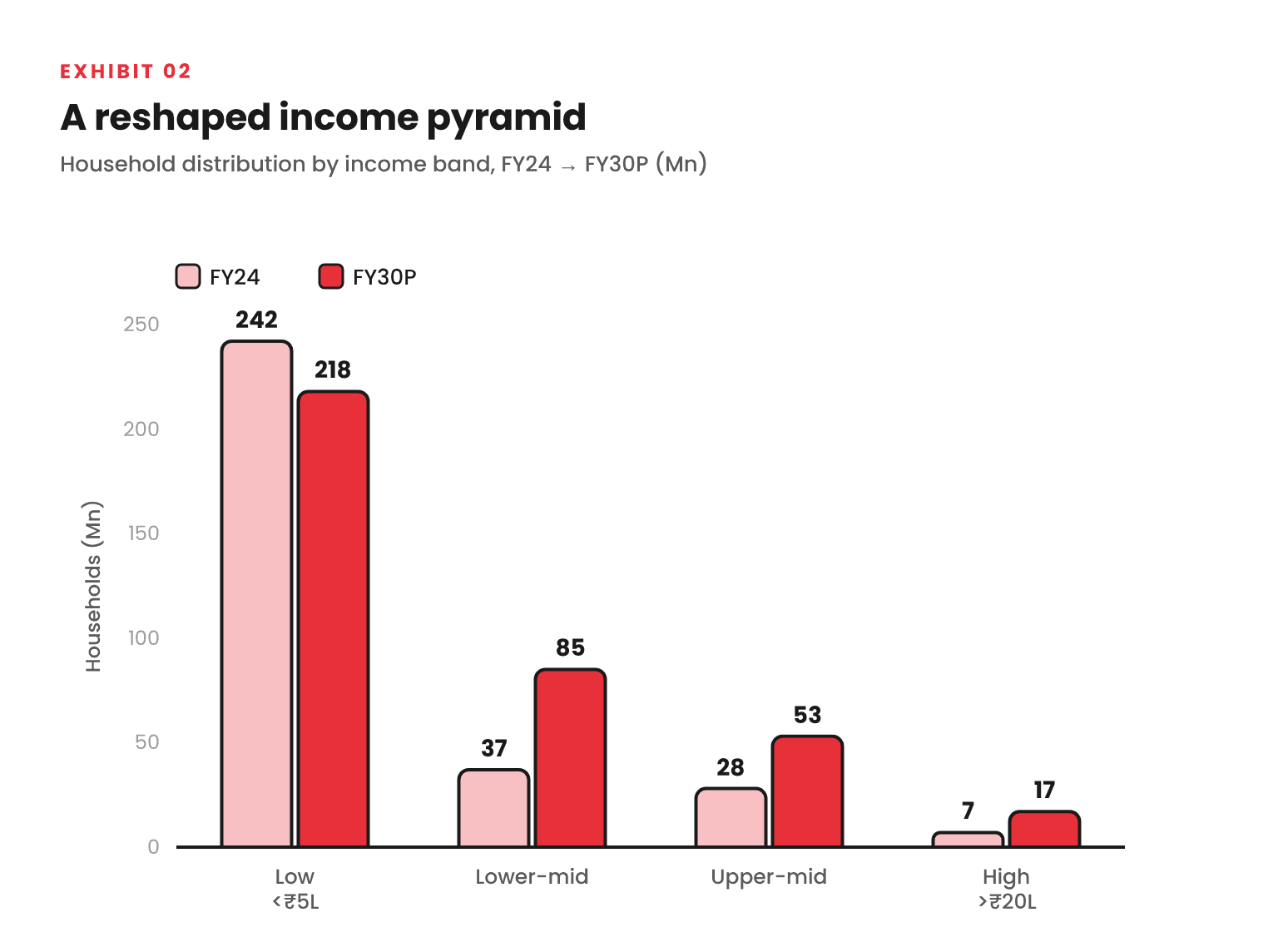
India 1, households (> ₹10 lakh) will grow from 42 Mn to 65 Mn by FY30, which adds 23 Mn premium households that can afford the end of the category where brand matters more than price. This group is the top 15% of the population, and it drives about 35% of total retail and about 60% of branded consumption. Just below it, India 2 (₹5–10 lakh) is growing from 65 Mn to 87 Mn, adding 22 Mn households that are crossing from loose staples to packaged, MRP-anchored buying for the first time.
A bigger market, a reshaped pyramid and easy payments explain how much India can spend. They don’t explain what goes into the basket, or when it gets bought.
Indians are spending a lot more than they were before, too. Per-capita spending has roughly doubled in a decade and is set to double again by FY30, faster in rural India than urban. Households are also saving less and spending more: the savings rate is down six points since FY09, and retail credit is set to grow from 14% to 34% of GDP between 2024 and 2030 – .
Online commerce is where all of this converges.
Redseer believes, the next wave of India’s online retail growth will be driven by Quick Commerce and Value Commerce, not traditional marketplaces. Together, these channels are expected to account for nearly half of online retail by CY30.
Quick commerce alone has gone from $0.3 Bn to $13 Bn in GMV in the last four years, and people are ordering more often in smaller baskets. Online is still only about 2% of grocery, so the runway is long.
While technology like UPI has made it easier for people to pay and expedite the decision-making process itself, it doesn’t illustrate the complete picture of what is in people’s carts and why they make those purchases. Three shifts do, along with a fourth that is changing the clock.
Trend 1: Emergence of the 9 PM Economy
One of the defining features of India’s evolving retail consumption story is the emergence of a completely separate economy that operates well beyond traditional norms. The nature of quick commerce, i.e. being on demand, readily available at disposal, has unlocked a type of demand that did not exist before. Take for instance, chocolates. Chocolate has never been a planned purchase. It is bought on a craving, and for decades the only way to act on one was a shelf, which at 9PM was shut.
Quick Commerce put it two taps away and created an absolutely new purchase occasion. In real numbers, one in every five rupees of online chocolate spend now comes after 9 PM, at roughly 1.3X the daytime price. Ice cream’s late-night share is higher still, at 22%. Chocolate on quick commerce grew 66% in twelve months, compared with 10% for e-grocery.
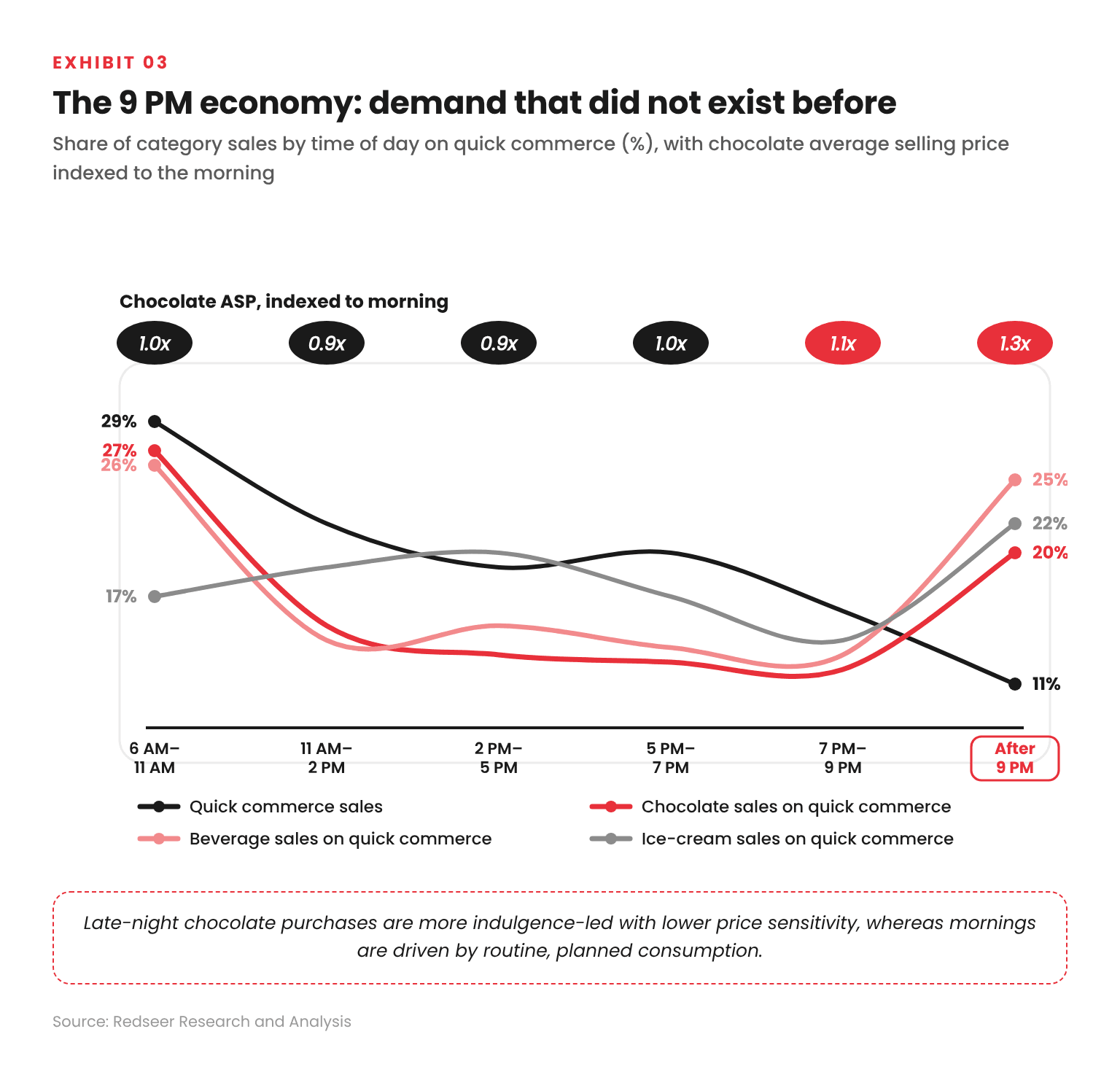
Most of this existing demand would have not found the neighbourhood kirana since it wouldn’t have been created in the first place. Chocolates are just one example of how this new reality is unfolding.
One in every five rupees of online chocolate spend now comes after 9 PM on Q-Comm, at roughly 1.3X the daytime price
Trend 2: Health is permitting consumers to indulge
The pandemic accelerated a growing awareness among Indians about the ingredients, quality and nutritional value of what they consume.
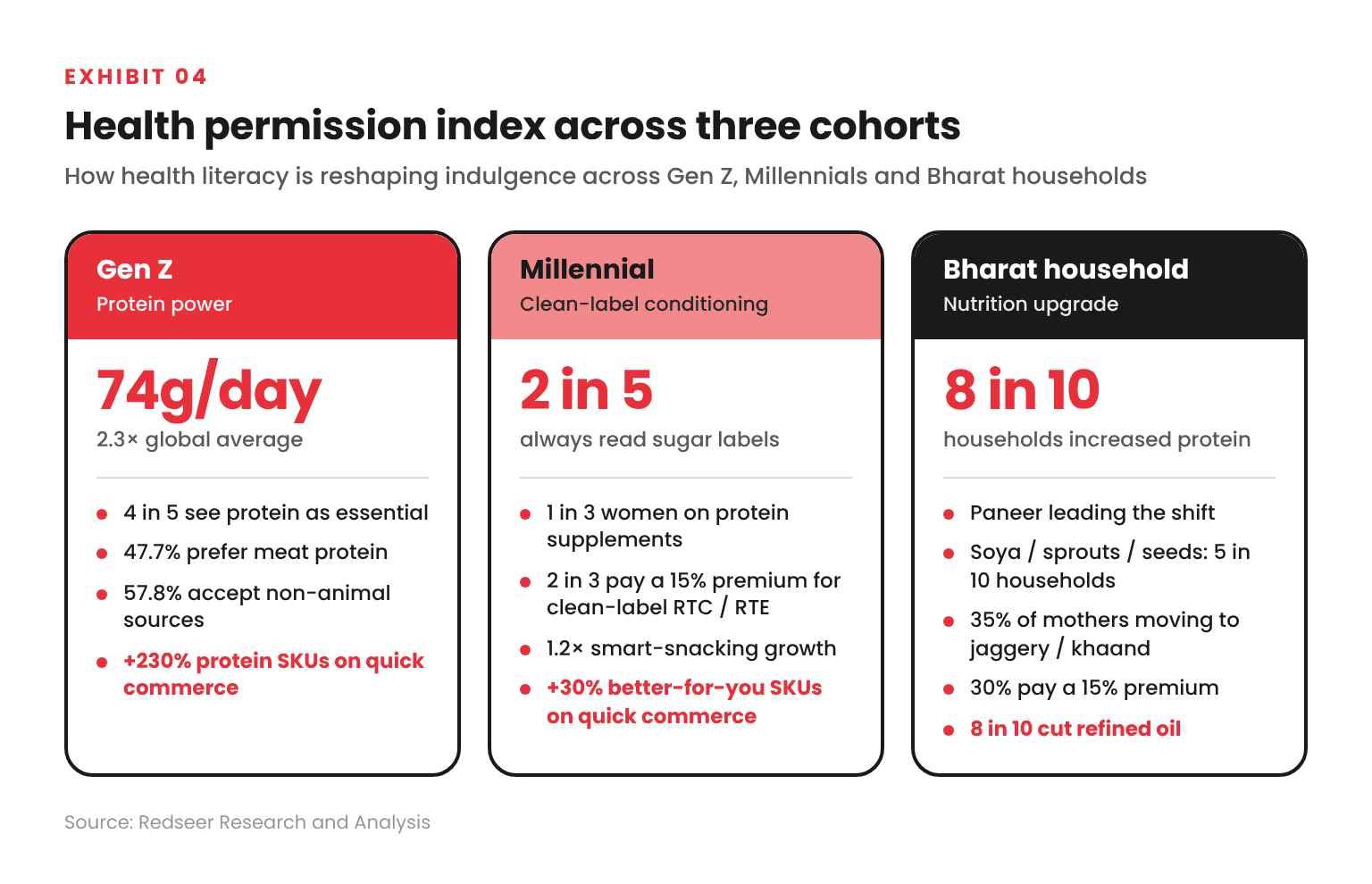
Two in three Millennials pay a 15% premium for clean labels
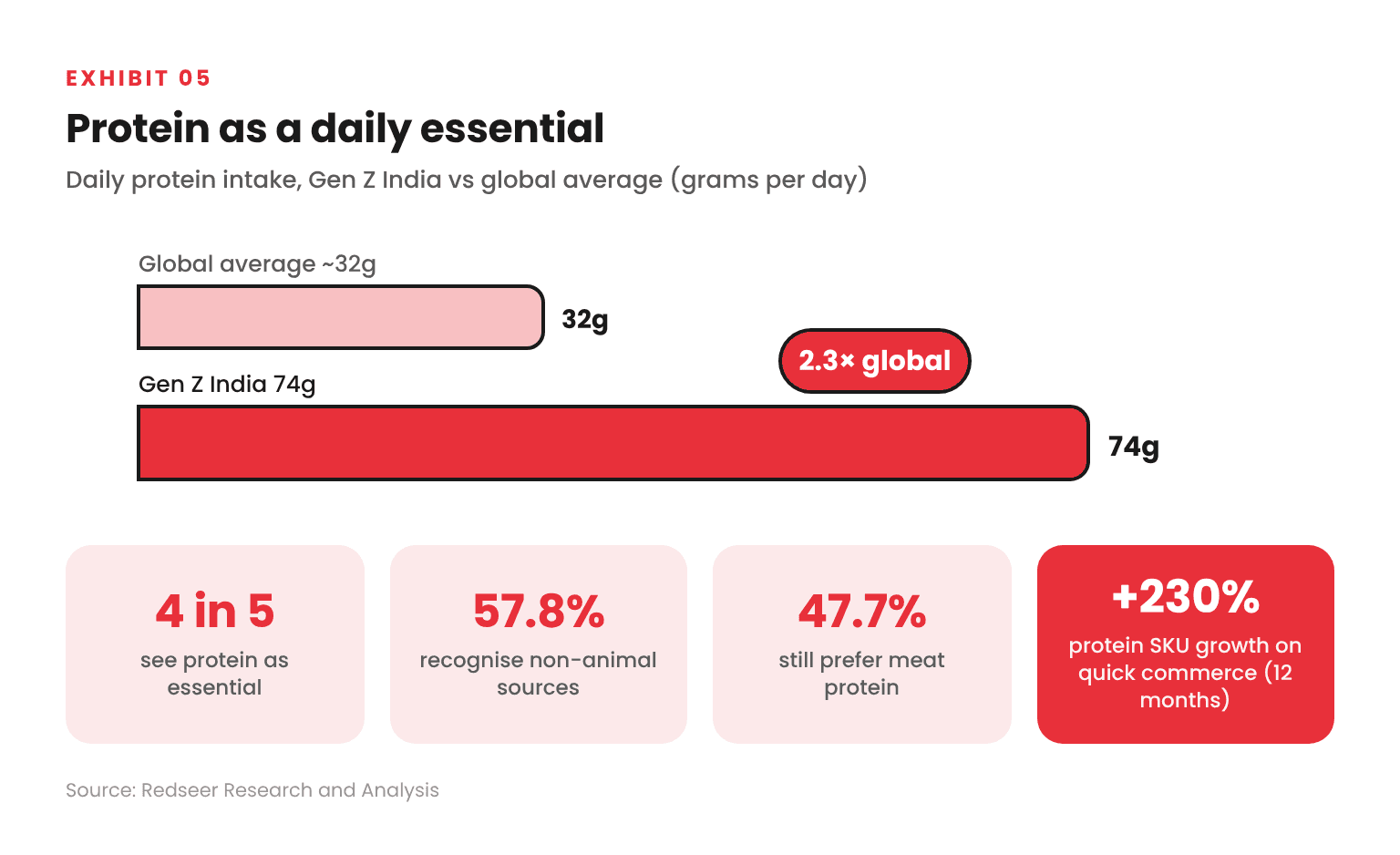
Gen Z’s daily protein intake is 74 grams, 2.3 times the global average, and protein SKUs on quick commerce are up 230%. Two in three Millennials pay a 15% premium for clean label. Bharat mothers are paying more for healthier sugar, at 30% prevalence. Gen Z’s daily protein intake is 74 grams, 2.3 times the global average, and protein SKUs on quick commerce are up 230%. Better-for-you assortment is growing 30% a year. The Sugar rejection, where consumers at the ₹200 price point returned a product over its sugar content, shows that health literacy in mass-market India is a present-tense reality.
Bharat’s mothers are paying more for healthier sugar alternatives, at a 30% prevalence
The winners won’t sell restriction. They will build the bridge: protein density in a chocolate bar that doesn’t taste like a protein bar. Brands that add protein and strip out the indulgence win a smaller, more contested slice.
Trend 3: Women are taking charge now more than ever
An important but defining feature of the retail consumption story have to do with women. Female work force participation rose from 22% to 36% between FY14 and FY24. About 75 Mn women are now in the formal economy, with a further 125 Mn in a pre-formalised pool that Redseer calls the largest single decade-long tailwind for convenience formats.
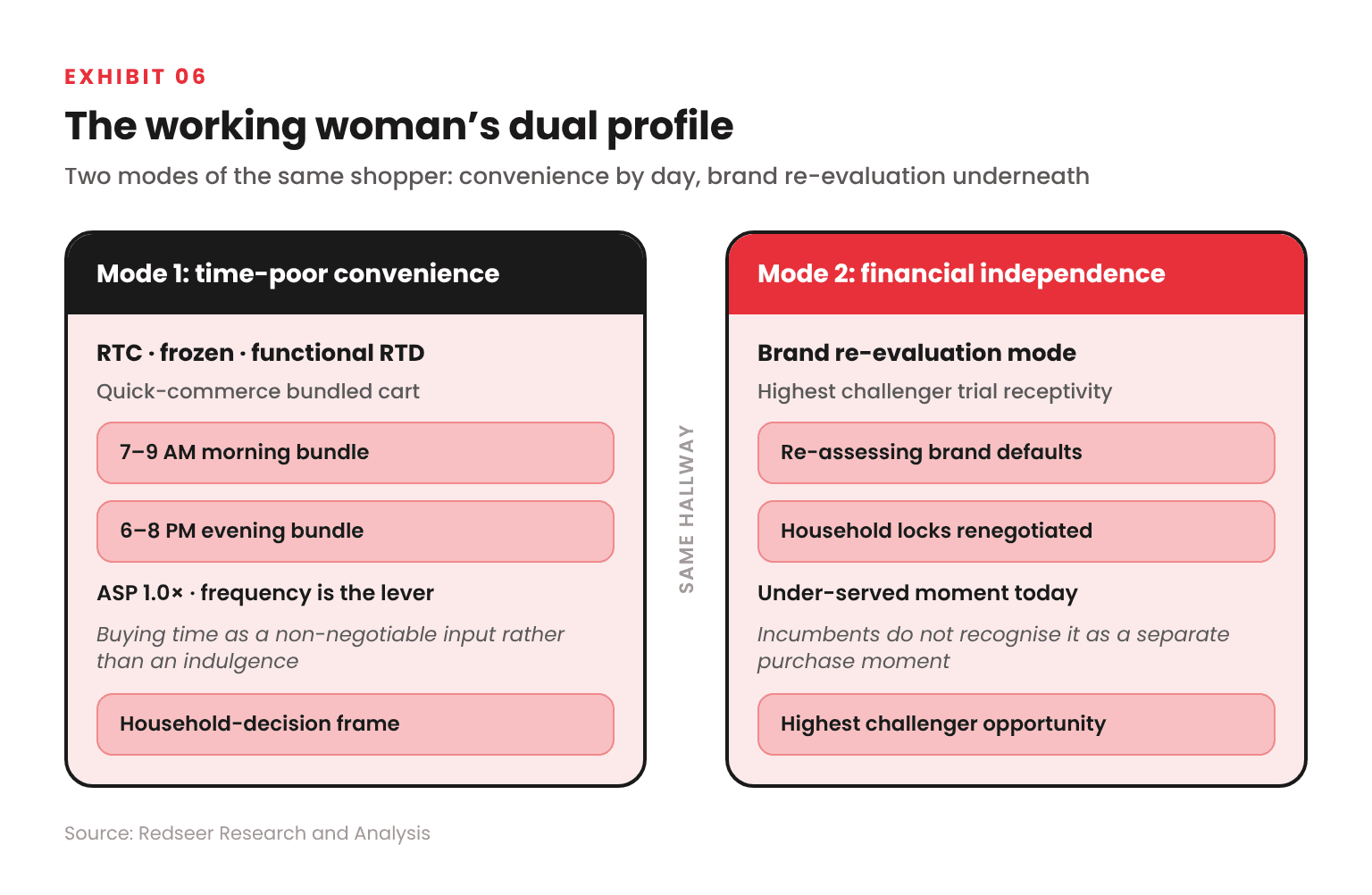
11 Mn women in upper-middle and high-income households are quick-commerce-first
As time for cooking from scratch shrinks, this cohort turns to ready-to-cook, ready-to-eat, frozen and functional drinks. Frozen ready-to-cook doubled in a year, up 88%.
Redseer believes convenience growth tracks female participation, not product innovation, so many brands are crediting their launches for what demographics delivered.
Women also aren’t just shopping for indulgence. She won’t trade nutrition for speed either, so convenience and clean label must arrive together. She is not one buyer: the roughly 11 Mn women in upper-middle and high-income households are quick-commerce-first, while the roughly 26 Mn in low-income households shop at the kirana.
Trend 4: The Gated Community Hook that draws in consumers
Some of the most valuable consumers of F&B today are concentrated in smaller footprints. Redseer puts India’s gated communities at roughly 200–300 pin codes, and they are the operational anchor of India 1, the households that drive most branded consumption.
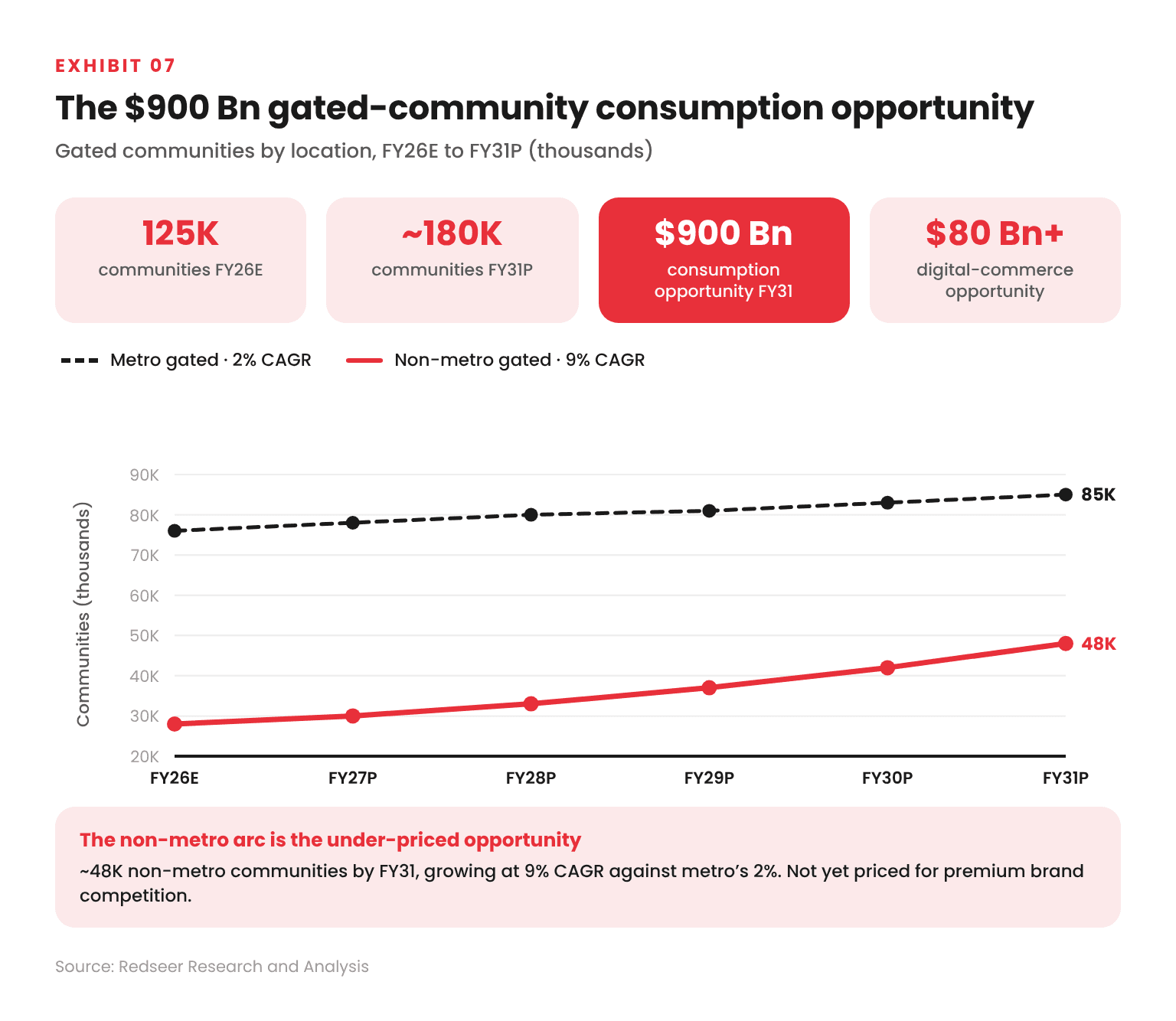
Gated community households offer high digital engagement, strong repeat potential and ₹12,000–20,000 monthly baskets – creating room for premium packs and product trials
Per-capita incomes inside them are converging on upper-middle global benchmarks, which makes this the first consumer cluster in India that compares with global peers rather than emerging-market averages.
These households are digitally active, and once a product gets in, the trial-to-repeat economics are unusually favourable. Their monthly baskets of ₹12,000–20,000 have room for premium and large-pack SKUs, so brands that default to small-pack mass-market formats here leave margin on the table. The opportunity is also moving outward. By FY31, non-metro gated communities will be a larger base than today’s metro ones, and they are not yet priced for premium brand competition.
Redseer Advisory
For Brands – Stop planning for the average consumer. Name the two cohorts that generate over half your revenue and build for them. Model demand against household formation and female participation, not historical category growth. Fix price architecture, because the middle is the losing position, and extend toward a sub-₹100 entry SKU, a ₹400+ aspirational SKU, or both. Then check your quick commerce visibility spend by hour. If it is spread flat, you are under-funding the highest-price window, and the fix needs no new budget.
For Platforms – Your pitch is that you create demand, so prove it. Late-night assortment, depth of range and dark-store availability are the levers, because a craving that meets an empty shelf is lost. Be honest about the economics too. Net margins are around –4 to –7%, against 8–10% for kirana, and take rates will rise as platforms move toward profitability. Brands will stay only if the data shows you are adding consumption rather than being subsidised.
For Investors – Back the structural forces, not the cycle: health built into the mass price band, convenience paired with clean label for working women, and premium households in a few hundred gated-community pin codes. Move early. New-age brands are growing two to three times faster than incumbents, but that edge closes by CY27–28 as quick commerce platforms rationalise listings. Favour brands building repeat-buy loops now.
Written by



India Online Retail 2026: The Fastest Year in Five, and the New Engines Behind It

Think Quick Commerce: Unlocking the $90Bn Opportunity

Digital Disruption in Home Category: Whitespace to Market Leadership

Value Grocery Commerce: The Bharat Unlock
Reinventing Packaged F&B with Quick Commerce
Smart clicks to win India’s online groceries & general merchandise basket
Value Grocery – Unlocking India’s Next 100 Mn Shoppers

Quick-Com, Value Commerce and GenZ Drive India’s Online Retail Growth in 2026

Two Engines, One Basket: How Quick & Value Commerce are Rewriting India’s Retail Story
How Quick Commerce Can Win Bharat
The Two Playbooks To Win India’s $90 Billion Quick Commerce

Quick Commerce vs Kiranas vs Hypermarkets, who will win the Indian Grocery Market?
India Online Retail 2026: The Fastest Year in Five, and the New Engines Behind It
Think Quick Commerce: Unlocking the $90Bn Opportunity
Digital Disruption in Home Category: Whitespace to Market Leadership
Value Grocery Commerce: The Bharat Unlock
Reinventing Packaged F&B with Quick Commerce
Smart clicks to win India’s online groceries & general merchandise basket