The Two Playbooks To Win India’s $90 Billion Quick Commerce


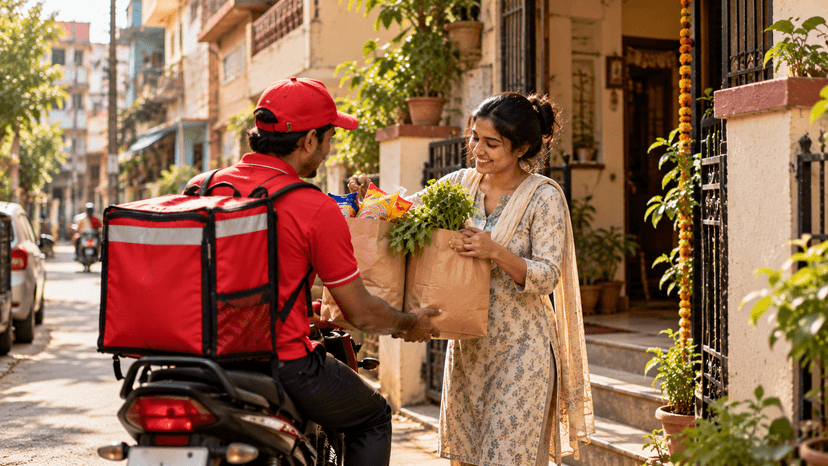
Quick Commerce began as an urban convenience for emergency top-ups. It is now a daily habit for millions of users. According to a joint report by Redseer and Google, the market is set to grow from roughly $13 Bn in FY2026 to $70-90 Bn by FY2031.
Getting there takes two different playbooks. In metros, platforms must close the trust and assortment gaps that keep planned grocery baskets offline. Beyond the metros, they must make low-ticket carts viable and rebuild trust from a very different starting point.
Playbook 1: Metro Cities- Winning the Planned Basket
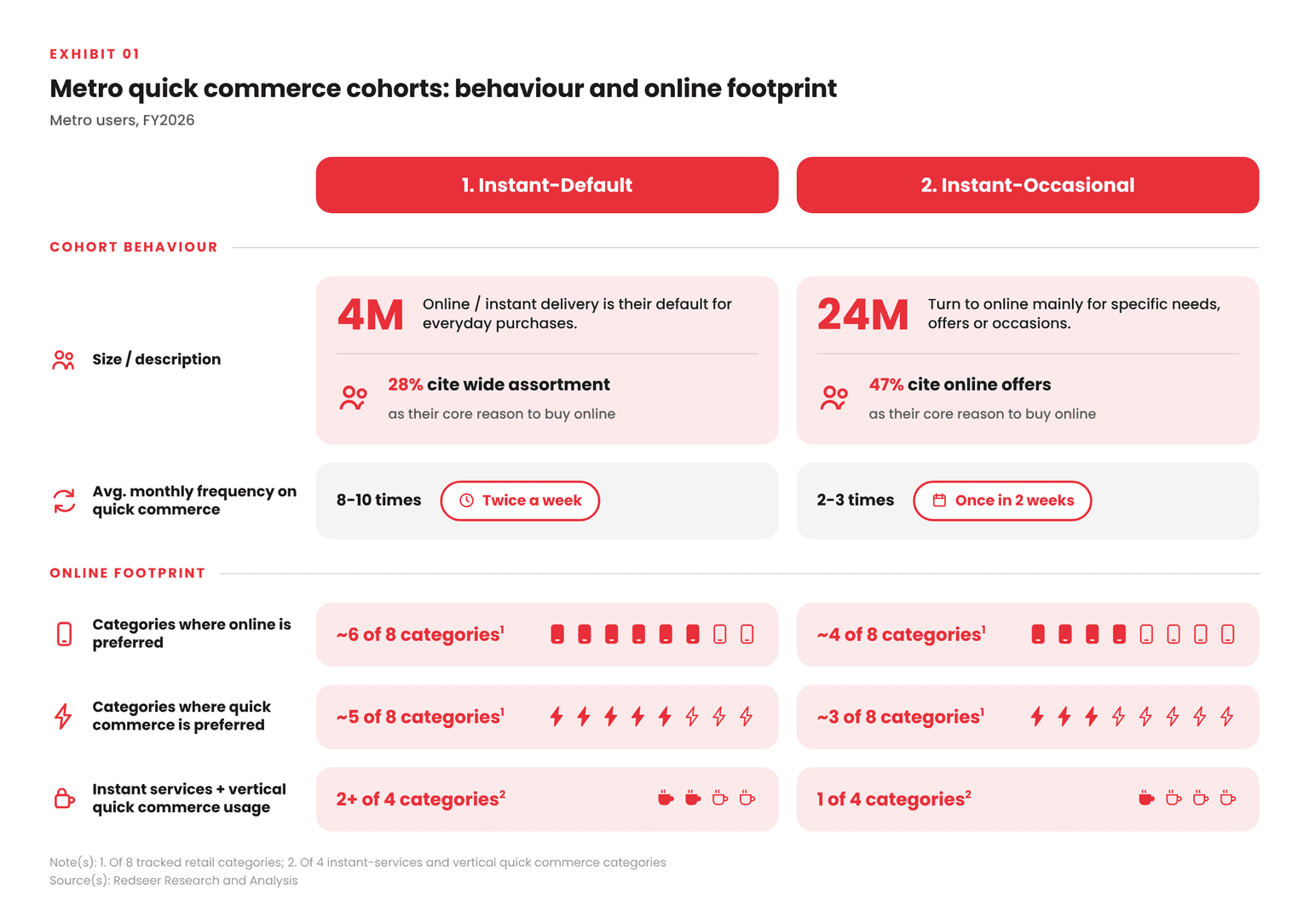
Step 1: Understanding Customer Cohorts
- Instant-Default (about 4 Mn users): Online delivery is their default for everyday purchases. They order on Quick Commerce 8-10 times a month, roughly twice a week. Wide assortment is their core reason to buy online (28%).
- Instant-Occasional (about 24 Mn users): They turn to online mainly for specific needs, offers or occasions. They order 2-3 times a month, roughly once every two weeks. Offers are their core reason (47%).
Step 2: Understanding the gap between these cohorts
Between Instant Default and Instant Occasional is one major gap: the monthly stock-up. While 53% of users in the Instant Default category use quick commerce as a regular option to stock their pantries, Instant Occasional users direct 27% of their grocery spends to supermarkets, typically around the time of their monthly stock-ups.
Step 3: Go after the monthly stock-ups and fix existing barriers
Since monthly stockups are a major hurdle between converting Instant Occasional users into Instant Default users, it is critical to look at this gap more closely. The stock-up is usually planned around payday and makes up 42% of the cohort’s grocery spend. A typical order is 12-15 products worth ₹3,000-4,000 in a single basket. Winning it is the biggest lever for deepening wallet share in metros. To win the monthly stock-up, it is important to solve for these three barriers: Assortment, Pricing, and Quality and Hygiene.
- Assortment (37%): More than one in three users say the app doesn’t carry the full range a planned basket needs. Stock a wider range, including bulk packs.
- Pricing (32%): Nearly one in three feels the app costs more than the supermarket. Close the price gap on high-velocity staples.
- Quality and hygiene (31%): Just under one in three doubt the freshness and handling of what arrives. Make trust visible with batch dates and published hygiene audits.
Non-Metros: small baskets, big trust gap
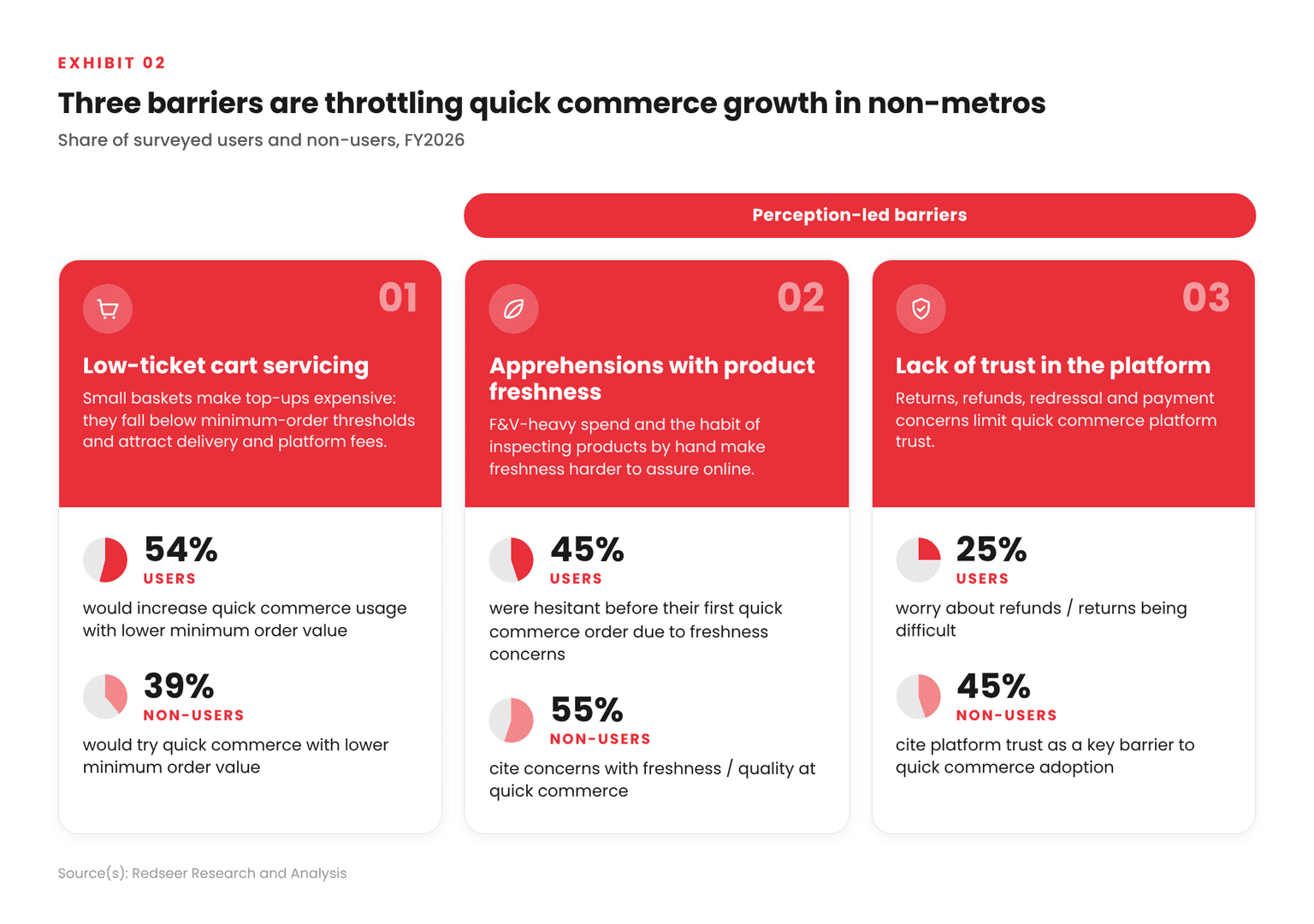
Outside the top eight metros, Quick Commerce operates in 300+ cities with an estimated 180-200 Mn addressable shoppers. Only 12-16 Mn of them transact monthly. Awareness isn’t the problem, since over 95% of non-users already know these platforms exist. Three barriers hold them back.
Step 1: Make low-ticket carts viable
Small baskets are expensive to serve. The average order value on a non-metro-focused e-commerce platform is roughly ₹264, about one-eighth of the ₹1,967 on a metro-focused one. Delivery and platform fees weigh heavily on carts this small: in a Meerut example, a ₹138 basket cost ₹138 offline but ₹165 on Quick Commerce. Demand pooling, wallet top-ups and BNPL are the levers Redseer points to for making these carts work.
Step 2: Earn trust, starting with freshness
Shoppers outside the metros hand-pick produce every day, and many hesitate to hand that over to an app. Farm-direct sourcing and cold chains address freshness, while vernacular support, COD-first messaging and community partners build wider trust in the platform. Together with viable small carts, these moves could add 40-50 Mn transacting users by FY2031.
Step 3: Design discovery around feeds
About 75% of sessions on a non-metro-focused e-commerce platform begin on the home feed or a product page, not on search. Discovery should lean on feeds and recommendations to match. Together, these four moves could add 40-50 Mn transacting users by FY2031.
The common thread across these fixes is that they are local, built around how non-metro shoppers actually buy rather than lifted from the metro playbook. Discovery should follow the same logic.
Take a cue from the behaviours we see on E-Commerce Platforms to understand Quick Commerce behaviour. About 75% of sessions on a non-metro-focused e-commerce platform begin on the home feed or a product page, not on search, so curated feeds and content-led recommendations should do more of the work.
(For a deeper understanding of this playbook, read our other story: How Quick Commerce Can Win Bharat)
Redseer Advisory
For Platforms, trust has to become a visible product feature: manufacture and expiry dates on every listing, published hygiene audits, a no-questions refund guarantee, bulk packs for high-velocity staples, and prices at par with value supermarkets. Beyond the metros, the work starts with making low-ticket carts viable and supporting users in their own language.
For Brands, the report points to three levers: working with platforms so the latest batches reach quick commerce, using creator storytelling to build trust in categories where shoppers hesitate, and using commerce media networks to link retailer purchase signals with digital touchpoints and convert intent into verified sales.
Written by


Engagement Manager

Think Quick Commerce: Unlocking the $90Bn Opportunity

India Online Retail 2026: The Fastest Year in Five, and the New Engines Behind It

Digital Disruption in Home Category: Whitespace to Market Leadership

Value Grocery Commerce: The Bharat Unlock
Reinventing Packaged F&B with Quick Commerce

Winning the Quick-Commerce Decade: Playbook for Brand Success
Smart clicks to win India’s online groceries & general merchandise basket

How Quick Commerce Can Win Bharat

Redseer Enabled a Global Investment Firm to Assess India’s Quick Commerce Market

We enabled a leading e-commerce player with decision-grade intelligence on India’s online grocery market
Value Grocery – Unlocking India’s Next 100 Mn Shoppers

Two Engines, One Basket: How Quick & Value Commerce are Rewriting India’s Retail Story
Think Quick Commerce: Unlocking the $90Bn Opportunity
India Online Retail 2026: The Fastest Year in Five, and the New Engines Behind It
Digital Disruption in Home Category: Whitespace to Market Leadership
Value Grocery Commerce: The Bharat Unlock
Reinventing Packaged F&B with Quick Commerce
Winning the Quick-Commerce Decade: Playbook for Brand Success