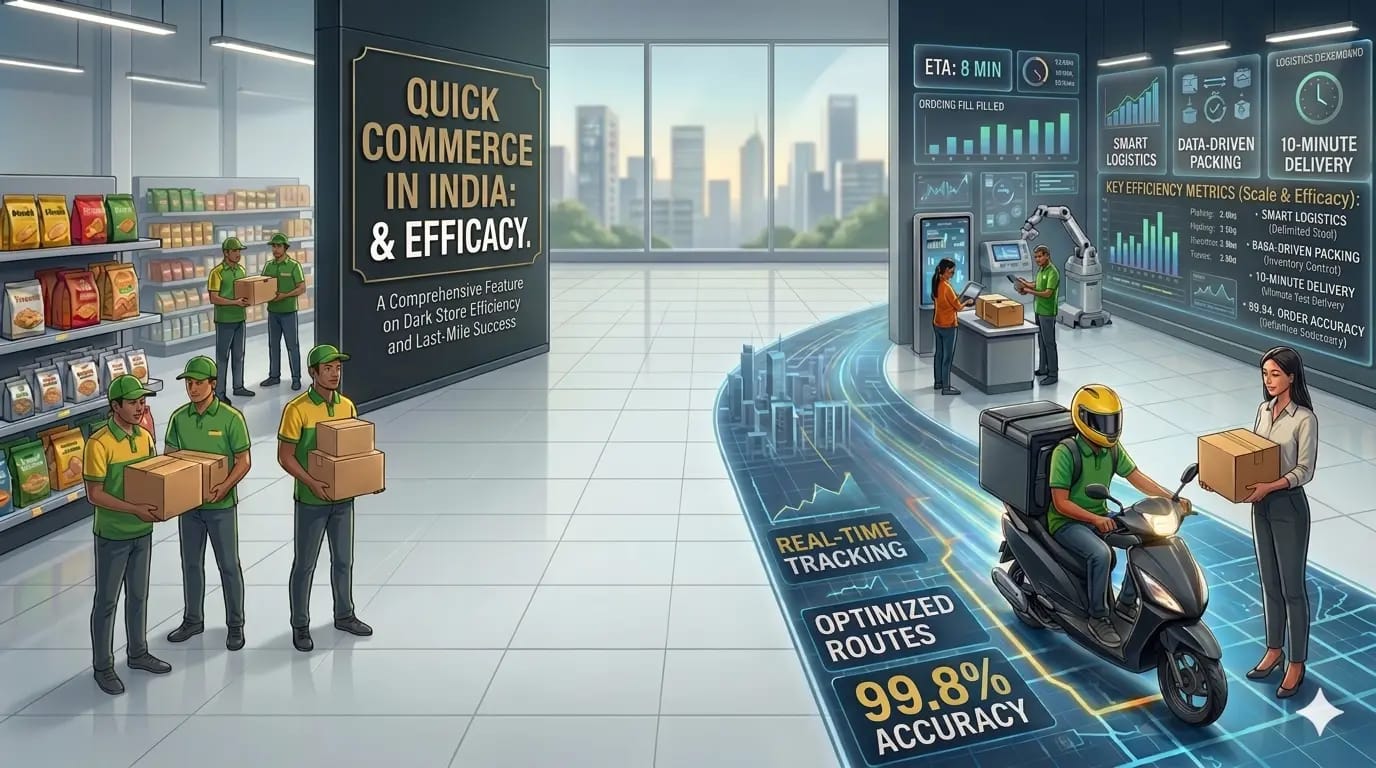
Quick Commerce in India: Is Scale Expanding with Efficacy?
Quick commerce has moved well beyond its early positioning as a metro-focused convenience layer. Over the past year, growth has broadened across categories, geographies, and use cases.
At a topline level, the story is straightforward. Order volumes are rising, dark store networks are expanding, and non-grocery categories are contributing more meaningfully to overall GMV. In January 2026 alone, the category reached ~₹11,000 crore in GMV, with order volumes growing ~95% year-on-year.
But beneath that growth, the structure of the market is becoming more complex.
For brands, platforms, and investors evaluating quick commerce strategy in India, the key question is no longer how fast the channel can grow. It is how sustainably that growth translates across cities, formats, and fulfilment models. This is where companies increasingly engage a strategy consulting firm in India or a retail consulting firm in India to assess long-term viability.
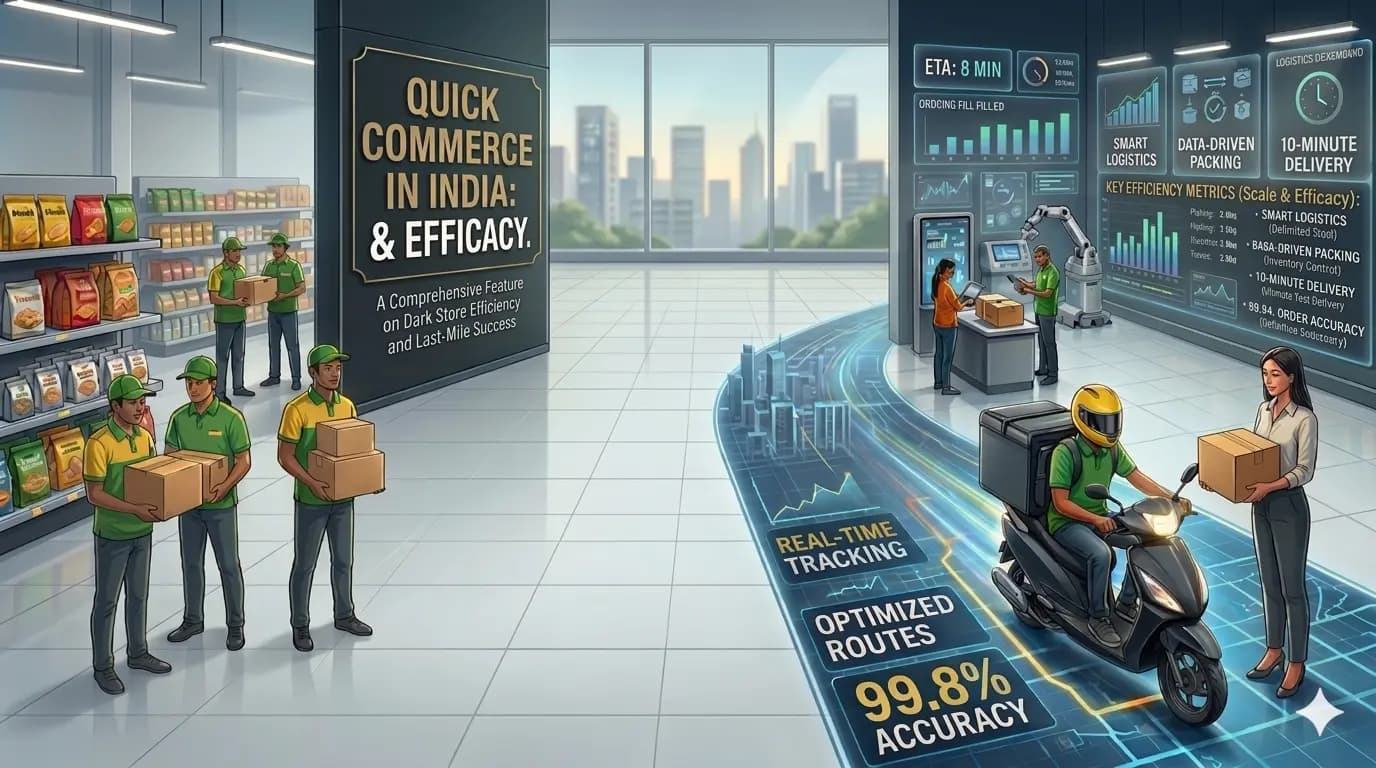
Quick Commerce Is Expanding Beyond Its Original Use Case
The initial success of quick commerce was built on grocery. That foundation remains strong, but the category mix is shifting.
Recent data shows that non-grocery segments are growing ~1.6x faster than grocery, indicating that platforms are successfully expanding into categories such as beauty and personal care, baby care, home, and even electronics. Beauty & Personal Care alone has grown by ~140% year-on-year, adding depth to the ecosystem.
This shift changes how the channel is used. Instead of being limited to urgent or fill-in purchases, quick commerce is increasingly becoming a multi-category consumption layer embedded in everyday behaviour.
Higher-value baskets are also beginning to scale, reflecting a gradual move away from purely low-ticket transactions. For platforms, this improves unit economics. For brands, it expands the role of quick commerce from a distribution channel to a demand-generation touchpoint.
As quick commerce expands into multiple categories, companies are re-evaluating how this channel fits into their broader FMCG and retail strategy in India, particularly across high-frequency consumption categories.
Growth Is No Longer Limited to Metros, But Economics Still Are
One of the most visible shifts in the past year has been the rapid expansion of quick commerce beyond top metros.
Non-metro markets have seen a ~328% year-on-year increase in daily orders, with dark store networks expanding faster outside major cities than within them. This expansion is often framed as the next phase of growth.
However, the economics of these markets tell a more nuanced story.
Dark store performance varies significantly by city maturity. While mature metro stores are able to operate at or above the ~1,200-1,250 orders per day breakeven range, non-metro stores are still averaging closer to ~850 orders per day.
This gap matters because quick commerce economics are highly sensitive to utilisation. Stores operating below breakeven levels spread fixed costs across fewer orders, increasing losses even as topline metrics continue to improve.
For companies expanding into new markets, understanding how quickly different city cohorts move toward maturity is becoming critical. This is typically where a business consulting firm in India specialising in consumer internet and retail strategy plays a role in guiding expansion decisions.
Dark Stores Remain Central, But Not Uniformly Viable
Across markets, one pattern is consistent: quick commerce players are converging toward dark store-led fulfilment models.
The reason is operational. Dark stores allow for tighter inventory control, faster fulfilment, and better service-level reliability compared to marketplace-led or store-picking models.
In global markets such as the GCC, this model is showing a clearer path to profitability under the right conditions. Stores that reach ~1,000+ orders per day are able to absorb fixed costs more effectively, improve basket sizes, and generate additional monetisation through advertising and category expansion. Under mature conditions, EBITDA margins in the range of 5-6% become achievable.
India presents a different operating environment.
Urban density in top metros supports similar economics, but as expansion moves into smaller cities, achieving that level of utilisation becomes more challenging. Demand is growing, but not always at the pace required to support dense, high-throughput dark store networks.
This creates a structural tension between expansion and efficiency, one that is not immediately visible in topline growth numbers, but critical for any retail consulting firm in India or investor evaluating the sustainability of quick commerce models.
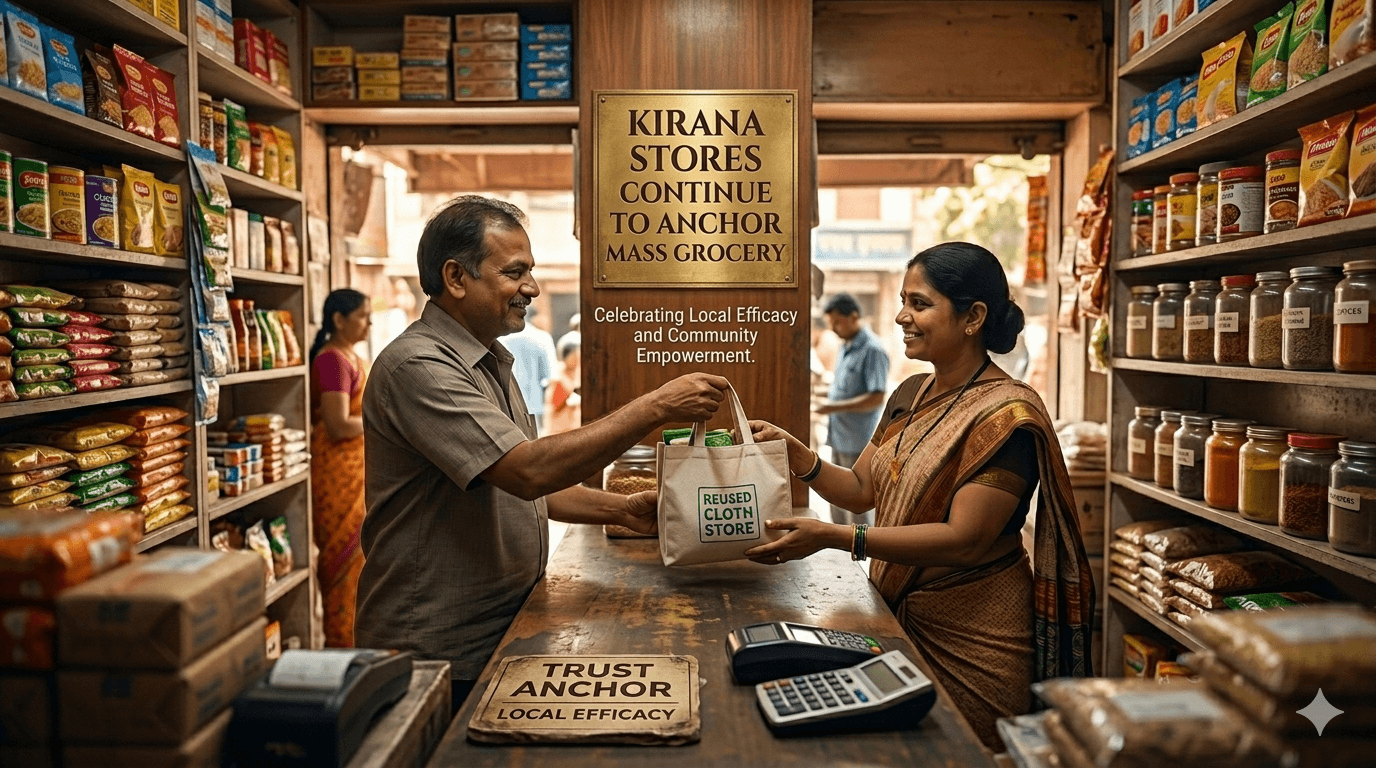
Kirana Stores Continue to Anchor Mass Grocery
Even as quick commerce expands, India’s grocery ecosystem remains fundamentally shaped by kirana stores.
These neighbourhood retailers still account for ~91% of grocery market share in CY2025, and are expected to retain a dominant ~86% share by CY2030. Their model aligns closely with how most Indian households consume, frequent, small-ticket purchases, often within the ₹100-₹200 average order value range.
Kirana stores operate with low overheads, flexible inventory cycles, and strong local relationships, including credit. These factors make them resilient in markets where large-format retail and online models struggle to operate profitably.
For quick commerce platforms, this creates a structural limitation.
While dark stores can scale in high-density urban environments, replicating that model across India’s fragmented, low-AOV consumption base is more difficult. The economics that work in metros do not automatically translate to mass markets.
For FMCG companies, this has direct implications on distribution strategy. While quick commerce is emerging as a high-growth channel, kirana-led distribution continues to dominate scale. As a result, many brands are working with an FMCG consulting firm in India or a strategy consulting firm in India to balance investments across traditional retail and emerging digital channels.
The Real Question: How Does the Model Evolve From Here?
Quick commerce is entering a phase where growth alone is no longer the defining metric. The focus is shifting toward how efficiently that growth is being converted into sustainable operations.
Three structural realities are shaping this phase:
First, demand is expanding across both metros and non-metros, but utilisation remains uneven across city cohorts.
Second, dark stores are emerging as the dominant fulfilment model, but their viability is closely tied to achieving sufficient order density.
Third, traditional retail formats, particularly kirana stores, continue to hold structural advantages in large parts of the market.
For brands and platforms, this creates a more layered operating environment. Channel strategy is no longer about presence across formats, but about understanding where each format works best and how they interact.
This is increasingly leading companies to work with a strategy consulting firm in India to evaluate how quick commerce should be integrated into broader retail, distribution, and growth strategies.
Conclusion
Quick commerce in India is scaling rapidly, but the shape of that growth is uneven. Metro markets are approaching operational maturity, with improving unit economics and stronger utilisation levels. Non-metro markets are expanding quickly, but still in earlier stages of ramp-up.
At the same time, kirana stores continue to dominate mass grocery consumption, reinforcing the need for coexistence rather than replacement.
For companies operating in India’s retail ecosystem, the opportunity lies in understanding how the grocery triangle of Ecom, Kirana’s, Big Box Retailers intersect, which cohorts and micromarkets rely on which of these channels and why, and their buying patterns. As the market evolves further, brands need to plan their 7P and digital strategy, and for this they would need to work with experienced strategy consulting firm in India that understand India’s consumer and internet DNA to solve your growth unlocks.