Innovation in business model helping improve online deliveries performance in GCC

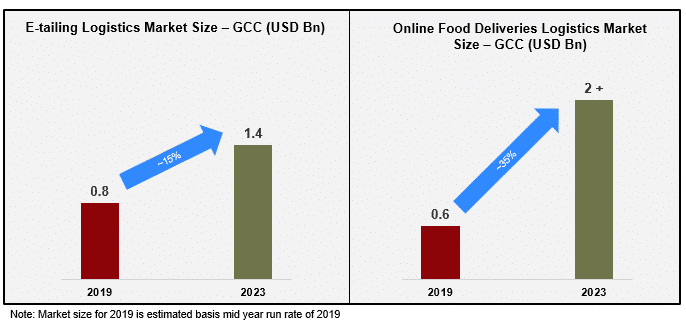
Logistics is driving eCommerce in GCC; the two key sectors of Etail and online food deliveries stand at ~$11 Bn, expected to grow ~3X in next five years
Published on: Sep 2019
Etail and online food are the two biggest sectors where deliveries are playing a critical role.
E-tail is currently observing a run rate of $8 Bn per annum in GCC, driven by the two key players Amazon and Noon. Electronics is the biggest category with ~65% share, however, its share is dropping. Fashion and Grocery are the biggest gainers and together represent 27-30% share currently.
Online food deliveries in UAE and KSA has touched ~$1 Bn each. Talabat and Zomato (part of Delivery Hero) are driving the market in UAE, together representing ~70% share; while in KSA, HungerStation (part of Delivery Hero) is the leader with 70%+ share of the market. Kuwait, with market size of $500 Mn+, is the third biggest country in the region, which in combination with Oman and Bahrain stands at ~$1 Bn in size.
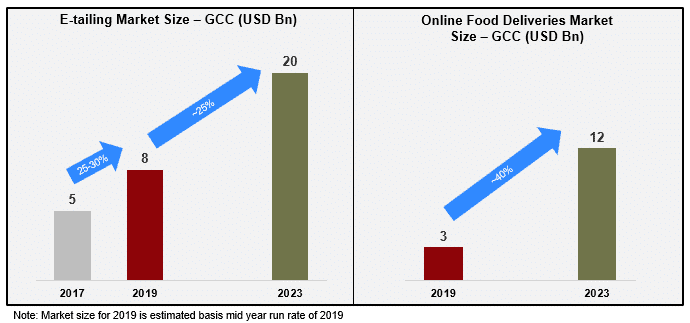
Logistics sector supporting the online deliveries in GCC is ~$1.4 Bn in size, expected to grow ~2.5X in next five years
Deliveries globally represent 7-10% of the etail value chain, however, in GCC this share is higher at ~10% as the market is fragmented and volume level efficiencies are yet to be achieved. Large e-tail players Amazon and Noon are investing heavily in building the logistics supply chain network and thereby save costs. Together the two players are currently capturing ~35% of the market.
Online food deliveries, which are dependent on hyperlocal deliveries, share ~20% of its GMV with logistics players. This share in comparison to India is 22-25%, primarily because the average order value in India is ~1/4th compared to GCC.
Together with online deliveries represent a market of ~$1.4 Bn in GCC, expected to grow ~2.5X to ~$3.5 Bn in next 5 years.
Sector neutral players are helping improve unit economics of online deliveries in the region
On average, a delivery executive can make 15-18 deliveries in a day. However, the performance observed in the region is only 10-12 deliveries per day. E-tail delivery executives generally cover longer distances. This coupled with a high number of cash transactions result in lower capacity utilization. Online food deliveries, on the other hand, observe its ~70% of daily demand coming during ~6 hrs of peak time (lunch and dinner), resulting in under utilization of its delivery executives.
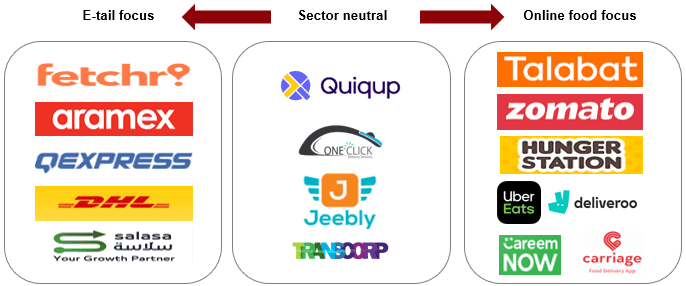
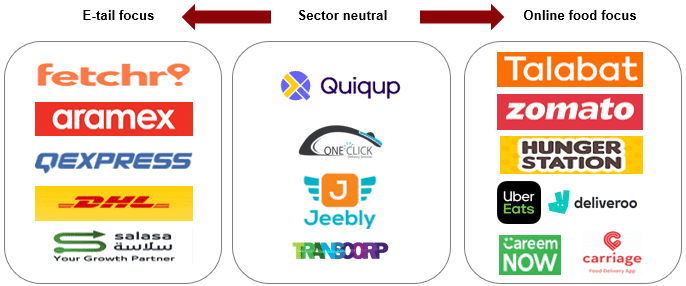
The emergence of sector-neutral delivery players, such as Quiqup, One Click, Transcorp and Jeebly, in the region have helped in solving this problem by handling food orders during peak time and e-tail last-mile deliveries during the remaining time of the day. There are examples of players achieving 25-30 deliveries per executive per day when delivery radius was reduced to 2Km, observed constant demand and reduced cash handling.

Written by
Sandeep Ganediwalla
Partner
Sandeep is the Partner with 20+ years of experience in consulting and technology. He has expertise in multiple sectors including ecommerce, technology, telecom and private equity.


Capturing the Growth Potential in India’s 3PL Market
Smart clicks to win India’s online groceries & general merchandise basket

The Two-Horse Race: Is Bigger Better for Online Food Delivery?
India’s Retail Transformation and Evolving Logistics Needs of Brands

Decoding the Exceptional Trend of eGrocery in Developing Markets
Outlook: Logistics in India by 2030

eGrocery’s Surge & Challenges

Hypergrowth in eGrocery – The new-age digital playing field
Will eGrocery crack the code among digital non-natives?

Retail-Tech – The next start-up opportunity
From Aisle Strolling to One-Click Buying: Unravelling eGrocery Boom

Galvanized by eCommerce, Logistics Sector is Scaling New Heights!
Capturing the Growth Potential in India’s 3PL Market
Smart clicks to win India’s online groceries & general merchandise basket
The Two-Horse Race: Is Bigger Better for Online Food Delivery?
India’s Retail Transformation and Evolving Logistics Needs of Brands
Decoding the Exceptional Trend of eGrocery in Developing Markets
Outlook: Logistics in India by 2030