The Private Label Playbook is Moving from Retail Shelves to Dark Stores

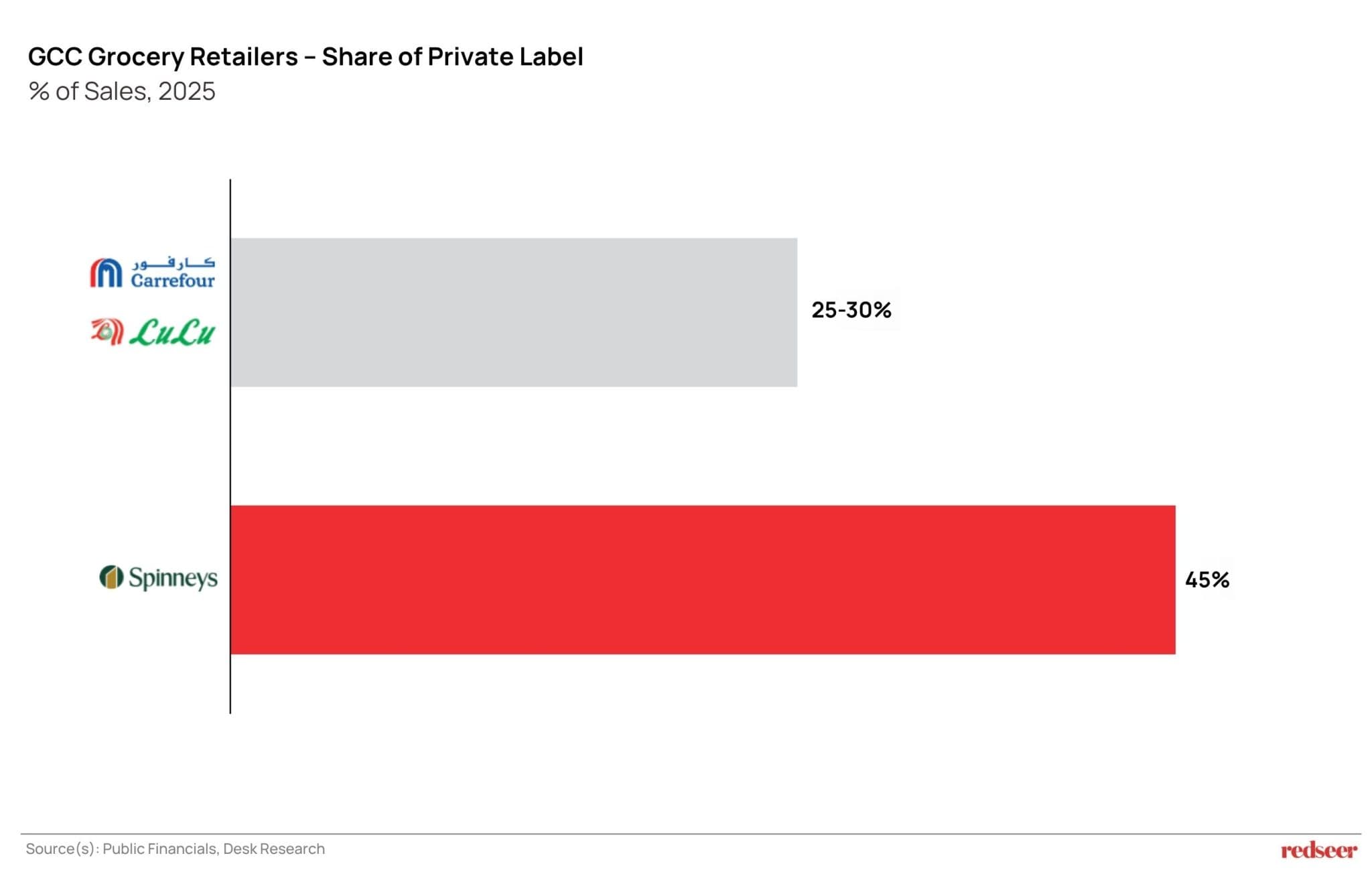
In May 2024, we published The Power Shift: From Brand to Retailer, exploring how GCC grocery retailers were building private labels into margin engines. Since then, the numbers have moved further. Private labels now make up more than 25% of sales for the region’s large grocery chains, including Lulu, Spinneys, and Carrefour.
The question now is what happens when this playbook moves to quick commerce. As dark stores capture a growing share of grocery retail, GCC quick retail platforms are already building their own product lines. And in India, where the same shift is playing out faster, private labels are helping platforms reach breakeven sooner. This piece maps where things stand.
Online grocery is now mostly quick, and private labels are following
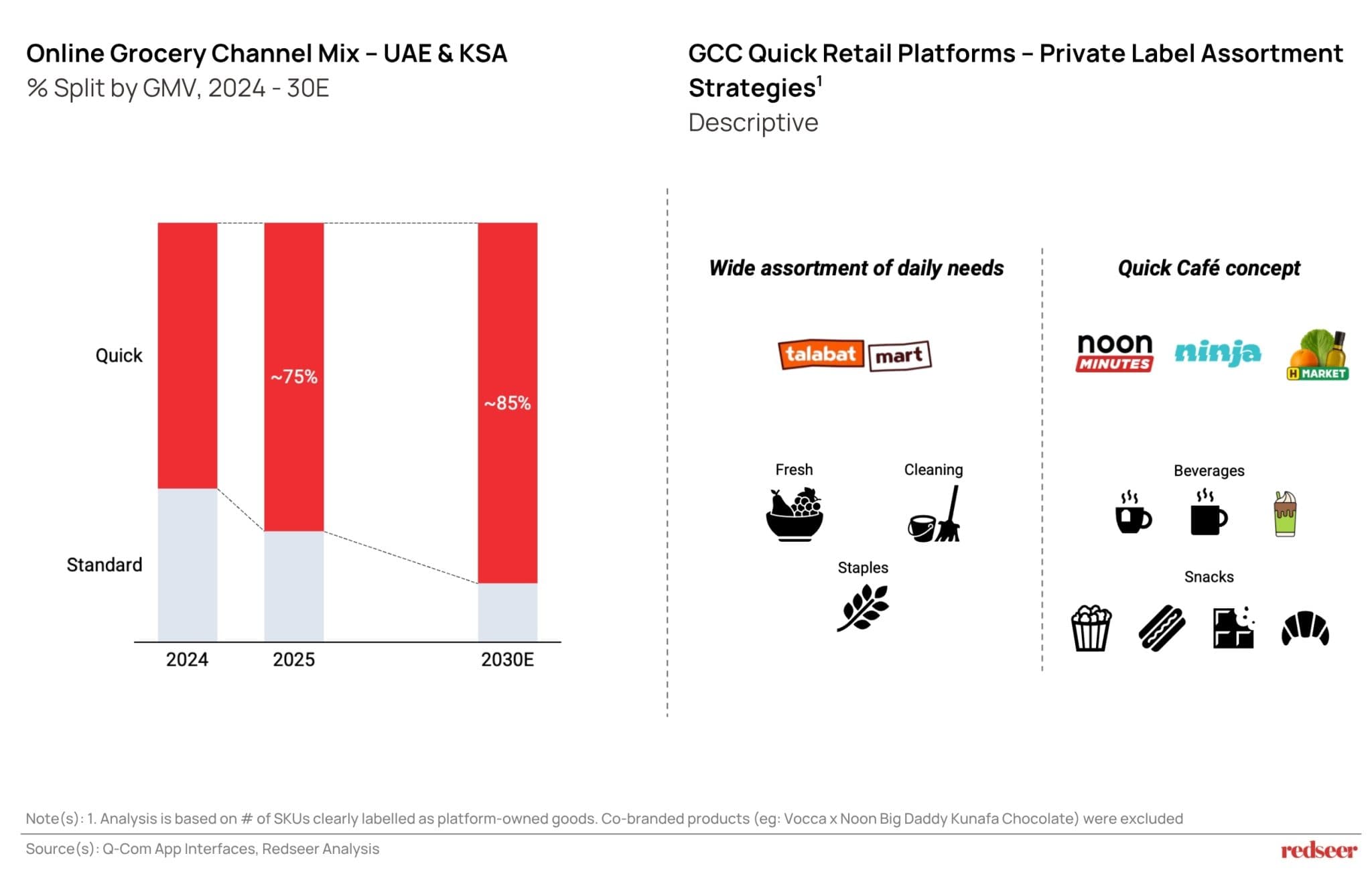
Within online grocery, quick commerce is the dominant model. We expect Quick Grocery to account for 85% of online grocery and around 15% of total grocery retail across the UAE and KSA combined by 2030
As grocery spend shifts from store shelves to delivery apps, the screen real estate that platforms control is becoming the new shelf space. And like any retailer that controls the shelf, platforms are starting to fill part of it with their own products.
Every major quick commerce platform in the UAE and KSA now has some form of owned or exclusive product line. Talabat has the most developed programme, with 100+ private label SKUs spanning cleaning supplies, staples, fresh products, snacks, condiments, and coffee. Noon’s owned brands focus on snacking and indulgence, with Noon Cafe processing around 2,500 orders daily across 50+ SKUs. Ninja’s dark store label “Now” covers 75+ SKUs concentrated in tea, coffee, and baked goods. HungerStation’s HG Mart runs a private label range called Everyday Roastery, focused on coffee and snacks.
The depth varies, but the direction is consistent. Platforms are investing in owned products because the economics are compelling: higher margins, exclusive assortment, and less dependence on brand partners.
India showing how fast this scales
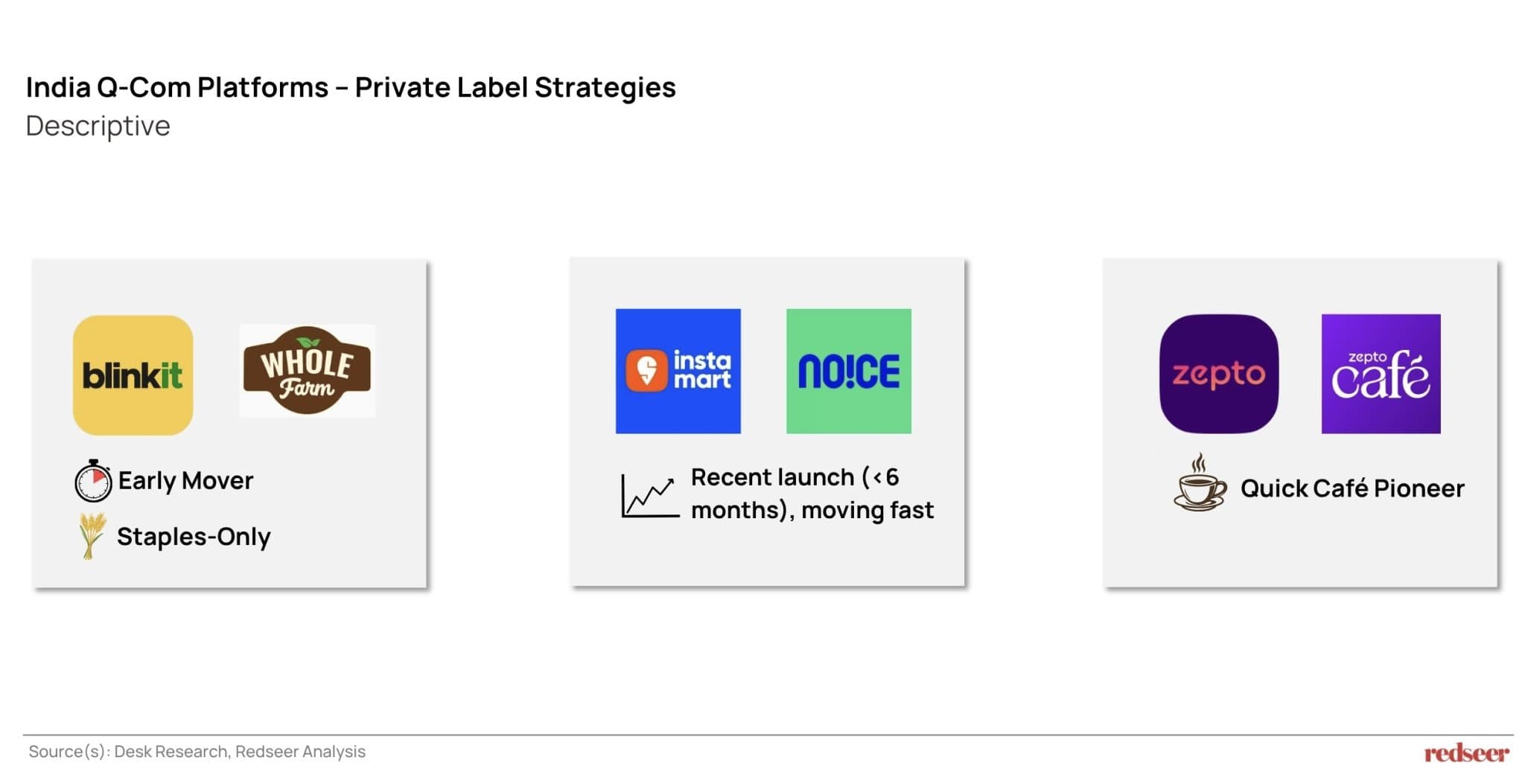
The most instructive examples come from India, where the playbook is being written in real time –
- Blinkit, owned by Eternal (formerly Zomato), has built its Whole Farm private label into the top-performing brand on the platform. Whole Farm focuses on staple pantry categories-dry fruits, masalas, cooking oils, atta, rice, and dal. While being among the first platforms to go the private label route, Blinkit made a conscious choice not to scale private labels beyond staples; one of the key reasons is possibly avoiding competition with branded suppliers detailed in the next section.
- Swiggy Instamart’s Noice label may be the most relevant example for GCC operators. Launched in August 2025, it scaled from 200 to 350+ SKUs across 40+ categories in under five months, partnering with over 70 local manufacturers. Noice targets 2-3x margins versus what is earned on third-party branded products.
- Zepto, on the other hand, set the precedent for Noon/Ninja in scaling a private-label quick café concept – Zepto Café (70-80K daily orders),limiting conventional private-labelling to a line of fresh-cut meats branded as Relish
The pattern is consistent: platforms start with high-frequency staples, then expand to snacks/beverages and fresh products. GCC platforms are following a similar trajectory
What this means for platforms and brands
For platforms, the opportunity is real, but so are the risks. Every private label SKU that gains share signals to branded suppliers that the platform is also a competitor. The Indian experience has surfaced this tension, with reports of higher customer drop-off when platforms prioritise private labels too aggressively over established brands. Quality and trust matter equally: private labels on quick commerce platforms do not yet carry the consumer confidence that a Spinneys or Lulu label does, and a poorly received product damages the platform’s broader reputation in ways a third-party brand would not.
How platforms position their private labels matters. Talabat, notably, does not force its own products to the top of search results-it allows its private label SKUs to compete with branded alternatives on consumer preference, letting organic ranking decide placement. This is the right approach. Platforms that artificially boost their own products risk eroding the trust that drives repeat usage. With Noon, Ninja, and HungerStation, the dynamic is somewhat different: their private labels are primarily ready-made beverages, fresh snacks, and café-style items that do not have direct branded competition on the platform. These are additive categories rather than substitutive ones, closer to the Zepto Café model in India, where the private label creates a new occasion rather than displacing an existing brand.
For FMCG and CPG brands, the stakes are significant. Brands that depend on quick commerce as a growing channel need to invest in salience that survives algorithmic curation, ensure pricing competitiveness against private label alternatives, and explore co-marketing partnerships with platforms that align interests rather than create competition.
The private label story in GCC quick commerce is early. What Lulu, Spinneys, and Carrefour built over decades is just beginning to take shape on quick retail platforms. But the direction is set, the Indian precedent shows how fast it can move, and the margin incentives guarantee it will. The players who get the balance right between owned products and branded assortment, between margin optimisation and customer trust, will shape how this market evolves.
If you would like to discuss implications for your market position or portfolio, we would be happy to chat.

Written by
Sandeep Ganediwalla
Partner
Sandeep is the Partner with 20+ years of experience in consulting and technology. He has expertise in multiple sectors including ecommerce, technology, telecom and private equity.


Brands Beyond the Shelf: MENA Consumer Brands’ New Growth Playbook
The Online Grocery Report 2026: The Five-Way Win and What Comes Next

GCC Q-commerce: Expansion & Consolidation

Unlocking the Next Wave of MENA E-commerce Growth
The Power Shift: From Brand to Retailer
UAE Online Grocery: Dark Stores Have the Momentum. Retailers Still Have the Market.

The KSA Beauty Shelf Is Getting Crowded From Two Sides. Brand Equity Alone Won’t Hold It.

The Two-Hour Window: How Quick Delivery is Reshaping KSA’s Beauty Market

Dark Stores Can Be Profitable. GCC Is Where It Happens First.

Omnichannel Owns a Big Slice of Online Retail in KSA

Quick Retail Surges: Ninja Leads in KSA, Talabat and Noon Share the Lead in UAE

Q-Commerce 2.0: Why Quick Retail is the New Norm- Quick Retail to be a bigger opportunity than Food delivery
Brands Beyond the Shelf: MENA Consumer Brands’ New Growth Playbook
The Online Grocery Report 2026: The Five-Way Win and What Comes Next
GCC Q-commerce: Expansion & Consolidation
Unlocking the Next Wave of MENA E-commerce Growth
The Power Shift: From Brand to Retailer
UAE Online Grocery: Dark Stores Have the Momentum. Retailers Still Have the Market.