Omnichannel Owns a Big Slice of Online Retail in KSA


Most of the attention in Saudi online retail goes to the pureplay names. Amazon, Noon, Shein, Ninja. The headlines are about marketplaces and quick commerce, and for good reason; they have driven a lot of the growth. But there is a quieter fact underneath the noise that is worth sitting with.
Roughly one in three riyals spent online in KSA still goes through an omnichannel player. That is retailers who run both stores and a website.
32% of online sales through 2025. Omnichannel is a structural part of how Saudis shop online, and it is holding its ground.
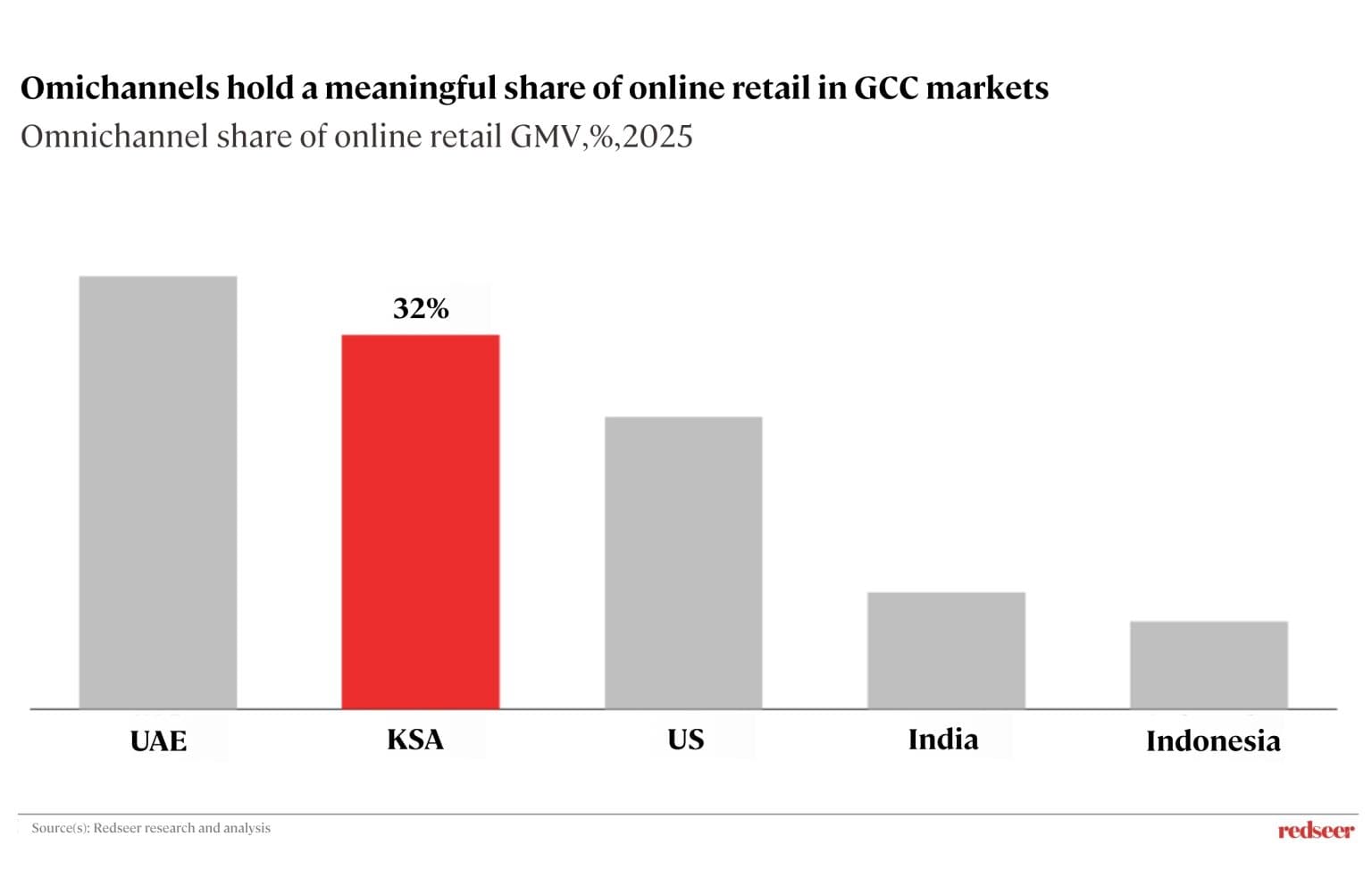
The cross-country picture makes the point clearer. Omnichannel is not just a Saudi story. Across GCC markets, a meaningful chunk of online spend flows through players who also run physical stores.
The catch: the omnichannel story is different from one sector to the next
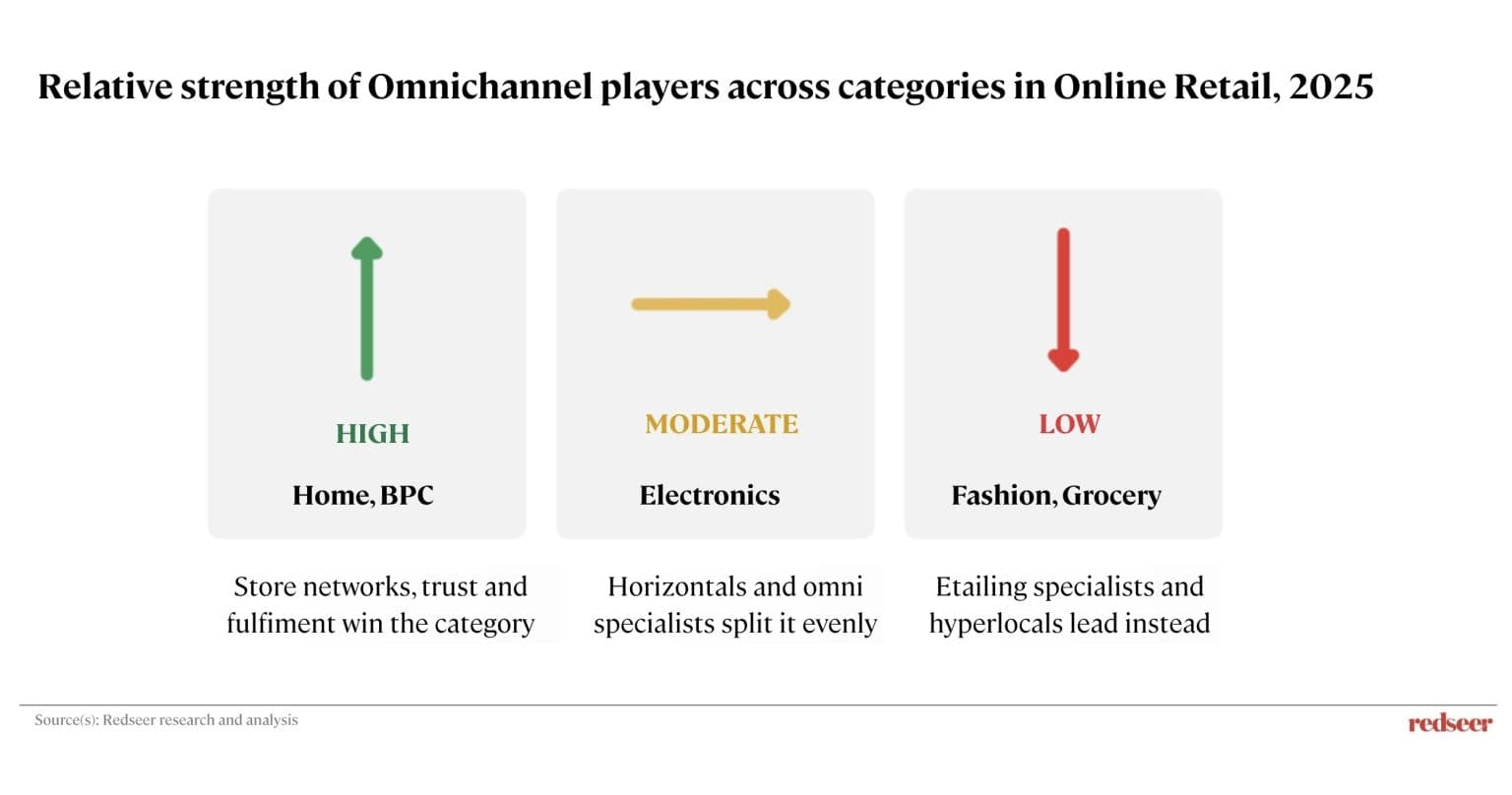
Look at the overall number and you would think omnichannel sits at a steady one-third everywhere. It does not. Once you split online retail by sector, the picture splits with it. In some categories omnichannel players are the natural home for the shopper. In others they are an afterthought. The dividing line is simple: it comes down to what the category actually demands, and whether a pureplay model can deliver it.
Where omnichannel is strong, it tends to hold around a third or more of online sales. Where it is weak, it sits well below that.
Home and BPC are the strongholds. Electronics is more balanced. Fashion and Grocery are where omnichannel is relatively weaker.
Home: the clearest omnichannel win
Home is the category where omnichannel is most clearly ahead. Online home retail leans heavily on players who also run stores, and pureplay etailing has actually been losing ground here, not gaining it. The reason is practical. Home is bulky, high-consideration, and logistics-heavy. People want to see a sofa before they buy it, returns are a nightmare to handle, and delivery is complicated. That is exactly the kind of work horizontal marketplaces would rather not take on. So players like IKEA and Home Centre, who already have the stores, the showrooms and the fulfilment muscle, are the ones doing well online. Home is a specialist category, and the specialists with physical infrastructure win it.
BPC: trust and speed, tilting omnichannel
Beauty and personal care sits on the omnichannel side too, though it is more contested. Omnichannel specialists hold a strong share, with names like Sephora and Faces, and the pharmacy ecosystem led by Al Nahdi doing a lot of the work. Beauty is a trust category. Shoppers care about authenticity, and a pharmacy or a known beauty retailer carries credibility that a long-tail marketplace listing does not. What is interesting is that these players are no longer relying on trust alone. Al Nahdi is leaning on its store network of more than a thousand pharmacies to offer 30-minute delivery, and Sephora now runs same-day delivery in KSA. They are turning their physical footprint into a speed advantage, which is exactly the ground hyperlocals tried to own. At the same time, pureplay and hyperlocal players are gaining here too, with Ninja scaling fast in personal care, so BPC is the one strong-omni category where the balance is genuinely shifting.
Electronics: more balanced than it looks
Electronics is the interesting middle. The horizontals are genuinely strong here, Amazon and Noon do big electronics volume, so this is not a pure omnichannel story. But the omnichannel specialists hold firm, with Jarir and eXtra anchoring a meaningful share. Electronics is big-ticket, and for a big-ticket purchase people want warranty, service, installation and the reassurance of a name they trust. The horizontals bring price and range, the omnichannel specialists bring trust and service.
Fashion: the etailers run this one
Fashion is where omnichannel share is thin. The category is dominated by etailing specialists like Namshi and Ounass alongside cross-border players like Shein and Trendyol. Fashion rewards assortment breadth, trend speed and price, which is exactly what a pureplay catalogue is built for. Omnichannel players are upping their game and improving their online execution, but the structural pull in fashion is toward the specialists and the cross-border names. Omnichannel is a smaller part of the picture here.
Grocery: hyperlocal took it
Grocery is the other weak omnichannel category, but for a different reason. Here it is not the etailing specialists who own it; it is the hyperlocals. Ninja and HungerStation built dark store networks and made instant delivery the default, and they now drive the overwhelming majority of online grocery. The big traditional grocers with large store estates, like Othaim and Panda, hold far less of the online channel than their offline size would suggest, because quick commerce got to the online shopper first. Grocery online is a fulfilment-density game, and the quick commerce players got there first.
Where this is heading
Step back and the same force is shaping both halves of the story. The quick commerce players, Ninja, HungerStation and the rest, cleaned up grocery on the back of dark stores and fast delivery, and that capability is now spilling into BPC and beyond. They have reset what shoppers expect on speed across the board.
The open question is what happens to the retailer-app and omnichannel model next. So far the retailer-led online play has not fully taken off in every category. But as the fast-delivery infrastructure matures and raises the bar everywhere, the more likely next phase is not omnichannel versus pureplay. It is omnichannel plus speed. The players who pair physical infrastructure and trust with quick-delivery capability are the ones to watch for a rebound. The early signs point that way.
One last point. We have talked about this as omnichannel versus pureplay, because that is the cleanest way to see the big picture. But the real market is more layered than two buckets. Online retail in KSA actually runs across six distinct business models, and which one wins depends heavily on the category:
- E-tailing horizontals: online-only players selling across many categories, like Amazon, Noon and AliExpress.
- E-tailing specialists: online-only players focused on one category, like Namshi, Ounass and Nice One.
- Omnichannel horizontals: store plus online players across many categories, like Carrefour, LuLu and Panda.
- Omnichannel specialists: store plus online players in one category, like Sephora, Jarir, eXtra and IKEA.
- Hyperlocals: quick commerce players delivering fast from nearby stores, like Ninja, HungerStation and Jahez.
- Shop and ship: logistics players that ship cross-border orders for platforms without a local presence, like Aramex Shop and Ship and Borderlinx.
Each of these models is winning and losing different categories for different reasons, and the share each one holds is shifting year on year. We track all of it. If you want the full breakdown of how these six models are contributing to the KSA online retail market and where each is heading, reach out to us.
Written by



Brands Beyond the Shelf: MENA Consumer Brands’ New Growth Playbook

The Online Grocery Report 2026: The Five-Way Win and What Comes Next

Unlocking the Next Wave of MENA E-commerce Growth

KSA-Hyperlocals: Moving Towards Multi-Verticality

UAE Online Grocery: Dark Stores Have the Momentum. Retailers Still Have the Market.

The KSA Beauty Shelf Is Getting Crowded From Two Sides. Brand Equity Alone Won’t Hold It.

The Two-Hour Window: How Quick Delivery is Reshaping KSA’s Beauty Market

Who Owns the Customer When AI Owns the Answer?

The Private Label Playbook is Moving from Retail Shelves to Dark Stores
GCC’s Online Retail Market is Truly Democratic
36% Growth. Falling Profits. Compressed Valuations. What Changed in KSA Food Delivery in 2025?
KSA is the Online Fashion & BPC leader in GCC
Brands Beyond the Shelf: MENA Consumer Brands’ New Growth Playbook
The Online Grocery Report 2026: The Five-Way Win and What Comes Next
Unlocking the Next Wave of MENA E-commerce Growth
KSA-Hyperlocals: Moving Towards Multi-Verticality
UAE Online Grocery: Dark Stores Have the Momentum. Retailers Still Have the Market.
The KSA Beauty Shelf Is Getting Crowded From Two Sides. Brand Equity Alone Won’t Hold It.