How Indian Consumers Think About Hair Loss


Of the 82 million urban Indians who suffer from hair loss, a mere 5 million – about 6% – use a retail OTC product to treat it. The instinctive read is that this is a conversion problem; you may be tempted to believe that awareness, access and trust might fix this gap. But zoom into the consumer demographics in this unique space, and you’ll see why cracking this market isn’t as straightforward as it seems.
Most consumers in this segment are one of four types. But brands tend to treat them as one. They end up building products, channels and price points that don’t serve any consumer at all. Let’s take a look at how understanding each consumer type can be beneficial for a brand.
The Funnel That Hides Four Consumers
On the surface, the hair growth market maps onto a familiar shape. Roughly 75 million urban Indians manage hair loss through home remedies. Five million have moved to retail products. Another 2.3 million are on the doctor channel. A small tail sits in clinical treatment. Read sequentially: this looks like a consumer moving through stages of conviction, from passive coping to active treatment.
It isn’t. 90% of these consumers in this category spend under INR 1,000 on products, but the brands that define the category are priced between INR 1,559 and INR 1,690 a month. This gap has persisted over the years, not because brands have failed to convert, but because the consumers in each tier were never the same person.
Each consumer’s spending cap is determined by budget, priority and severity. This categorises them into different tiers. No amount of marketing can move a consumer from one tier to another.
Who They Are and How They Buy
Digital Champions are 20-30 years old, dealing with mild to moderate hair loss, and commercially the most visible cohort in the category. They research online, purchase online, and arrive at a product with more information than most category entrants expect. They are also the leakiest. Cost and inconvenience are their primary reasons for dropping off, which creates a specific irony: the cohort most accessible to performance marketing is the one that brands are most efficiently acquiring and then losing. The acquisition economics look attractive until retention is factored in. The real challenge is not getting them to try a product. It is to keep them past the first month with a well-priced and packaged product.
Doctor-care Advocates are 30-45 years old, at moderate to severe hair loss stages, and the highest-value cohort by any lifetime value calculation. They will not make the choice – whether it’s from a retail store or a social media ad. Their entry point is clinical endorsement, either through a dermatologist’s recommendation or a trichologist’s consultation, and their usage horizon is longer once they are in. The commercial implication is structural: any brand targeting this cohort must build the doctor relationship before the consumer relationship. The channel in this case is not a distribution decision; it is an acquisition strategy. Brands that try to reach these consumers through conventional marketing will find the spend lands on the wrong person entirely.
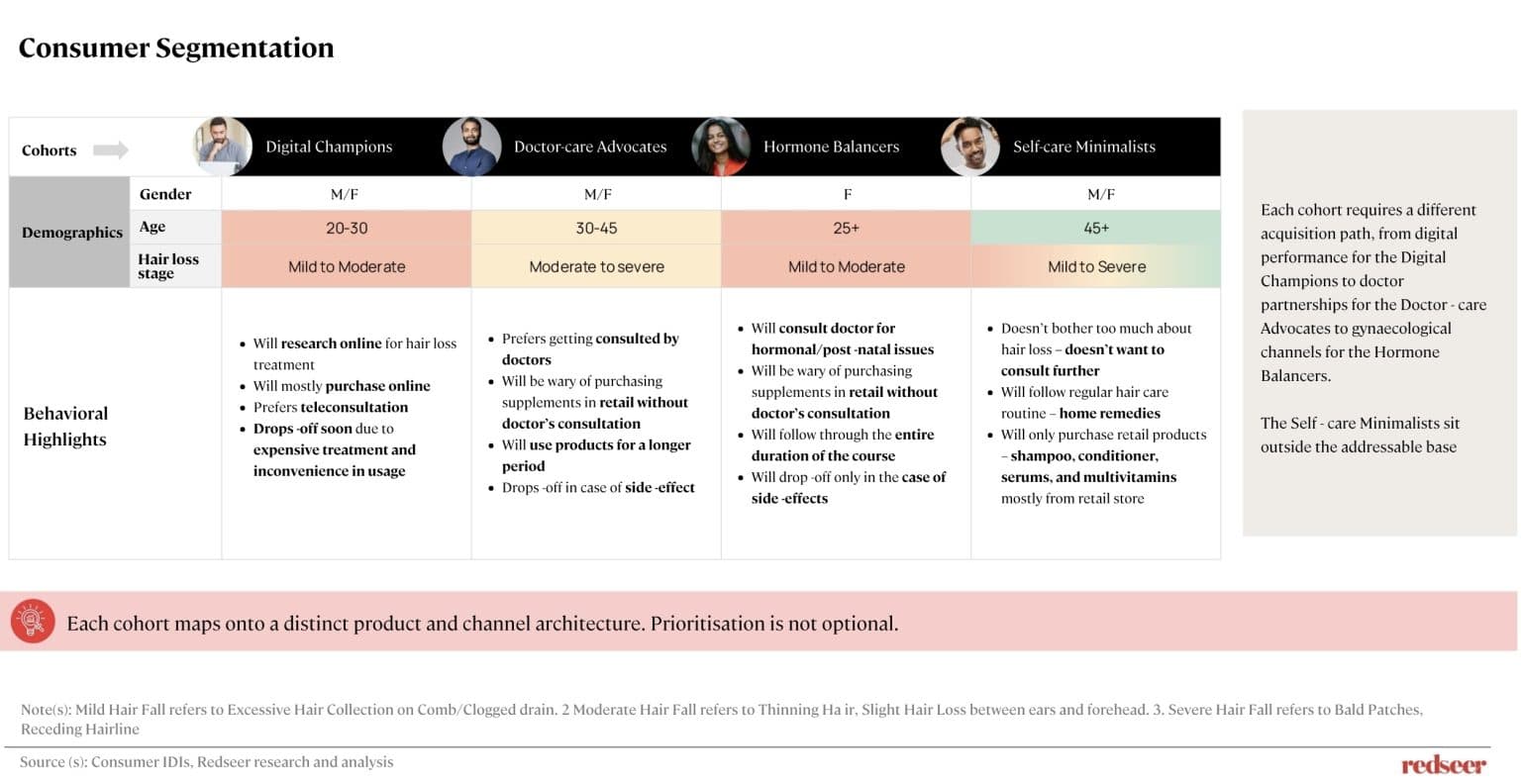
Hormone Balancers are women aged 25 and above, managing mild to moderate hair loss, and the most under-leveraged cohort in the category today. Their entry point is a gynaecologist, not a dermatologist or a search engine. The issue here is that the dominant acquisition playbook in the Indian hair growth market was never built to address this cohort. It was built around digital and dermatology and doesn’t reach these customers at all. Therefore, no brand is currently positioned at the right entry point. Building a gynaecologist relationship is the way to get to a whole cohort that follows clinical guidance through a full course. Right now, this is an unclaimed territory, and the cohort sits behind it, waiting.
Self-care Minimalists are 45 and above, spanning mild to severe hair loss, and are effectively outside the addressable market for any current commercial model. Their engagement is low, they swear by home remedies, and have limited willingness to shift purchasing behaviour. The cohort isn’t unimportant. They’re a large population. But no existing product, price point or channel reaches them. They sit in the funnel visually but not commercially.
The Journey Isn’t Unidirectional
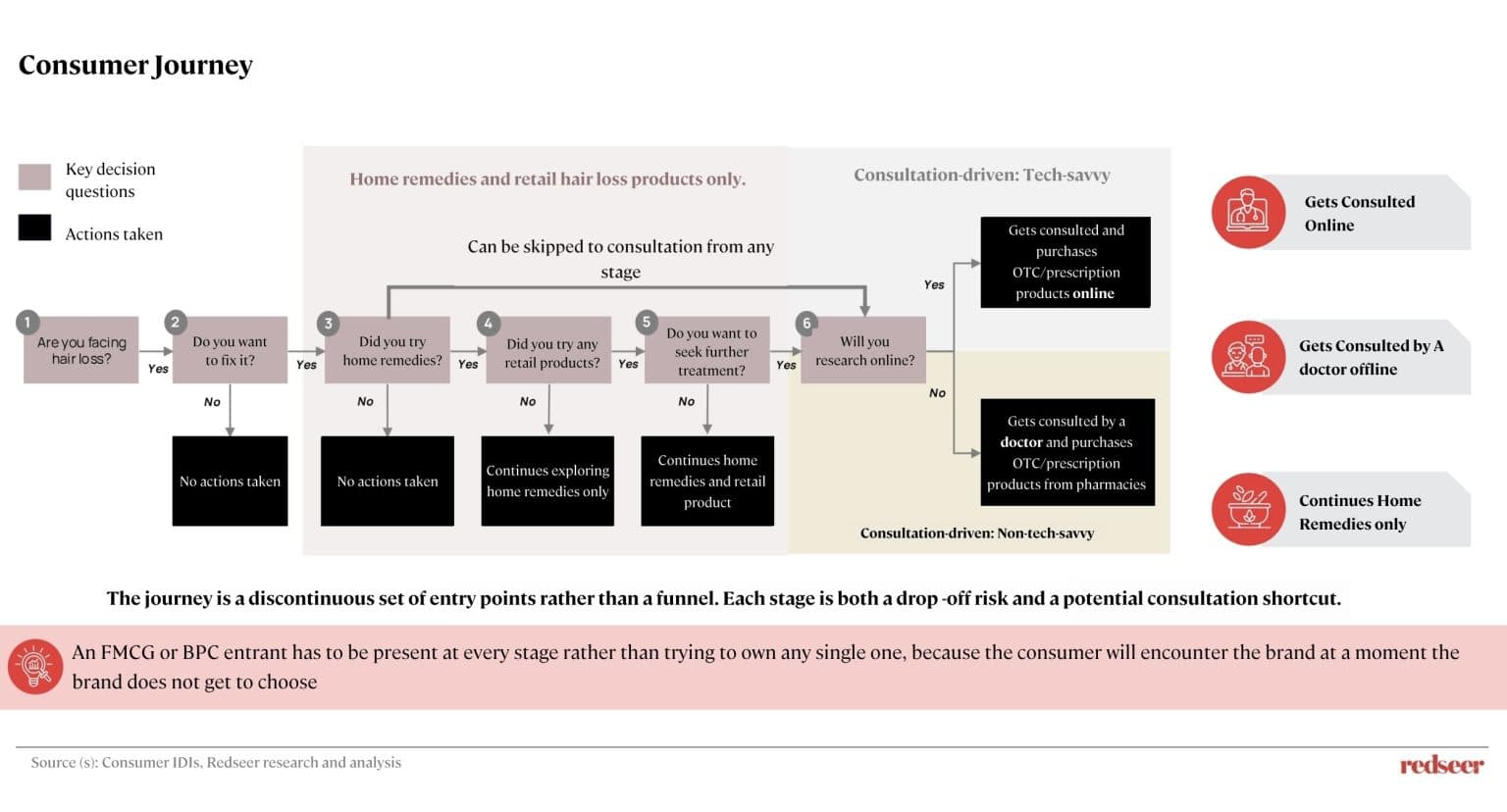
Most category funnels are sequential, but this one isn’t. Consumers don’t move in order – they can enter at any stage. That’s why the brand must meet the consumer at all stages.
A consumer can shortcut from home remedies directly to a clinical consultation, essentially skipping retail products and doctor-channel supplements entirely, if the trigger is strong enough. A diagnosis, a sudden acceleration in hair loss, a peer referral to a specialist: any of these can collapse three funnel stages into one decision.
The implication for brands is both practical and overlooked. At any given moment, a brand’s communication will be encountered by consumers who are at different stages. The brand does not get to choose the moment of encounter. A Doctor-care Advocate might see a brand’s content two years before they book a consultation. That exposure will not convert them immediately, but it will shape what they ask for when the trigger eventually fires.
Presence across stages becomes a recall-building exercise. Brands that are only present at the conversion moment will lose to brands that have been building recognition earlier, even passively.
Why One Brand Can’t Win This Whole Market
Two strategic models have emerged in India.
The first is D2C personalisation. It is diagnostic-led, digitally distributed, and built on customised product kits. The second is doctor-channel supplements, which are a clinical endorsement model distributed through dermatologists and trichologists. These are not competing strategies for the same consumer. They are purpose-built architectures for different cohorts.
D2C personalisation serves Digital Champions. They are research-oriented; the personalisation addresses that. The digital channel matches their purchase behaviour, and their drop-off tendency is where the subscription tendency helps retention.
Doctor-channel supplements serve Doctor-care Advocates. The clinical entry point matches their trust requirement; the longer usage period justifies the price; and the doctor simultaneously serves as the channel and the credibility infrastructure.
Brands must choose a cohort. The model, product and channel will flow from that choice. Brands that attempt to run models for both cohorts under a single architecture tend to serve neither customer well.
Way Forward
Most category entry decisions begin with the product, the channel and then the consumer. In India’s hair growth market, this sequence produces the wrong answer. The cohort choice is upstream of everything. It determines the price point, the channel architecture, the clinical investment required, the retention mechanic, and the communication strategy. All decisions are dependent on the cohort choice.
The brands defining this category’s next phase will not have the best formulations or the widest distribution. They’ll be the ones with a cohort choice – with every commercial decision around that choice. They’ll also be smart enough to leave behind other unrelated cohorts. In this market, focus becomes the go-to strategy.
Written by


Engagement Manager

India Hair Growth Market Report 2026

Digital Disruption in Home Category: Whitespace to Market Leadership

India’s Digital Lending Report 2026: Value Beyond Acquisition

India’s $40Bn Beauty & Personal Care Market: Growth, Shifts and Opportunities for 2030

The Body Lotion Opportunity in Indian E-Commerce

The Indian Consumer at 2030: Redefining Aspirations, Choices, and Markets

Micro-Drama’s J-Curve Moment: What Marketers, Platforms, and Investors Need to Know

India’s Beauty Industry : Transforming boundaries across Audiences and Categories

New-Age vs Legacy: The Future of Fashion in India and the Battle for Consumer Loyalty

Redseer advised a global beauty company on its acquisition of a multi-brand D2C Platform

Value Grocery – Unlocking India’s Next 100 Mn Shoppers

The Next Lever of Growth in India’s Wealth Tech
India Hair Growth Market Report 2026
Digital Disruption in Home Category: Whitespace to Market Leadership
India’s Digital Lending Report 2026: Value Beyond Acquisition
India’s $40Bn Beauty & Personal Care Market: Growth, Shifts and Opportunities for 2030
The Body Lotion Opportunity in Indian E-Commerce
The Indian Consumer at 2030: Redefining Aspirations, Choices, and Markets