Online Retail Heads for USD 90 Bn+ in 2026, Its Fastest Growth in Five Years


This year, India’s online retail is growing fastest where demand is steadiest.
– Kushal Bhatnagar, Partner, Redseer
India’s online retail is usually judged by its mobile sales, and for good reason: mobiles accounted for a third of festive GMV in 2025, more than any other category.
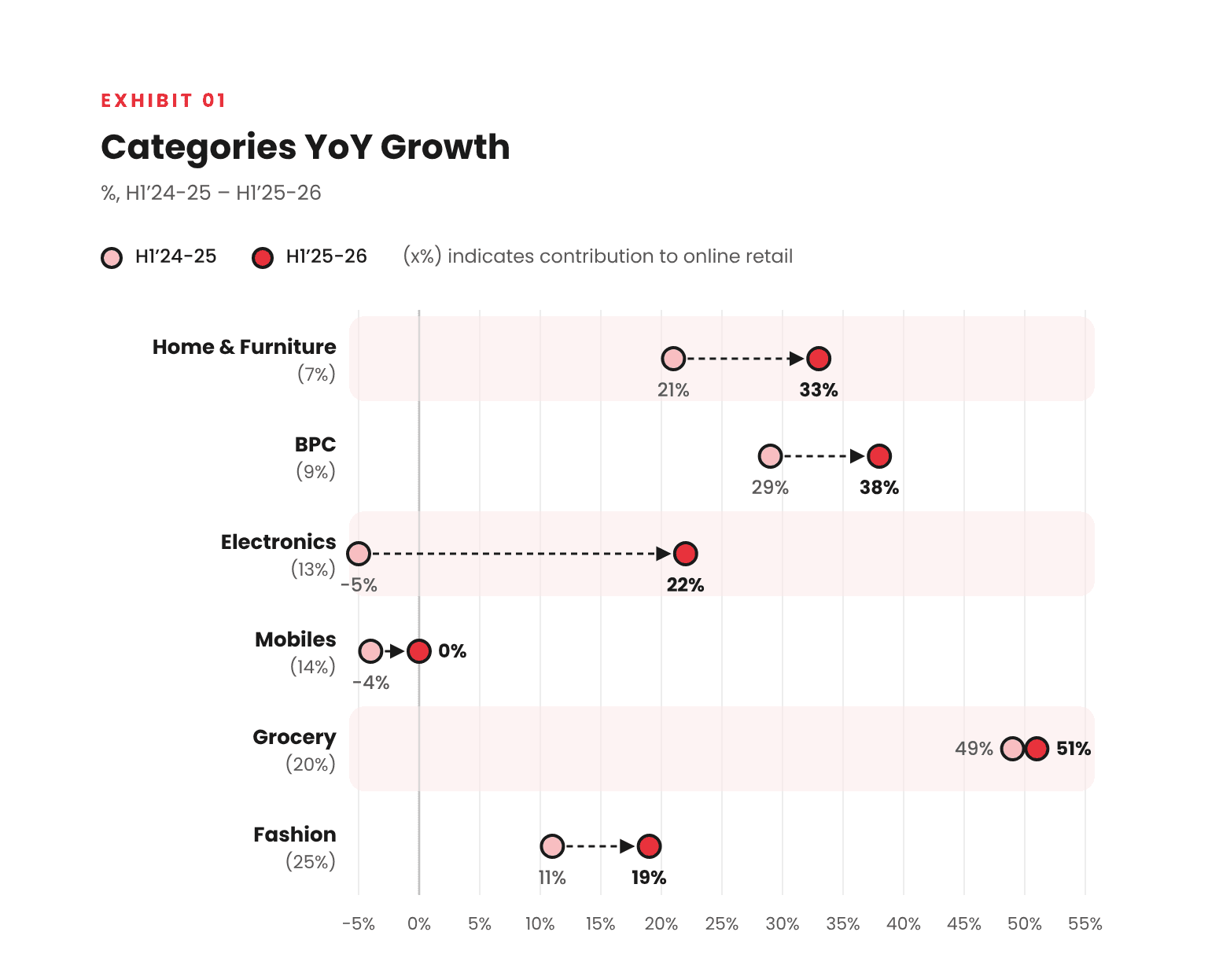
That view needs revision this year. Online retail grew about 25% year on year to about USD 38 Bn in H1 2026, its strongest first half in four years and roughly twice the pace of the three first halves before it, while mobiles were flat at 0%.
Redseer projects the full year will cross USD 90 Bn at 22-24% growth, the fastest in five years, with mobiles growing just 2-3%.
Grocery, beauty and personal care (BPC), and home and furniture account for about 40% of online retail GMV in 2026 and, by our calculation, roughly three-fifths of the GMV it adds this year. Their growth has held at a high level for the last two halves, and Redseer projects similar rates for H2. Grocery is set to overtake mobiles as the second-largest category bought online.
Redseer believes this marks a shift in what sets the pace of India’s online retail. Mobiles and electronics, which move with prices and policy, are contributing less to the year’s growth than their share of the market, while grocery, BPC, and home and furniture, whose growth has held at a high level across the last two halves, are contributing more.
Electronics rebounded to 22% growth and is set to normalise in H2
Every major category grew faster in H1 2026 than a year earlier. Electronics grew 22%, up from a 5% decline in H1 2025, with part of that demand pulled forward.
Four things drove it:
a. The GST cut on large appliances in September 2025 (28% to 18%) brought buying forward.
b. A long, early summer lifted demand for air conditioners, and a change in BEE star ratings pushed sellers to discount old-rated stock heavily.
c. LPG shortages drove a 200-300% surge in induction cooktops.
d. DRAM and NAND prices rose more than 100%, so people bought laptops and tablets early, ahead of expected price revisions.
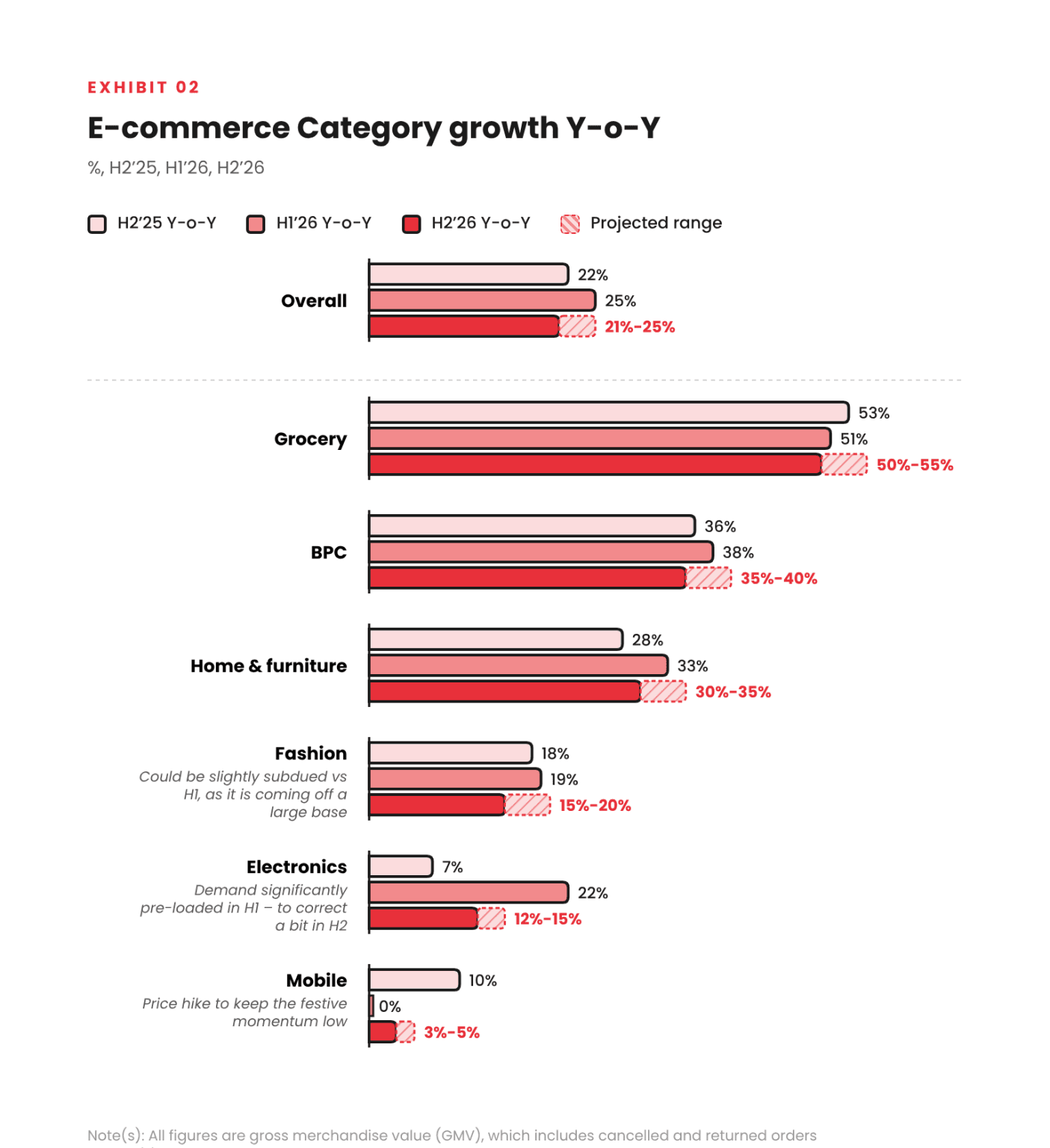
Redseer describes this demand as significantly pre-loaded and projects electronics growth of 12-15% in H2, 7-10 points below H1’s 22%.
Grocery, BPC, and home and furniture are where the steadiest growth sits. Grocery grew 53% and 51% in the last two halves, BPC 36% and 38%, and home and furniture 28% and 33%. Redseer projects 50-55%, 35-40% and 30-35% for H2.
All figures are gross merchandise value, which includes cancelled and returned orders.
Mobile growth stays subdued as price hikes hold back volumes
Mobiles declined 4% in H1 2025, grew 10% in H2 2025, and were flat in H1 2026. Redseer expects sharp price hikes to keep volumes subdued for the rest of the year, with growth of 3-5% in H2, 5-7% through the festive season and 2-3% for the full year. That takes mobiles’ share of online retail from about 19% in 2025 to about 16% in 2026.
Festive growth is broadening beyond mobiles and electronics
Redseer projects the 2026 festive season, the 30-35 days that typically run up to Diwali, will grow about 25% to USD 15-16 Bn. That would be the strongest festive growth in about five years.
Redseer expects the pre-festive momentum in grocery, BPC, home and furniture, and general merchandise to carry over into it. Grocery is projected to grow 48-50%, BPC 35-40%, and home and furniture 32-35%, against 5-7% for mobiles.
Redseer projects that mobiles and electronics together will fall below half of festive GMV this year, from 51% to 46% by our calculation, owing to sharp price hikes that will keep volumes subdued.
Grocery is set to overtake mobiles as the second-largest category online
Across the full year, Redseer projects grocery’s share of online retail rising from about 16% to about 19%, on 50-53% growth. Mobiles, the second-largest category in 2025, slip from about 19% to about 16% and fall to third, behind fashion and grocery.
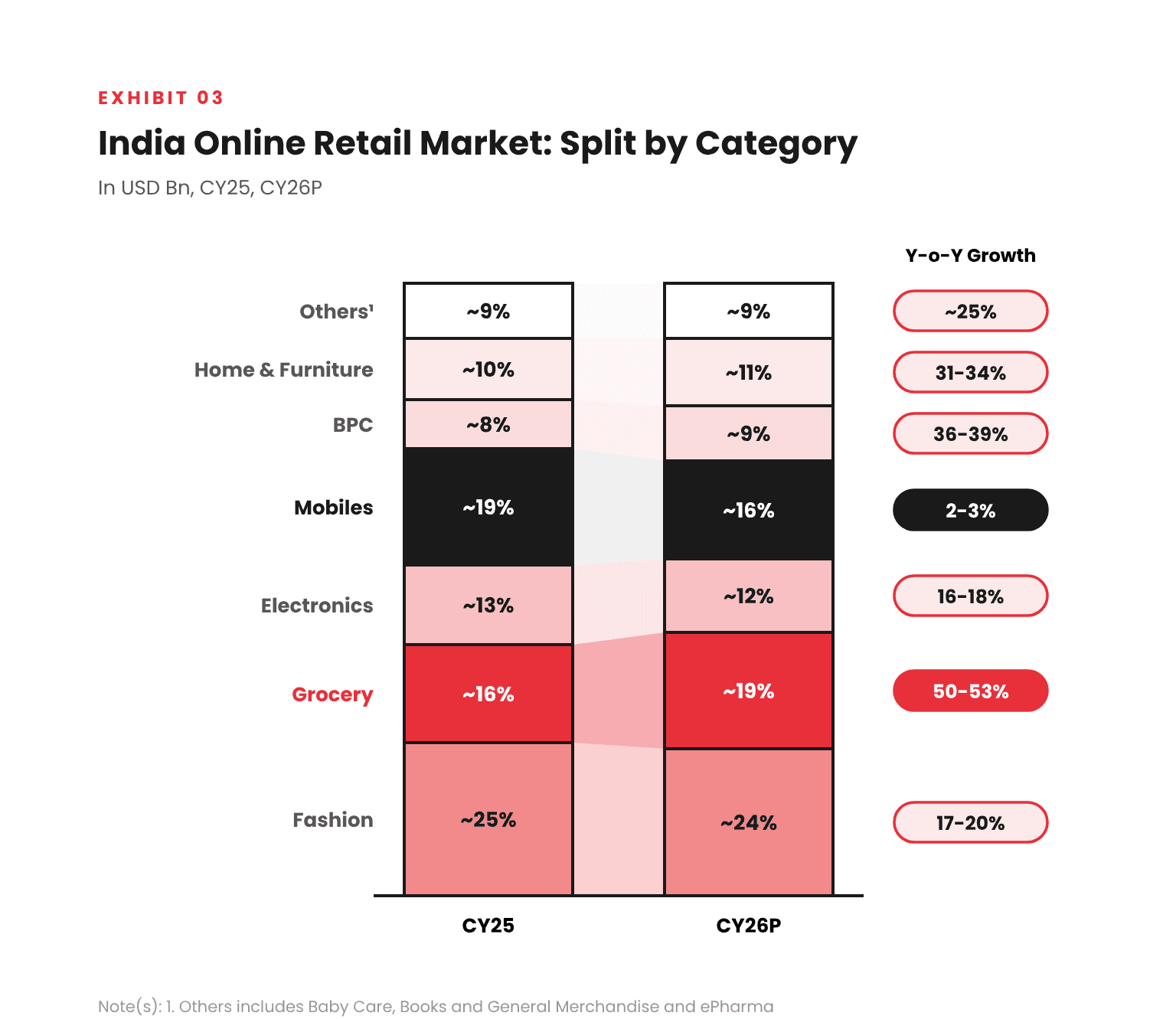
By our calculation, grocery alone will account for roughly a third of the GMV online retail adds in 2026, while mobiles contribute only a few percent of it. BPC, at 36-39%, and home and furniture, at 31-34%, are also growing well ahead of the market.
Redseer Advisory
• For brands and platforms in grocery, BPC, and home and furniture: Redseer projects festive growth of 48-50%, 35-40% and 32-35%, close to their H1 rates. Build festive supply and marketing plans on the demand these categories carry into the season, and treat the sale as an extension of it.
• For electronics players: H1’s 22% is best read as pre-loaded demand. Plan H2 inventory, pricing and discount depth against the projected 12-15%, which avoids building for a rate the second half is unlikely to repeat.
• For mobile brands and sellers: price hikes are expected to keep volumes subdued through the festive season. A plan built for 5-7% festive growth is more realistic than one counting on the sale to recover the first half’s flat performance.
Mobiles will still account for just under 30% of festive GMV this year, and fashion remains the largest category online, so the change is one of balance. What has changed is where the market’s pace comes from, and on the evidence of the last two halves and Redseer’s projections for the rest of the year, it now comes from the everyday categories.
Written by


Engagement Manager

India Online Retail 2026: The Fastest Year in Five, and the New Engines Behind It

Digital Disruption in Home Category: Whitespace to Market Leadership

Value Grocery Commerce: The Bharat Unlock

Festive Season 2025: What to Expect? What to Action?

Festive 2024 Insights: Redseer projects 20% YoY E-Commerce Growth

India’s Festive E-Commerce Market 2024: Unveiling Growth Trends and Emerging Opportunities

Smart clicks to win India’s online groceries & general merchandise basket

Two Engines, One Basket: How Quick & Value Commerce are Rewriting India’s Retail Story

E-commerce Festive Sale Trends: 1st leg (11 day) closes at INR 60K to 62K Crore, up by 20% to 22%

Speed in Metro, Scale in Bharat: India’s $80 Bn Online Retail Story

Festive 2025: Day0+Day1 Ecommerce Sales Surge 25% with GST Boost, demand led by Smartphones and TVs

The Bharat Unlock: India’s Next Grocery Growth Engine Lies Beyond Quick Commerce
India Online Retail 2026: The Fastest Year in Five, and the New Engines Behind It
Digital Disruption in Home Category: Whitespace to Market Leadership
Value Grocery Commerce: The Bharat Unlock
Festive Season 2025: What to Expect? What to Action?
Festive 2024 Insights: Redseer projects 20% YoY E-Commerce Growth
India’s Festive E-Commerce Market 2024: Unveiling Growth Trends and Emerging Opportunities