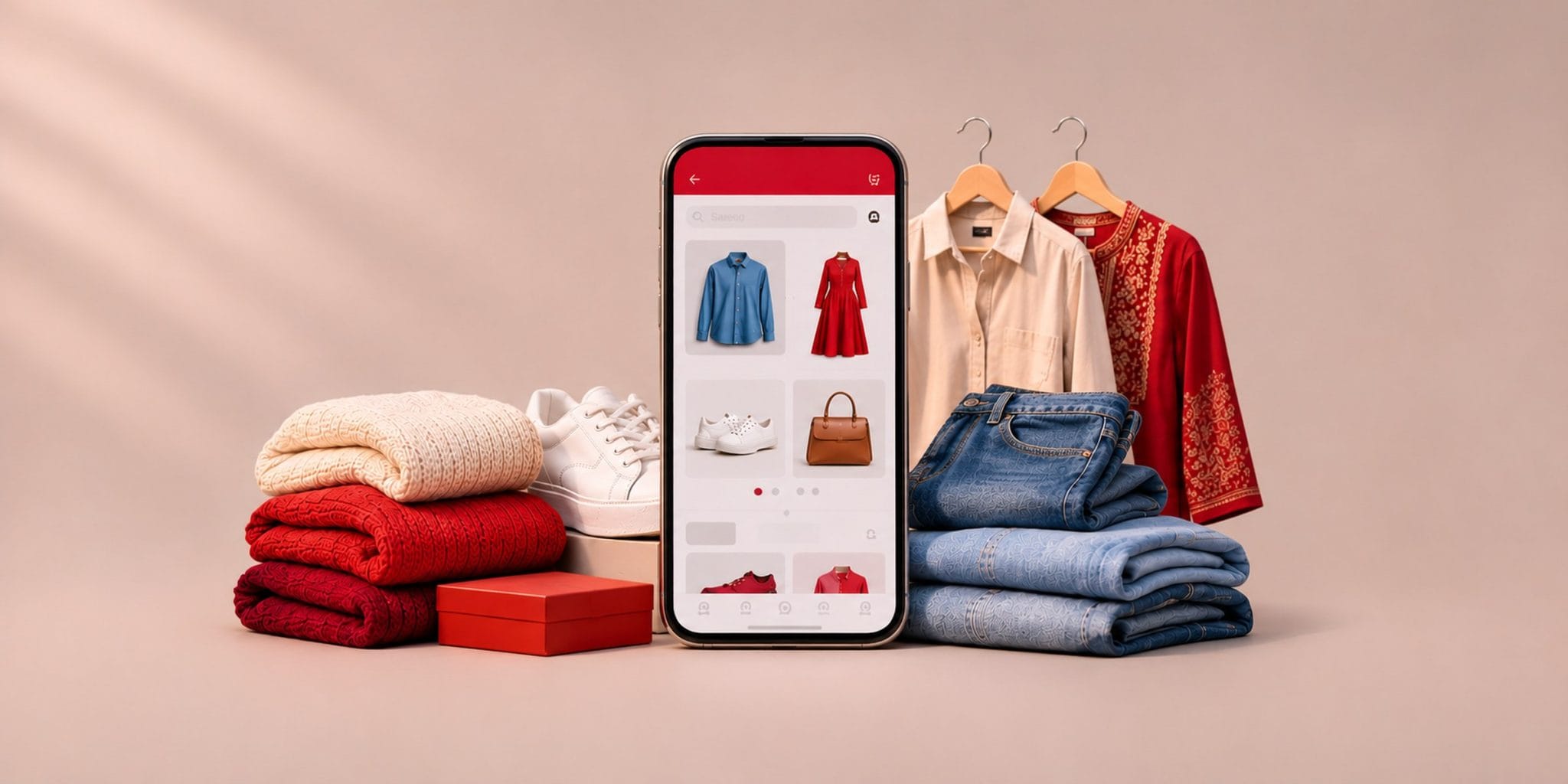
Four Levers to Win in India’s Online Fashion Market


The next phase of online fashion growth will accrue to brands that read where demand is moving within their own category and price band – Nikhil Dalal, Associate Partner, Redseer
Redseer forecasts India’s online fashion GMV (excluding jewellery) to grow from an estimated $22-23 Bn in CY26 to $46–53 Bn in CY30P; over the same period, e-commerce is projected to rise to 25-27% of India’s fashion market, with Quick Commerce contributing a further 1-2%. Growth at this scale, however, offers limited guidance on where incremental demand for a given brand will originate, or which channels and price points will capture it.
Redseer believes fashion brands need not enter new categories or reposition across price bands to capture this growth. The opportunity lies in aligning an existing portfolio to four structural shifts in the market: the channels through which consumers buy, the city tiers from which demand originates, the delivery speeds consumers increasingly expect, and the price points at which growth is concentrating.
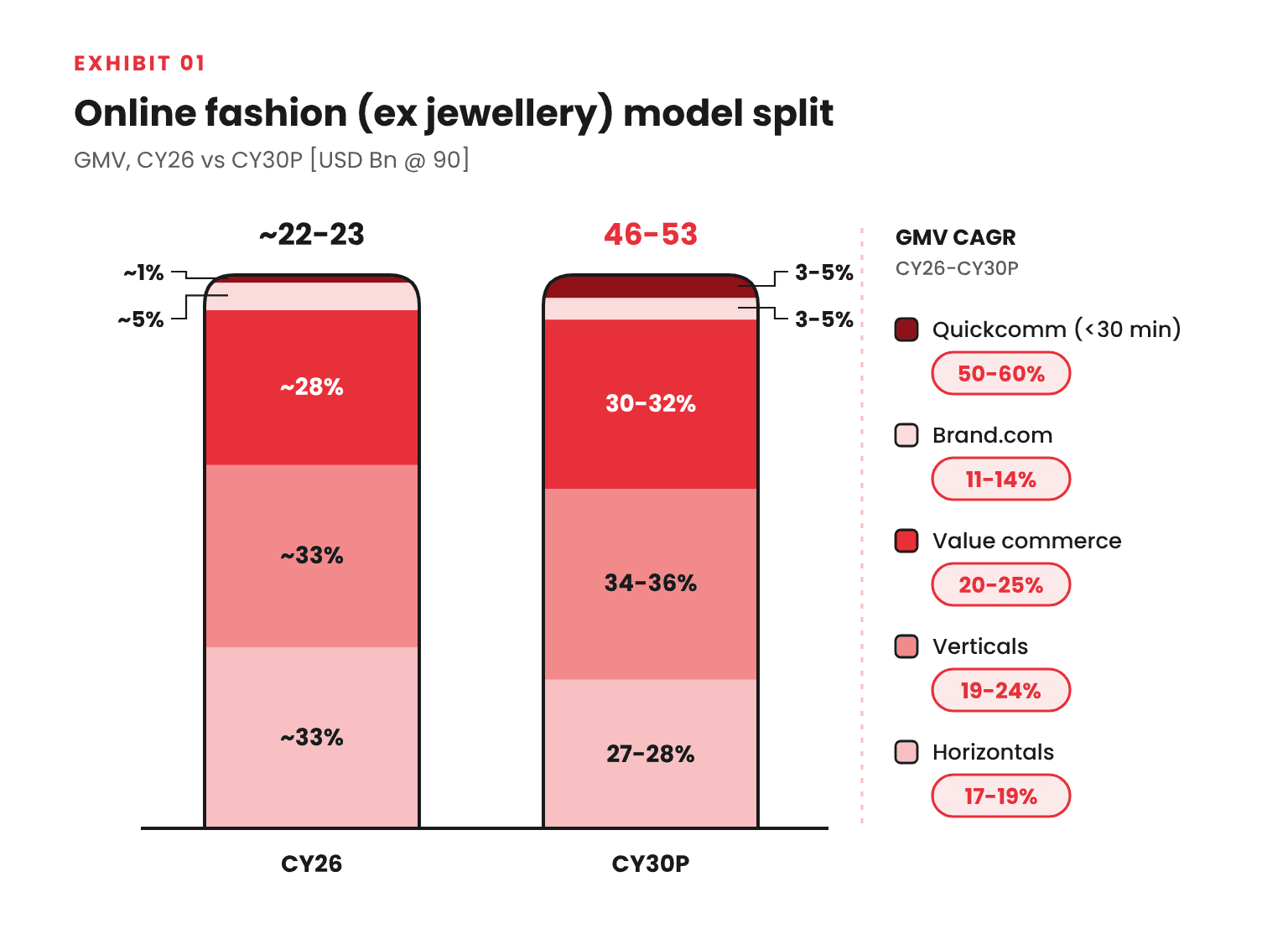
As per Redseer’s Brand Index, Online Fashion 2026, these are the four growth levers for fashion and footwear brands:
Lever #1: Assign each channel a distinct role, with a range to match
Channel mix within online fashion is shifting. According to Redseer, Value Commerce and Verticals are projected to account for 65-70% of incremental online fashion GMV through CY30P, growing at 20-25% and 19-24% a year respectively, against 17-19% for Horizontals. For brands already present across multiple platforms, the strategic question is therefore the role each channel plays in the portfolio, and the range and price point it should carry.
The experience of an established Indian footwear brand shows how online growth can be built alongside an existing trade business. Trade accounted for about 93% of the brand’s revenue in FY19, and it expanded into e-commerce from 2018 to broaden its consumer reach. Its trade network continued to serve shoppers through local retailers, particularly in Tier 2+ markets; its exclusive brand outlets showcased the brand and its premium range; and entry-level styles were designed for buyers moving up from unbranded footwear. Online-specific ranges, seasonal drops and channel-partner-exclusive merchandise ensured the channels did not all sell an identical catalogue on price.
As Redseer’s case study concludes, the brand gave each channel a clear role and its own range and price point, so online scaled without disrupting trade.
A fast-growing D2C menswear brand shows how channels can also be added in sequence. It moved from its app and site to the marketplaces, then to its own stores (about 130 today) and now to Quick Commerce, adding each channel only once the one before it was working.
Where does your brand stand across channels? The Redseer Brand Index tracks apparel and footwear brands across India’s leading marketplaces, showing who leads each category and who is gaining ground.
Lever #2: Build for Tier 2+ while metros and Tier 1 keep accelerating
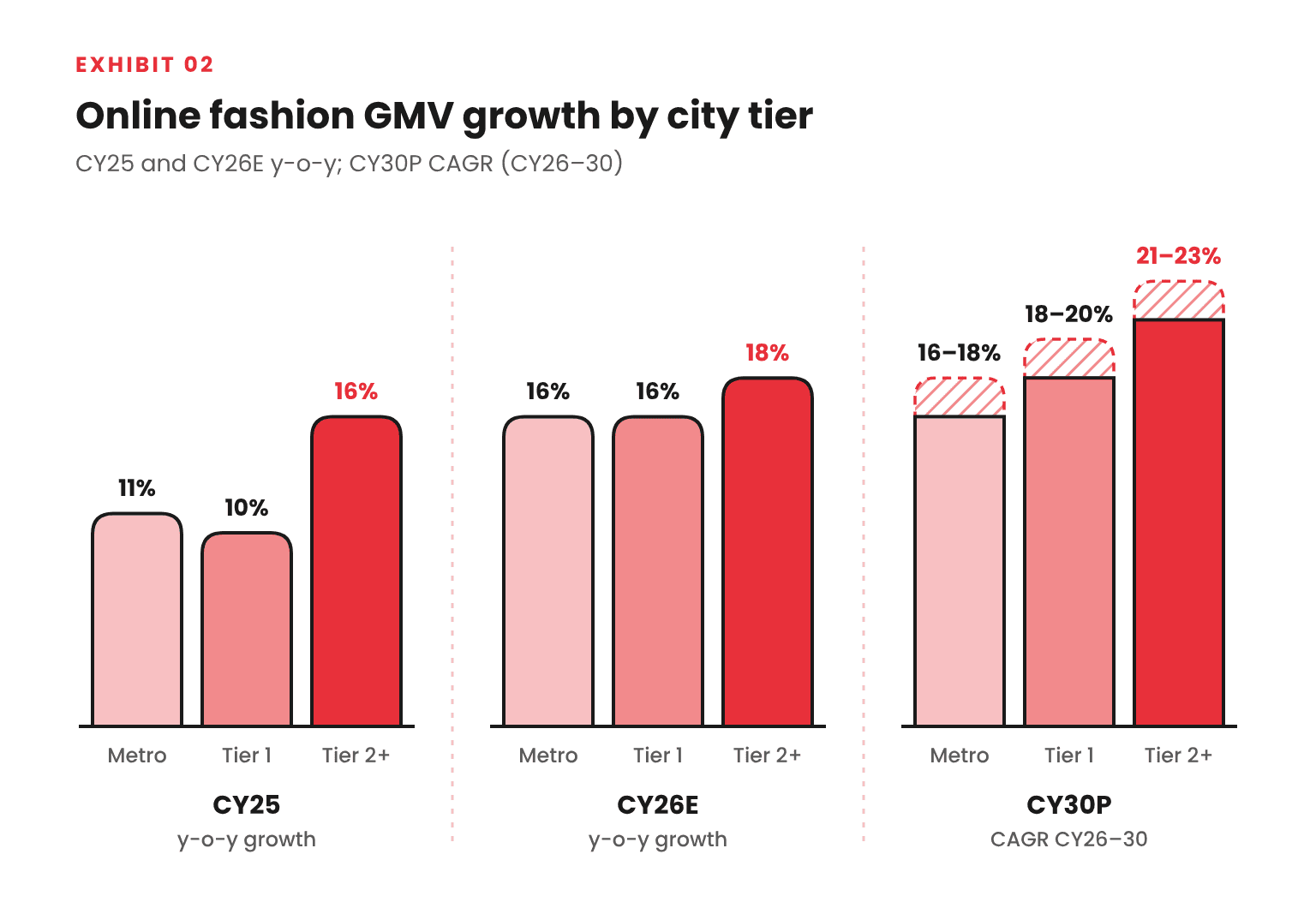
Online fashion is already a Bharat market. Tier 2+ cities, those with a population below 1 Mn, account for an estimated 60% of online fashion GMV in CY26E, and Redseer projects them to grow fastest, at 21-23% a year through CY30P. Most of the next 100-120 Mn online shoppers will come from these cities, and fashion is typically their first online purchase: low ticket, high frequency, and with no need to touch and feel once trust is built.
Metro and Tier 1 cities, however, are accelerating, not fading. They grew about 10% in CY25 and an estimated 16% in CY26E, close to Tier 2+ at 18%, and Redseer projects them to grow at 16-18% and 18-20% a year respectively through CY30P. Shoppers here are buying more branded fashion, Gen Z is a growing part of the market, and fashion’s share of these shoppers’ overall discretionary spend (online and offline) has risen from about 10% to about 22%.
Ethnic wear shows what Tier 2+ demand looks like within a single category. In Redseer’s deep dive on Amazon, Flipkart, Myntra and Ajio (AMJ25 → AMJ26), Tier 2+ contributed the majority of the category’s growth as women bought daily-wear ethnic in the ₹500-700 range, and the ₹500-1,000 band was the largest rupee gain, at about ₹350 Cr, while new brands delivered about 58-61% of women’s ethnic wear growth.
For brands already in a category, Redseer’s approach is to test proposition fit (assortment, sizing, ASP and imagery) against what Bharat actually buys, and to benchmark discoverability and conversion against the brands winning there.
Lever #3: Stock high-velocity SKUs in the right city, starting with metros
Speed is becoming a marketplace expectation in online fashion. Demand is shifting from planned to on-demand: fashion is becoming more routine and less seasonal, while occasion- and trend-led purchases (party, vacation clothing, cricket seasons) create urgency. Myntra M-Now and AJIO Rush are already scaling 30-minute to 4-hour delivery, and Redseer projects rapid commerce (<4 hrs) to reach 10-15% of online fashion GMV by CY30P, up from 2-6% in AMJ26, with same-day delivery (4-24 hrs) growing to 25-30%.
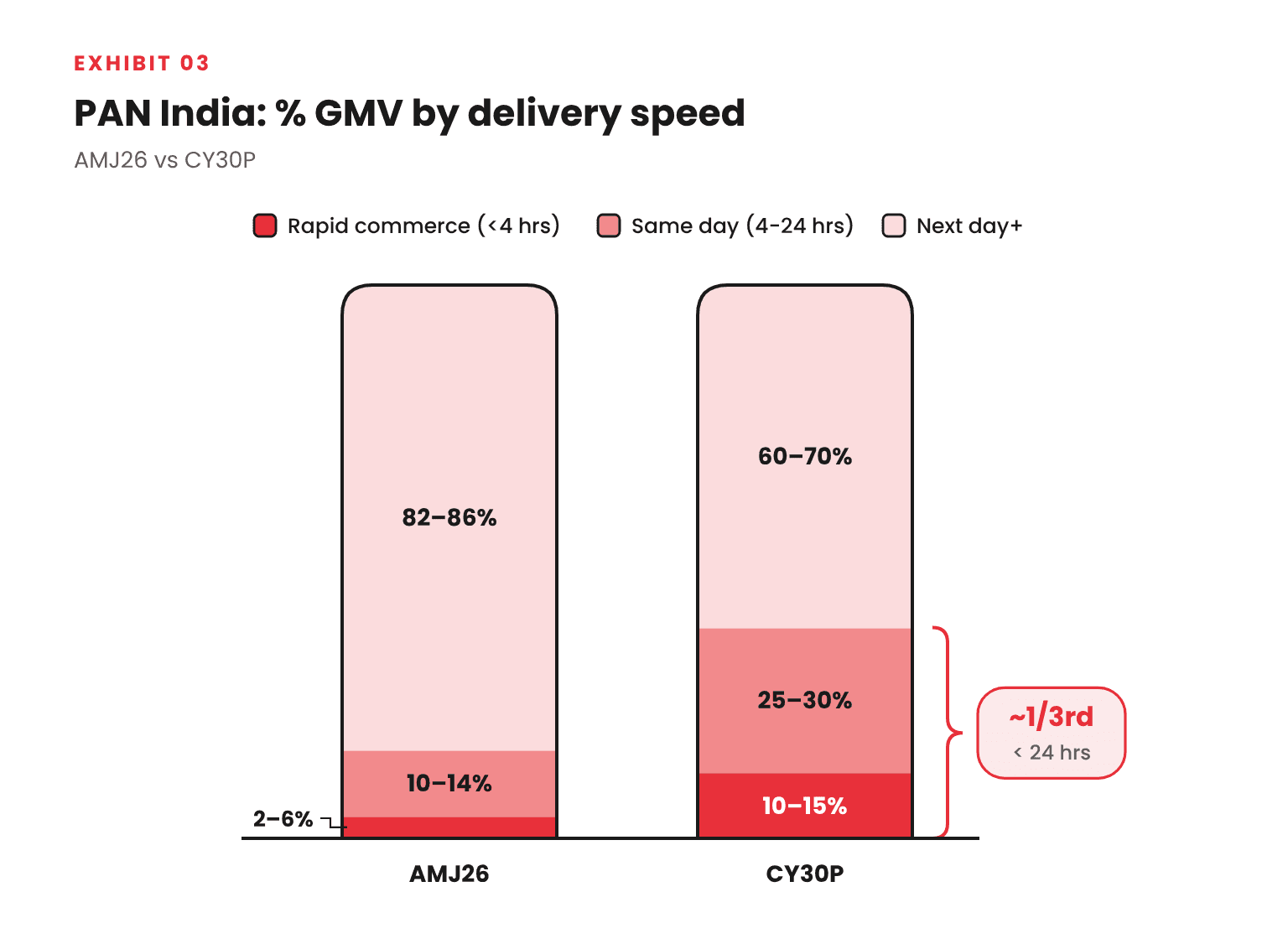
Metros lead the shift. Redseer projects 55-70% of metro GMV will be delivered within 24 hrs by CY30P, against 25-35% in Tier 1 and Tier 2+, where next day+ still carries 65-75%. Same-day delivery becomes far more common, especially in metros, while next day+ is still projected to carry 60-70% of online fashion GMV pan-India in CY30P.
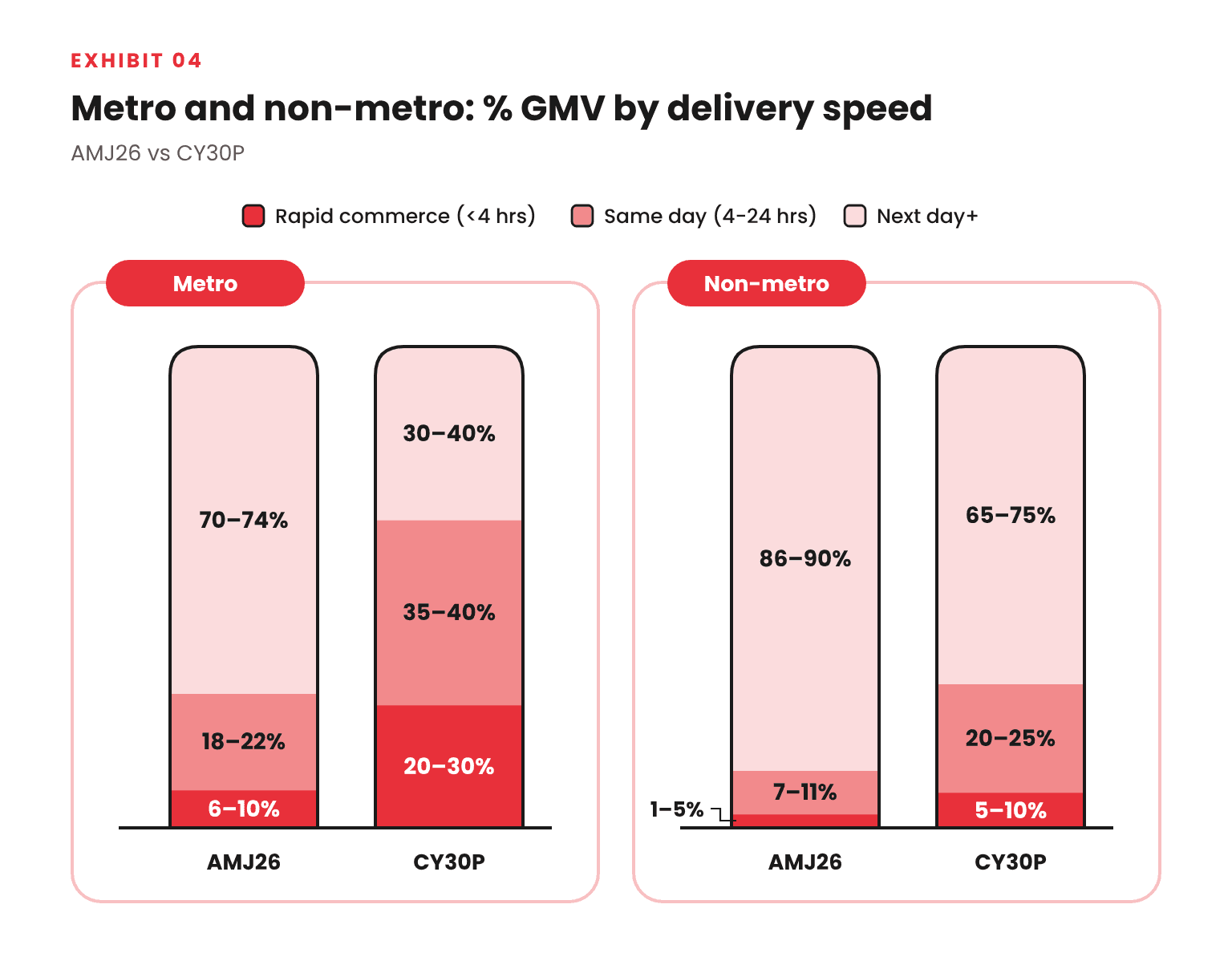
For brands, Redseer finds that the competitive advantage shifts from “having the right assortment online” to “having high-velocity SKUs stocked in the right city, ready to ship the same day”, starting with metros.
Lever #4: Price to the lines, and know which end of the category is growing
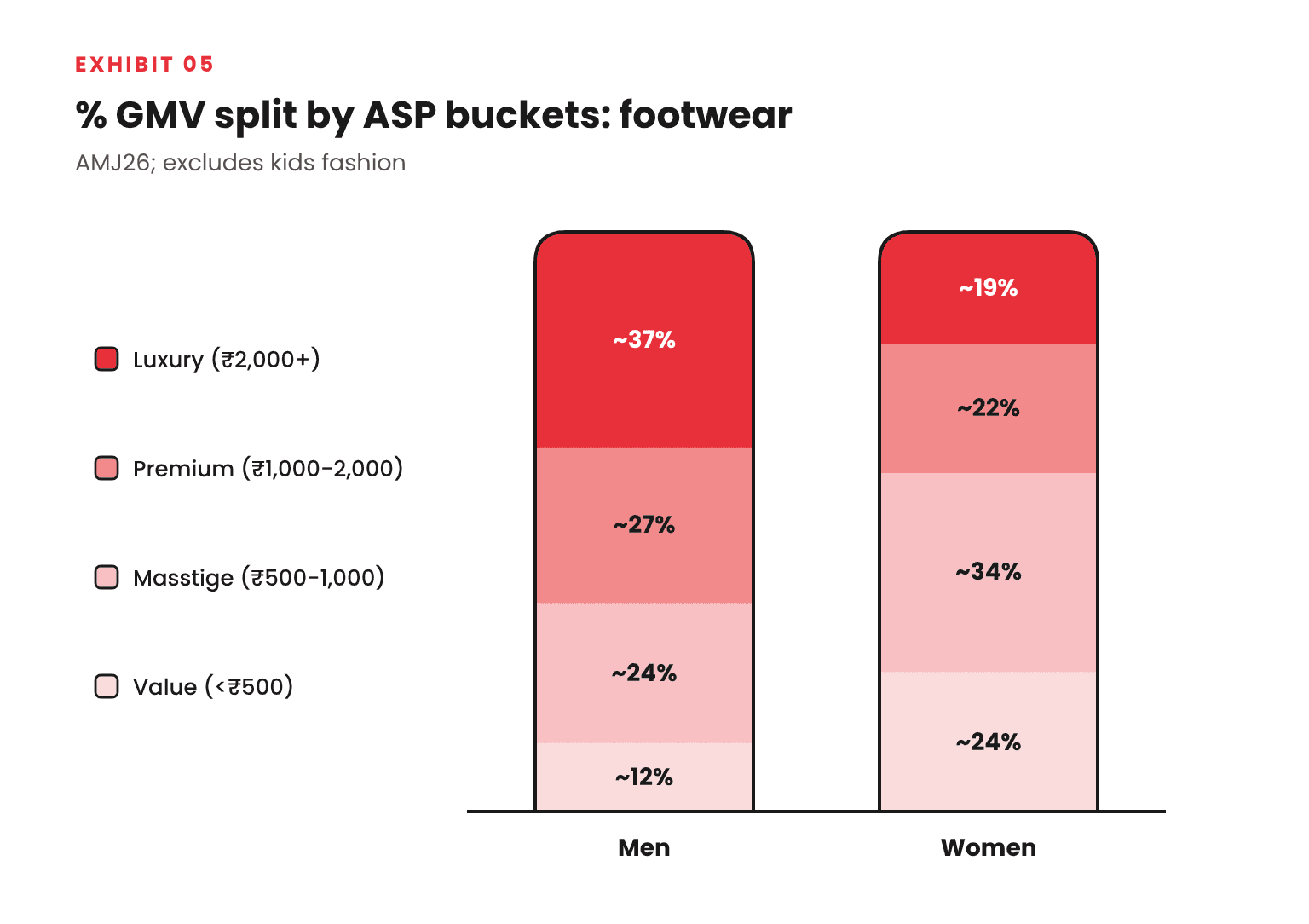
The middle is being squeezed as growth sits at both ends of the price ladder, although women’s ethnic masstige (₹500-1,000) is an exception. In Redseer’s deep dive on Amazon, Flipkart, Myntra and Ajio (about 70% of the online apparel and footwear market), across apparel overall, value and luxury are growing 1.5-2.5x as fast as masstige and premium (₹500-2,000). In footwear, ₹2,000+ is already a third of footwear GMV, while the ₹1,000–2,000 middle grew slowest between AMJ25 and AMJ26, at about 3-5% for women and under 10% for men.
Each category is also growing from a different end. Between AMJ25 and AMJ26, men’s western wear grew from value (sub-₹500, +28%) while women’s grew from luxury (₹2,000+, +51%). In ethnic wear, masstige (₹500-1,000) is the biggest women’s segment, while luxury is the fastest growing (+52%). Redseer believes that in apparel, women are pulling online demand up the price ladder and men are pulling it down; women’s categories are about 63% of apparel and footwear GMV, and a brand without a women’s engine is fighting for a third of the market.
Within a brand’s existing band, Redseer’s advice is to price to the lines, ₹999 (zero commission) and ₹2,499 (5% GST), and to avoid the band just above each.
In ethnic wear, the ₹2,499 line is already at work: 66–69% of the growth in luxury (₹2,000+) is driven by the ₹2,000–2,500 bucket, as existing brands such as Indo Era, House of Pataudi and Biba extend ranges into the 5% GST slab. Repricing around price thresholds is moving demand in western wear too: about 20% of men’s brand-lines cut prices to below ₹500, and GMV for the more than 200 brand-lines that crossed that threshold roughly doubled, on about 3x units, with platform private labels leading the wider sub-₹500 surge.
Together, the four levers give brands a way to respond to shifting demand within the category and price band they already compete in: what role each channel should play, how to serve buyers across city tiers, where to stock fast-moving products, and which price points to focus on.
Redseer Advisory
1. For Platforms
- Define your role in a brand’s channel mix. Value Commerce and Verticals are projected to capture 65-70% of incremental online fashion GMV through CY30P, and brands that assign each channel a distinct role will weigh platforms on that role.
- Plan private labels and brand partnerships together. Platform labels are the fastest-growing cohort like-for-like, at 20-25%, and compete directly with brands in men’s value.
- Invest in city-level fulfilment in metros. Redseer projects 55-70% of metro GMV will be delivered within 24 hrs by CY30P.
2. For Investors
The brand cohort and concentration figures below come from Redseer’s deep dive on Amazon, Flipkart, Myntra and Ajio for AMJ26, with growth measured from AMJ25.
- Assess brands on like-for-like growth. Digital-native brands are growing about twice as fast as legacy brands, but on a like-for-like basis both grow at about 13-15%. The gap comes from new entrants.
- Look beyond the top 50. The top 100 brands hold about 50% of online apparel and footwear GMV, and beyond the top 50, nearly 80% of GMV is digital-native.
- Track premium footwear. Indian brands hold only about 12% of online footwear GMV above ₹2,000, but that slice grew 63%, against 21% for international brands.
Written by



India Online Retail 2026: The Fastest Year in Five, and the New Engines Behind It

Think Quick Commerce: Unlocking the $90Bn Opportunity

Digital Disruption in Home Category: Whitespace to Market Leadership

India’s Internet Economy: Built for Scale, Ready for Capital
Why Global Apparel Players Are Betting Big on India!

New-Age vs Legacy: The Future of Fashion in India and the Battle for Consumer Loyalty

Quick-Com, Value Commerce and GenZ Drive India’s Online Retail Growth in 2026

Two Engines, One Basket: How Quick & Value Commerce are Rewriting India’s Retail Story

The New Rules of Growth in India’s $150 Bn Packaged F&B Market

How Quick Commerce Can Win Bharat
The Two Playbooks To Win India’s $90 Billion Quick Commerce

Online Retail Heads for USD 90 Bn+ in 2026, Its Fastest Growth in Five Years
India Online Retail 2026: The Fastest Year in Five, and the New Engines Behind It
Think Quick Commerce: Unlocking the $90Bn Opportunity
Digital Disruption in Home Category: Whitespace to Market Leadership
India’s Internet Economy: Built for Scale, Ready for Capital
Why Global Apparel Players Are Betting Big on India!
New-Age vs Legacy: The Future of Fashion in India and the Battle for Consumer Loyalty