India’s Specialty Coffee Inflection Point


“What the region’s best coffee operators have already proven, and how India’s scorecard reads against them”
Executive Summary
Investors and founders are calling India’s specialty coffee category an inflection point rather than a rerun of the store-count land grab that defined the sector five to seven years ago. The claim rests on four questions: what has changed since the first wave, what the rest of the world has already proven or disproven, what India has begun to build beyond the café, and whether India’s current operating performance supports the growth story. Comparables are drawn from listed and scaled regional and global operators; no company is named.
Why the first wave broke, and what is different this time
The first wave of Indian café chains did not fail for lack of demand. The most severe collapse in the sector’s history was a leverage crisis at the parent-company level, where group debt had been raised to fund unrelated bets in real estate and logistics. The coffee business itself was still generating scaled revenue when the crisis hit. A second legacy chain did not collapse at all; it stagnated under conservative strategic ownership: under-invested, undifferentiated and never reinvented.
What failed was the operating model beneath both: mass-market, ubiquity-led, low ticket size, competing on footfall and discounting rather than product differentiation. That model has no margin cushion and no second revenue engine, which leaves it fragile to any shock, corporate or category-level.
Four shifts that make this cycle checkable
- Demand has matured – Search interest has grown ~2x in four years against ~1.2x for tea, driven by young, affluent, globally exposed consumers. Social media-led discovery and coffee creators are accelerating specialty adoption, and Tier-1 and stronger Tier-2 cities are becoming increasingly addressable as incomes rise; Tier-3 remains largely price-sensitive and aspirational.
- Quick commerce has created a second revenue engine – The channel did not exist five years ago. Packaged coffee sold through it can run at meaningfully higher gross margin than the café itself, and reaches consumers without capex-heavy store rollout.
- Capital discipline has changed since 2022 – Funding now underwrites payback period and store-level EBITDA before rewarding store count.
- Format innovation is unlocking sites the full-café footprint could not reach – Compact and satellite formats can deliver roughly twice the EBITDA margin of full cafés, along a ladder from ₹10–15 lakh kiosks (200–300 sq ft) to ₹40–60 lakh mid-size cafés (1,000–1,500 sq ft) and ₹80 lakh to ₹2.5 crore flagships. Tier-1 cities favour full cafés, while compact and delivery-led formats suit residential catchments and Tier-2 and Tier-3 markets; around a third of networks could skew compact, though premium brands remain cautious on pure kiosks.
The operating environment has changed. Whether the operators have is the question the rest of this note tests.
What the region’s winners do that its stragglers do not
Across the comparable set, the clearest separator is format and channel discipline. The strongest regional operators run a deliberate mix of store formats matched to site economics rather than one template everywhere. They pair that with owned digital ordering and loyalty infrastructure that captures first-party data. Critically, they have built a second high-margin revenue engine in packaged and wholesale distribution that does not depend on café footfall at all. The weakest performers in the same set look like the first wave of Indian chains: chasing store count and geographic coverage without payback discipline, which shows up as flat or negative same-store growth masked behind new openings.
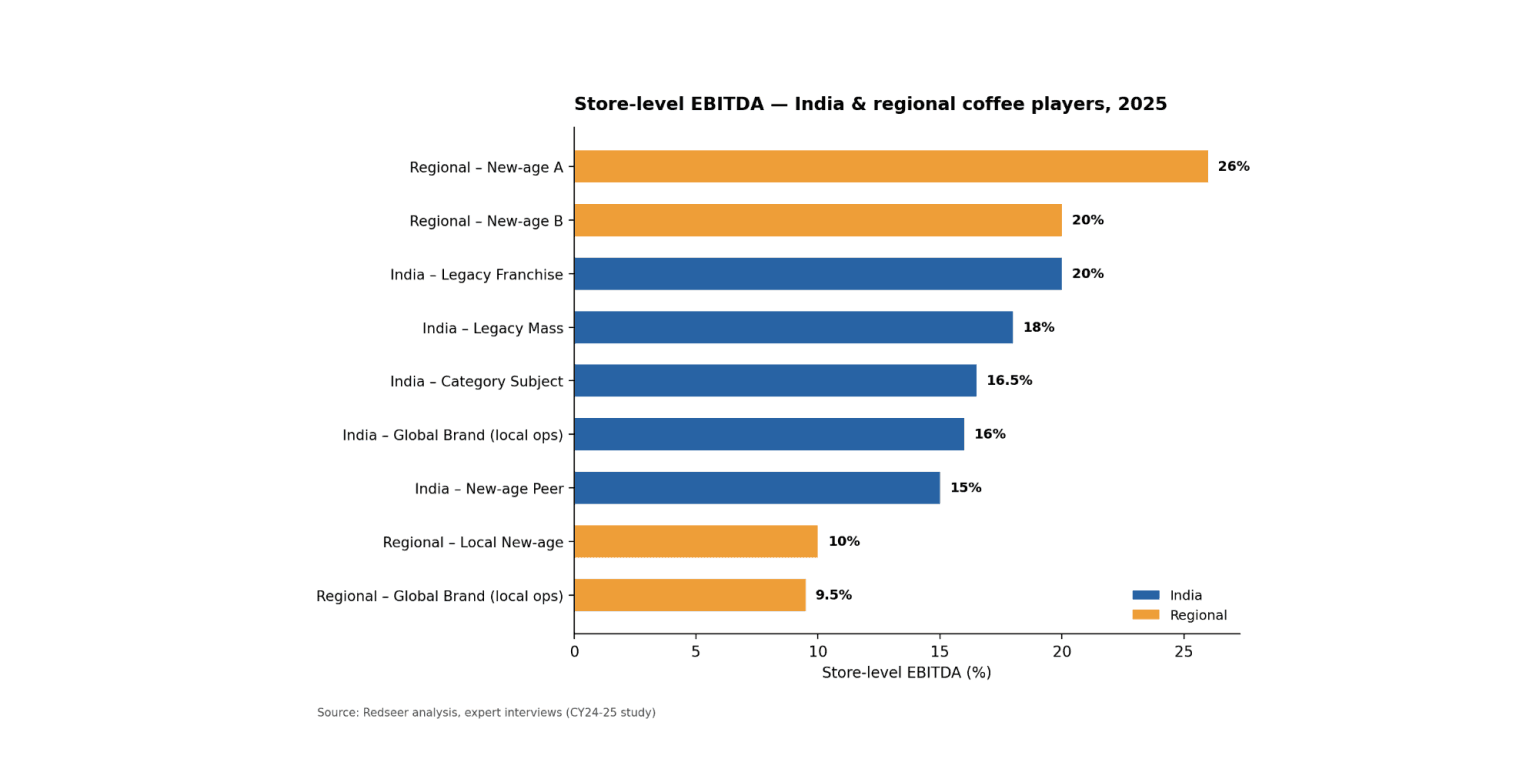
Store-level EBITDA across the comparable set is widely dispersed. Two regional new-age operators are running at roughly double the margin of the weakest names in the same market, including at least one globally recognised brand’s local operations.
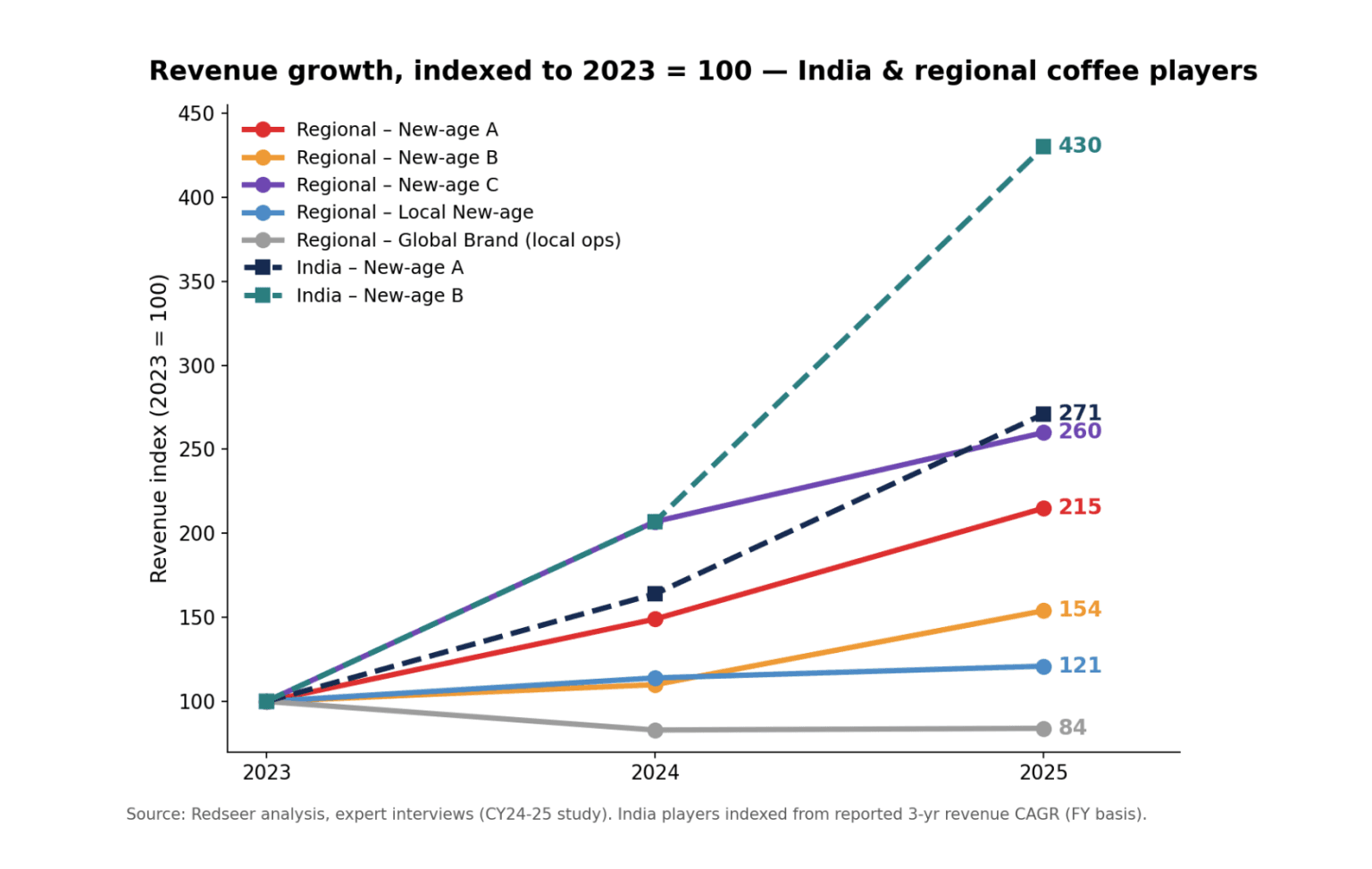
The same dispersion shows in growth. The weakest regional performer has shrunk in absolute revenue over the past two years while every new-age comparable, strongest and weakest alike, has compounded well ahead of it. India’s new-age specialists are compounding ahead of the regional median on total revenue, though almost entirely through store expansion; the same-store picture, examined below, is more mixed.
Volume alone does not close the margin gap
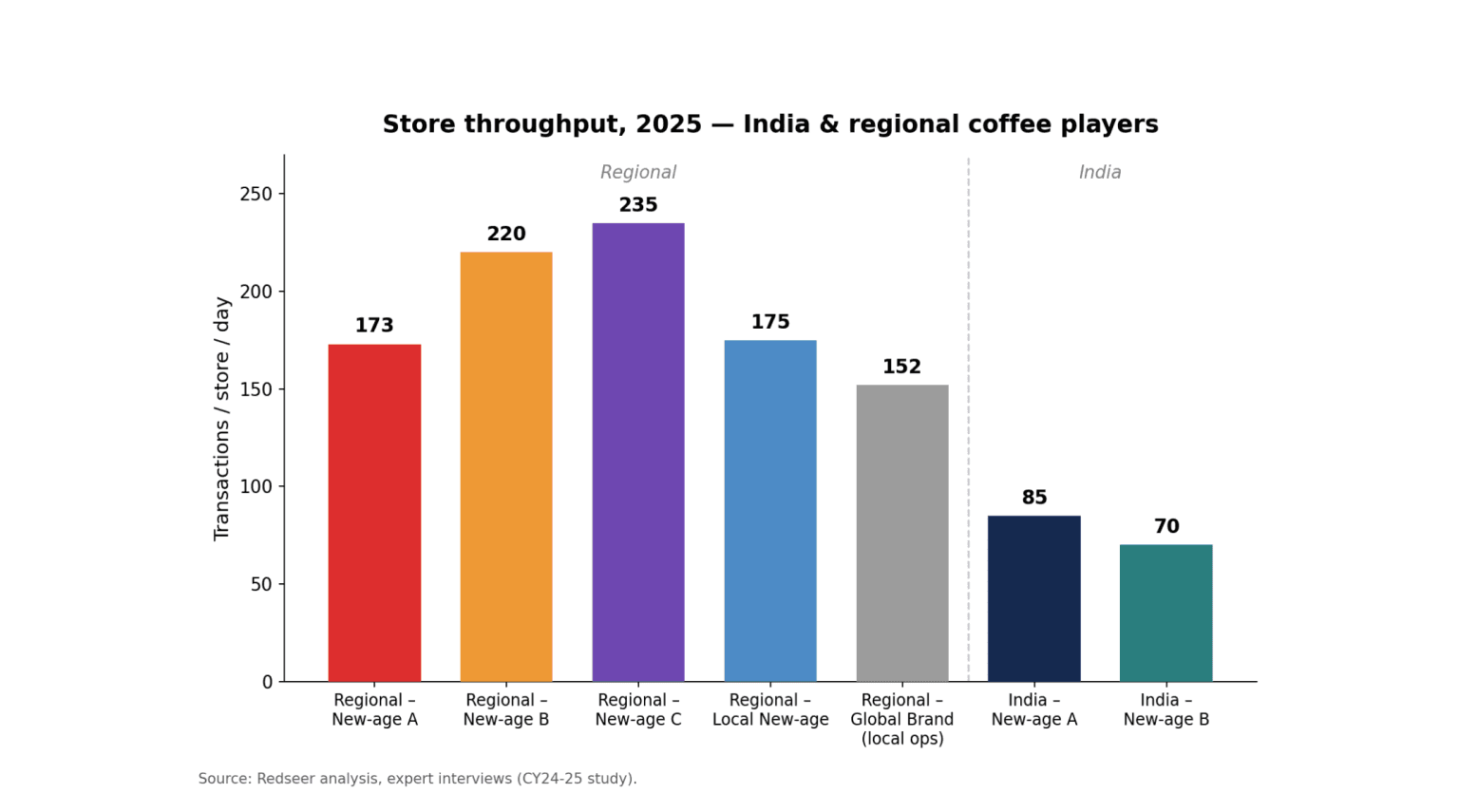
The obvious explanation is that the EBITDA leaders run higher throughput, and that this protects the margin. The data does not support it. The leader’s throughput is only around 15% above the weakest performer’s, which points to cost-structure discipline as the driver: real-estate and rent efficiency, lean opex and tighter COGS. Chasing transaction volume without that discipline will not close the margin gap. India’s cafés run at roughly half the daily transactions per store of the regional leaders, a further sign that its operating metrics still trail the regional benchmark.
Even the standouts have to buy or build their way to scale
Two caveats apply. First, even the best-performing regional operator has been criticised for same-store sales growth lagging its headline revenue growth. Like-for-like growth is the hardest lever in the model, and the standout is not exempt. Second, two well-known specialty coffee brands from a mature Western market show the same tension from a different angle. One reached scale only after being acquired by a much larger strategic with a bigger balance sheet. The other leaned on a distinctive, deliberately low-capex brewing set-up to control machine and labour cost per cup while funding expansion on venture capital. In both cases premium positioning had to be paired with either outside capital at scale or an operating and format innovation.
Where ten minutes matters, and where it does not
Combined online penetration for packaged coffee, quick commerce plus e-commerce, is ~12–15%; roughly 85% of purchases still go through kirana and modern trade.
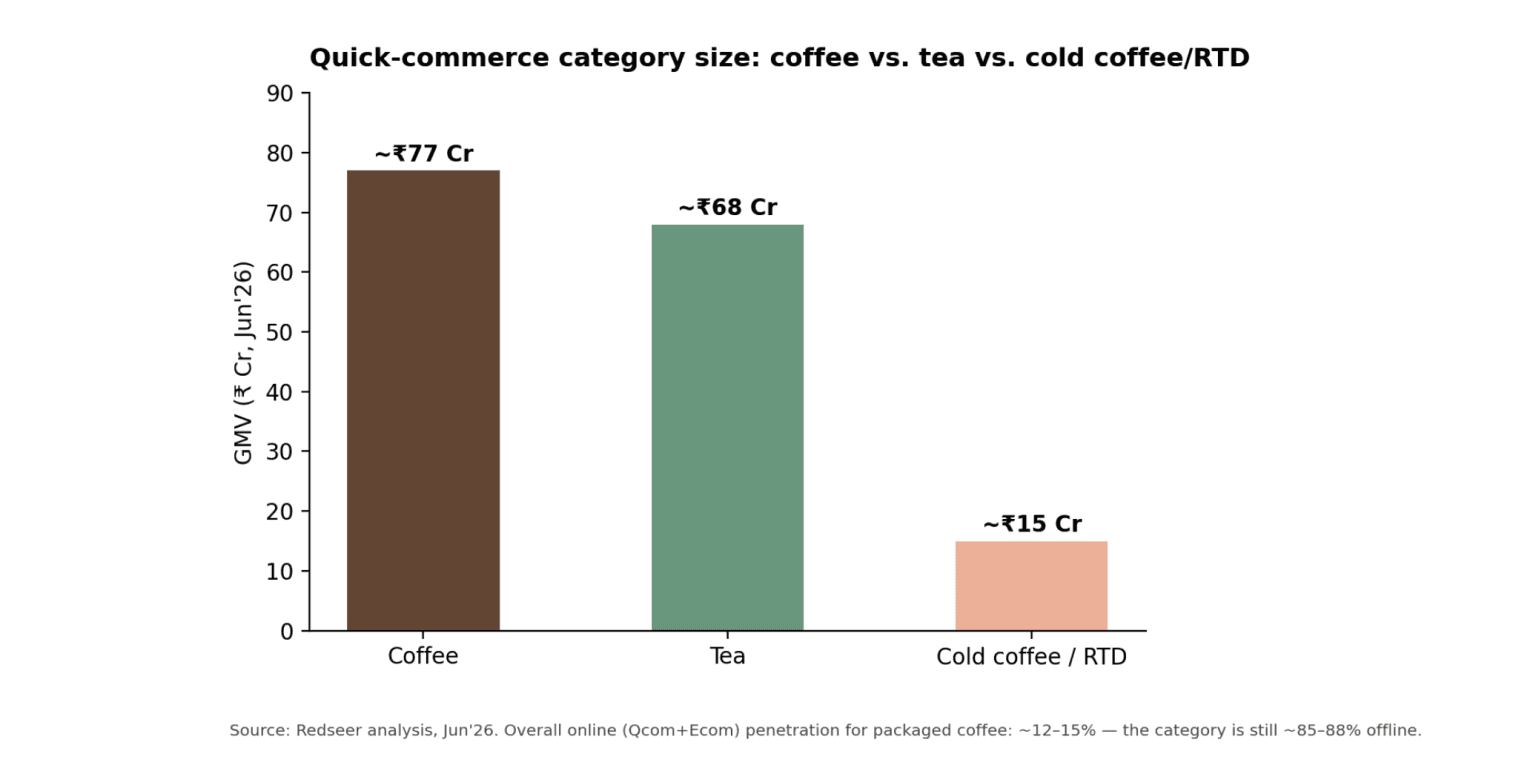
The constraint is purchase frequency. More than half of buyers who use quick commerce as their primary at-home channel still purchase fewer than twice a month, at a modest monthly spend. That is top-up behaviour, not stock-up behaviour. Coffee and tea are non-perishable, long-shelf-life, habitual purchases. The ten-minute proposition that wins in fresh or urgent categories matters far less for something people plan ahead and buy through a decades-old, trusted local relationship. The large majority of category volume is also commoditised, low-differentiation instant coffee at a low average selling price, which further reduces any urgency to switch channels.
Quick commerce earns its keep in the premium tail. Beans and capsules carry two to three times the category’s average selling price and a disproportionate share of value from a small share of units. Those purchases are occasion-driven: a specific SKU not stocked locally, gifting, a one-off trial. That is the urgent, non-habitual need the channel is built for, and it is where the whitespace sits.
The scorecard: India against the best in the region
India’s category leader outperforms every domestic peer. Against the regional and global benchmark the picture is more mixed.
- Same-store growth: leading India, trailing the region
Among businesses of comparable scale over a similar recent period, same-store sales growth (SSSG) spans an unusually wide range across the regional and global comparable set, from the low-40s% at the top to negative double digits at the bottom. The best performer got there through four levers: store maturation as footfall recovered, menu innovation that lifted average order value, digital ordering and loyalty driving repeat frequency, and compact, high-throughput formats improving sales per square foot without adding cost. More than one globally recognised, publicly listed coffee business was in negative same-store territory over the same period; size and brand recognition do not protect like-for-like growth on their own.
India’s leading player is running SSSG in the low teens, comfortably ahead of its domestic peer set, where one large global chain’s India operations are the only name posting negative growth. Set against the regional and global range, low-teens SSSG sits in the middle of the distribution; the strongest regional comparables are compounding at close to double that pace.
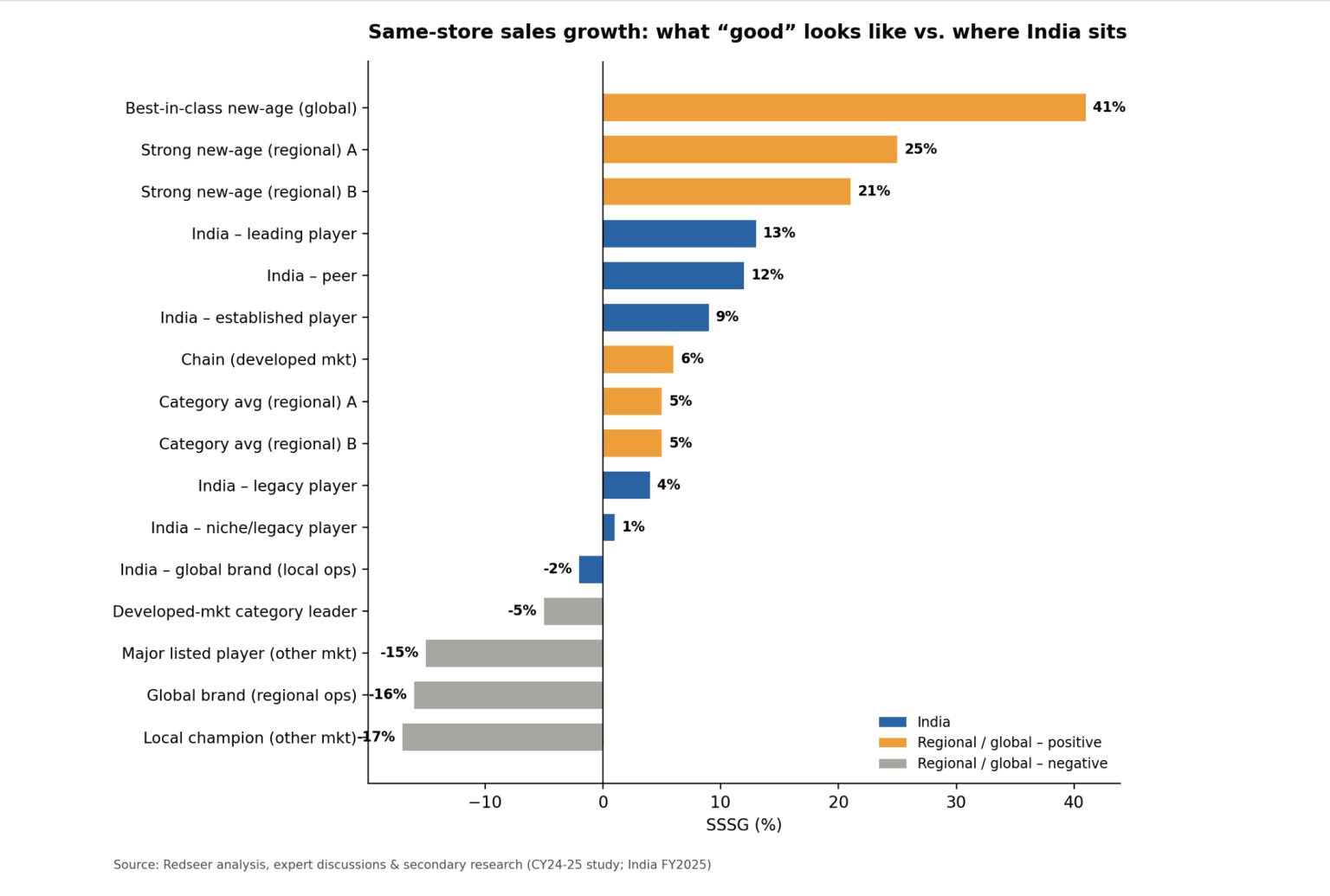
Same-store sales growth: what good looks like vs. where India sits
- Capex: the price of ambience
A new-age specialty store in India costs ₹50–60 lakh to build against roughly ₹30 lakh for the legacy and mass-format benchmark, a gap of ₹20–30 lakh. Expert interviews attribute it to heavier spend on store ambience and to weaker negotiating leverage on real estate than incumbents who signed leases years ago at scale.
- Payback: twice as long as the format it is replacing
Payback widens the gap: 12–15 months for the new-age format against 6–7 for legacy. The broader industry benchmark for a new brand or location runs wider still, at 12–24 months. Higher capex and a longer payback window compound into a drag on returns on capital relative to the legacy comparison set.
- Repeat rate: premium has not yet bought loyalty
India’s new-age format has the lowest repeat rate of the three benchmarks: 18–20% at the high end, against 28–30% for the domestic legacy format and 30–35% for the global best-in-class, associated with the strongest global category leader’s loyalty programme. Premium positioning in India has not yet converted into loyalty economics.
The verdict, and the one question left open
The demand-side and channel-shift arguments for an inflection point are well supported. The category leader is outgrowing every domestic peer, including the international brands operating locally. Globally, though, the benchmark for a good coffee business is growth paired with cost discipline, capital efficiency and loyalty economics that do not depend on discounting. On that scorecard, India’s specialty format is mid-pack on same-store growth and visibly behind on capex, payback and repeat rate, against both its domestic legacy peers and the best regional operators. The thesis holds. Diligence should concentrate on the operating model, because that is the part of the story not yet proven at India’s current scale.
Written by



India’s Internet Economy: Built for Scale, Ready for Capital
Disruption in the Indian Small Home Appliances Category

Think Quick Commerce: Unlocking the $90Bn Opportunity

Digital Disruption in Home Category: Whitespace to Market Leadership

State of India’s Food Services Market

Value Grocery Commerce: The Bharat Unlock

India Hair Growth Market Report 2026

Reinventing Packaged F&B with Quick Commerce

Why Global Apparel Players Are Betting Big on India!

New-Age vs Legacy: The Future of Fashion in India and the Battle for Consumer Loyalty
Redseer Charted a Leading Food Delivery Platform’s Path to Leadership in Southern India

We enabled a leading e-commerce player with decision-grade intelligence on India’s online grocery market
India’s Internet Economy: Built for Scale, Ready for Capital
Disruption in the Indian Small Home Appliances Category
Think Quick Commerce: Unlocking the $90Bn Opportunity
Digital Disruption in Home Category: Whitespace to Market Leadership
State of India’s Food Services Market
Value Grocery Commerce: The Bharat Unlock